

The most common mistake in interdisciplinary school projects isn’t a lack of creativity; it’s assessing only the final product and ignoring the process. In practice, assessment of school interdisciplinary projects works best when it measures process, collaboration, decision-making, and real learning—not just a pretty poster or a well-rehearsed presentation.
This matters because an interdisciplinary project isn’t “group work with a fancy name.” It’s an approach that brings subjects together, requires research and collaboration across disciplines, and calls for evidence that students have made progress. Here, you’ll find objective criteria, simple rubrics, examples of assessment tools, and a more reliable way to judge what students have learned without making everything subjective.

What You Need to Know
- A well-assessed interdisciplinary project measures the product, the process, and evidence of learning; focusing only on the result can lead to unfair grades.
- A clear rubric reduces disagreements among teachers by turning broad criteria into observable descriptors.
- Collaboration shouldn’t be assessed based on how much group members like one another, but on contributions, listening, responsibility, and problem-solving.
- Portfolios, project journals, and self-assessments are valuable evidence because they document students’ thinking throughout the project.
- Not every project needs to give the same weight to content and presentation; it depends on the learning objective and grade level.
Assessing School Interdisciplinary Projects: Criteria That Make Sense in the Classroom
First, a technical definition: assessing an interdisciplinary project means using explicit criteria to examine how students draw on knowledge from more than one subject to solve a problem, create something, or defend an idea. In plain language, it means seeing whether students actually learned while working on the project—not just whether they turned something in on time.
The most useful criteria usually fall into four areas: subject-matter knowledge, integration across disciplines, quality of the process, and communication of the results. This combination helps avoid a common pitfall: projects that look interdisciplinary but simply place different subject areas side by side, without making meaningful connections. In practice, assessment is fairer when criteria are shared before the work begins, not afterward.
The difference between a strong interdisciplinary project and an assignment that merely “covers several subjects” lies in the genuine integration of knowledge, not in adding up disconnected parts.
Documents such as Brazil’s Base Nacional Comum Curricular (BNCC), Brazil’s national curriculum framework issued by the Ministry of Education, emphasize competencies, skills, and student agency. This aligns directly with evidence-based assessment: the focus shifts from memorized content alone to application, argumentation, and original work.
What to Look For Without Relying on Subjective Judgment
- Whether students connect concepts from different subjects coherently.
- Whether the proposed solution addresses the original problem or simply repeats information.
- Whether students conducted research, revised their work, and made adjustments along the way.
- Whether the presentation demonstrates understanding rather than mechanically reading from slides.
A Simple Rubric for Separating Effort from Learning
A rubric is an assessment matrix with performance levels and objective descriptors. It works because it moves grading beyond “I liked it” or “I didn’t like it” and grounds decisions in observable evidence. A good rubric fits on one page and can be understood by teachers, students, and families without a complicated explanation.
In practice, the best rubric isn’t the longest one. It clearly distinguishes between beginning, proficient, and advanced performance for each criterion. If every level is described as “good,” “great,” or “excellent,” the tool loses its value. If it has ten lengthy descriptors for everything, no one will use it.
Criterion
Beginning
Proficient
Advanced
Integration across subjects
Names subjects without connecting them
Makes meaningful connections between content areas
Brings subject areas together to solve the problem
Research
Uses weak sources or sources without evaluating them
Consults relevant sources
Compares sources and justifies choices
Process
Submits work without documenting the process
Documents the main steps
Revises, makes adjustments, and documents decisions
Communication
Presents with limited understanding
Explains ideas with reasonable clarity
Defends ideas confidently and draws on a broad range of knowledge
A good practice is to give visual polish less weight than conceptual integration. This reduces the risk of rewarding groups with attractive designs but weak reasoning. In elementary and middle school projects, for example, oral presentation skills are often weighted less than understanding of the topic. In high school, the reverse may make sense when presenting and defending ideas publicly is part of the objective.
Evidence of Learning That Matters More Than the Final Product

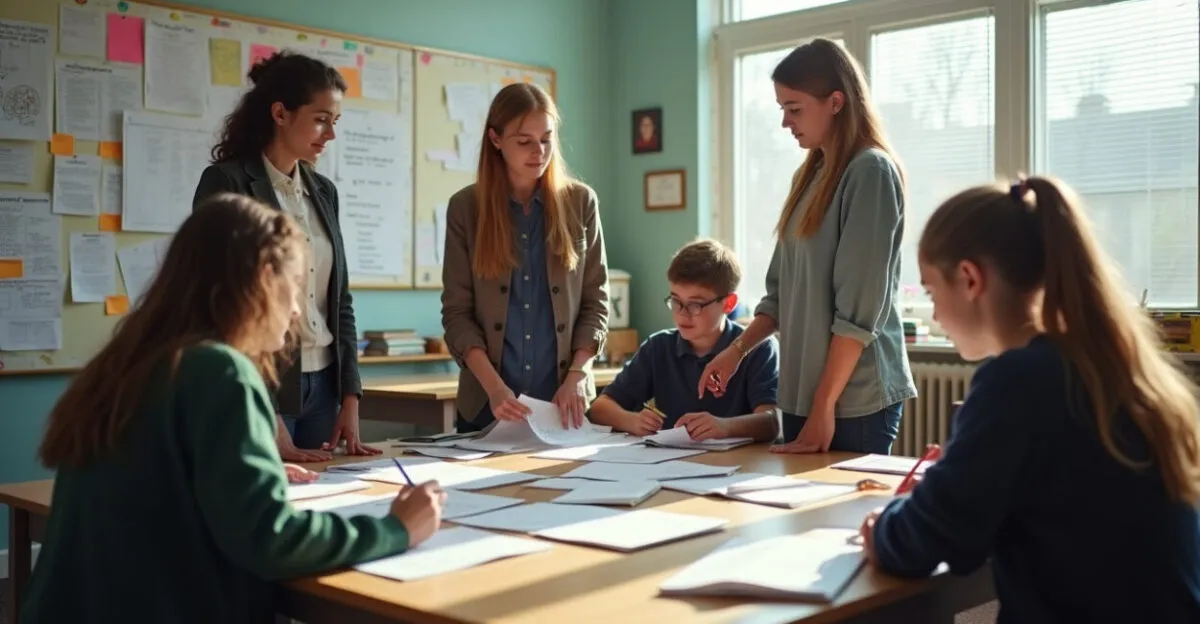
If the final product is all you see, your assessment will miss what actually happened. That’s why it’s worth using evidence of learning such as portfolios, drafts, research notes, concept maps, interim versions, and project journals. These materials show students’ thinking as it develops.
UNESCO resources on education and skills underscore the importance of meaningful learning experiences and documenting development. In a school setting, this comes down to something simple: teachers need to see the journey, not just the destination.
Evidence That Makes a Difference
- A project journal documenting decisions, questions, and changes in direction.
- A portfolio with successive versions of the work.
- Self-assessment and peer assessment by group members.
- Brief group discussions during the project.
When schools assess only the final product, they encourage students to focus on appearances; when they assess evidence from the process, they begin to measure actual learning.
I’ve seen groups present flawless projects, only for their portfolios to reveal that one student did all the research, writing, and organizing. Without evidence of the process, the grade was unfair to the others and gave no insight into the class’s actual learning. That’s when tools such as self-assessments and weekly progress logs stop being busywork and become a way to support fair, effective teaching.
Read also: Formative Assessment: Workshops That Strengthen Learning
Collaboration, Each Student’s Role, and Fair Grading
Not every group project is collaborative. Sometimes students simply divide up disconnected tasks. Assessment needs to distinguish between individual contributions, cooperation among peers, and shared responsibility. If teachers give everyone the same grade without keeping any records, they risk creating inequity and resentment.
A balanced approach usually combines three components: a group grade, an individual grade, and observations of the process. This doesn’t mean penalizing students who have more difficulty communicating; it means recognizing effort, participation, and concrete contributions. On a school team, the student who organizes, synthesizes, and revises can contribute just as much as the student who presents more fluently.
Read also: Interdisciplinary Science and Math Projects
How to Assign Grades Without Confusion
- Set a percentage of the grade for the group’s final product.
- Set aside part of the grade for individual performance.
- Use teacher records to confirm participation.
- Include a brief self-assessment with clear criteria.
Experts disagree on the ideal weight for individual grades in interdisciplinary projects. With more mature classes, it makes sense to give the group greater autonomy; with younger students, teachers need to provide more guidance. A good rule of thumb is this: the less developed students’ collaboration skills are, the more explicit the monitoring should be.
How to Make an Interdisciplinary Project Formative
Formative assessment takes place throughout the project, with feedback that helps students improve before the final submission. It’s the opposite of a surprise test at the end. This matters in project work because students test hypotheses, make mistakes, revisit sources, and revise their work based on meaningful feedback.
For it to work, teachers need to schedule brief check-ins and provide specific feedback. Saying “looks good” or “needs work” isn’t helpful unless you explain what needs work. Try writing: “You’ve made a connection between History and Science, but you still need to explain why the data you collected supports your conclusion.”
A Real-World Example of a Project in Action
In an eighth-grade class, a group investigated how cooking oil was disposed of in their neighborhood, connecting Science, Geography, and Math. At first, the project looked promising, but the data was scattered and the proposed solution was vague. After receiving feedback in the form of three specific questions, the group collected data again, organized it into graphs, and revised its campaign. The final product improved, but the most important progress was the learning that took place along the way.
This kind of improvement only becomes visible when assessment goes beyond the final submission. That’s when teachers move from being judges to becoming guides in the learning process.
Mistakes That Undermine Assessment and How to Avoid Them
The first mistake is assessing appearance alone. The second is confusing behavior with learning. The third is failing to share criteria before work begins. These missteps are common because they seem like shortcuts, but they come at a high cost: disputed grades, discouraged students, and projects that turn into performances.
Another common problem is using overly broad criteria, such as “creativity” or “effort,” without clear descriptors. Creativity does matter, but it needs to be observable: the originality of the solution, the quality of connections, and the relevance of the choices. Effort, however, can’t replace subject-matter knowledge. Students may work very hard and still not demonstrate sufficient learning.
Common Mistakes to Avoid
- Giving too much weight to oral presentations.
- Rewarding the most organized group instead of the group with the strongest work.
- Using a rubric after the project is over.
- Failing to document participation at each stage.
For more on criteria and curriculum references, consult Brazil’s BNCC on the official website and formative assessment resources from public universities. If a school wants alignment between planning and grading, assessment needs to be built into the project from the start, not tacked on at the end.
Close the Loop with Feedback, Revision, and Documentation
A project shouldn’t end with a public presentation. The most valuable step often comes afterward: specific feedback, guided revision, and a record of what the class learned. Without this step, schools miss the chance to turn experience into lasting knowledge.
The most effective approach is to save an annotated final version, a learning summary, and a brief self-assessment. This creates a record that supports future teaching. In the next project, students already know what they need to improve; teachers, in turn, can identify patterns in student progress and challenges. In practice, this file is worth more than a single grade.
A well-assessed interdisciplinary project doesn’t end with a grade. It ends when students can explain what they learned, how they learned it, and what they would do differently next time.
If a school wants to improve its assessment of school interdisciplinary projects, the next step is to standardize a short rubric, require evidence of the process, and set aside time for individual or partner feedback. That’s what separates a polished project from an experience that leaves a lasting record of learning.
Frequently Asked Questions
What Is the Best Criterion for Assessing a School Interdisciplinary Project?
The best criterion measures genuine integration across subjects, not just the sum of content from different classes. In general, it’s worth combining subject-matter knowledge, the quality of the process, collaboration, and clear communication. When these four areas appear in a simple rubric, grades are fairer and easier to explain to students and families. The key is to assess concrete evidence, not vague impressions.
How Do You Assess Individual Participation in Group Projects?
Individual participation should be assessed through records kept throughout the process, such as project journals, checkpoints, and self-assessments. It also helps to track who conducted research, revised the work, organized materials, and presented. If possible, assign part of the grade to the group’s performance and another part to each student’s contribution. This reduces unfairness and prevents the work of a few students from disappearing into a single group grade.
Are Rubrics Required for Interdisciplinary Projects?
They aren’t required by law in every context, but they’re one of the most useful tools for making assessment transparent. A rubric defines performance levels and reduces differences in judgment among teachers. In interdisciplinary projects, rubrics work even better when criteria are shared before the project begins. Without that, assessment can become subjective and difficult to justify from a teaching perspective.
Should the Final Product Count More Than the Process?
It depends on the project’s goal, but in most cases the process should carry significant weight. The final product shows the result, while the process reveals planning, research, revision, and learning as it develops. With younger students, the process often matters even more because they’re still building independence. When schools value only the result, they risk rewarding appearances rather than understanding.
How Can Teachers Document Evidence Without Adding Too Much Work?
The most practical approach is to use short, repeatable tools, such as a one-page observation form, a checklist for each stage, and a self-assessment with just a few questions. It also helps to create a standard template for a digital or paper portfolio. The key is to cut down on paperwork and standardize the essentials. That way, documentation becomes a natural part of the project rather than an extra task added at the end.
Artigos Relacionados
 Interdisciplinary Projects in Elementary School: A Guide
 6 Interdisciplinary Projects for Schools: Quick Models
 Interdisciplinary Projects for Elementary School
 Original Work Assessment: Tools and Criteria for the School Year
 Science Projects Integrated Into the Elementary School Curriculum
 How the Digital Economy Strengthens School Projects Today
