
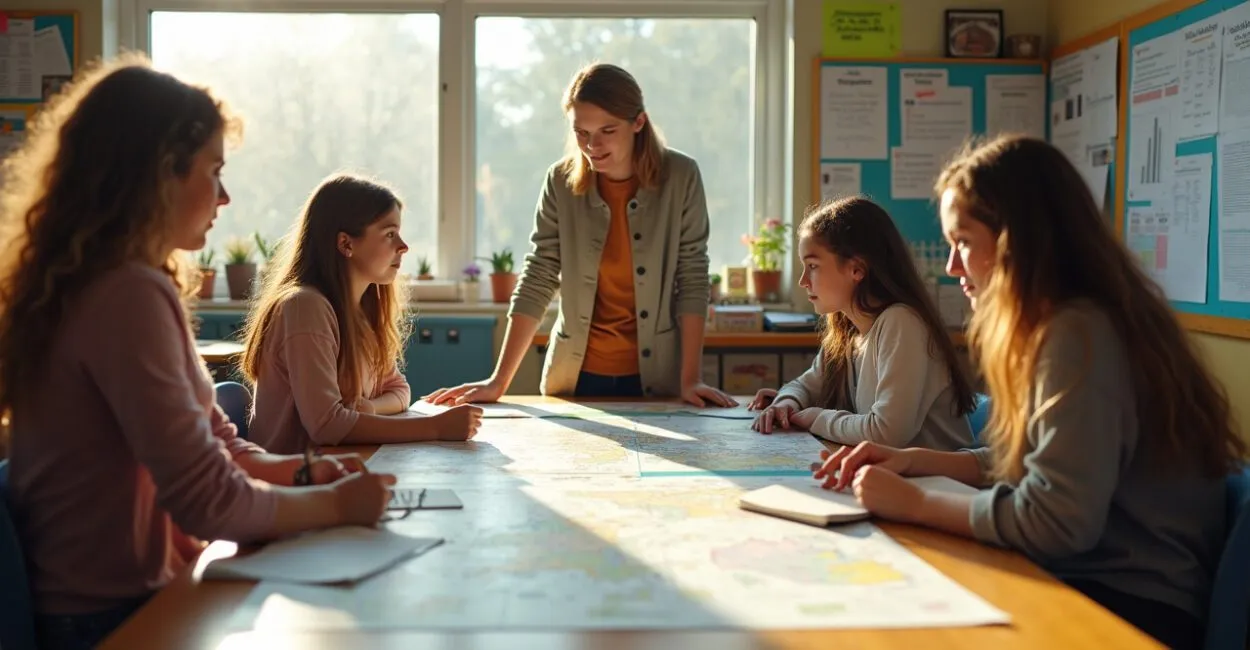
When a school gets subject areas working together, learning reaches a new level. With Interdisciplinary Projects in Elementary School, students move beyond studying subjects in isolation and work through a real-world challenge that brings together reading, writing, math, research, historical context, and creative work.

That’s what gives classroom learning meaning.
In practice, school interdisciplinary projects work best when there’s a clear problem, a shared theme, and well-defined learning goals. They’re especially useful in elementary school because these years help students build literacy, logical reasoning, scientific knowledge, and social skills. When subjects connect, learning feels less fragmented.
Here’s how to plan this kind of project, what separates a well-designed project from a polished-looking activity, and a ready-to-adapt example.
The Essentials
- An interdisciplinary project isn’t about “mixing subjects.” It’s about working toward one goal, with each subject making a meaningful contribution.
- Its educational value comes from requiring students to read, analyze, document, calculate, research, and present—not just create a decorative final product.
- In elementary school, these projects help students build skills outlined in Brazil’s Base Nacional Comum Curricular (National Common Curricular Base, the country’s national curriculum framework) while keeping the specific content of each subject in view.
- A strong project has a guiding question, a short timeline, clear assessment criteria, and an observable final product.
- Without clear roles, a project becomes a collection of disconnected activities. With them, it becomes genuine integrated learning.
Interdisciplinary Projects in Elementary School: What They Are and Why They Work
An interdisciplinary project in elementary school is a learning experience in which two or more subject areas work around the same theme, question, or challenge. The goal isn’t simply to “cover the material,” but to bring subjects together to solve a concrete problem, with evidence of learning along the way.
This approach works because students learn more effectively when they can connect information, action, and context. Instead of memorizing isolated concepts, they read a text to conduct research, use math to organize data, draw on science to explain a phenomenon, and use history or the arts to communicate what they’ve learned.
The BNCC, Brazil’s National Common Curricular Base from the Ministry of Education, supports this approach by prioritizing skills and competencies that span different subject areas.
Why It Makes a Difference in Learning
In practice, the benefits show up in three ways: greater relevance, more participation, and better retention. Anyone who works with elementary school students knows they’re often more engaged when they see an immediate use for what they’re doing.
A project about waste, water, the local community, or nutrition connects classroom content with students’ everyday experiences.
What distinguishes an interdisciplinary activity from a true project isn’t a shared theme—it’s the intentional alignment of goals, steps, and assessment.
That difference may seem small on paper, but it changes everything in practice. A project without real integration simply piles together assignments from different subjects.
A well-designed project creates a single line of reasoning, with each subject contributing at the right time and serving a clear purpose.
When This Type of Project Is Most Useful
These projects tend to work especially well in the early and later elementary grades when the chosen theme connects with students’ daily lives and supports hands-on work. Topics such as the environment, local culture, healthy eating, the water cycle, neighborhood history, and responsible consumption can lead to strong results because they lend themselves to language arts, math, science, social studies, and art without forcing connections.
How to Plan an Interdisciplinary Project at School Without Improvising
Start by choosing a real educational challenge, not just an idea that sounds “nice.” Then decide which skills each subject will develop, what students will produce, and how much time each step will take.
Without a clear plan, the risk of overloading students increases and learning becomes unfocused.
1. Choose a Theme with Educational Potential
Choose a theme that lends itself to research and creation. “Water,” for example, is too broad on its own, but it works well as a concrete question: Where does the water we use at school come from? From there, students can explore the water cycle, consumption, graphs, personal accounts, conservation, and visual communication.
2. Map Out the Subject Areas
Each subject needs a clearly defined educational role. Language arts can focus on reading and writing; math on organizing data and measurement; science on observation and explanation; history and geography on social and geographic context; and art on visual expression and communication. If a subject is included only to “decorate” the project, it isn’t truly integrated.
- Language Arts: reading, interviews, documentation, editing, and oral presentations.
- Math: tables, graphs, estimates, measurements, and data comparisons.
- Science: hypotheses, observation, evidence collection, and explanations of phenomena.
- History and Geography: local history, place, change over time, and social impact.
- Art: posters, models, infographics, exhibits, and visual storytelling.
3. Set the Steps, Timeline, and Final Product
Good projects have a beginning, middle, and end. Teachers should plan for research, organizing information, creating drafts, revising, and sharing the work. The final product could be a fair, an exhibit, a presentation to another class, a bulletin board display, or a school podcast, as long as it shows the learning process—not just an attractive end result.
A common mistake at school is to leave assessment until the end, as if the only thing that matters is the final submission. That undermines the whole project. Ideally, teachers assess the process, collaboration, conceptual understanding, and communication throughout.
If the project doesn’t define goals for each subject, it may be engaging for students, but it falls short as a curriculum-based learning experience.
To align the plan with curriculum goals, consult the Base Nacional Comum Curricular (Brazil’s National Common Curricular Base). Schools looking to strengthen collaborative practices can also draw on the project-based approach promoted by educational networks such as the Instituto Unibanco (a Brazilian education institute) to build more consistent teaching practices.
How to Integrate Subjects Without Losing Their Individual Focus

Integration doesn’t happen by itself. It depends on a central question that connects the subjects and on tasks that build on one another. Instead of assigning “one language arts activity, one math activity, and one science activity,” the team creates a sequence in which each subject feeds into the next.
Read also: Formative assessment: practices to improve teaching
Start with a Guiding Question
The guiding question should be clear and open to investigation. “How can our school reduce water waste?” is more useful than “water” because it points students toward observation, analysis, and action. The question gives the project focus and keeps it from turning into a patchwork of unrelated exercises.
Give Each Subject a Meaningful Role
A class could interview school staff, gather water-use data, create graphs, compare solutions, study the water cycle, and develop awareness campaigns. Each subject makes a different contribution, but they all work toward the same goal. That’s how learning stops being compartmentalized and becomes an integrated experience.
Read also: Interdisciplinary Science and Math Projects
I’ve seen cases where the only sign of interdisciplinarity was the final product, such as a well-made bulletin board. That can be misleading. What matters is the thinking built throughout the process: reading sources, selecting information, calculating, making an argument, and reaching a group decision. Without that, the project looks more like an event than a meaningful learning experience.
Use the Language of Formative Assessment
Assessing students throughout the project makes it possible to adjust course. Brief feedback on clarity, source use, data accuracy, and group participation helps keep the project on track. This works better than waiting until the final grade to discover that half the class didn’t understand the assignment.
A Practical Example of an Interdisciplinary Project for Elementary School
One project you can put into practice is “Water at School, Water in the Community,” designed for grades 4–6. It starts with a simple question: How do we use water at school, and what could we improve? The project brings together research, observation, reading a water bill, writing, and visual communication.
Project Steps
- Initial survey: Students observe where water is used at school and record any waste.
- Research: Students read short texts about the water cycle, sanitation, and responsible water use.
- Data collection: The class organizes information in a table and creates a simple graph of the main uses.
- Interdisciplinary creation: Each group creates a campaign with text, images, an argument, and a suggested change.
- Sharing: Students present their work to another class, school administrators, or the school community.
This project works because it’s concrete. Students observe their school, measure, document, interpret, and propose solutions. The final activity isn’t just a poster; it’s a response based on data and communication.
To make the project more challenging, the school could include an interview with the maintenance staff, compare water use across different months, and study official sources on water conservation. The IBGE, Brazil’s national statistics agency, also provides geographic and social data that can help put projects about neighborhoods, cities, and families’ living conditions into context.
How to Tell If the Project Is Well Designed
A project isn’t automatically good just because it involves several subjects. Quality depends on alignment between goals, activities, and assessment. When these elements align, students learn. When they don’t, the class may be busy, but students learn little in terms of the curriculum.
| Criterion | Signs It’s Working | Warning Signs |
|---|---|---|
| Curriculum integration | Subjects complement one another within a single sequence | Each subject has an assignment with no real connection to the others |
| Learning goals | Each step has a defined skill to develop | The topic is interesting, but the learning goals aren’t clear |
| Assessment | Both the process and final product are observed | Only the final presentation counts |
| Student participation | Students make decisions, conduct research, and take ownership | Students only follow prewritten instructions |
This approach works well with classes that can engage in research and creative work, but it can fall short when time is too limited or the school tries to run an interdisciplinary project without coordinating the team’s planning. Teachers may also disagree about how much freedom students should have: some prefer more structure, while others favor greater student ownership. Either approach can work as long as the goal is clear.
Common Mistakes That Weaken a Project
The most common mistake is choosing a topic that’s too broad and then trying to fit any content into it. This often leads to superficial learning. Another problem is confusing interdisciplinary learning with assigning more tasks, as if simply adding activities from several subjects were enough.
Four Common Pitfalls
- a decorative theme with no real problem to solve;
- an attractive final product without a meaningful learning process;
- vague assessment based only on participation;
- a mismatch between what each subject is supposed to teach.
In practice, a project falls apart when no one takes responsibility for coordinating the learning sequence. The school needs someone to organize deadlines, keep teachers aligned, and make sure the work doesn’t become a repeat of the same content in a different package. Coordination isn’t bureaucracy; it’s essential to quality.
How to Make the Project Part of the School Routine
The safest approach is to start small. A short project that integrates two or three subjects well will often teach the team more than an ambitious plan that isn’t well coordinated. The school can then expand to other classes, topics, and presentation formats.
The key is to treat the project as part of the curriculum, not as an extra event. When a school adopts this approach, Interdisciplinary Projects in Elementary School stop being a one-time experiment and become part of a consistent teaching culture, giving students more ownership and teachers more clarity.
The next step is practical: choose a topic from the school’s daily life, define a guiding question, assign roles by subject, and set an assessment criterion before the first activity. With that structure in place, the project is already off to a much stronger start than most initiatives that only look interdisciplinary.
Frequently Asked Questions
What’s the difference between an interdisciplinary project and an interdisciplinary activity?
An interdisciplinary project has a defined duration, goal, set of steps, and final product. An interdisciplinary activity can be a one-time exercise within a class or lesson sequence. A project connects the curriculum over a longer period and requires real integration between subjects.
How many subjects need to be involved in an interdisciplinary project?
There’s no strict minimum, but two subject areas can be enough for a strong project. What matters most is the quality of the integration, not the number of subjects involved. Three well-aligned subjects tend to work better than five that are only “involved” in name.
How do you choose a good topic for elementary school?
The topic should connect with students’ lives, allow for research, and lead to something concrete. Topics related to school, the local community, the environment, and local culture tend to work well. If a topic doesn’t invite questions, data collection, or creation, it’s likely to remain just a decorative theme.
How should students be assessed in an interdisciplinary project?
Assessment should consider the process, collaboration, conceptual understanding, and final communication. Simple rubrics help make the criteria clear to students. Assessing only the final product can hide important challenges that arose along the way.
Do interdisciplinary projects work with every class?
They work best when the project fits students’ age, available time, and prior knowledge. In classes with significant learning gaps, the project should be shorter, more structured, and divided into clear tasks. Without these adjustments, it can become too demanding.
What’s the biggest mistake schools make with this type of project?
The biggest mistake is treating interdisciplinarity as a decorative teaching method. If each subject works separately, with no shared goal, there’s no real integration. A project only succeeds when it has a central question and a coherent learning process.
%%AGPTRH6%%
Artigos Relacionados
 Interdisciplinary Projects for Elementary School
 Elementary School: A Complete, Practical Guide
 Science Projects Integrated Into the Elementary School Curriculum
 School Political-Pedagogical Project for Whole-Child Education: A Practical Guide
 6 Interdisciplinary Projects for Schools: Quick Models
 A Practical Guide to School Sustainability Projects
