
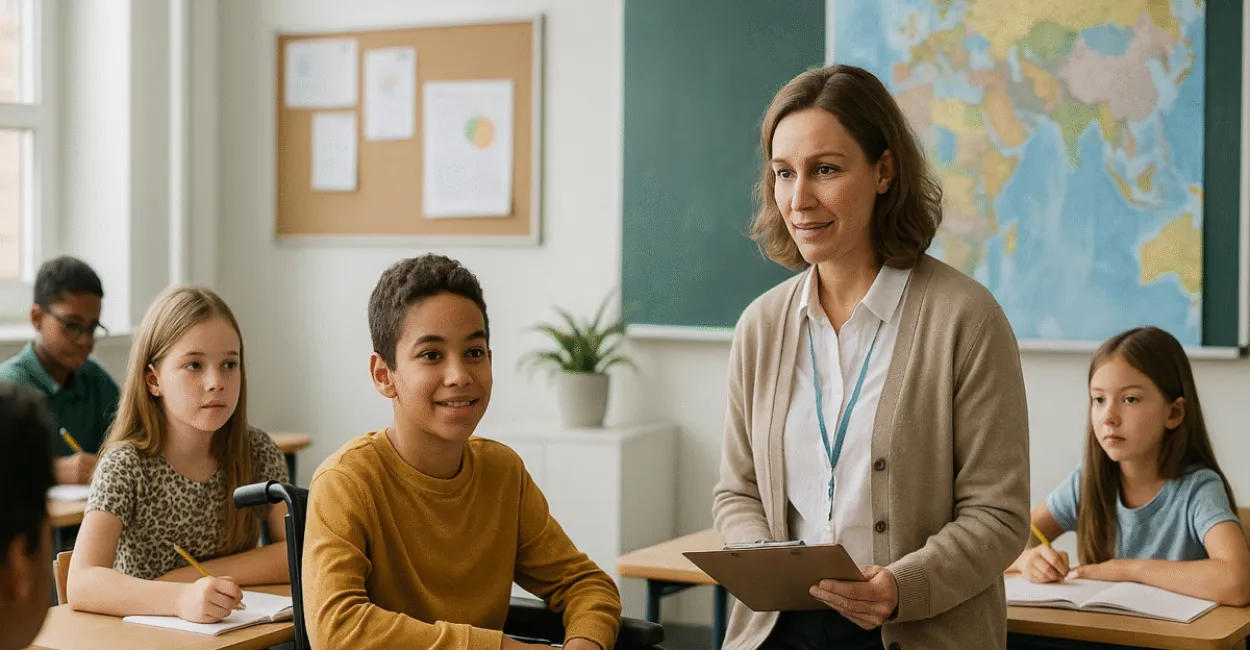
A school can have excellent facilities, new materials, and dedicated teachers—and still exclude students without realizing it. This happens when physical access is available, but the curriculum, assessments, and social environment are still designed for a “typical” student.

Inclusive education in schools exists to break that pattern and ensure that everyone can participate, learn, and feel they belong.
In practice, inclusion doesn’t mean putting students with different needs in the same classroom and expecting them to adapt on their own. It means organizing the school so that differences are part of its planning, routines, and instructional decisions.
Here, you’ll learn exactly what the concept means, see what works in everyday practice, and identify the key ways to make inclusion a reality rather than just a talking point.
What You Need to Know
- School inclusion is about more than enrollment; it means access, participation, learning, and connection with classmates.
- Curriculum adaptations, universal design for learning, and flexible assessment are key elements that make a real difference in the classroom.
- The biggest barrier to inclusion is rarely the student. It’s more often the way the school is organized, teacher preparation, and institutional culture.
- Resources such as Atendimento Educacional Especializado (AEE), Brazil’s specialized educational support service, assistive technology, and multidisciplinary support work best when built into instructional planning from the start.
- Genuine inclusion reduces dropout rates, improves school climate, and benefits students without identified disabilities or disorders, too.
Inclusive Education in Schools: What It Really Means
Technically, inclusive education is an approach that ensures every student has the right to learn alongside their peers, with the support needed to remove barriers. This includes students with disabilities, Autism Spectrum Disorder (ASD), giftedness, specific learning disabilities, gaps in learning, and any other profile that calls for a different kind of instructional support.
In practice, this means the school doesn’t just ask, “Who can keep up?” It asks, “What needs to change so everyone can participate?” That shift in perspective changes everything—from classroom organization to assessment methods. Inclusive education in schools works when difference is no longer treated as an individual problem, but as a shared responsibility across the institution.
Inclusion Isn’t Integration in Disguise
Integration usually means adapting the student to a system that’s already in place. Inclusion does the opposite: it adapts the system to welcome different ways of learning. That distinction changes the logic of the entire school, avoiding the trap of giving everyone the same lesson, the same test, and the same amount of time.
What sets an inclusive school apart from one that is merely accessible isn’t the presence of ramps. It’s the ability to ensure learning through meaningful participation.
The Barriers That Most Often Hinder Learning
Anyone who works in a school knows that the biggest challenges rarely come down to a student’s “lack of effort.” The problem is usually a combination of barriers: inaccessible language, rigid assessments, poorly managed class time, a lack of specialized support, and little coordination among teachers, administrators, and families.
There are also attitudinal barriers, which are the hardest to spot. They arise when a student is treated as an exception, when staff believe inclusion “disrupts the class,” or when adaptations are seen as special treatment. These attitudes undermine relationships and hinder everyone’s learning.
Common Barriers in Everyday School Life
- Architectural: stairs, narrow doorways, inadequate restrooms, and poor signage.
- Instructional: one-size-fits-all lessons for students with very different needs, without varied strategies.
- Communication-related: overly abstract language, a lack of visual resources, and unclear directions.
- Attitudinal: low expectations, student isolation, and resistance to making adaptations.
- Organizational: no routine for monitoring progress, keeping instructional records, or coordinating among staff.
Data from IBGE, Brazil’s national statistics agency, highlight the importance of access to and retention in school in Brazil. Meanwhile, guidelines from Brazil’s Ministry of Education (Ministério da Educação) emphasize that inclusion requires ongoing support and planning, not isolated efforts.
The Teacher’s Role in Everyday Practice

Teachers are essential, but not because they’re expected to “do it all.” They’re essential because they turn a lesson plan into a real learning experience. In practice, it’s simple: when a lesson offers more than one way in—spoken explanations, images, guided activities, concrete examples, or partner work—more students can make progress.
This doesn’t require reinventing every lesson. It requires intentional teaching. The same learning objective can be taught with different levels of support, different amounts of time, and varied ways for students to respond. The goal isn’t to lower the bar; it’s to adjust the path so the goal remains challenging and attainable.
Classroom Strategies That Work
- Break long directions into short, clear steps that students can check off.
- Use concrete examples before introducing abstract ideas.
- Offer more than one way to participate: speaking, writing, visual work, or hands-on activities.
- Introduce new vocabulary with visual support and review it later.
- Review classroom expectations regularly instead of assuming students will remember them right away.
A study by UNESCO underscores that more inclusive education systems tend to achieve greater equity when they invest in teacher training, flexible curricula, and ongoing support.
School inclusion doesn’t depend on a “heroic” teacher. It depends on a school that organizes its curriculum, routines, and assessments to welcome different ways of learning.
Adapting the Curriculum Without Sacrificing Quality
Curriculum adaptation doesn’t mean automatically reducing the amount of content. It means adjusting access to knowledge without watering down the instructional goal. That distinction matters because some students need guidance, supplemental materials, more time, or another way to respond. In other cases, the core content should remain the same, with only the learning path changed.
Experts disagree about how far adaptations should go in certain situations, especially in upper grades. Still, there is strong agreement on one point: if a school doesn’t set clear criteria, adaptations become improvised. And in inclusive education, improvisation often leads to unfairness.
Read also: How to Include Students with Disabilities in the General Education Classroom
When to Adapt and When to Maintain the Challenge
| Situation | What to do | Risk if handled poorly |
|---|---|---|
| Difficulty accessing language | Rephrase directions and provide examples | The student gets the task wrong because they don’t understand it |
| Specific gap in subject knowledge | Review prerequisite skills before moving on | Learning gaps continue to accumulate |
| Need for additional support | Use visual aids, tutoring, and extended time | Quiet exclusion |
| Core curriculum goal | Keep the objective and change the path | Low expectations and a less rigorous education |
The term universal design for learning is especially helpful here. It calls for planning activities from the start with multiple ways to engage with, represent, and express learning. In other words, instead of making adjustments later for a few students, the school plans better for everyone.
Read also: Architectural Accessibility in Schools: How to Adapt Spaces
Why AEE, Assistive Technology, and Multidisciplinary Teams Matter
Atendimento Educacional Especializado (AEE), Brazil’s specialized educational support service, doesn’t replace the general education classroom. It complements classroom instruction, helping students access the curriculum more independently. When AEE staff coordinate with the classroom teacher, the chances of meaningful progress increase considerably.
Assistive technology tools also make a difference: alternative communication, screen readers, visual boards, adapted keyboards, audio aids, and organizational apps. These supports aren’t “extras”; in many cases, they’re what make learning possible.
When the Team Works Together
At a public elementary school in a neighborhood community, one student with ASD avoided long written assignments. Working with AEE staff, her teacher began offering response cards, then short sentences, and eventually brief paragraphs with visual support. The content was the same for the whole class; the learning path was adjusted. Within two months, her participation increased and her resistance to assignments dropped considerably.
This kind of progress doesn’t happen by magic. It happens when school administrators, teachers, AEE staff, families, and, when needed, speech-language pathologists, educational psychologists, or occupational therapists work toward compatible goals. Without that coordination, each professional pulls in a different direction, leaving the student caught in the middle.
Families, School Culture, and Relationships Matter as Much as the Curriculum
Inclusion fails when a school treats a student as an “individual case” and the family as an “outside user.” Family involvement isn’t about shifting responsibility; it’s about bringing in more information, consistency, and continuity. In many cases, families notice things the school hasn’t seen yet, while the school observes social challenges that don’t show up at home.
School culture matters, too. An inclusive school doesn’t rely on goodwill or one-off projects. It sets clear expectations for how people treat one another, addresses isolation, and regularly checks in on the classroom climate. This matters for students with disabilities and for anyone who feels left out.
What Helps Build a Stronger Classroom Community
- Cooperative projects instead of constant competition.
- Classroom expectations that are explained and revisited throughout the year.
- Conflict resolution focused on making things right, not humiliation.
- Representation in learning materials, examples, and activities.
This point is also emphasized by organizations such as Instituto Alana, a Brazilian nonprofit that publishes research and resources on the right to education, diversity, and antidiscrimination practices in schools.
How to Start Transforming a School Without Waiting for Ideal Conditions
The biggest trap is believing inclusion can only begin once perfect resources are available. That brings entire school systems to a standstill. The most effective approach is usually less glamorous: identify barriers, set priorities, and track what actually changes in daily routines.
Not every situation is the same. A small school in a rural community won’t have the same resources as a large urban school system, and that affects the pace of implementation. But the basic approach is the same: observe, document, adjust, and sustain. Without that cycle, initiatives become short-term campaigns.
Practical Steps to Move from Talk to Action
- Assess physical, instructional, and attitudinal barriers.
- Choose two or three manageable changes to make this quarter.
- Align adaptation criteria among teachers and school administrators.
- Document what worked and what didn’t in the classroom.
- Review results based on participation and learning, not just attendance.
When a school starts measuring participation, access, and progress, the conversation changes. Inclusive education in schools stops being an abstract ideal and becomes a measure of institutional quality.
Next Steps
The most important step isn’t launching an impressive project; it’s building consistency. An inclusive school teaches with dignity, without requiring students to hide their differences to fit the system. The most honest test is simple: How many students are truly learning, participating, and feeling they belong?
To take the next step, look at your school’s daily routines and identify where exclusion shows up quietly—in instructions, assessments, recess, language, or physical access. Then compare those practices with the guidelines for Brazil’s national inclusive education policy and resources from UNESCO. That’s how change stops being a promise and becomes instructional work.
Frequently Asked Questions
Is inclusive education the same as special education?
No. Special education is a service model that provides resources and support services; inclusive education is the principle that guides the entire school in welcoming students with different needs. In practice, inclusion organizes school life and the curriculum so those supports work within general education.
Does every student with a disability need curriculum adaptations?
Not necessarily. Some students need adjustments to access, timing, language, or resources, but the core learning objective can remain unchanged. Decisions should be based on an individual instructional assessment, not an automatic rule.
Does a teacher need to know everything about every diagnosis?
No. What matters most is understanding how that student learns, where they encounter barriers, and what support helps. A diagnosis can provide guidance, but it doesn’t replace instructional observation or collaboration with AEE staff and the school team.
Does school inclusion hold the rest of the class back?
When poorly implemented, it can create additional demands. When well planned, it often improves clarity of instruction, collaboration, and classroom management for everyone. The problem isn’t inclusion itself; it’s the lack of organization to support it.
What’s the first step a school can take to become more inclusive?
Identify the most visible barriers and choose one manageable change at a time. Adjusting how students are taught, assessed, and supported can already make a real difference. From there, the school can expand its efforts to include teacher training, accessibility, and family partnerships.
%%AGPTRH8%%
Artigos Relacionados
 Industry-School Partnerships: Benefits for Students and Businesses
 Socio-Environmental Change Through Education: Paths to a Sustainable Future
 Physical Education Teacher: A Complete Guide to Training and Career Paths
 How Artificial Intelligence Is Revolutionizing Learning in 21st-Century Schools
 School Health: How Schools Promote Student Well-Being
 Digital Transformation in Education: How to Revolutionize Learning
