
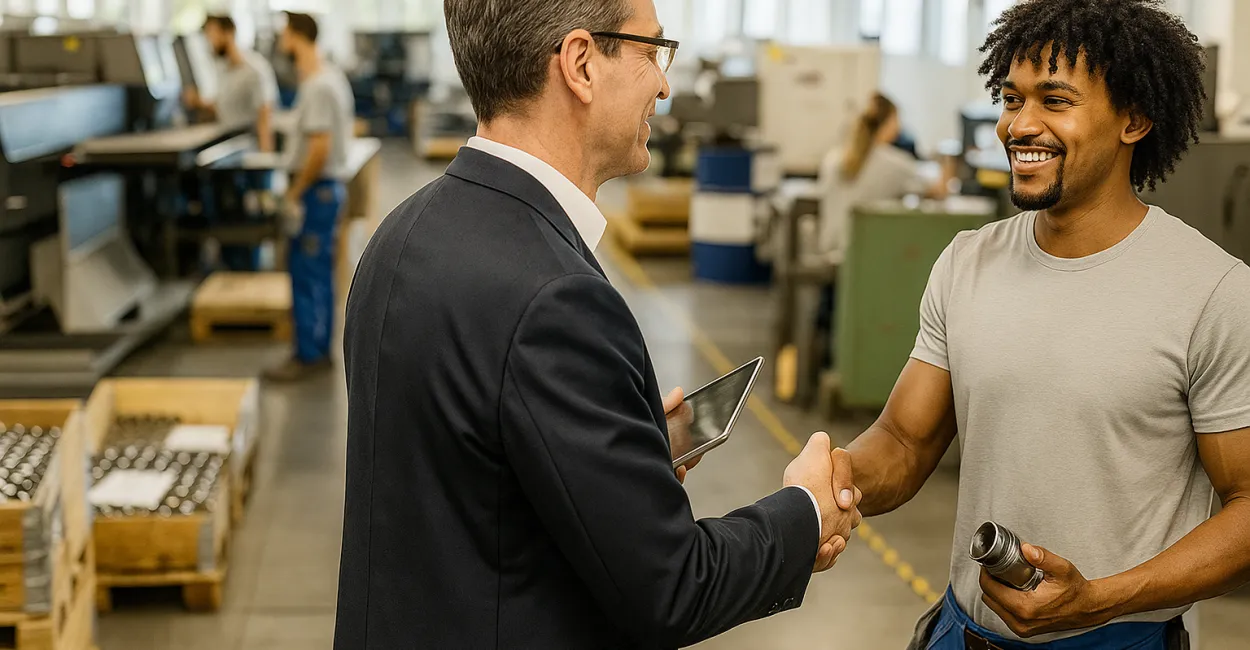
The distance between the classroom and the factory floor comes at a high cost: students graduate with a diploma but without the experience needed to solve real-world problems. Industry-school partnerships are designed to close that gap by bringing curricula, technology, and day-to-day operations together in a structured way. In practice, this means much more than “taking students on a company tour.” It means building an ongoing bridge between technical education, professional skills, and the real needs of the job market—with a direct impact on students’ employability and business productivity. Below, you’ll learn how these partnerships work, what models are available, where they succeed, and which mistakes can derail even promising projects.

What You Need to Know
- Industry-school partnerships connect education, hands-on experience, and employability in one learning pathway.
- Businesses gain professionals who are better prepared for day-to-day operations, reducing onboarding time and rework.
- Students develop technical and professional skills that are difficult to build through theory alone.
- Successful partnerships require strong governance, clear goals, up-to-date curricula, and joint evaluation of results.
- These models fall short when they become one-off events without educational follow-up or meaningful industry involvement.
Industry-School Partnerships: What They Are and How They Transform Education
Technically, an industry-school partnership is a cooperative arrangement between educational institutions and businesses to align the skills students develop at school with workplace requirements. Put simply, schools teach with more context, and businesses get involved so learning makes sense beyond the classroom.
This alignment matters because the job market has changed too quickly for courses to rely on outdated content. Automation, data, predictive maintenance, workplace safety, and quality control all require hands-on knowledge, along with critical thinking, communication, and the ability to keep learning. That’s why the topic features prominently in initiatives by Brazil’s Ministry of Education and in vocational education networks such as SENAI, Brazil’s National Service for Industrial Training.
What distinguishes a genuine partnership from an education marketing stunt is continuity: when a business helps define skills, take part in activities, and assess results, learning stops being abstract and becomes real preparation for work.
From Theory to the Workplace
A strong partnership doesn’t replace theoretical foundations; it puts them in context. Students understand why they need to study metrology, technical drawing, statistical process control, or programming logic. Without that connection, the content is just another subject. With it, it becomes a tool.
Technical and Professional Skills Go Hand in Hand
Anyone involved in workforce training knows that the problem is rarely just technical. Often, the biggest challenges involve punctuality, communication, operational discipline, collaboration, and safety awareness. These skills become more visible when students take part in real-world settings, such as applied labs, capstone projects, supervised internships, or well-planned site visits.
How Partnerships Build the Skills Employers Actually Need
Industry doesn’t just want to know whether a student “passed the course.” Employers want to know whether that person can read a procedure, follow a standard, document an incident, and ask for help at the right time. That’s where partnerships show their value: they turn isolated knowledge into observable performance.
Technical Skills with Less Guesswork
In technical courses and job-training programs, working with machinery, instruments, industrial software, and quality processes shortens the learning curve on the first job. Students feel less out of their depth and make fewer mistakes on repetitive tasks because they’ve already seen the process before they’re hired.
Professional Behavior Doesn’t Come from a Slide Deck
Responsibility, reliability, teamwork, and situational awareness are developed through guided exposure, feedback, and practice. In practice, projects with support from supervisors and teachers help students quickly see how their own behavior affects the team’s results.
A Common Scenario
I’ve seen students who struggled in class excel on a company project because they finally understood why the material mattered. They didn’t suddenly love everything, but they started asking better questions, meeting deadlines, and correcting their own mistakes before anyone pointed them out.
That kind of turnaround doesn’t come from empty motivation. It comes from context, method, and clear expectations.
Models That Work in Practice: From Internships to Capstone Projects

There’s no single ideal format. The right choice depends on the course, the company’s readiness, the time available, and the skills students need to develop. Experts disagree about which model has the greatest impact because results vary by industry, age group, and level of educational support.
| Model | When It Makes Sense | Main Benefit | What to Watch For |
|---|---|---|---|
| Supervised internship | Technical and college-level education | Direct exposure to day-to-day work | Requires supervision and clear goals |
| Work-based learning | Young people entering the workforce | Combines education with workplace experience | Must follow legal and educational requirements |
| Site visits | Introduction to processes and industries | Broadens students’ knowledge and career awareness | On their own, they have little lasting impact |
| Capstone projects | When there’s a real problem to solve | Builds applied problem-solving skills | Requires a well-defined challenge |
| Shared labs | Technical and technology-focused fields | Brings students closer to industry equipment and processes | Requires investment and ongoing maintenance |
Sources such as the International Labour Organization and the OECD education report emphasize that school-to-work transition programs tend to work best when they’re structured, ongoing, and assessed using clear metrics. Having a “partnership” isn’t enough; you need to know what it delivers.
The Company’s Role: More Than Opening Its Doors for Tours
When a company is only there as a backdrop, the project quickly loses momentum. When it helps define skills, provide real-world challenges, and evaluate student work, the benefits are much greater. Students see that standards, deadlines, quality, and consequences matter.
What Industry Needs to Bring to the Table
- Real problems, not generic exercises.
- Experienced professionals to mentor students and provide feedback.
- Controlled access to processes, tools, and performance metrics.
- Clearly defined safety and confidentiality requirements.
- Time for ongoing support, because a partnership without real involvement is just a photo op.
This also benefits the company. Teams that work with well-prepared students or apprentices can spot talent before making a formal hire, improve communication with schools, and help develop professionals who are a better fit for the company culture.
Companies that take part in workforce training don’t have to start from scratch later. They can bring new hires up to speed faster, reduce operational errors, and improve their chances of hiring people who already understand their standards.
The School’s Role: A Living Curriculum, Not a Rigid Course Plan
For schools, integration doesn’t mean abandoning course content. It means reviewing the curriculum so it reflects the real world without turning it into training for a single company. It’s a delicate balance: schools that drift too far from practice may produce underprepared graduates; schools that cater too closely to industry’s immediate needs risk losing their educational independence.
Where Schools Can Make the Biggest Difference
- Updating learning pathways based on the region’s industries.
- Designing projects around authentic problems.
- Assessing skills, not just written test performance.
- Bringing teachers, coordinators, companies, and students together around shared goals.
This model is prominent in networks such as Brazil’s Industry System and in public policies focused on vocational education because it brings training and job requirements into closer alignment. Schools become more relevant, and students gain direction.
Why Projects Fail and How to Avoid Frustrating Everyone
Not every partnership works, and pretending otherwise only delays course correction. The most common failures stem from three problems: vague goals, poor communication, and mismatched expectations. Companies expect job-ready workers; schools expect cooperation without interference; and students are caught in the middle, unsure why the activity matters.
Mistakes That Can Derail Good Projects
- Turning everything into a one-off event with no follow-through.
- Choosing a company for its brand name rather than its educational fit.
- Failing to assign points of contact on both sides.
- Measuring success only by the number of participants.
- Overlooking safety, ethics, and data protection.
There’s another important limitation: not every school has the facilities or faculty to support this model, and not every company can provide high-quality supervision. In highly regulated industries, for example, partnerships require extra care around compliance, trade secrets, and safety regulations.
How to Move Beyond Improvisation
The safest approach is to start small: one course, one class, one partner, and one measurable goal. Then expand. Well-designed projects almost always start modestly and grow because they deliver measurable results—not because they promise to transform everything overnight.
How to Measure Results Without Relying on Vanity Metrics
If a partnership doesn’t generate data, it becomes a story. And a story alone isn’t enough to guide decisions. Evaluation should look at learning, retention, employment outcomes, and performance after the experience.
Metrics That Matter
- Project or internship completion rate.
- Performance in technical and social-emotional skills.
- Average time to adjust to a first job.
- Feedback from supervisors and teachers.
- Percentage of students who continue in the field.
When schools and companies track these metrics, they can revise curricula, adjust schedules, and improve hands-on learning. That’s how industry-school partnerships move beyond talk and become part of a workforce development strategy.
Next Steps to Get a Partnership Off the Ground
You don’t need to wait for the perfect model to get started. The best first step is to identify which skills the course should strengthen and which local companies are a good fit. Then, design a short experience with clear goals, assigned supervisors, and evaluation criteria agreed on in advance.
If the goal is to provide better training and make better hires, the smartest move is to test a small partnership, measure what changed, and make adjustments before expanding. The benefits show up when schools stop teaching in a vacuum and companies stop demanding job readiness without helping build it.
Frequently Asked Questions
What is an industry-school partnership?
It’s a structured collaboration between educational institutions and companies to align academic training with workplace skills. The goal is to bring coursework, hands-on experience, and employability closer together without sacrificing theoretical foundations.
What’s the difference between a site visit and a true partnership?
A site visit is a one-time opportunity to observe. A true partnership involves ongoing engagement, educational goals, company participation, and evaluation of results over time.
What skills do students develop through this model?
Along with technical skills, students develop communication, responsibility, teamwork, operational discipline, and an understanding of workplace processes. These skills often make a difference in a first job.
Can any company take part in this type of partnership?
Many companies can in principle, but not all have the resources to support students effectively. The most important factors are the fit between the company and the course and the company’s ability to provide supervision.
Does this model replace traditional education?
No. It complements education and puts theory in context. When done well, it improves learning, but it doesn’t replace course content, educational planning, or formal assessment.
How can you tell whether a partnership is working?
Look for improvements in performance, the quality of student work, adjustment to the workplace, and feedback from teachers and supervisors. If the results don’t change, the project needs to be reviewed.
%%AGPTRH8%%
Artigos Relacionados
 Assessing Learning: Modern and Innovative Methods for Students
 School Bullying: A Complete, Practical Guide
 Social Media in Education: Key Impacts, Benefits, and Challenges
 Fake News: How to Address the Topic Effectively in School Projects
 Key Benefits of Graduate Programs
 Credit Cards: Maximize Your Rewards and Benefits
