
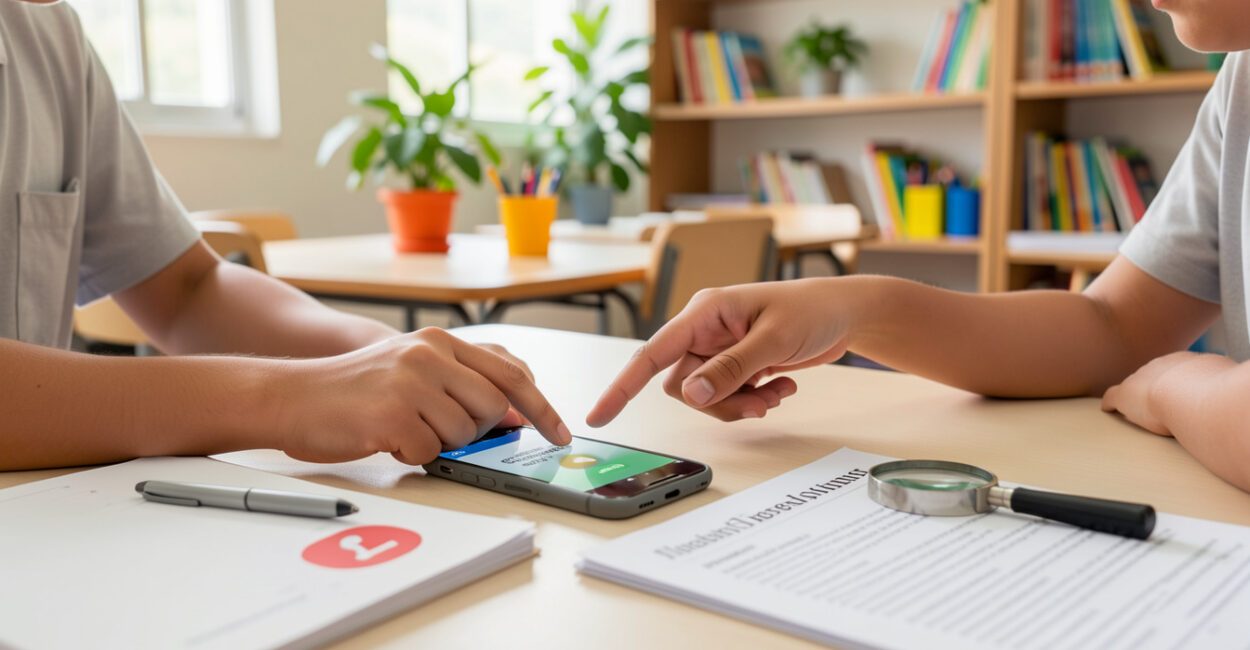
An alarming message arrives in the family group chat with a photo, a date, and a supposed statement from a public official. Before sharing it, take time to investigate: fake news can influence decisions and harm people. Understanding how it spreads, checking evidence, and distinguishing deception from error can help in everyday life and when preparing a school project.
The term “fake news” is commonly used for false or misleading content presented as news. To analyze it, however, you need to consider intent, context, and evidence: a rumor, satire, and a journalistic error may circulate in similar ways, but they have different origins.

Making this distinction also improves a school project. Instead of simply collecting examples, students can explain how they checked a claim, which sources they consulted, and what they still cannot conclude.
Fake News: What It Is and Why It Matters
Fake news is fabricated or distorted content that imitates news or presents itself as reliable information. The term is also used broadly to refer to disinformation, but an analysis should consider whether there was intent to deceive, how the material was produced, and what evidence exists. In everyday language, it is content that looks informative but leads readers to an unsupported conclusion.
A real image may be shared with a false caption; a statement may be taken out of context to change its meaning; a website may copy the look of a well-known news outlet. In each case, looking like a news story does not prove that the content is true.
Disinformation can affect individual choices and public debate. The risk grows when a post uses urgency, fear, or outrage to encourage people to share it before checking its source.
Whether information is reliable depends on the evidence and context, not on how many times it has been shared.

How to Distinguish Disinformation, Rumors, Satire, and Journalistic Errors
Fake news and rumors are not exact synonyms. A rumor is an unconfirmed claim that circulates without proof; disinformation is false or misleading content shared with the intent to deceive. A rumor may eventually be confirmed, debunked, or remain unresolved for lack of sufficient evidence.
- Disinformation: False or manipulated content created or shared to deceive. Intent can be difficult to prove, so distinguish what the evidence shows from what you infer about the person who posted it.
- Rumor: A claim that circulates without confirmation. Someone who shares it may believe it, even if it is false.
- Satire: Humorous content that imitates informational formats. Outside its original context, it can be mistaken for news.
- Journalistic error: Incorrect information published without proven intent to deceive. Corrections, transparency, and updates are relevant signs when assessing a news outlet’s conduct.
Careful classification helps prevent accusing someone of making up a lie when all you know is that there was an error or that the information has not yet been verified. In many cases, intent cannot be determined from the content alone; it is more rigorous to describe the claim and the available evidence.
How to Identify Fake News in Practice

Start with the central claim: What exactly does the content say happened? Separating the claim from the comments and images makes it easier to verify, because each part may have a different origin or level of accuracy.
- Check the author and source. Look for the author’s name, the news outlet, and the original page. A familiar logo in a screenshot does not prove that the material came from that outlet.
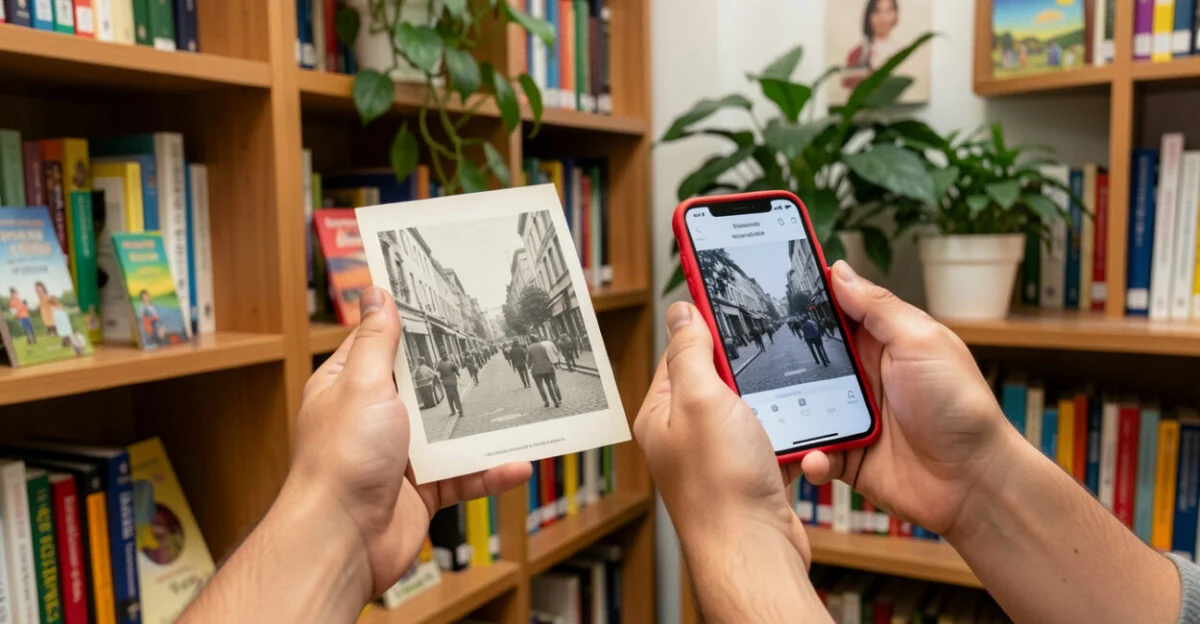
- Check the date and context. An old photo may resurface as if it showed a recent event. Find the original post and compare the location, people, and circumstances.
- Look for the cited evidence. If the text mentions a study, document, or statement, try to find the primary source. A quote without a link or reference does not let you check the full passage.
- Compare independent sources. See whether outlets or institutions with no apparent connection confirm the same fact. Several pages copying the same text do not count as independent confirmation.
- Pay attention to what the fact-check actually concludes. Information may be false, misleading, out of context, or still inconclusive. Do not turn a partial conclusion into absolute certainty.
A common mistake is to search for the exact phrase on Google and treat repeated results as proof. Posts may copy one another. To avoid this false consensus, trace the claim to its origin and look for evidence that does not rely on the same post.
The UNESCO Media and Information Literacy program focuses on the ability to access, evaluate, and produce information. This approach helps make fact-checking a regular reading habit, not just a one-time reaction to a suspicious message.
How to Choose an Example of Fake News for a School Project
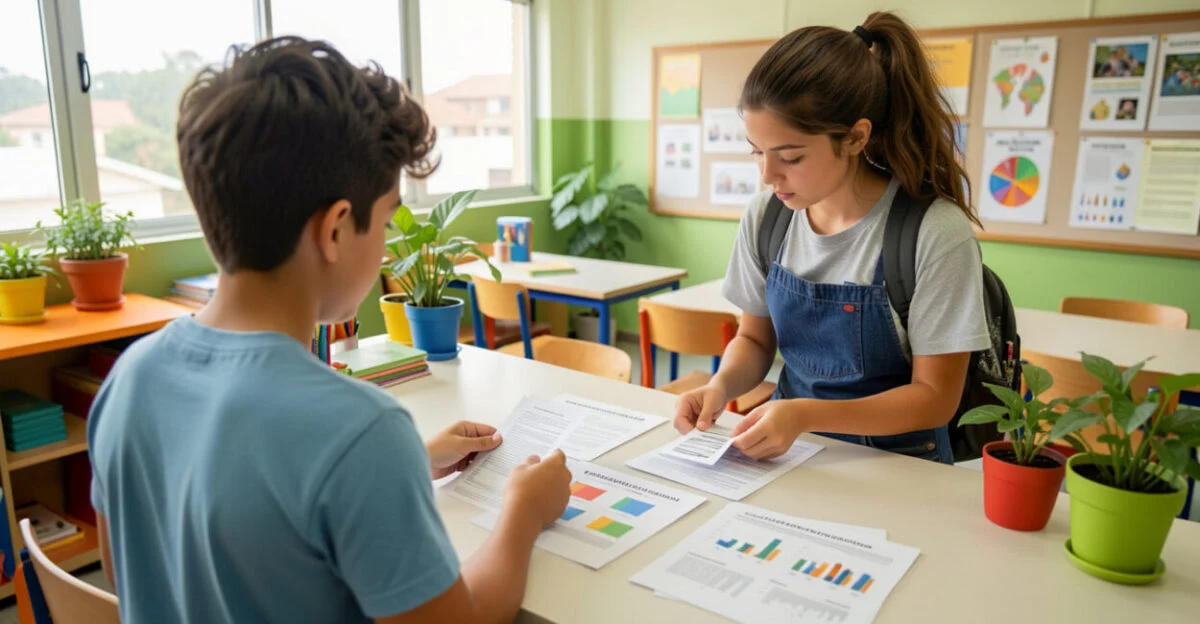
Choose a case whose original claim and fact-check can be consulted in accessible sources. A good example lets you show the content, explain what was wrong or out of context, and point to verifiable evidence without relying on rumors about who created it.
When discussing well-known examples of fake news in Brazil or fake news that looks real, avoid lists with no clear sources. Choose a case documented by a fact-checking organization or a news outlet that explains its verification process and cites its references. Before including it, check:
- whether there is an original post or a reliable record of the claim;
- whether the fact-check identifies documents, images, or data supporting its conclusion;
- whether the case can be explained without repeating the falsehood as if it were true;
- whether the sources let you distinguish confirmed facts from interpretation or uncertainty.
When citing an example, give the context first and make it clear that the claim has been checked. You do not need to prominently repeat a misleading headline: a brief description accompanied by the correction and sources is usually enough. This reduces the risk of spreading the very message your project set out to analyze.
Fake News in Schools: What Media Literacy Adds
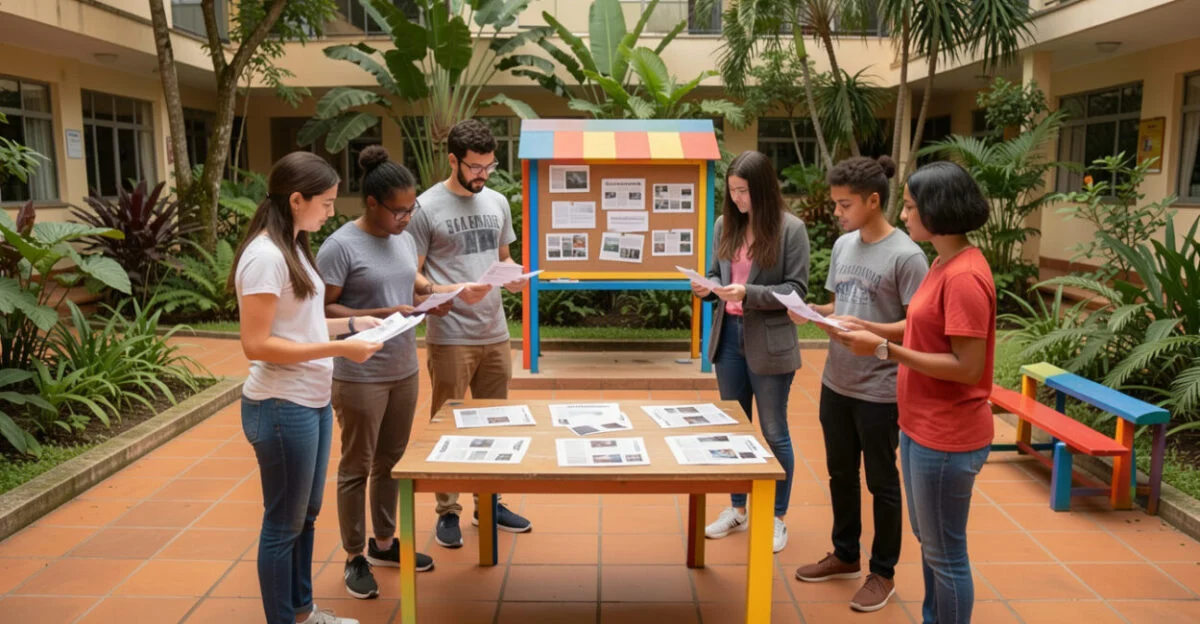
Studying disinformation helps develop critical reading, research, and responsible communication. In the classroom, the topic can be connected to source analysis, language interpretation, and discussion of how information circulates, depending on the activity’s and subject’s objectives.
The Base Nacional Comum Curricular (BNCC), Brazil’s national curriculum framework, guides learning related to reading, argumentation, and the use of different forms of communication. This does not mean there is one required assignment about fake news: teachers can develop these skills in different ways, depending on the grade level and instructional plan.
A school analysis is stronger when it separates three layers: what the post claims, what evidence was found, and what conclusion can be drawn. This separation also highlights an important limitation: when sources conflict or data is missing, the right result may be “inconclusive,” not a forced answer.
How to Write a School Project About Fake News
A project about disinformation should present a research question, explain the criteria used to verify information, and support its conclusions with identifiable sources. The structure can be simple, as long as each part serves a purpose.
- Introduction: Introduce the topic and pose a question, such as “What signs can help verify an image shared out of context?”
- Key concepts: Distinguish disinformation, rumors, satire, and journalistic errors without treating the terms as interchangeable.
- Analysis: Describe a verifiable case, identify the claim, and present the evidence you consulted.
- Conclusion: Answer the question based on your findings and note the limits of your research.
- References: List the webpages, documents, articles, and fact-checks you used, including the title, author or institution, and URL.
Social media can be a subject of analysis, but it is not enough as proof. A post can help you study language, format, and circulation; to confirm the fact it reports, look for documents, records, or independent sources. If you use a screenshot, try to find the original post and say when that is not possible.
To find fact-checking materials, consult organizations that explain their methods and identify the sources they use. Agência Lupa, a Brazilian fact-checking organization, publishes verifications that can serve as a starting point; your school project should still check the references provided and cite the fact-check itself.
How to Present the Topic Clearly and Avoid Vague Claims
In an oral presentation, first explain your research question and the claim you investigated. Then show how you found the original source, which evidence you compared, and why you reached your conclusion. This sequence helps the class follow your reasoning instead of simply hearing a verdict.
Replace statements like “the internet is full of lies” with specific claims: “In this case, the image circulated with a caption that did not match its origin.” Also explain what you could not confirm. Acknowledging a gap is more reliable than filling a lack of evidence with assumptions.
Before submitting your project, check that every important claim has a source, that quotes preserve their context, and that your conclusion does not go beyond the evidence. As a first step, choose a specific claim and try to trace it to its origin; if there is not enough material to verify it, choose another case.
Frequently Asked Questions
Should I include the definition of fake news in another language?
You can explain that “fake news” literally means “false news.” In your text, also define how you will use the term, since it is used in different ways in public debate and research.
Can I use an artificial intelligence tool for research?
It can help organize questions or suggest search terms, but it should not be treated as a source of verification. Check every reference it provides and consult the original documents or pages before using any information.
What should I do if the fact-check does not reach a conclusion?
State that the information remains inconclusive and explain which evidence is missing or conflicting. This sets clear limits on your research without treating a lack of confirmation as proof that the claim is false.
Artigos Relacionados
 Digital Education: Transforming Teaching with New Technologies
 Automated Learning Tools: A Complete Guide to Better Learning
 Ethics in Educational AI: Challenges, Impacts, and Essential Guidelines
 Women in Science: Overcoming Challenges and Shaping the Future
 Education and New Technologies: Transforming the Future of Teaching
 AI in Education: Exploring Philosophical Impacts and Challenges
