
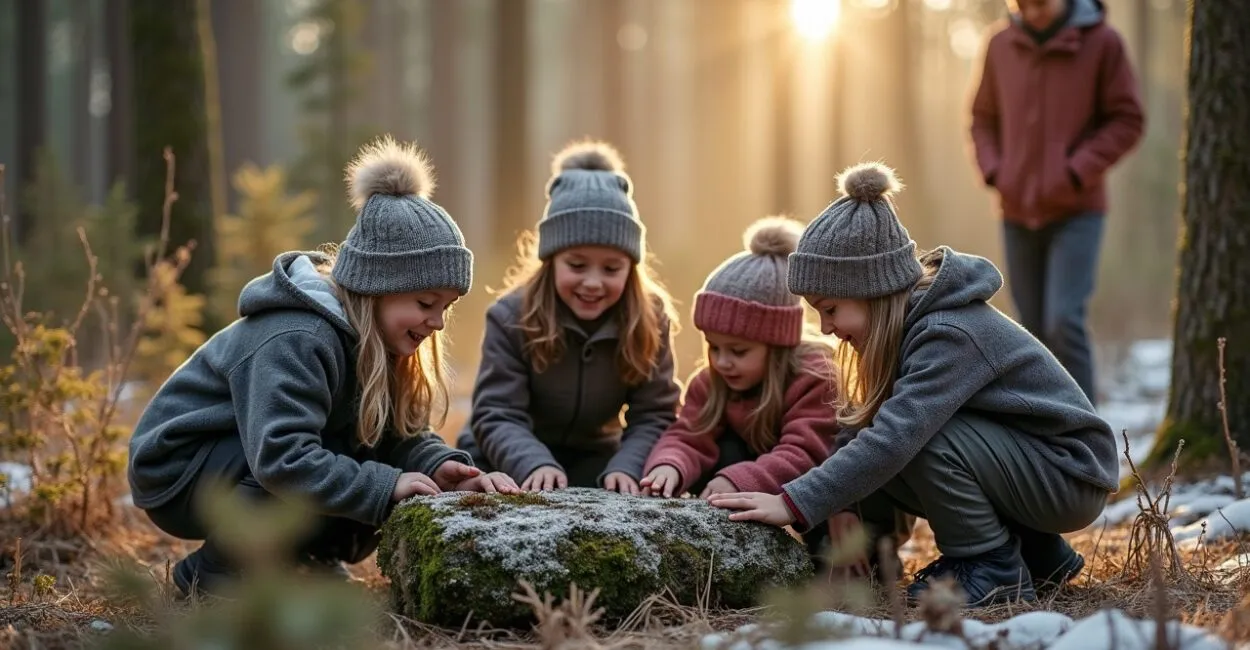
At a Swedish preschool, a puddle can become the subject of an investigation: children compare its depth, see what floats, and talk about the rain. Early childhood education in Sweden that incorporates outdoor pedagogy combines play, exploration of the environment, and educational goals.

Children spend part of their day outdoors with educators, while continuing to learn language, math, and science.
However, the image of children spending time outdoors in all weather oversimplifies the model. Practices vary among institutions and depend on the curriculum, available space, weather, children’s needs, and local rules.
The principles that can be adapted to other settings include frequent contact with the environment, active participation, and attentive supervision.
What characterizes Swedish early childhood education with outdoor pedagogy?
Pedagogy practiced outdoors is an educational approach that organizes learning experiences in outdoor settings, using exploration, movement, and interaction with the surroundings as intentional parts of teaching. In Swedish early childhood education, it may be part of a preschool’s routine, but it does not, by itself, define every institution in the country. Put simply, going outside to play can also be a planned opportunity to observe, ask questions, talk, and learn.
Sweden’s national preschool curriculum, Förskolans läroplan (the Swedish preschool curriculum), guides educational practice and includes play, development, learning, and children’s participation. How time and spaces are organized varies among schools. Some offer frequent access to green spaces; others make use of playgrounds and urban areas.
This approach is also called nature pedagogy or nature-based learning. The key is the educational intention: a walk around the playground can spark conversations about leaves and the seasons, while a short trail can create opportunities to negotiate the route and notice changes in the terrain.
What roles do educators, play, and autonomy have?
Educators prepare the environment, observe children’s initiatives, and step in when safety, inclusion, or learning call for support. They may introduce a question or a material, while leaving room for the group to explore and decide how to play.
An important difference lies in the kind of attention the staff provides. Rather than directing every step, adults stay with the group, notice conflicts, identify interests, and offer challenges suited to the children’s ages. If children find branches of different sizes, for example, an educator might ask how they could sort them or which one seems longer. The conversation grows out of the situation without turning every moment into a formal lesson.
Outdoor autonomy grows when children encounter manageable challenges with an attentive adult nearby.
Play also supports social skills: agreeing on rules for a fort, waiting for a turn on a narrow path, and asking for help putting on boots are everyday opportunities to practice communication and cooperation. Different children may need different amounts of time and support to participate.
What benefits can nature-based learning offer?

Outdoor activities can create more opportunities for movement, sensory exploration, shared play, and contact with changes in the environment. These are possible benefits, not guaranteed outcomes for every child or in every setting.
Movement happens through everyday actions: balancing on an uneven surface, carrying a light bucket, or walking along a path. Contact with natural elements can also spark curiosity and conversation, while group play lets children practice negotiation and conflict resolution. The quality of the experience depends, among other things, on supervision, accessibility, and how the activity accommodates each child.
Research on child development and nature does not justify attributing every gain in health, attention, or learning to a single approach. Studies vary in design and context, so it is important to distinguish research findings from universal promises. To learn about Sweden’s curriculum framework, visit the Swedish National Agency for Education (Skolverket).
How does an outdoor routine connect with reading and math?
Outdoor pedagogy can support academic learning when educators connect experiences to language, math, science, and creative goals. It does not require giving up books, writing, or indoor activities.
Read also: Child Development from Birth to Age 6: A Guide for Parents
A group might count how many pinecones they found, compare their sizes, draw the route, or dictate a story about what they observed to an educator. Later, children can revisit drawings, photographs, or notes and return to their questions indoors. This connects the outdoor experience with other ways of representing ideas.
In an outdoor school routine, staff also account for transitions: getting dressed for the weather, checking the group, reaching the outdoor space, and coming back inside all take time. A common mistake is to plan an outing packed with activities and forget about these moments. With young children, a short, well-observed activity can be more rewarding than a rushed sequence of tasks.
How can you ensure safety without limiting exploration?
Safety during outdoor activities depends on assessing the space, anticipating risks, setting clear boundaries, and providing supervision suited to the group. The goal is to allow age-appropriate challenges while reducing dangers children are not yet able to assess.
Before going out, staff can check the terrain, weather forecast, equipment, and potential hazards such as deep water, unsafe plants, or sharp objects. During the activity, they count children when moving between locations, define exploration areas, and adjust supervision to the setting and the group’s needs.
- Choose clothes and footwear suited to the temperature, rain, and terrain; make sure children can move comfortably.
- Explain clear boundaries, such as how far the group can go and which objects should not be touched.
- Offer increasing levels of autonomy: start with simple tasks, then allow more freedom as children show they understand the rules.
Cold, heat, wind, and rain call for different decisions; no single rule works for every place or every child. Health, age, activity length, and the option to return to a protected space also matter. Swedish guidance can help explain the local context, but it does not replace safety protocols and regulations that apply in other countries.
Can children under age 3 participate?
Yes, children under age 3 can spend time outdoors as long as the duration, setting, activity, and supervision suit their age and individual needs. There is no single ideal age to start: short walks around the playground or supervised exploration can be part of the routine from an early age.
For babies and toddlers, staff need to consider mobility, communication, temperature, and the need for rest. A child who cannot yet walk can observe sounds and textures in a protected spot; another may prefer to explore a small area before approaching a larger one. Adults adjust the activity rather than expecting every child to participate in the same way.
If a child refuses to go outside or seems afraid, it is worth finding out what is causing the discomfort. It could be the noise, clothing, a previous experience, or leaving a familiar setting. Starting near the entrance, allowing the child to watch before joining in, and offering a familiar object are all options; forcing contact tends to make it harder to build trust.
How can nature pedagogy be adapted to other countries?
Adapting the practice means starting with the climate, available space, local culture, and regulations that guide early childhood education. There is no need to recreate a Swedish forest: a playground, an approved park, or a small garden can offer opportunities to observe and play.
In hot regions, routines can prioritize shade, hydration, and cooler times of day. In urban areas, staff can map nearby spaces, check routes, and set boundaries for movement. Where equipment is limited, simple materials found safely can support sorting, drawing, and building activities.
The Swedish curriculum is a reference for understanding the approach, not a manual that replaces local regulations. In Brazil, educators should consider the curriculum and safety guidelines that apply to their institution, as well as the characteristics of the local area. UNICEF’s early childhood development resources include materials on conditions that support child development; applying any approach still depends on the specific context.
To get started, choose a nearby space, assess the risks, and plan a short activity with an observable goal, such as comparing leaves or describing the route. Then note what engaged the children, what made them uncomfortable, and which adjustments helped them participate. This cycle of observing and adapting is more valuable than copying a foreign routine without considering the children in the group.
| Question | Answer |
|---|---|
| What defines the approach? | Intentional learning that also takes place in outdoor settings. |
| Does it replace academic content? | No. It can incorporate reading, writing, math, and science into the routine. |
| Can young children participate? | Yes, with activities, durations, and supervision suited to their age. |
| How can you balance exploration and safety? | Assess the space, set clear boundaries, and gradually increase autonomy. |
| Can the approach be adapted outside Sweden? | Yes, by adjusting it to the local climate, space, rules, and culture. |
To try the approach, start with a short outing and a question children can investigate in the available environment. At the end, assess participation, comfort, and safety before expanding the routine. Outdoor pedagogy becomes more effective when each choice responds to the children in the group and the conditions of the place.
Frequently Asked Questions
Do you need a forest near the school?
No. A playground, a small green space, or a safe outdoor area can provide a place to observe, play, and investigate. The educational value also depends on the questions asked and the educator’s guidance.
Does an outdoor outing need a teacher-led activity?
Not necessarily. Free play can be part of the plan, as long as staff organize the space, supervise the group, and notice the learning opportunities that arise.
How can you involve families in this approach?
Explain the goals, describe how the institution handles weather and safety, and coordinate appropriate clothing with families. It is also helpful to share specific examples of what children observed or created during outings.
How can you tell whether an activity worked?
Observe whether children were able to participate, explore, and communicate under the planned conditions. Brief notes on what they said, drew, and did can help you adjust future activities without relying only on a general impression.
%%AGPTRH3%%
Artigos Relacionados
 Early Childhood Education in Japan: The Yōchien Method Explained
 What Age Should Kids Start School in Europe? A Guide
 The Montessori Method: How It Works in Europe
 Indigenous Education: Traditional Knowledge in Childhood
 The Montessori Method: What Does It Look Like in Practice?
 Early Childhood Education Across Cultures
