
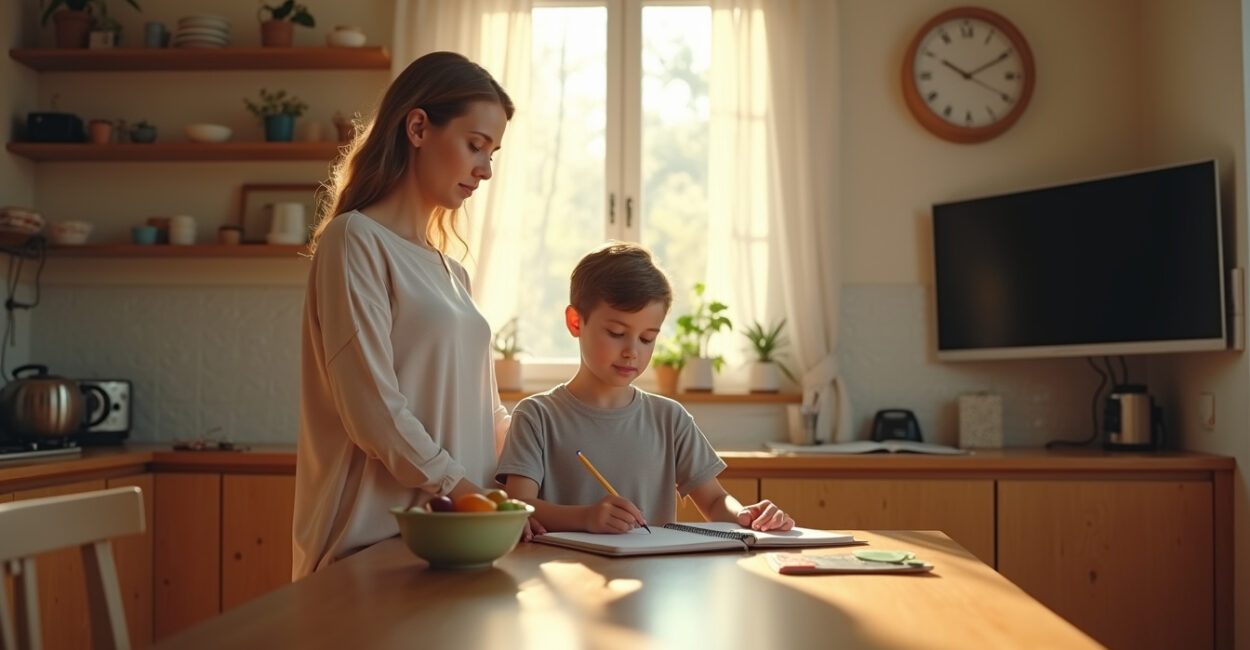
The backpack is ready, but the homework notebook is still in the living room; the next morning, the rush turns into an argument. An organized school routine helps children know what comes next and lets families make room for studying, meals, rest, and getting ready without having to improvise at the last minute.
The best plan fits your family’s schedule and real-life circumstances. Visible reminders, breaking tasks into steps, and leaving room for the unexpected usually work better than a packed schedule full of rigid time slots.

A chart provides guidance; adults still need to stay involved and make adjustments over time.
What Is a School Routine, and Why Can It Reduce Conflict?
A school routine is a predictable way of organizing activities related to a child’s day, including school, studying, meals, play, sleep, and getting supplies ready. To create one, choose a few recurring parts of the day, agree on their order with your child, and leave transition time between them. The goal is to reduce uncertainty and forgotten tasks without expecting every day to be exactly the same. When children know that after a snack they’ll have time to rest and then do their homework, there are fewer decisions to negotiate in the heat of the moment. Predictability also helps adults give clearer instructions. This won’t eliminate conflict: fatigue, schedule changes, learning challenges, and individual needs may call for other strategies.
A routine works best when children can anticipate the next step and the family can adjust it when the day changes.
How to Create a Plan That Fits Your Child’s Age and Schedule
Start with commitments the family can’t change: school drop-off and pickup times, transportation, meals, and the usual bedtime. Then add study time and play.
Set the order based on your child’s age, independence, and how much time they need to decompress after school.
For younger children, use short instructions and pictures; an adult will still need to guide them through each step. Older children can help estimate how long a task will take and choose between two workable options, such as studying before or after a snack. Getting them involved makes the agreements more meaningful without assigning them responsibilities that still belong to adults. Also consider how the school day affects the rest of the day. If your child comes home exhausted, starting homework right away may increase resistance. A break for food and rest may make it easier to get started, as long as you agree on when it ends and it doesn’t push bedtime later.
What to Include: School, Homework, Breaks, and Sleep

A useful chart shows the actions your child needs to remember, not every minute of the day. Include only what matters for your family and your child’s school life:
Read also: School Motivation: What to Say When Your Child Feels Discouraged
- times to leave, come home, and eat;
- time to rest after school;
- homework or review, broken into steps when tasks are long;
- play, movement, or free time;
- getting the backpack, clothes, and supplies ready;
- a calm bedtime routine.
Sleep deserves attention because it affects energy and concentration. Guidance from Brazil’s Ministry of Health can serve as a general reference, but sleep needs vary depending on the child’s age and circumstances.
If your child has ongoing trouble sleeping or is extremely tired during the day, a chore chart is no substitute for a health evaluation.
When it’s time for homework, keep the necessary supplies close by and agree on a reasonable break. Attention spans vary; there’s no single study session length that works for every age. If your child repeatedly gets stuck on the same subject, consider whether they may not understand the material instead of adding more time at the table.
Read also: School Supply List: How to Avoid Buying Duplicates
Printable School Routines: Daily and Weekly Charts and Checklists
A printable routine can be made on a sheet of paper, poster board, or a digital file. Before looking for a template, decide what it needs to help with: remembering the morning sequence, organizing the week’s homework, or checking that the backpack is ready. Printable daily routine pictures can help children who aren’t reading independently yet, as long as each image shows an action that’s familiar to them.
A daily chart works for recurring sequences; a weekly chart shows activities that vary by day, such as PE, library time, or an after-school activity. Printable school routine checklists can serve as short lists for specific tasks, such as checking the pencil case before leaving. If you use a printable weekly routine chart as a PDF, mark only the commitments that vary and leave room for changes.
Customize the file before printing: replace activities that don’t apply at home, use words or pictures your child recognizes, and put the chart somewhere they can reach. Crossing off or turning over a completed checklist item gives a visual sign of progress. Don’t fill the chart with every possible detail; if it’s hard to read, it no longer works as a reminder.
How to Adapt the Routine for Morning, Afternoon, or After-School Programs
The school shift changes the order of activities, not the need to account for meals, transportation, and rest. The table below is a starting point, not a schedule you have to follow.
Schedule Daily priorities What to watch for School in the morning Pack the backpack and set out clothes the night before; plan for breakfast and departure Avoid a morning full of decisions and reminders School in the afternoon Plan the morning around meals, free time, and a short task if there’s room Don’t fill the whole time before school with homework After-school program Account for transportation, meals, and recovery time between activities Review the total workload, especially if your child gets home late
For morning school, packing the night before usually prevents a rushed search for things left lying around. With afternoon school, there may be time to study before class, but only if your child is rested and the schedule isn’t too tight. For after-school programs, count travel as part of the day: it takes time and energy, too.
A common example: a child gets home from school, leaves the homework notebook in the backpack, and starts working without having a snack. Hunger makes them irritable, and the adult interprets the delay as a lack of motivation. By changing the order to snack, break, and homework, and checking the school planner together, the family can see whether the problem was the timing or a specific challenge with the assignment.
How to Help Your Child Follow the Plan Without Arguments
Introduce the sequence at a calm time, not during an argument. Explain what happens first and what comes next; for young children, pointing to pictures may work better than repeating long instructions. Give transition warnings, such as “Ten minutes until it’s time to put the toy away,” and offer limited choices when there’s room for flexibility.
If a step isn’t completed, find out why before deciding on a consequence. The task may be too difficult, the chart may have too much information, or the timing may coincide with hunger and fatigue. A printable classroom routine, for example, needs to fit how the class works and the teacher’s guidance; a template made for home shouldn’t automatically be used at school.
UNICEF Brazil brings together resources on the rights and development of children and adolescents. At home, the key is to treat the chart as a visual aid and keep the conversation open: children can point out what’s difficult while adults remain responsible for protecting time for sleep, study, and rest.
Common Mistakes and When to Revisit the Plan
A schedule with tightly packed time slots can fall apart with the first delay. It also doesn’t help to change the chart every day without explaining why, punish every late assignment, or expect a young child to manage the whole process alone. To adjust the plan, spend a week noting where delays, forgotten tasks, or arguments come up, then change one thing at a time.
If your child always resists one subject, can’t start activities that are appropriate for their age, or remains tired, household organization may not be the only issue. Talk with the school and, as needed, seek guidance from health or education professionals. A routine can help reveal patterns, but it can’t diagnose learning, sleep, or emotional health challenges.
To get started, choose the three moments that cause the most friction, such as leaving the house, starting homework, and packing the backpack. Create a simple chart with your child, try it for a few days, and adjust based on what actually happens, while protecting time for free play and rest.
Artigos Relacionados
 An At-Home Study Routine: Schedules That Actually Work
 Reading at Home and Family Engagement: Build Routines, Choose Books, and Motivate Kids to Improve Reading Habits and School Performance
 Building Healthy Relationships: Effective Strategies to Foster Positive Social-Emotional Development at School and Home
 Study Routine: A Simple Method for Daily Academic Independence
 Morning Habits: 7 Routines That Build School Independence
 School Autonomy: How to Build Independent School Routines
