
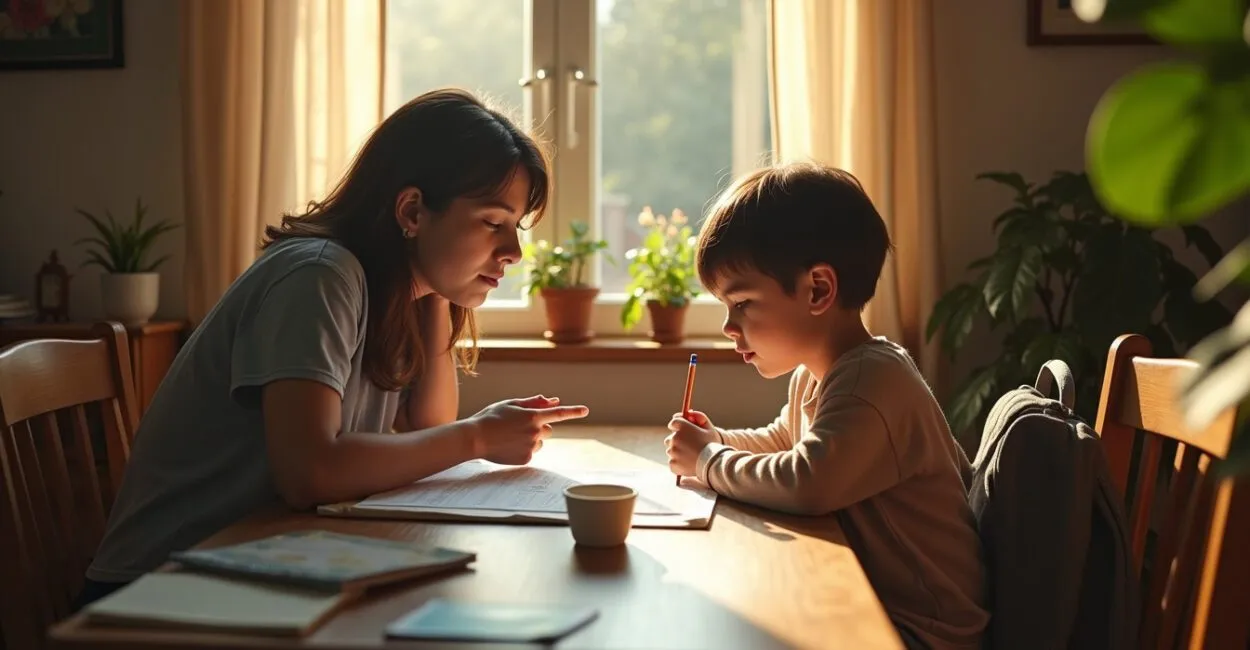
When homework turns into a fight, the problem is rarely laziness. It’s usually exhaustion, too much work, or fear of making mistakes.
School motivation doesn’t come back when you raise your voice. It usually returns when a child feels capable of getting started—without feeling small.

Here’s the key: instead of pushing your child to “just finish already,” try changing how you talk, how much work you ask them to do, and the tone of your routine. That can make a difference in their focus, independence, and even their relationship with school.
What to Say When Your Child Gets Stuck on Homework
The right words can change the mood in seconds. When a child loses interest, their brain is often saying, “This is too much” or “I’m going to get it wrong.” If you respond with pressure, their body goes into defense mode. If you offer a brief, clear direction, the resistance eases.
Try changing how you give the instruction. Instead of “Sit down and do all of it now,” say, “Let’s start with just the first question,” or “Show me where you got stuck.” It may seem like a small change, but it makes the task feel less overwhelming.
In practice, anyone who works with school routines sees this all the time: the problem isn’t a lack of ability, but a barrier to getting started. Your child doesn’t need a long speech.
They need a first step that feels doable.
Phrases That Help Without Sounding Like Pressure
Some phrases help because they acknowledge the effort while keeping the situation on track. Others sound supportive but come across as pressure in disguise.
The difference in tone is small, but the effect is huge.
- “Let’s take it one step at a time.”
- “You don’t have to get it perfect. Just get started.”
- “Which part feels most boring or difficult?”
- “Show me the first step.”
- “Let’s check in again after 10 minutes.”
Avoid phrases like “This is easy,” “It’ll only take a minute,” or “You should already know this.” They minimize the real challenge and make your child feel misunderstood. School motivation grows more from practical reassurance than from generic praise.

The Biggest Mistake That Kills School Motivation at Home

The most common mistake is turning homework into a test of character. A child doesn’t finish an assignment, and the adult decides they’re careless, stubborn, or uninterested. But often, the child is tired, confused, or trying to avoid an unpleasant feeling.
Here’s the honest comparison: pressure may get the work done in the short term, but it often makes your child more resistant the next day. A small adjustment—like a break, a brief instruction, or help getting started—can work faster than you might think.
That doesn’t mean “letting everything slide.” It means choosing the right amount of help. This approach works well when a child is unmotivated, but it may not be enough if they have a learning difficulty, severe anxiety, or attention problems. In those cases, it’s smarter to look for a pattern than to keep pushing.
Read also: School Curriculum: Design and Effective Structure
How to Set Up a Routine Without Fighting Every Day
A good routine cuts down on arguments by removing decisions from the moment. If homework starts on the fly every day, your child negotiates, puts it off, and tests limits. When the sequence is predictable, their brain shifts into “we already agreed on this” mode.
A simple setup can help a lot:
Read also: School Routine: 7 Steps to Study at Home Without the Fights
- a set start time;
- a clear desk with few distractions;
- a short time commitment to get started;
- a planned break after one work session;
- a clear stopping point.
According to UNICEF Brazil, consistent family support makes a difference in a child’s connection to school. And consistent support doesn’t have to be perfect—it has to be predictable. Children relax when they know what’s coming next.
When Refusal Looks Like Defiance but May Be Exhaustion
Not every refusal is defiance. Sometimes a child has spent the whole day holding it together, following directions, working through conflicts, and managing their emotions. Homework becomes the last straw.
I’ve seen cases where a task looked like “laziness,” but the real problem was hunger, lack of sleep, or an overload of activities. The turning point was something very simple: a snack, a 15-minute break, or splitting the task into two parts.
Sometimes a child isn’t avoiding homework; they’re avoiding the discomfort of getting started.
If the lack of motivation shows up in just one subject, the answer may be different. The material may be too difficult, or your child may have lost confidence after being corrected repeatedly. In those cases, take a closer look before deciding it’s “a lack of interest.”
Small Adjustments That Restore Focus Without Pressure
Sometimes school motivation comes back after changes that seem almost invisible to adults but make a huge difference to a child. It’s not magic. It’s the emotional ergonomics of the task.
- reduce the initial workload;
- let your child choose between two ways to tackle the work;
- set a timer for 10 to 15 minutes;
- stay nearby without correcting everything right away;
- praise getting started, not just the result.
A child who gets started with less friction is more likely to stick with it. That’s worth more than a long, tense study session. If homework becomes a battleground, the content matters less than the emotions your child associates with it.
Information from Brazil’s Ministry of Education reinforces the importance of family involvement in learning. What many people overlook is that involvement doesn’t mean constant supervision. It means being present and measured: helping without taking the wheel.
What to Do When Nothing Seems to Work
If you’ve already adjusted the way you talk, the routine, and the size of the task, but the resistance is still strong, stop repeating the same strategy more forcefully. When everything turns into a struggle, the problem may no longer be motivation—it may be a genuine difficulty.
At times like these, look for three signs: your child cries, avoids tasks for a long time, or gets stuck on nearly every assignment. If this happens often, talk with the school and seek an evaluation from an education or health professional. The right approach depends on the cause.
The uncomfortable truth is that continuing the same way can wear down both your confidence and your child’s. Sometimes, the smartest next step isn’t to push harder. It’s to understand more.
Frequently Asked Questions
What Should I Say When My Child Says They Hate Homework?
Don’t argue with the statement itself. Respond in a way that acknowledges the feeling and offers a practical next step: “I get that this feels frustrating. Should we start with the easiest part?” This reduces resistance without turning the moment into a confrontation. The goal isn’t to convince your child that homework is great; it’s to show them they can get started without feeling trapped.
How Can I Encourage My Child Without Putting on Too Much Pressure?
Encouragement works best in short, specific doses. Instead of demanding results, help your child get started, break up the task, and plan a break. Too much pressure may get the work done quickly, but it often makes a child more reactive the next day. The best balance is to offer support without doing the work for them. That way, independence grows along with confidence.
When Could a Lack of Motivation Point to a Bigger Problem?
If refusal is frequent and intense, and comes with crying, irritability, or getting stuck in several subjects, it’s worth looking into more closely. It may be more than a passing slump. There could be a learning difficulty, excessive fatigue, anxiety, or even a poorly structured routine. If the pattern continues for weeks, talking with the school can help you tell a rough patch from a more serious concern.
Should I Help With Every Question or Let My Child Try Alone?
The goal is to offer enough help to get your child unstuck, but not so much that you take away their chance to try. Start by guiding them through the first step and see how they do. If they get going, step back a little. If they get stuck, offer a hint, not the answer. This balance prevents dependence and preserves their sense of competence. Children learn more when they feel they’ve made progress with support, rather than having someone do it for them.
Does Praise Really Help With School Motivation?
It does, as long as it’s specific. “Great job getting started without complaining” works better than “You’re so smart.” The first reinforces a behavior; the second can create pressure to appear capable all the time. Praising the process, not just the result, gives your child a clear idea of what to do again. That strengthens school motivation without creating an expectation that they always get things right.
When a child feels they can get started without fear, homework stops being a wall and becomes a stepping stone again. That’s when school motivation returns—not through yelling, but with one doable first step.
Artigos Relacionados
 School Political-Pedagogical Project for Whole-Child Education: A Practical Guide
 Student Motivation: Strategies for Staying Focused at School
 Math Homework: 9 Strategies to Guide Your Child
 Middle School and High School: Criteria for a Diagnostic Assessment
 Diagnostic Assessment: An Elementary School Guide
 Inferential Reading: 5 Strategies for Elementary School
