
A structured set of activities, time blocks, rules, and transitions organized by the school to promote learning, well-being, and students’ self-regulation throughout the school day. It covers everything from arrival and welcoming students to dismissal and classroom procedures, including planning breaks, lesson sequences, and behavioral strategies that support daily learning.
Revisiting the school routine is urgent because new clinical and educational recommendations call for adjustments for students with Attention Deficit Hyperactivity Disorder (ADHD). These changes affect schedules, assignment length, classroom protocols, and communication with families and school administrators.

A model that combines clinical evidence, classroom management, and teaching resources reduces disruptions, improves engagement, and limits academic setbacks—the central goal of this practical guide.
Key Takeaways
- Adjusting the length and structure of activities improves focus and performance for students with ADHD without reducing the amount of content covered.
- Practical strategies include brief active breaks, multimodal instructions, visual schedules, and contingent reinforcement.
- Standardized communication with parents and administrators (brief reports and action plans) speeds up effective interventions.
- Objective measurement (such as disruption frequency and time on task) is essential for making informed adjustments to the routine.
Why the School Routine Shapes Academic and Behavioral Success
A well-structured school routine creates predictability—a critical factor in self-regulation. For students with ADHD, predictability reduces the cognitive effort required to plan and start tasks, freeing up attention for learning. Studies show that predictable, clearly marked environments increase time on task by 15–25% among children with attention deficits (for example, meta-analyses of school-based behavioral interventions). A routine also provides a framework for incorporating instructional accommodations without fragmenting the curriculum.
Routine as a Tool for Equity
Routines are tools for differentiation, not standardization. Adjustments to timing, how work is submitted, and support strategies allow students with different needs to reach the same learning goal. This requires the team to view routines as flexible: clear protocols, with justified and documented exceptions, ensure that accommodations are not arbitrary. Implementing tracking systems and conducting regular reviews (monthly or every two months) keeps routines aligned with outcomes.
How to Adjust Activity Length and Transitions for Students With ADHD
Adjusting activity length means breaking long assignments into smaller chunks (microtasks) and scheduling transitions. For students with ADHD, we recommend work blocks of 10–20 minutes followed by 2–5-minute active breaks. For more complex cognitive tasks, use 15–25-minute blocks with a 5-minute break. These evidence-based behavioral guidelines should be tailored to each student through objective observation.
Practical Schedule Examples
Example: a 50-minute math class divided into three cycles—direct instruction (12 minutes), guided practice (18 minutes), and independent practice with a visual check-in (15 minutes)—with a 5-minute break between cycles if needed. Another option for reading: three 15-minute blocks interspersed with 3 minutes of active breathing and goal review. Tracking time on task and the number of disruptions allows for fine-tuning each week.
Read also: Cooperative Games in Physical Education: 12 Practical Ideas

Instructional and Behavioral Strategies Built Into the Routine

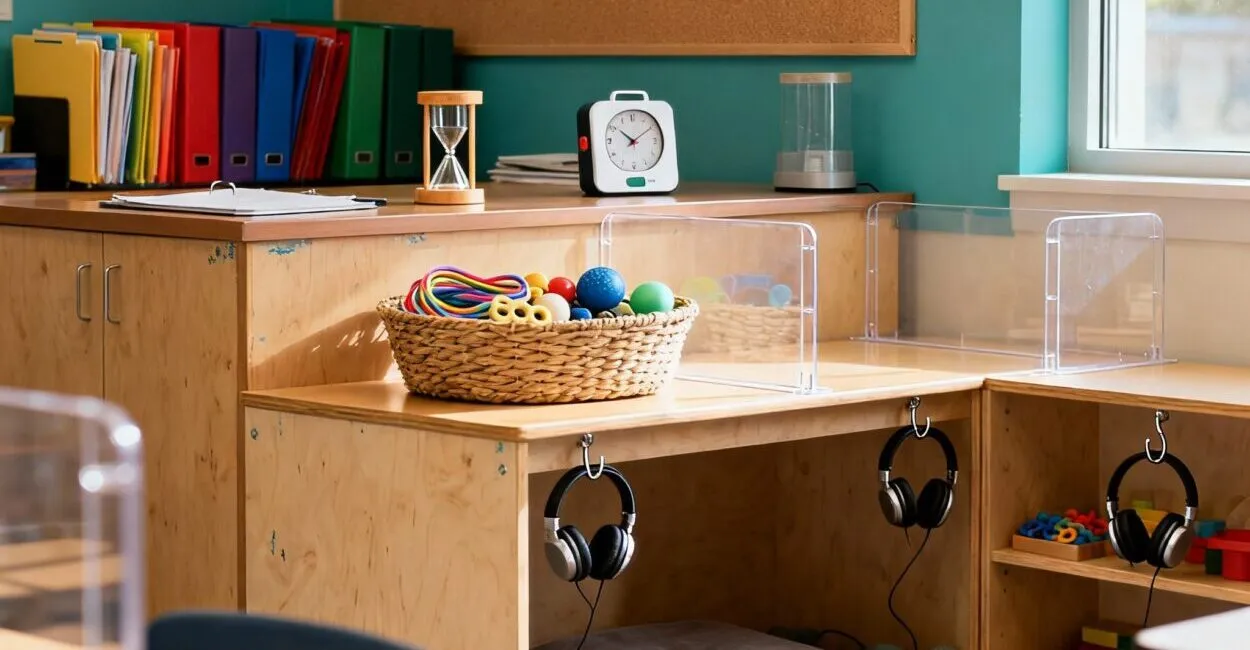
Effective strategies combine multimodal instruction (spoken, visual, and kinesthetic), scaffolding, and immediate positive reinforcement. Use visual schedules with numbered steps on the board, visual timers (such as hourglasses or apps), and nonverbal transition cues. Contingent reinforcement works best when it is immediate and specific (for example, “Great focus for 10 minutes—we earned 3 extra minutes of reading”), and should be built into the daily plan to ensure consistency.
Specific Classroom Techniques
Task mapping (checklists), cooperative partner roles, and sensory supports (a discreet fidget tool or a preferred seat near the teacher) reduce distraction without stigmatizing students. Short behavior contracts (one week) with measurable goals and rewards can lead to quick improvements. Briefly reviewing expectations with the class reduces resistance: practicing transitions and giving group feedback helps establish shared norms.
How to Measure Impact: Indicators and Tools
Objective measurement is essential for validating changes to the school routine. Practical indicators include time on task (productive minutes per activity), disruptions per session, assignment completion, and academic performance by unit. Useful tools include observation logs (momentary time sampling every 30 seconds), validated behavior rating scales (such as the Conners Teacher Rating Scale), and formative assessment data to compare results before and after changes.
Indicator Comparison Table
| Indicator | Measurement method | Initial measurable goal |
|---|---|---|
| Time on task | Observation by work block (minutes) | +15% in 4 weeks |
| Disruptions | Event log (count) | -20% in 4 weeks |
| Assignment completion | Submission rate (%) | 80% weekly completion |

Effective Communication With Parents and School Administrators
Standardizing communication reduces confusion and speeds up responses. Recommendation: use a brief form (three sentences) for daily or weekly communication, and a monthly report that includes objective data and an action plan. Fifteen-minute meetings with families and school administrators, with an agenda and goals, are more effective than lengthy meetings. Documenting agreements and deadlines helps ensure the school follows through.
Practical Communication Templates
Daily message (example): “Today, X completed three 15-minute work blocks with 70% time on task; there were two disruptions; the goal for the week is 75%—suggested reinforcement: praise task initiation.” Monthly reports should include simple trend graphs, strategies already tried, and proposals for the next cycle. Include referrals to health professionals when needed, and attach consent forms for sharing information externally.
Staff Training and Scaled Implementation
Sustainable changes require practical staff training—not just theory. Programs totaling 6–12 hours, delivered in hands-on modules with role-play, peer observation, and case reviews, increase buy-in at schools. Assigning a “routine coordinator” at 0.2 FTE to monitor implementation and provide feedback improves fidelity. Starting with a pilot in one grade and expanding based on data prevents overburdening the school.
Managing Change and Resistance
Resistance often stems from a lack of perceived evidence or additional workload. Strategy: start with low-administration-cost interventions (timers, checklists) and demonstrate gains after four weeks using simple data. Involving teachers in co-creating routines and offsetting implementation time by reducing administrative tasks helps ensure sustainability. Impact reports support requests for additional resources.
Next Steps for Implementation
In summary: adjust activity lengths, integrate instructional interventions, use objective indicators to measure outcomes, and standardize communication with families and school administrators. Start with a four-week pilot in one class: record baseline data for one week, implement accommodations for three weeks, and review the results. If outcomes improve, expand by grade with modular training. For support, consult educational and school mental health guidelines, and use data to justify resources.
Question 1: How Do You Determine the Ideal Work Block Length for a Student With ADHD?
Start by observing the baseline: measure time on task without intervention for one week. Then use blocks that match the student’s current attention span and gradually increase their length (the shaping principle). Practical guidelines suggest 10–25 minutes, depending on task complexity and age. Adjust based on objective data (time on task and number of disruptions) and input from the family; document changes for assessment. Individualize the approach: some students respond better to shorter blocks with frequent reinforcement.
Question 2: What Are the Signs That a Student’s Routine Needs to Be Reviewed?
Signs include a sustained drop in time on task, an increase in disruptions, low assignment completion despite interventions, behavioral regression, and consistent negative feedback from parents. Formative assessment data showing below-expected performance despite appropriate instruction can also signal the need for a review. Use weekly logs to spot trends; if two key measures worsen for two consecutive weeks, review the routine with the multidisciplinary team and family, make small changes, and monitor their effects.
Question 3: How Can You Communicate Accommodations Without Stigmatizing a Student?
To avoid labeling, focus communication on universal strategies and how they benefit everyone. Present adjustments as “learning options” available to any student (for example, preferred seating, timers, or brief breaks). Teach the new routines to the whole class to normalize differences. When individual accommodations are needed, discuss them privately with the family and school administrators. Use functional language (focused on goals and evidence) and agree on a limited information-sharing plan with relevant teachers to protect the student’s privacy.
Question 4: What Evidence and Sources Should I Present to School Leaders to Request More Resources?
School leaders respond to clear data: present baseline and post-intervention results for measures such as time on task, disruptions, and assignment completion; include simple graphs and estimates of academic impact. Cite guidelines and studies from recognized institutions, such as publications from pediatric associations and government school mental health resources from Brazil’s Ministry of Health, or education sources. Propose a pilot with projected costs and returns, highlighting potential savings on future remediation.
Question 5: When Should You Involve Outside Providers (Psychologist, Pediatric Neurologist, or Multidisciplinary Team)?
Involve outside providers when well-implemented school interventions show no improvement after 6–8 weeks, when there are concerns about co-occurring conditions (such as anxiety or a specific learning disorder), or when behavior puts learning or safety at risk. Request a formal assessment if data show a sustained decline in performance or if related disorders are suspected. Coordination among the school, family, and health professionals should be documented with consent and shared plans to ensure continuity and consistency in strategies.
Artigos Relacionados
 How to Calm Students With ADHD Before an Important Test
 How to Help Students With ADHD Stay Focused Before an Exam
 How to Effectively Prepare Students With ADHD for Exams
 Career Counseling for High School Students: Planning Ahead
 Effective School Management: Practices for Students and Staff
 Brazil’s LGPD in Schools: Protecting Student, Family, and Staff Data
