

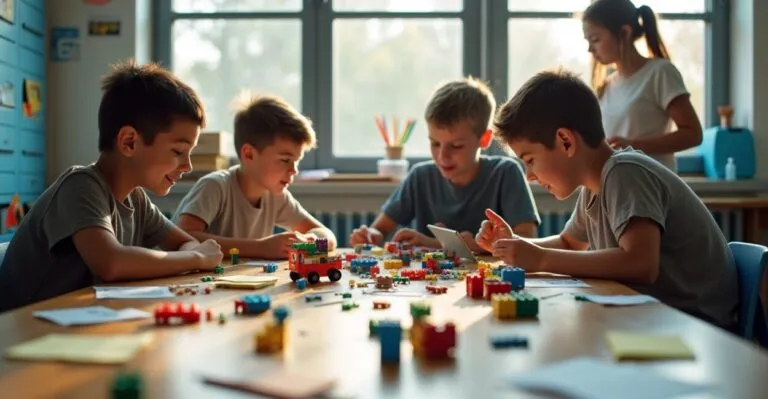
These are learning environments where students explore math concepts through games, hands-on activities, and projects. Unlike lecture-based lessons, they prioritize student action, productive mistakes, and tangible materials that make abstract ideas observable and testable. At their core, math workshops are carefully planned sequences of activities that help students build mathematical understanding through guided experiences.
Now is an ideal time to expand the use of workshops: growing evidence shows that active learning improves retention and transfer. Teachers face diverse classrooms and limited resources; well-designed workshops offer scalable solutions.

This article covers the fundamentals, tested activities, grade-level adaptations, formative assessment, and practical recommendations for implementing workshops that really work.
Key Takeaways
- Math workshops turn abstract concepts into concrete experiences using games and manipulatives, increasing conceptual understanding and motivation.
- Effective design combines clear goals, scaffolded tasks, and ongoing formative assessment to adjust the level of challenge in the classroom.
- Simple materials—counters, bottle caps, rulers, and poster board—make it possible to teach fractions, geometry, and operations at low cost without sacrificing instructional quality.
- Grade-level adaptations should account for cognitive development: the first cycle focuses on representation and verbalization; the second expands strategies and algebraic generalization.
- Assessment in workshops is ongoing: observation notes, portfolios, and transfer challenges reveal learning more effectively than one-time tests.
Why Math Workshops Change How Students Understand Concepts
Math workshops help students move from concrete experiences to abstract ideas through activities that require decision-making and justification. Active learning supports stronger neural connections than rote memorization. When a student builds a fraction using cut-out rectangles, they do more than reproduce symbols; they connect area, proportion, and language. These connections make mistakes easier to identify and explore.
The Cognitive Process Behind Workshops
Hands-on manipulation provides immediate feedback as students develop concepts. Deliberate practice in varied contexts supports generalization. Education research shows that using multiple representations—physical, graphical, and symbolic—reduces barriers for students with limited prior proficiency. In short, workshops act as bridges between sensory experience and formal mathematics.
Instructional Implications
The teacher’s role shifts from delivering information to facilitating learning. Teachers need to plan sequences, look for evidence of learning, and make targeted interventions. These interventions should prompt reflection rather than provide ready-made answers. Teacher training is therefore essential to the quality of workshops.
Projects and Games for Teaching Fractions with Simple Materials
Fractions are a particularly valuable topic for workshops because they connect measurement, partitioning, and representation. Games and tasks using paper, rectangles, bottle caps, and counters let students move between concrete and symbolic representations in multiple ways. The goal is for students to recognize equivalence, compare fractions, and perform operations through hands-on exploration.
Activity: Fraction Bank
Materials: fraction cards, bottle caps, envelopes, and a marker. Each student represents fractions with bottle caps and trades with classmates to complete “equations” showing equivalent fractions. The activity includes a written reflection challenge: explain why the equalities are true. This builds mathematical language while providing formative assessment.
Grade-Level Adaptations
First cycle: Use physical pieces to represent 1/2, 1/3, and 1/4. Focus on partitioning and names. Second cycle: Introduce equivalent fractions and addition with like denominators through counter exchanges. Third cycle: Use bar graphs and introduce algebraic operations with simple fractions.
Exploring Geometry Through Games and Construction

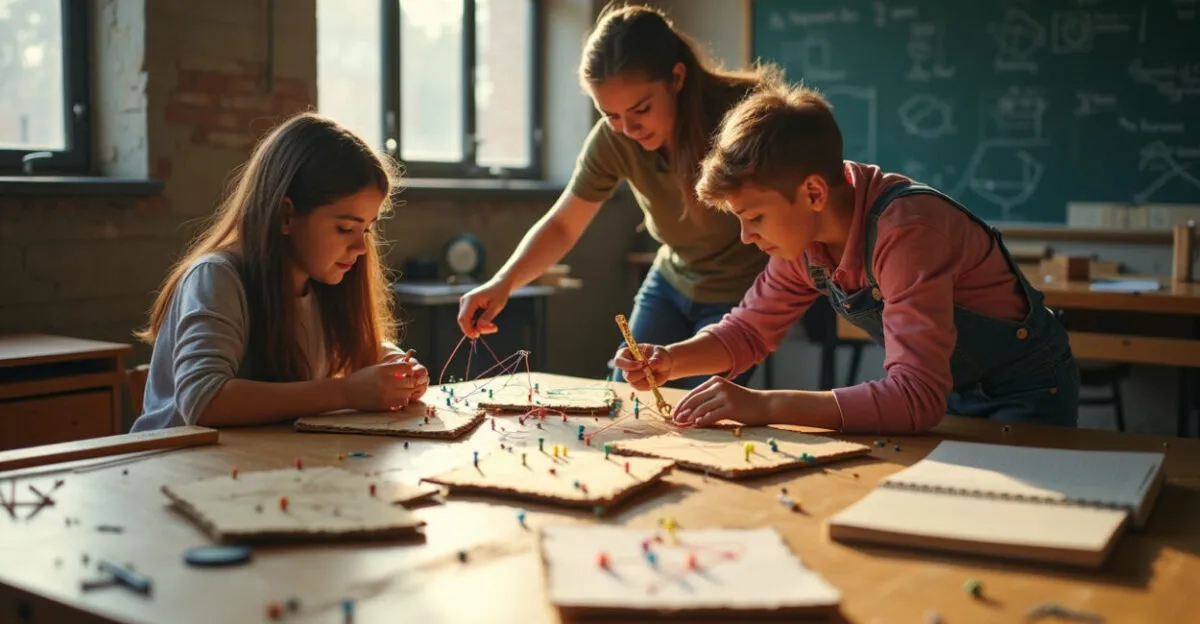
Geometry becomes meaningful when students build and measure. Workshops using paper folding and mosaics connect properties, theorems, and empirical demonstrations. The goal is to use observation as a starting point for formal generalizations.
Activity: Polygon Web
Use string, cardboard boards, and nails to create polygons and study angles and symmetry. Students measure angles with protractors and test conjectures about angle sums. Recording hypotheses and refutations turns the workshop into a mini science investigation.
Connecting Practice and Formalism
After hands-on exploration, it’s essential to express findings in symbolic language. Exercises that ask for brief justifications—“Why is the sum of the angles X?”—strengthen the connection between experience and proof. Teachers should model clear mathematical reasoning.
Arithmetic Operations: Games That Reveal Calculation Strategies
Workshops on operations focus on strategies, not just answers. Games like “strategy showdown” and decomposition challenges show different ways to solve the same problem. This brings efficient methods and alternative ways of interpreting operations to light.
Read also: Playful Math Instruction: Foundations for Teaching Math Through Play
Activity: The Operations Market
Students receive play money and shopping lists. They calculate prices, discounts, and change. The activity calls for computation, estimation, and explanations of their process. Assessing students’ work reveals whether their understanding is procedural or intuitive.
Map Strategies for Teaching Mental Math
Record the strategies students use: decomposition, making 10, multiplying by 5 by dividing by 2, and so on. Turn these notes into reference cards students can consult. This practice reduces reliance on rigid algorithms and builds flexibility.
Read also: Biotechnology Cutoff Scores: How to Find and Understand Them
Planning by Grade Level: Adapting Tasks to Student Development
Cognitive differences by age call for age-appropriate tasks. In the first cycle, focus on concrete representations and language. In the second, expand strategies and problem-solving. In the third, promote abstraction and connections between algebra and geometry. Planning should be modular, with clear assessment checkpoints.
Recommended Sequence for Three Cycles
Start with sensorimotor activities and pictorial representations. Next, introduce tasks that require written explanations. Finally, present transfer problems that call for generalization. Each stage should have measurable goals and success criteria.
Success Criteria and Fine-Tuning
Define observable evidence: correct use of language, repeatable strategies, and the ability to solve variations of the same problem. Use these criteria to adjust groups and tasks in real time. This maximizes learning in diverse classrooms.
Formative Assessment in Workshops: Tools and Routines
Formative assessment should be ongoing and integrated into the activity. Practical tools include observation notes, simple rubrics, activity portfolios, and transfer checkpoints. The goal is to capture students’ progress and reasoning skills, not just isolated correct answers.
Recommended Tools
- A three-level rubric for justifying answers;
- A quick record (five-item checklist) during the activity;
- A portfolio with three pieces of work: beginning, middle, and end;
- A transfer challenge completed without materials to measure internalization.
After reviewing the work, look for patterns: Which justifications are missing? Which errors are conceptual? Use this information to plan targeted interventions.
Effective Feedback
Feedback should be specific, actionable, and immediate whenever possible. Avoid correcting everything; ask questions that guide students to review their strategies. Track progress to share with families and support instructional decisions.
Materials, Costs, and Logistics: Affordable, Scalable Options
High-quality workshops don’t require expensive equipment. Bottle caps, poster board, string, tape, sticky notes, rulers, and small scales cover most needs. What matters is using them with intention. A good classroom kit costs less than R$50 when purchased thoughtfully from educational suppliers.
Basic Materials List by Topic
| Topic | Essential materials | Instructional use |
|---|---|---|
| Fractions | poster board, bottle caps, ruler | partitioning, equivalence, recording |
| Geometry | string, nails, cardboard | construction, measurement, symmetry |
| Operations | counters, cards, play money | strategies, estimation, calculation |
Logistics and Organization
Organize materials in bins for each station. Train student helpers to reduce the teacher’s workload. Schedule short 20–30-minute rounds with clear goals. This maximizes engagement and makes workshops easy to replicate across schools.
How to Put This Knowledge into Practice
Start small: run a pilot workshop on one topic and document evidence of learning. Use rubrics and portfolios to measure impact. Scale up across grade cycles, training teachers in observation and intervention. The goal isn’t to replace lessons, but to supplement them with experiences that accelerate deep understanding.
I recommend piloting three workshops per semester, with clear goals for each class. Collect simple data: engagement rates, progress in written justifications, and performance on transfer tasks. This data supports larger investments and informs school policies.
Useful links: National Council of Teachers of Mathematics, IBGE (Brazilian Institute of Geography and Statistics).
Frequently Asked Questions
How Can You Adapt a Fractions Workshop for Classes with a Wide Range of Skill Levels?
Layer the tasks: offer a basic hands-on version, an intermediate version with symbolic representations, and an advanced version that calls for generalization. Group students by skill level and have them rotate through stations. While some explore with materials, others work on quick abstraction challenges. Track the strategies they use and offer brief, individualized support. This approach preserves student independence and lets students at different levels learn the same core concept while maintaining high expectations for everyone.
What Is the Teacher’s Role During a Math Workshop?
The teacher observes, asks questions, and records evidence of student thinking. Their role is to identify strategies, prompt reflection, and introduce challenges that raise the level of thinking. Rather than solve problems for students, the teacher asks questions that guide their analysis. The teacher also organizes materials, manages time, and decides when to bring the class together to synthesize what they’ve discovered. Training in observation and feedback is essential for teachers to make interventions that truly advance conceptual understanding.
What Evidence Should You Collect to Show That Workshops Improve Learning?
Collect portfolios with early and final work, observation notes describing students’ strategies, short recordings of oral explanations, and results from transfer tasks completed without materials. Compare performance on structured problems before and after the workshops. Qualitative indicators, such as the complexity of students’ mathematical language and their ability to explain procedures, are just as important as quantitative measures. This data helps validate teaching practices and guide instructional adjustments.
How Can Schools with Limited Resources Scale Up Workshops?
Standardize low-cost mini-kits and reusable activity guides. Train teacher leaders to share practices with colleagues. Use inexpensive materials like bottle caps and paper, and organize material exchanges between schools. Document routines and success criteria to make adoption easier. Small administrative steps, such as setting regular times and recording evidence, help make the practice sustainable. Scalability depends more on clear processes than on large budgets.
What Common Mistakes Should You Avoid When Implementing Math Workshops?
Avoid turning workshops into fun activities without clear objectives. Don’t combine too many concepts in one session; it dilutes the focus. Don’t assess only final products; prioritize records of the learning process. Also, don’t substitute superficial manuals for teacher training. Teacher facilitation is the backbone of a workshop; without skilled guidance, its impact drops sharply. Correcting these mistakes improves effectiveness and the return on instructional investment.
Artigos Relacionados
 Hands-On Learning Workshops: 12 Ideas for Schools
 2025 Environmental Education Workshops: Hands-On Activities
 Augmented Reality in the Classroom: Turning Abstract Concepts Into Hands-On Experiences
 Sustainable Workshops: Low-Cost Activities for Schools
 Low-Cost Educational Games for Early Literacy
 LEGO Education: 7 Hands-On Projects for Today’s Class
