
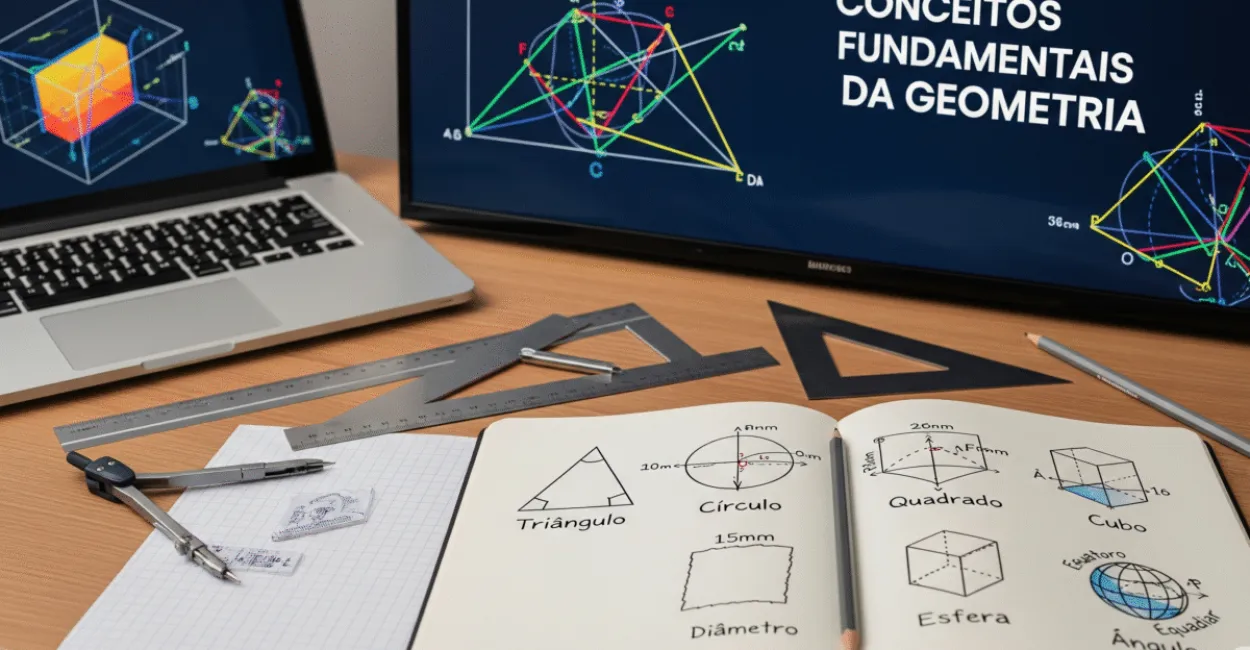
A building plan, a map on your phone, and a mechanical part design all rely on the same foundation: Geometry. It organizes space, measures distances, describes shapes, and helps predict how objects behave in the real world.

Without this set of ideas, many things would come down to guesswork—from product packaging to a drone’s flight path.
Technically defined, geometry is the branch of mathematics that studies points, lines, planes, angles, surfaces, and solids, along with the relationships between them. In everyday terms, it’s the tool that helps us understand “where something is,” “what shape it has,” and “how much space it takes up.”
In this article, you’ll explore the core concepts, the main branches, and why this subject remains so useful beyond the classroom.
The Essentials
- Geometry studies spatial relationships and helps solve problems involving shape, measurement, and position.
- Points, lines, planes, angles, perimeter, area, and volume are the subject’s foundational concepts.
- In practice, geometry is used in architecture, engineering, design, navigation, robotics, and cartography.
- The difference between a successful project and a failed one often comes down to a misunderstood geometric measurement.
- Not every geometry problem calls for a long formula: in many cases, visualizing the figure gets you halfway to the solution.
Geometry and the Language of Space in Mathematics
Before it becomes a calculation, geometry is a way of thinking. It translates space into mathematical language so we can compare, measure, and predict relationships between objects.
This applies to both flat figures and three-dimensional spaces.
People encountering the subject for the first time often think of triangles and squares. But geometry covers much more: it also explains symmetry, transformations, coordinates, and trajectories. In practice, it turns visual observation into precise decisions.
Foundational Concepts
- Point: Indicates a position and has no dimensions.
- Line: An infinite set of points extending in one direction.
- Plane: A two-dimensional surface used as a reference for flat figures.
- Angle: The opening between two rays.
- Polygon: A closed figure made of line segments.
What makes geometry so useful isn’t memorizing formulas; it’s recognizing relationships. Shape, measurement, and position often solve the problem before you start calculating.
For an institutional overview of school mathematics and its learning strands, see the resources from the National Council of Teachers of Mathematics, which develops teaching standards used in many education systems.
The Elements Found in Every Geometric Figure
Nearly every problem uses the same basic building blocks. What changes is how they fit together. A triangle, for example, is more than “three sides”: it has vertices, sides, interior angles, and relationships that vary depending on the type of figure.
Perimeter, Area, and Volume: Keep Them Straight
Perimeter measures the boundary. Area measures the surface. Volume measures the space occupied by a solid. It sounds simple, but many people mix up these three concepts and misunderstand the entire problem.
A common mistake is to assume that every measurement in geometry serves the same purpose. It doesn’t. If you’re buying flooring, you need area. If you’re fencing a property, you need perimeter. If your project involves a box, a tank, or a package, volume is what matters.
Plane Figures and Solids
Plane figures lie on a plane: circles, triangles, squares, rectangles, trapezoids, and parallelograms. Solids occupy three dimensions: cubes, prisms, pyramids, cylinders, cones, and spheres. This distinction helps you choose the right formula without guesswork.
| Concept | What It Measures | Practical Example |
|---|---|---|
| Perimeter | The boundary of a figure | A garden fence |
| Area | The surface covered | A room’s floor |
| Volume | The space inside a solid | A water tank |
Plane Geometry: Where Visualization Makes a Difference

Plane geometry deals with two-dimensional figures. This is where side lengths, bases, heights, and angles come in. Triangles remain some of the most useful figures in the subject because nearly anything can be reduced to triangles at some point.
This branch also shows why visualization is so powerful. I’ve seen students get stuck on a calculation, then solve it in seconds after carefully redrawing the figure. The problem wasn’t a lack of formulas; it was a lack of spatial understanding.
Read also: Neuromarketing: Basic Definitions and Concepts
Triangles, Quadrilaterals, and Circles
Triangles can be classified by their sides and angles. Quadrilaterals include shapes such as squares, rectangles, rhombuses, and trapezoids. Circles involve radius, diameter, and circumference, and often appear in problems involving symmetry and motion.
For a structured review, Khan Academy in Portuguese offers a consistent learning sequence on plane figures, congruence, and area.
How Plane Geometry Is Used in the Real World
- Architecture: Reading floor plans and fitting spaces together.
- Design: Visual composition, proportion, and alignment.
- Surveying: Representing land on maps.
- Graphic production: Margins, cropping, and consistent layouts.
Solid Geometry and Three-Dimensional Thinking
When a figure gains depth, the challenge changes. Solid geometry requires you to imagine faces, edges, vertices, and cross-sections. Knowing the volume formula isn’t enough; you also need to understand how the shape behaves in space.
Anyone working in construction, packaging, or manufacturing knows that a part that’s off by a millimeter can lead to waste, rework, and poor fit. Solid geometry helps prevent these problems by connecting design, measurement, and function.
Common Geometric Solids
- Cube: All edges have the same length.
- Prism: Has two parallel bases and lateral faces.
- Pyramid: Has one base and faces that meet at a vertex.
- Cylinder: Has two circular bases and a curved lateral surface.
- Cone: Combines a circular base with a top vertex.
- Sphere: Every point on its surface is the same distance from its center.
Not every problem is straightforward. An irregular solid, for example, may need to be broken into smaller parts to make the calculation work. That’s when geometry stops being something you memorize and becomes a strategy.
In solid geometry, the most common mistake is imagining the figure incorrectly; the most reliable way to get it right is to break the solid into simple parts.
Angles, Parallel Lines, and Proportions That Solve a Lot
Angles and parallel lines appear in nearly every serious study of geometry. They explain slope, direction, and comparisons between line segments. Once you understand these relationships, many problems become shorter.
What to Look at First
- Whether the lines are parallel, intersecting, or perpendicular.
- Whether there are corresponding angles, alternate interior angles, or same-side interior angles.
- Whether parts of the figure are symmetrical or congruent.
A useful academic resource for exploring properties and proofs is the open course material from MIT OpenCourseWare, which offers mathematics content with a strong conceptual foundation.
Proportion Is No Small Detail
In many problems, the answer depends on proportion and similarity. Similar figures aren’t identical, but they have the same shape. This lets you calculate unknown side lengths, estimate measurements, and validate designs using scale.
How Geometry Shows Up Outside School
The subject’s value becomes clearer when you take it off the page. GPS maps, digital games, image-guided surgery, civil engineering, 3D printing, and even photography all rely on geometric reasoning. It’s no exaggeration to say geometry underpins much of modern visual technology.
In cartography, for example, projecting a curved surface onto a plane always creates distortions. This points to an important limitation: geometry can solve a lot, but it can’t eliminate the characteristics of the real object. Experts disagree on which map projection is “best” because the right choice depends on how the map will be used.
A Practical Example
An installation technician needs to position a metal structure on uneven ground. If they measure only the distance between two points, they might get the slope angle wrong. By adding a simple geometric check—using the base, height, and diagonal—they can prevent misalignment and save material. It’s a common scenario: the right drawing cuts costs before the first cut is made.
Why Studying Geometry Improves Your Reasoning
Geometry trains a skill that’s useful beyond math: thinking in terms of relationships instead of guesses. Rather than seeing isolated elements, you begin to identify dependencies, symmetry, and constraints. This helps with schoolwork, professional tasks, and everyday problems.
If you want to strengthen your foundation, combine theory with exercises and reliable resources. The Brazilian Society for Mathematics Education (Sociedade Brasileira de Educação Matemática), a Brazilian organization, publishes discussions and useful references for people studying math education in Brazil.
What Helps You Learn Faster
- Draw the figure before calculating.
- Clearly mark known values and unknowns.
- Distinguish linear, surface, and volume measurements.
- Check whether the answer makes visual sense.
This method works very well for school exercises and simple technical tasks, but it can fail when a figure is incomplete, poorly drawn, or missing a reliable scale. In those cases, the problem isn’t the calculation; it’s the quality of the information you started with.
How to Master the Subject Without Memorizing Everything
The best approach is to build understanding in order, not pile up formulas. First, learn to recognize figures and their properties. Then move on to perimeter, area, volume, angles, and similarity. Finally, practice mixed problems, which are the best way to see whether your understanding is solid.
If your goal is real understanding, focus on reading figures, choosing a strategy, and checking your results. That matters more than trying to memorize a long list without context. Geometry becomes much simpler when you understand the role each element plays in a drawing.
Next Steps
Solve short problems using hand-drawn figures, then move on to problems with multiple steps. Focus on correcting your interpretation before trying to work faster. Getting the reasoning right first saves time later.
Frequently Asked Questions
What exactly does geometry study?
It studies shapes, sizes, positions, and relationships in space. This includes points, lines, planes, angles, plane figures, and solids. In practical terms, geometry helps us measure, represent, and analyze objects and environments.
What’s the difference between plane geometry and solid geometry?
Plane geometry deals with two-dimensional figures, such as triangles and circles. Solid geometry deals with three-dimensional objects, such as prisms, cylinders, and spheres. The main difference is the depth of the object being analyzed.
Why aren’t perimeter, area, and volume the same thing?
Perimeter measures the boundary, area measures the surface, and volume measures the space inside an object. Confusing these concepts leads to errors in interpreting and solving a problem. Each one addresses a different type of problem.
Where is geometry used in everyday life?
It appears in construction, design, maps, sports, navigation, packaging, and technology. Whenever there’s a need to measure shape, space, or direction, geometry is involved. That includes simple tasks like arranging furniture in a room.
Does learning geometry require memorizing lots of formulas?
No. Memorization can help in some cases, but the real foundation is understanding the relationships between the elements in a figure. As your spatial reasoning improves, it becomes easier to choose and apply the right formula.
%%AGPTRH9%%
