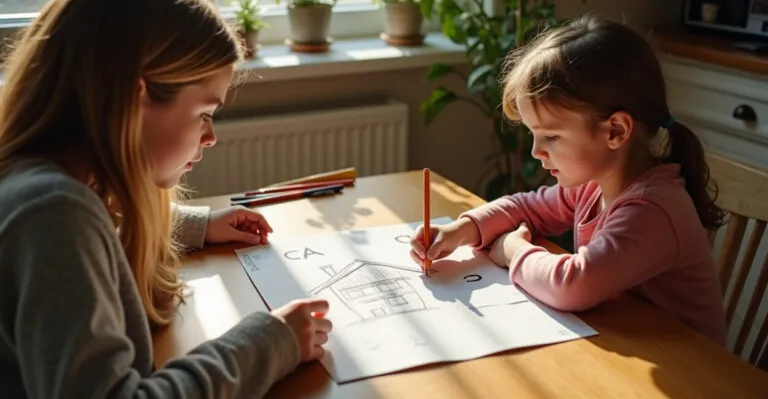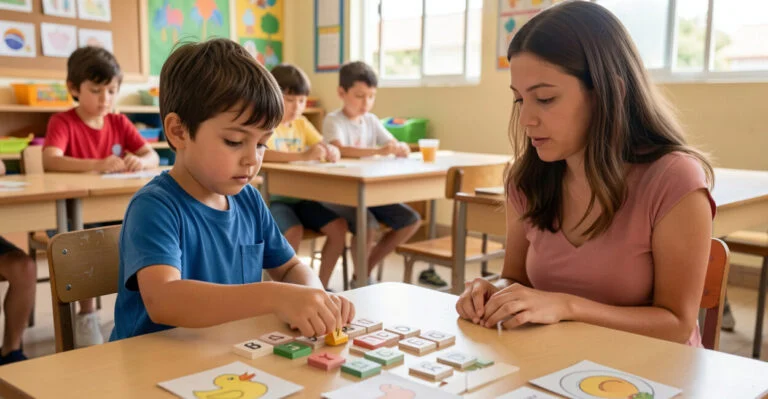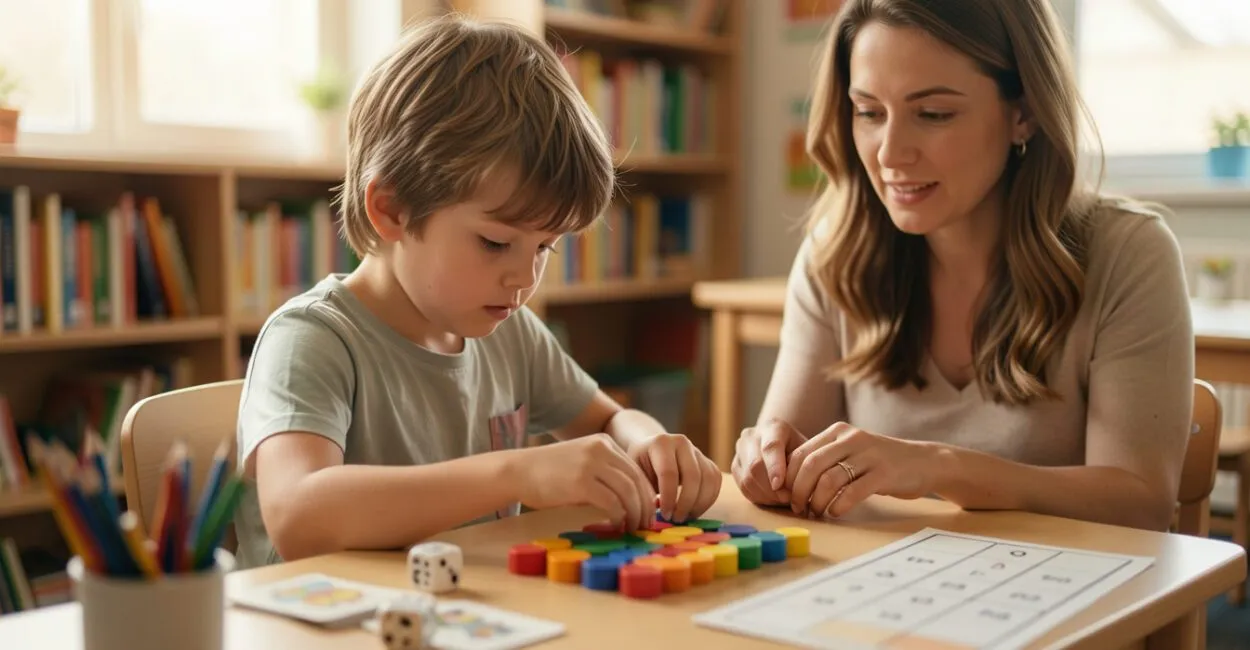
A child who knows that 6 × 4 means six groups of four has a way to solve the problem, even if they can’t yet recall the answer from memory. Multiplication games help build that understanding and practice basic facts using simple materials, printable activities, or digital tools. The right choice depends on what the class already knows. To start, grouping activities and illustrated problems work well; then, students can move on to times-table challenges, mental math, and multistep problems. The goal is to see how a child thinks, not just how many answers they get right.
Key Takeaways
- Representing multiplication with equal groups, drawings, or a rectangular array helps connect the equation to the total quantity.
- Games with cards and dice let students practice mental math without expensive materials.
- A printable worksheet can work as a game when it includes rules, choices, and opportunities to explain a strategy.
- Wordwall offers a range of digital formats, but teachers should check that the content and difficulty level are right for their class.
Multiplication Games for Understanding and Practicing
Multiplication games are activities with clear rules and goals that encourage children to represent, calculate, or compare products. To choose a good option, look for one that connects multiplication to equal groups, repeated addition, rectangular arrays, or word problems. Memorizing facts can come later to help students work more quickly.

This sequence matters because a memorized answer doesn’t always show understanding. If a child knows that 4 × 5 = 20 but can’t show four groups of five, they may struggle when the problem appears in a different context. A rectangular array, with rows and columns, also helps students visualize the commutative property: 4 × 5 and 5 × 4 make the same total, even though they show different arrangements.
Brazil’s National Common Core Curriculum (BNCC) organizes math learning by grade level and skills. Consulting the Base Nacional Comum Curricular, Brazil’s national curriculum framework, can help align an activity with what the class is studying without assuming that all children in the same grade progress at the same pace.
Activities with Cards, Dice, and Everyday Objects
A short activity with clear rules is usually easier to adapt than a long competition. In these activities, an adult can ask the child to explain how they found the product before confirming the move.
- Product showdown: Each player turns over two cards and multiplies the numbers. The player with the greater product wins the round. Start with cards numbered 1 to 5, then use larger factors. The goal is to practice mental math and compare strategies.
- Dice and groups: Roll two dice. One number sets the number of groups, and the other sets how many objects go in each group. The child builds the situation with counters or draws the array, writes the multiplication equation, and finds the total. This activity connects concrete and symbolic representations.
- Product bingo: Give each player a card with products on it. An adult calls out a multiplication problem, such as 3 × 6, and players look for 18. To keep bingo from becoming just a visual matching game, ask players to explain one way to find the answer.
A common detail in these activities: a child may get the product right by counting every object one at a time. That shows they found an answer, but they may not yet have developed a multiplication strategy. Ask whether they can count by twos, make groups, or use a known fact, such as 3 × 5, to work out 3 × 6.
To find more games with accessible rules and materials, try adapting some of these educational games that make learning fun, as long as each activity keeps a specific math goal.
Games to Print and Adapt for Your Class

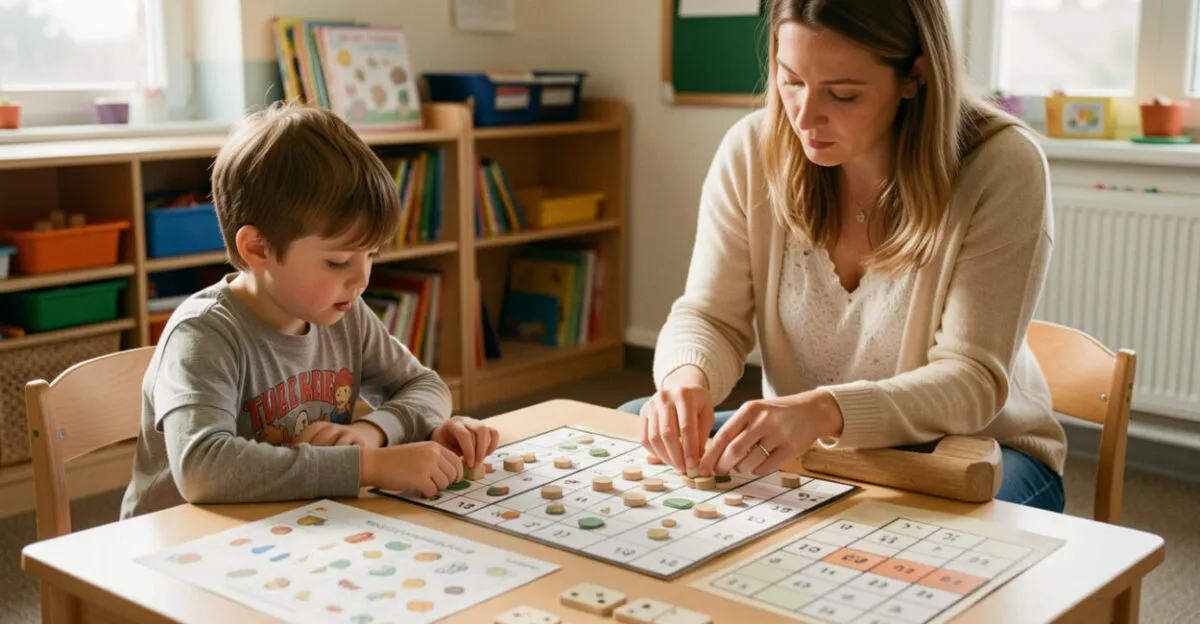
Printable multiplication games can include board games, dominoes that match problems with answers, bingo cards, or worksheets with word problems. The format alone doesn’t teach; the rules are what encourage children to make decisions and practice reasoning.
On a board game, for example, each space can show a multiplication problem. Players solve it to move ahead; if they get it wrong, they can go back one space or use a visual aid, such as an array. One useful adaptation is to print two versions: one with illustrations for beginners and another with larger factors for students who can already calculate with confidence.
Complete guide: Math Games: A Guide to Teaching Grades 1–9
Before using a ready-made worksheet, check that it has room for students to show their work and that the numbers match the material being taught. Multiplication word problems for second graders tend to work best with short prompts, objects or drawings, and equal-group situations. If reading the text is the main challenge, read the prompt aloud and assess math understanding separately.
Wordwall and Other Online Tools with a Teaching Purpose
Wordwall lets teachers create or find interactive activities in formats such as quizzes, spinners, and matching games. To find Wordwall multiplication activities for third or fifth grade, search by grade and topic, but review the questions: materials posted by users can vary in accuracy and difficulty.
Read also: Geometry Games: Shapes and Space in the Classroom
A digital round can work as a warm-up or a short practice activity. Afterward, ask the child to write down two questions in a notebook and explain one calculation strategy. Moving from the screen to paper helps check whether the child understood the operation or simply recognized familiar answers.
Online tools are useful when they provide immediate feedback and let students try again, but they don’t replace conversations about strategies. Teachers should also consider device access, screen time, and accessibility features. The Ministry of Education website is an official source for education information in Brazil; choosing a specific activity depends on the lesson plan and the needs of the class.

Multiplication Activities for Grades 2–5
Grade level helps guide activity selection, but it doesn’t determine the right level of challenge on its own. A child may be able to solve simple multiplication problems and still need support interpreting a written problem.
Grade Possible focus Sample activity 2nd grade Understanding equal groups and repeated addition Make groups with counters and show the situation with a drawing and an addition equation. 3rd grade Connecting representations, basic facts, and short word problems Roll dice to create multiplication problems and write down different strategies. 4th grade Expanding multiplication facts and solving problems with larger numbers Use cards to calculate products and explain estimates. 5th grade Applying multiplication to multistep problems Solve challenges that involve more than one operation and check the answer another way.
For second graders, a prompt such as “There are 3 plates with 4 cookies on each one” can be represented with a drawing, repeated addition, and, depending on what the class has already studied, multiplication. In third grade, multiplication games can combine this type of representation with basic facts and mental math.
In fourth grade, multiplication games can include larger factors and estimation; in fifth grade, they can involve multistep problems, as long as reading the prompt doesn’t obscure the math goal. Choosing teaching methods to suit each child can also help teachers plan different kinds of support for the same activity.
How to Adjust the Difficulty Without Splitting Up the Class
The same activity can offer different levels without sorting the class into fixed groups of “struggling” and “advanced” students. Adjust the factors, the supports available, or the type of explanation you ask for.
- For students who are just starting: Use smaller numbers, concrete objects, drawings, and a number line. Let students refer to facts they already know as they build new connections.
- For students who are ready for more: Remove some of the supports, ask for two strategies to find the same product, or present a problem that requires choosing the operation.
- For students working at different paces: Keep the game rules the same and vary the cards or challenges. That way, everyone takes part in the same activity, with an appropriate level of challenge.
Adjustments should respond to the child’s progress. A visual aid may be essential for one student and unnecessary for another; there is no identical path for everyone. If an activity causes anxiety or leads to a string of random guesses, lower the difficulty and revisit the group representation before pushing for speed.
Look Beyond Times Tables to Track Reasoning
Keep track of not only right and wrong answers, but also how the child solved the problem. Did they count by ones, add equal groups, use a known fact, or arrange an array? These observations show what kind of support makes sense for the next activity.
A simple check is to present the same multiplication in three ways: as groups of objects, as an equation, and as a word problem. If the child gets the equation right but doesn’t recognize the multiplication in the prompt, the next step is to work on interpreting the situation, not to assign more repeated calculations.
Every game has its limits: winning rounds or memorizing products doesn’t, by itself, ensure that a child can apply that knowledge to new problems. The results depend on the quality of the questions, opportunities to explain strategies, and follow-up practice. Choose an activity, watch for one specific strategy, and note what changes after a few rounds.
Frequently Asked Questions
What Game Helps Children Understand Multiplication Without Memorizing?
Making equal groups with objects and drawing the total is a good place to start. Then, the child can write the repeated addition and the corresponding multiplication equation.
How Can You Teach Multiplication to a Second-Grade Class?
Start with concrete situations, such as putting four objects on each of three plates. Invite students to draw or build the groups and talk about ways to count the total; introduce the multiplication symbol in line with the curriculum plan.
How Do You Choose a Wordwall Activity for Fifth Grade?
Check that the factors, operations, and reading level of the prompts match the lesson objective. Try the activity beforehand, then use a few questions to ask students to write down and explain their reasoning off-screen.
What Should You Do When a Child Gets a Practiced Fact Wrong?
Ask the child to show how they thought it through before giving the answer. The error may come from mixing up factors, a calculation mistake, or a strategy that isn’t secure yet; each case calls for a different kind of review.
Is It Better to Play in Pairs or Individually?
It depends on the goal. In pairs, students can compare strategies, but set turn-taking rules and ask them to explain their answers so participation doesn’t end up concentrated among those who respond fastest.