
Geometry Games: Exploring Shapes and Space at School
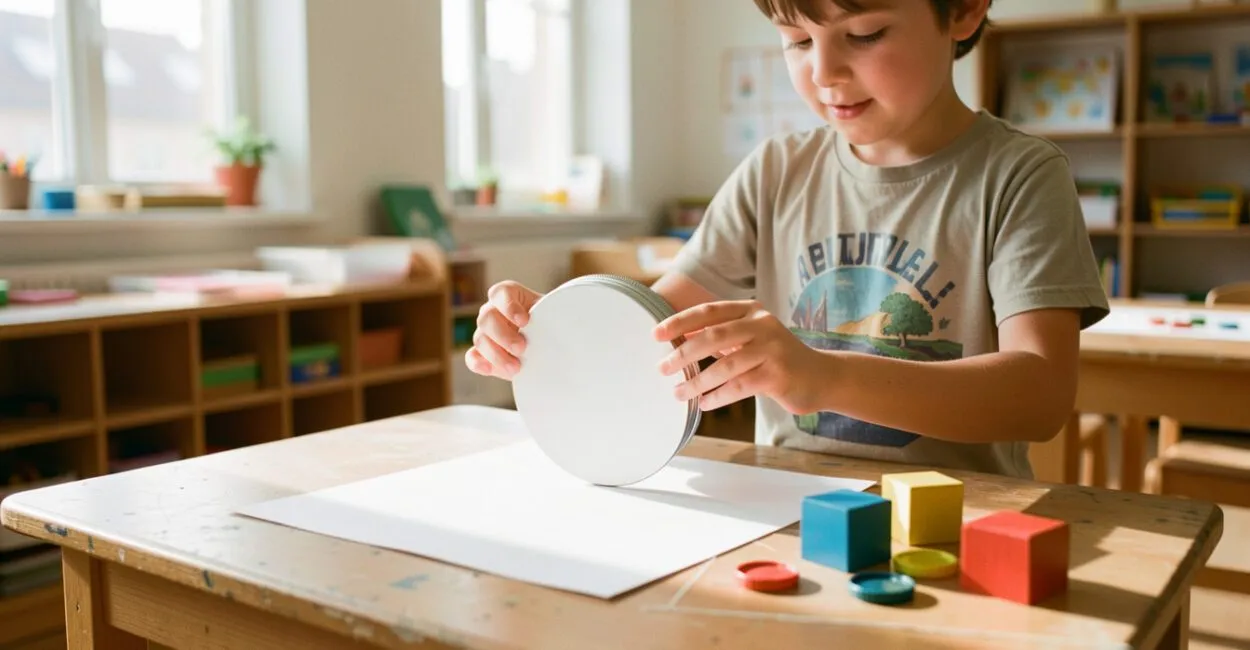
A child may recognize a circle on paper yet have trouble identifying a round lid when viewed from the side. Geometry games help connect these experiences through activities that encourage kids to observe, compare, and build shapes, while also exploring positions and spatial relationships. The activities below can be done at school or at home using paper, bottle caps, string, and everyday objects. There are options for early childhood and elementary school, with difficulty adjustments and questions that help kids explain what they notice.
Before You Begin
- Choose a skill to focus on: recognizing shapes, comparing properties, composing figures, or locating objects.
- Gather materials that are safe and age-appropriate; small pieces require supervision when working with young children.
- Plan a simple rule and a question to encourage conversation during the activity.
- See what the group already knows before increasing the challenge.
Geometry Games: Activities for Exploring Shapes and Space
Geometry games are activities with rules or challenges that engage concepts such as plane figures, geometric solids, properties, location, and spatial orientation. To get started, try sorting shapes, matching figures, building with pieces, or following paths on a grid; each activity can be adapted to the group’s age and goals.

Start by deciding what the child should do and explain. If the goal is to compare triangles, for example, varying the color and size helps you see whether the child recognizes the shape by its properties rather than relying on a single visual model.
A good geometric game lets a child show how they recognize shapes, rather than simply repeat their names.
This approach aligns with guidance from Brazil’s Base Nacional Comum Curricular, the national curriculum framework published by the Ministry of Education, which includes geometry among the thematic areas of mathematics. For more playful ideas for young children, you can also explore activities for creative early childhood education.
What Games Can Teach About Shapes and Space

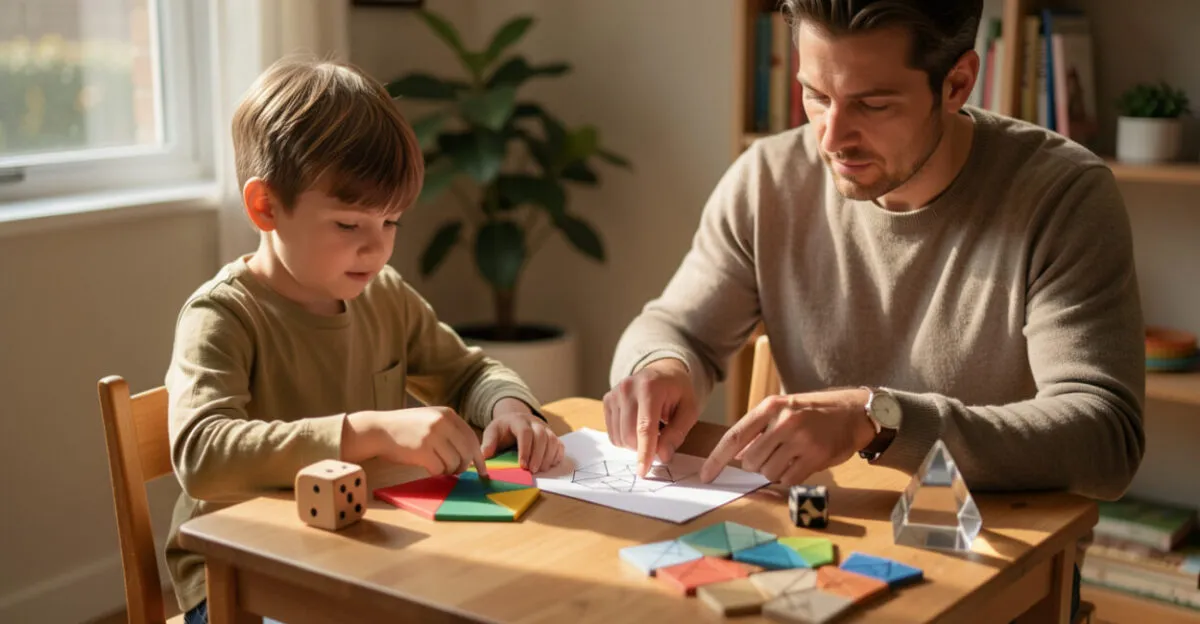
Plane figures have two dimensions: length and width. Geometric solids occupy space and may have faces, edges, and vertices. This distinction matters: a drawing of a cube on paper is a flat representation, while a die is a three-dimensional object shaped roughly like a cube.
Through these activities, children can identify the sides and vertices of polygons, compare the faces of prisms, explore symmetry, recognize patterns, and describe positions such as “to the right,” “between,” or “behind.” Geometry also comes into play when a child rotates a piece to make it fit or predicts what will appear when two shapes are put together.
Brazil’s BNCC document outlines learning expectations for each grade level. Use it as a reference without turning every game into a rigid checklist of content. Children’s learning pace and prior experiences vary.
Games with Geometric Shapes for Early Childhood Education
Shape Hunt Around the Room
Choose a shape, such as a circle or rectangle, and invite the child to find objects with a similar outline. Then compare what they find: a window may be rectangular, but its inner divisions create other shapes. The goal is to connect shapes to objects without expecting real objects to be perfect geometric figures.
Touch-and-Feel Shape Bag
Cut large shapes from cardboard, craft foam, or poster board and place them in an opaque bag. Without looking, the child picks a piece and describes its outline by touch before trying to name it. For younger children, use just a few clearly different shapes; for older kids, include triangles in different sizes and a variety of rectangles.
A common mistake is to accept the answer “it’s a triangle” and end the round there. Asking “what did you feel along the edges?” encourages the child to notice sides and corners. These games can be combined with other educational games, as long as the geometry focus remains clear.
Geometry Games for Elementary School
Tangram Shape-Building Challenge
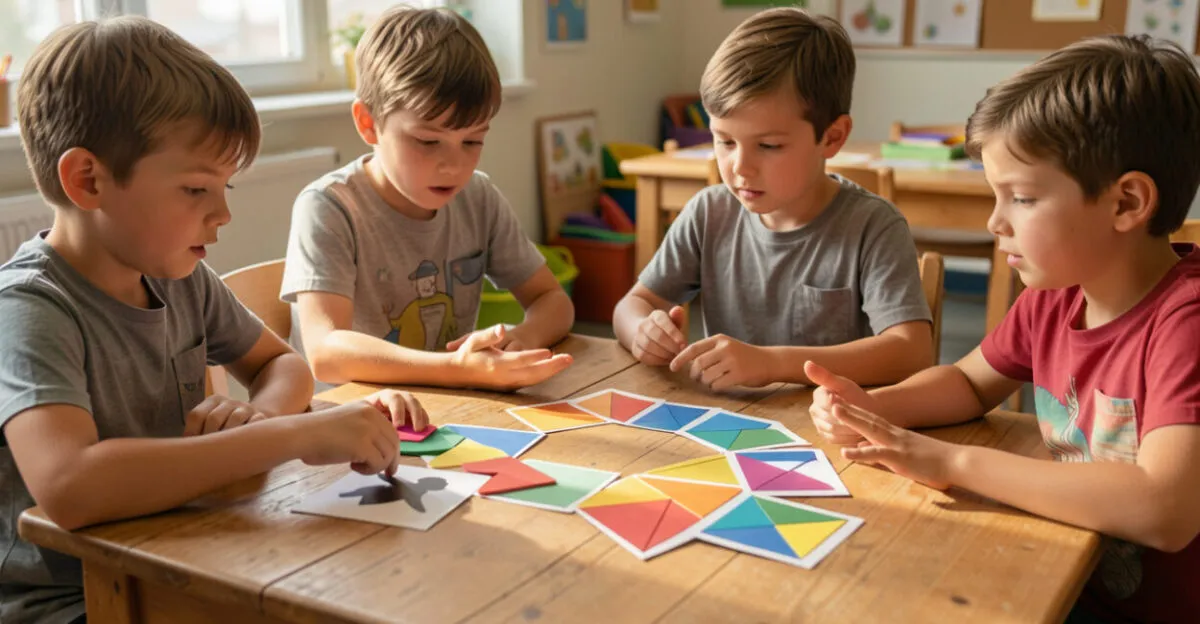
Use a printed tangram or draw one on sturdy paper. Give the child all seven pieces and ask them to make a silhouette, first following a model and then creating their own figure. The challenge builds composition and decomposition skills, spatial orientation, and an understanding that the same piece can be placed in different positions.
Read also: School Partnerships: How to Support Reading in Elementary School
Property Detectives
Lay out cards showing polygons in different colors and sizes. One person chooses a shape without revealing it, and the others ask questions that can be answered with “yes” or “no”: “Does it have four sides?” “Are all its sides the same length?” The group must distinguish defining properties from incidental features, such as the color or orientation of the drawing.
Example: In one round, a child describes a shape as “it has four sides and two pairs of parallel sides.”
Classmates can make guesses and ask for more information.
Complete guide: Math Games: A Guide to Teaching Grades 1–9
If the shape is tilted, its position shouldn’t prevent anyone from recognizing it.
For children who benefit from visual and tactile cues, consider accessible materials such as pieces with raised outlines. You’ll find organizational ideas in these multisensory activities, which can be adapted to the math objective.
Geometry Games to Print or Make
Cards, boards, and grids can be made with plain paper and a pencil. To create a printable memory game with geometric shapes, make pairs that match a shape with its name or a property. Don’t limit every pair to identical drawings; matching a figure with a description builds reasoning skills.
To make a printable geometry game, draw a grid, mark a starting point and a destination, and write directions such as “move forward two spaces” or “turn left.” For a more advanced version, players can describe the route using coordinates or record it on a grid. You can also find activities on platforms such as Wordwall using terms like “geometric shapes” and “geometry.” Check the instructions and adjust the content to the grade level, since materials vary in accuracy and difficulty.
String, blunt craft sticks, and modeling clay can be used to make polygons and solids. For example, children can use craft sticks and clay to build a prism framework and count its vertices. For solid shapes, clean boxes and packaging are a free alternative. These activities are useful when a flat representation alone doesn’t make the difference between a face and a three-dimensional volume clear.
How to Guide Math Conversations During Play
Ask questions that call for evidence, not just names. “How do you know they’re the same?” “What changed when you rotated the piece?” and “How many vertices did you count?” help children organize their observations and explain their choices.
When working on location, ask for precise descriptions: “Which piece is above the square?” or “How can you get to the circle without passing through the triangle?” In an activity with solids, ask which parts are faces and which points are vertices. Children can use their own words at first; formal vocabulary can be introduced gradually and connected to the objects they handle.
A child’s explanation is part of the game: it shows which geometric relationships they can already recognize.
One practical observation: when a piece doesn’t fit, children often rotate the board or switch shapes before trying to rotate the piece itself. Giving them a few seconds to test the rotation without correcting them right away makes the spatial reasoning the challenge is meant to develop easier to observe.
How to Choose and Adapt a Geometry Activity
Start with the goal, then choose the materials. A group that can already name shapes may be ready to explore their properties; children who still rely on visual models benefit from handling pieces in different positions and sizes. The same rules won’t work for every age, and assessment should take children’s explanations into account, not just their final answers.
Goal Suggested activity Difficulty adjustment Recognize outlines Shape hunt Start with two clearly different shapes, then add more Compare properties Property detectives Move from questions about sides to parallelism and symmetry Develop spatial orientation Grid path Start with verbal directions, then add coordinates Compose figures Tangram Remove the visual model after a few attempts
If the challenge is too easy, change one condition: remove the model, limit the number of pieces, or ask for two different solutions. If it’s too hard, reduce the choices and demonstrate a move without giving away the answer. The key is balance: a game that’s too open-ended may not engage the intended content, while too many rules can leave little room for exploration.
To try this approach, choose one skill for the next activity, prepare simple pieces, and set aside time to listen to the strategies children use. Write down a question that helped a child explain their reasoning; that note can guide the next challenge more precisely than repeating the same worksheet.
Frequently Asked Questions About Geometry Activities
How Can You Make Plane Geometry Fun?
Use cutout shapes, tangrams, shape hunts, and sorting games. Ask children to compare sides and vertices, explain their criteria, and look at shapes in different positions.
How Can You Make Geometry Games with Simple Materials?
Poster board, packaging cardboard, bottle caps, and pencils are all you need to make cards, matching pieces, and grid boards. If you use craft sticks, choose blunt ones or swap them for cut-up straws, especially when working with young children.
How Can You Adapt These Activities for Elementary School?
Add properties, explanations, and challenges with more than one possible solution. Instead of simply asking a child to identify a quadrilateral, ask them to explain which features support the classification and compare shapes in different orientations.
Artigos Relacionados
 Fun First-Grade Math: Games, Activities, and Hands-On Ways to Explore Numbers, Shapes, and Logic
 Multiplication Games: How to Practice Times Tables in Class
 Fraction Games: Fun Activities for Learning
 Syllable Games for Dyslexia: 7 Ideas to Build Reading Skills
 School Adjustment: Supporting Children in Their First Days
 School Adjustment in Early Childhood Education: How to Help
