
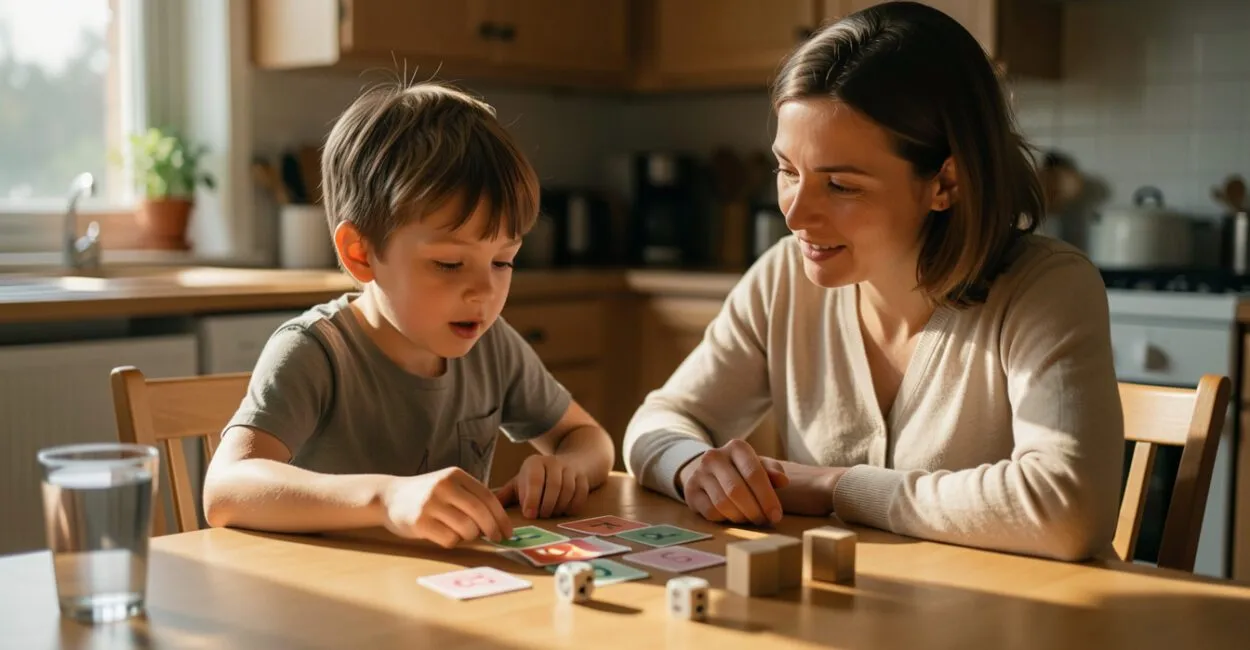
A child can solve 28 + 17 without paper in several ways: add 2 to 28 to make 30, then adjust; break 17 into 10 + 7; or add the tens and ones separately. Mental math games help kids practice strategies like these through short challenges at home or school, without making speed the only measure of learning.
The activities below work with cards, dice, a game board, or improvised materials. You can adjust the rules for your group: start with numbers kids can work with confidently, then increase the difficulty when they can explain how they found the answer.

Quick Facts
- Goal: build calculation skills and develop strategies for working with numbers.
- Materials: cards, dice, paper, or everyday objects.
- Where to play: at home, in the classroom, or in small groups.
- Difficulty: adjustable based on the numbers and operations.
- Progress indicators: reasoning, accuracy, independence, and participation.
What Are Mental Math Games, and What Do They Develop?
Mental math games are structured activities in which players solve problems by using number relationships, without relying on written work for every step. They build number fluency, decomposition, estimation, memory of arithmetic facts, and flexibility in choosing strategies. Put simply, they help kids think about numbers instead of just following a written procedure.
For example, to calculate 39 + 26, one person might add 40 + 26 and subtract 1. Another might break 26 into 20 + 6.
Both strategies lead to 65, and comparing the approaches shows that the same problem can be solved in different ways.
The BNCC, Brazil’s official national curriculum framework issued by the Ministry of Education, guides the development of math skills such as reasoning, communication, and problem-solving. A game has educational value when it creates opportunities to practice these skills—not just when it presents a series of questions with right answers.
Consult the Base Nacional Comum Curricular (Brazil’s national curriculum framework) when aligning an activity with your group’s learning goals.
Mental math skills grow stronger when kids can explain why a strategy works.
How to Choose Challenges for Different Ages and Skill Levels
Age can help guide your choice, but it shouldn’t determine the starting point on its own. It’s more useful to notice which operations a child can solve confidently, which strategies they already use, and when they start guessing. An activity may be easy for one third grader and difficult for another in the same class; that doesn’t mean either child lacks ability.
Approximate grade level Starting challenge How to extend it Preschool Count objects and recognize small quantities Combine groups of objects and predict how many more are needed Grades 1 and 2 Add and subtract small numbers Use multiples of ten and familiar number facts Grades 3 and 4 Work with tens and simple hundreds Add estimation and more than one way to solve a problem Grade 5 Work with larger numbers and relationships between operations Introduce multiples, simple fractions, and multistep problems
In preschool, flashcards and hands-on objects help kids connect quantities to numerals. For playful activities suited to this age group, explore ideas for creative early childhood education. In the early grades, you can gradually phase out the materials as kids learn to picture quantities in their minds.
Games to Practice in the Classroom or at Home

Number Target
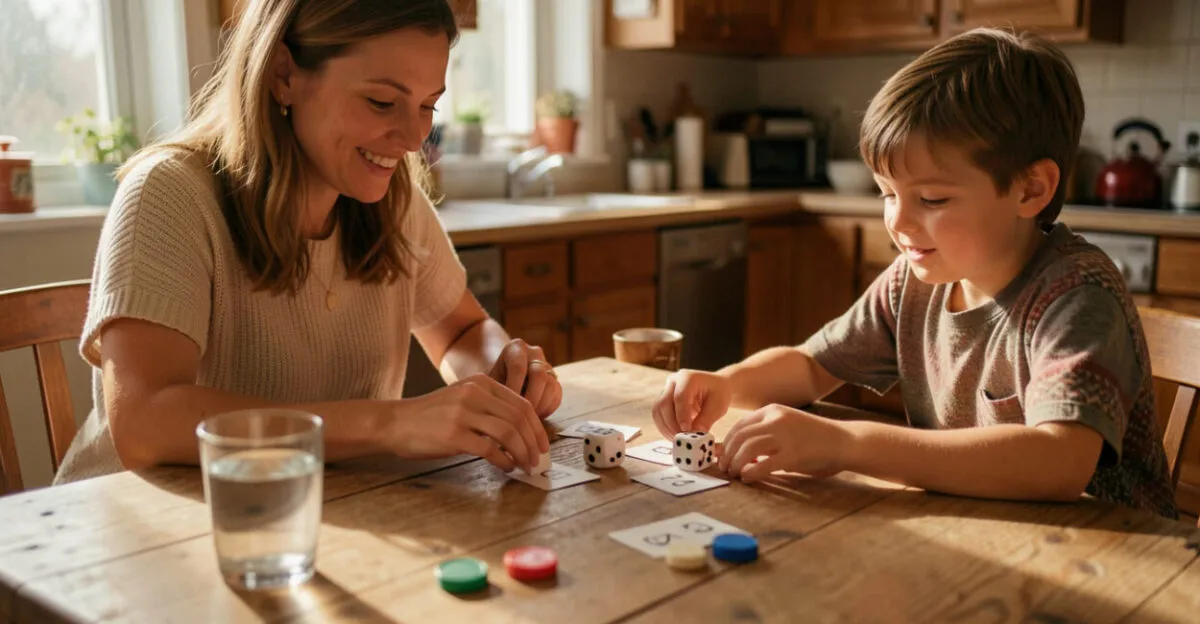
Choose a target, such as 50, and hand out number cards. Each player picks two or three cards and tries to create an expression that equals the target or comes as close as possible. To start, allow addition only; later, add subtraction and multiplication. You can award points for both getting close and explaining the chosen approach.
Dice in Sequence
Each player rolls two dice and adds the results. In the next round, subtract the smaller number from the larger one; in another round, try to make the largest possible number using the digits rolled. The teacher can swap the dice for cards with larger numbers. The key is to adjust the number range without changing all the rules of the game.
Calculation Chain
One person starts with a number, such as 20, and suggests an operation: “plus 8.” The next person answers 28 and adds a new operation. If the chain gets long, let players write down the results or start over with a smaller number. This keeps working memory from becoming the main obstacle when the goal is to practice calculation.
If competition makes the group anxious, remove the timer and challenge everyone to find two ways to get the same answer. For more ways to mix movement and learning, try these educational games that make learning fun.
Read also: Science Learning Games: 5 Activities That Work
Addition and Subtraction Games with Adjustable Difficulty
To teach mental addition, use challenges that make number relationships visible. In “make a ten,” one player gets 8 and says how many more it takes to reach 10; then the group can try going from 18 to 20 or from 48 to 50. This practice builds compensation strategies, such as turning 29 + 16 into 30 + 16 − 1.
For subtraction, the game “how much more?” focuses on the distance between two numbers. If the question is how much more it takes to get from 37 to 50, a child can count up 3 to reach 40, then 10 more to reach 50, for a total of 13. They can check their reasoning with the inverse operation: 50 − 37 = 13.
Complete guide: Math Games: A Guide for Teaching Grades 1–9
For a card-based variation, draw two cards and make an equation. For beginners, use positive answers and numbers up to 20; later, expand the range and let each player choose whether to add or subtract. A simple addition game can still be useful with larger numbers: increase the difficulty gradually instead of introducing several new rules in the same round.
A good round offers enough challenge to encourage reasoning and enough support to make kids want to try again.

How to Adapt Activities for Grade 5 and Other Groups
For fifth graders, math games can involve hundreds, multiplication, division, and estimation, based on what the group has already learned. For example, in Number Target, use cards from 10 to 100 and allow different operations; players must explain why they chose a particular approach. In addition and subtraction games, include numbers such as 245 and 198 to explore compensation and decomposition.
You can also use online math games, as long as the screen serves a clear purpose. A 2048 addition game can prompt a conversation about powers of 2, number composition, and move planning; on its own, though, it doesn’t cover all the skills involved in mental math. On sites such as Escola Games, choose games based on the skill being practiced, reading level, and whether kids can play without time pressure.
For students who need other ways to access the activity, reduce the number of items in each round, read the instructions aloud, or offer cards with colors and symbols. Adapting how a student participates doesn’t mean lowering the math goal. Inclusive strategies can also draw on guidance about teaching methods for different needs.
How to Value Strategies Without Rewarding Speed Alone
A timer can make an activity exciting, but it can also lead some kids to answer impulsively or avoid participating. In many situations, allowing time to explain a strategy tells you more about learning than noting who answered first. Speed can come with fluency, but by itself, it doesn’t prove understanding.
A specific example can help: when solving 52 − 28, one child might count backward, while another works out how much it takes to get from 28 to 52. If both can explain their answers, they’re using mathematical reasoning. Note the method each child uses and watch to see whether, with practice, they choose more efficient strategies without losing understanding.
The teaching guidance from the National Council of Teachers of Mathematics (NCTM) highlights processes such as problem-solving, communication, and reasoning. This supports an approach to assessment that listens to students’ thinking, though each school should align its practice with local curricula and goals.
How to Track Progress and Increase the Challenge
After a few rounds, make brief notes: which operation the child solved, which strategy they chose, whether they checked their answer, and whether they could explain their thinking. Compare each child with their own progress, not with the fastest classmate. When mistakes happen, look for patterns: mixing up tens and ones calls for different support than an occasional counting error.
Change one variable at a time. Increase the numbers or introduce a new operation, but avoid changing the time limit, number of players, and all the rules at once. At home, five minutes with a well-chosen question may be more productive than a long session that ends in frustration. You don’t need a computer or internet access: cards, bottle caps, and dice are enough to create complete activities.
These activities can also be part of a lesson plan: identify the skill, explain the rules, observe the strategies, and wrap up with a conversation about different solutions. Try one activity each week and note not only correct answers but also which number relationships the child has started using independently.
Frequently Asked Questions
Which Games Help Develop Mental Math Skills?
Number Target, Dice in Sequence, Calculation Chain, and games that involve making a ten are good options. The results depend on adjusting the rules to the child’s skill level and discussing the strategies they use.
Can Kids Practice Without a Computer or Internet?
Yes. Cards, dice, bottle caps, paper, and even numbers spoken aloud can all be used to create a variety of challenges at home or school.
How Can You Make Addition and Subtraction Fun to Learn?
Turn the operations into game goals, such as reaching a target number or figuring out how much more it takes to make a ten. Invite kids to explain their approach, and change the numbers once they’ve mastered the current round.
Can an Online Math Game Replace a Group Activity?
Not necessarily. Digital tools can provide repetition and immediate feedback, while conversations among players make their strategies audible. The best choice depends on the goal and how each child participates most effectively.
How Can You Tell if a Child Is Making Progress?
Notice whether the child solves problems more independently, chooses appropriate strategies, and can check or explain their answers. You can track time, but it shouldn’t be the only measure of progress.
Artigos Relacionados
 Syllable Games for Dyslexia: 7 Ideas to Build Reading Skills
 Simple Syllable Activities: How to Build Reading Fluency
 Fun First-Grade Math: Games, Activities, and Hands-On Ways to Explore Numbers, Shapes, and Logic
 Math Workshops: Hands-On Games for Understanding Concepts
 Building Reading Fluency in Children: Daily Routines and Activities to Improve Speed, Expression, and Comprehension in Elementary Students
 Phonological Awareness in Early Literacy: Playful Techniques and Exercises to Build Sound Recognition and Reading Fluency in Children
