

When science class moves off the board and into students’ hands, retention often reaches a new level. Instead of memorizing plant parts or the states of matter, students observe, compare, test, and make purposeful mistakes.
That’s exactly where classroom science games come in: structured activities that turn abstract concepts into hands-on experiences.

In practice, this matters because science calls for investigation, not just memorization. A good game isn’t there to “kill time”; it helps students form hypotheses, recognize cause-and-effect relationships, and support their answers with evidence.
In this article, you’ll find five activities that work in elementary school, learn when to use them, and see how to adapt each one to your class time, students’ ages, and lesson goals.
The Essentials
- Classroom science games work best when they have a clear learning goal, simple rules, and a wrap-up with guided discussion.
- The activity should assess more than participation: scientific vocabulary, observation, classification, logical sequencing, or interpretation of phenomena.
- Not every game works for every topic; highly abstract concepts call for stronger teacher guidance than topics students can observe directly.
- The best results come from games that are short, repeatable, and connected to the next lesson—not treated as a one-off event.
- A good elementary science activity typically uses inexpensive materials, involves little risk, and requires minimal setup.
How Classroom Science Games Support Better Learning
Classroom science games are activities with rules, goals, and immediate feedback, designed to reinforce a specific curriculum concept. Put simply, students learn as they make decisions, compare information, and see the consequences of their choices.
This improves learning because science depends on precise language, observation, and reasoning, not just passive reading.
Brazil’s Base Nacional Comum Curricular (National Common Curricular Base, Brazil’s national curriculum framework) reinforces this approach by emphasizing investigation, argumentation, and active participation across grade levels. In practice, teachers gain a tool that helps them move beyond “explain and copy” without abandoning the curriculum. Anyone who works in a classroom knows students engage more when they have to handle something, compare results, or defend an answer in front of the group.
The technical point is simple: a game needs to align the learning objective, the rules, and the evidence of understanding. If any one of these three is missing, the activity becomes little more than a pastime. This often happens with games that look great but lack substance: students have fun, but can’t explain what they learned.
What separates an educational game from unstructured play isn’t the materials—it’s the presence of a scientific concept students must apply to move forward.
When to Use This Type of Activity
This format works well for reviewing material, introducing a topic, and wrapping up a unit. It’s also useful when students have a wide range of skill levels, because games allow everyone to participate at different levels of understanding. On the other hand, games fall short when teachers expect an activity to “teach itself”—especially a complex concept—with no prior explanation or follow-up discussion.
If the lesson involves experimentation, connect the game to safety, observation, and note-taking. Resources from Brazil’s Ministério da Educação (Ministry of Education) and public school system guidelines can help keep the activity aligned with the curriculum and students’ age levels.
Game 1: Science Bingo for Reviewing Concepts
Science bingo is one of the most effective ways to review terms, characteristics, and examples without much preparation. It works especially well with topics such as living things, properties of matter, the human body, and ecosystems. The teacher reads clues rather than giving direct answers, and students mark the correct concept on their cards.
How to Set It Up
- Choose 12 to 20 key concepts from the unit.
- Create different cards to prevent students from simply copying one another.
- Read definitions, examples, or brief problem scenarios.
- Ask students to explain aloud any answers that are uncertain.
What It Builds
This game builds conceptual recognition, attentive listening, and the ability to connect definitions with technical terms. In the early elementary grades, it helps students learn scientific vocabulary. In later grades, it works best when clues require comparison, such as “the process that turns liquid water into vapor” or “a living thing that makes its own food.”
There’s a limitation: if the cards are filled with unrelated words, students mark answers by luck rather than understanding. In that case, the game loses its educational value and becomes a lottery. The INEP’s assessment and indicators page offers a useful reference for planning activities suited to students’ learning levels and thinking about observable evidence of learning.
Game 2: Matching Game for Living Things and Natural Phenomena

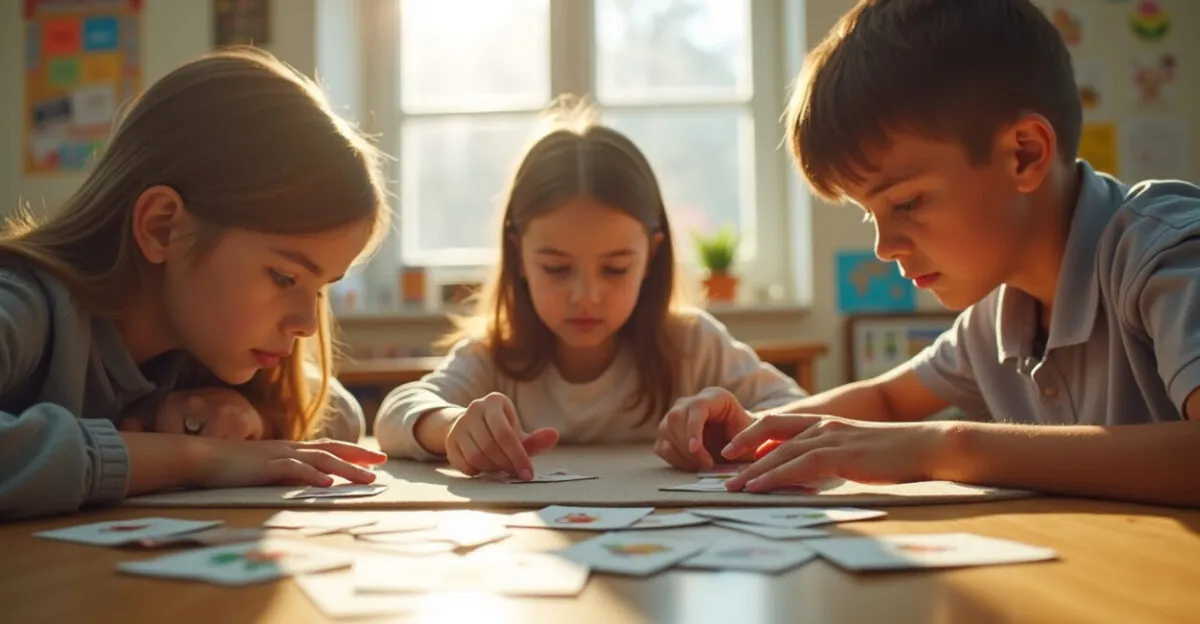
Matching games are useful when the material calls for pairing items: image and name, cause and effect, organ and function, animal and habitat, or phenomenon and explanation. In science, they work best when students do more than match identical pictures; the real benefit comes when each pair requires reasoning.
Variations That Work
- Picture of a leaf + the function of photosynthesis.
- Animal + type of diet.
- Material + physical property.
- Weather phenomenon + brief explanation.
In my experience with these activities, the biggest mistake is using images that make the answers too obvious. When that happens, students get it right based on appearances, not understanding. The game becomes much more effective when the teacher asks students to explain each match before taking the cards off the table.
Read also: Syllable Games for Dyslexia: 7 Ideas to Improve Reading
In science, visual memory helps, but lasting learning happens only when students put into words the relationship between the items they just matched.
Game 3: An Investigation Trail with Quick, Direct Challenges
An investigation trail is a more engaging version of a traditional board game. Instead of moving ahead based on luck alone, students solve short content-related challenges to keep going. This gives teachers more control over what students are learning and keeps the activity from feeling like “playing just to play.”
When to Use It
It works well for reviewing topics such as food chains, the water cycle, the solar system, states of matter, and hygiene. Teachers can add special spaces with explanation questions, brief observation tasks, or comparisons between scenarios. For students in grades 4 through 6, it tends to work best in pairs or groups of three.
Read also: Dyslexia Activities: 12 Literacy-Building Practices
A Real Classroom Example
I watched a fifth-grade class struggle with “producers, consumers, and decomposers” until the teacher replaced her lecture with a trail game using challenge cards. Students who got an answer right had to explain why. In 20 minutes, the classroom went from quiet to competitive, with real scientific discussion. The key was that each move forward depended on an explanation, not just a correct answer.
This format also pairs well with shorter, observable diagnostic activities, because it quickly reveals who understands the concepts and who still needs teacher support.
Game 4: Sorting Cards to Organize Scientific Thinking
Classification is a core science skill. A card-sorting game focuses on exactly that: grouping, separating, explaining criteria, and revising categories. It’s especially effective for topics such as vertebrates and invertebrates, natural and synthetic materials, homogeneous and heterogeneous mixtures, and energy sources.
Item
Example
Primary skill
Picture cards
Rock, plastic, leaf, metal
Classification by properties
Question cards
“Is it living?” “Can it be recycled?”
Decision-making
Explanation cards
“Because it dissolves in water”
Scientific argumentation
This game calls for more teacher guidance than you might expect. If the teacher doesn’t define the classification criteria, every student comes up with a different one, and the lesson turns into elegant chaos. State the rules at the beginning, then wrap up by asking students to explain why they grouped the items that way.
To plan the difficulty level, it’s also worth looking at teaching support resources such as guidance strategies for school assignments. The principle is similar: clear instructions reduce unnecessary mistakes and help students become more independent.
Game 5: Hypothesis Quiz and Simple Experiments
A hypothesis quiz comes closest to scientific reasoning itself. Instead of simply asking, “What’s the answer?” the teacher presents a scenario and asks students to choose the most plausible hypothesis. This builds prediction, evidence comparison, and interpretation of results.
How to Use It
- Present a scenario: “What happens to ice in the sun?”
- Offer three hypotheses: two plausible ones and one clearly incorrect one.
- Ask students to defend their choice aloud or in writing.
- Finish with a hands-on observation or mini-experiment.
This activity is excellent for topics such as changes in the state of matter, germination, motion, shadows, temperature, and the water cycle. It also helps teachers identify magical thinking, vocabulary errors, and confusion between cause and effect. Here, a wrong answer is valuable when it comes with reasoning; it shows where understanding is still stuck.
Not every topic is a good fit for this format. Some require extended observation, such as decomposition or plant growth, so a quiz works only as an introduction, not as the main activity. It’s important to be clear about this limitation: a good game isn’t one that works for everything, but one that respects the kind of knowledge being taught.
How to Choose the Right Activity for Your Class
Your choice depends on three factors: the goal, the time available, and your students’ readiness. If the focus is vocabulary review, bingo and matching games are usually enough. If the goal is reasoning and explanation, a trail game, sorting cards, or a hypothesis quiz will do more. The most common mistake is choosing an activity for its visual appeal rather than the skill you want to develop.
It’s also worth considering your school’s schedule. In classes with limited time, 10- to 15-minute activities work better than long games because they leave room for a closing discussion. In a 50-minute class, you can combine a quick activity with a brief explanation and a written wrap-up. For instructional continuity, resources on study routines and organizing learning can help connect classroom and at-home learning.
Goal
Best choice
When to avoid it
Learn key terms
Science bingo
When the material calls for in-depth analysis
Match related items
Matching game
When there’s little time for teacher guidance
Explain answers
Investigation trail
When students haven’t mastered the foundational topic
Classify items
Sorting cards
When the criteria can’t be explained clearly
Predict phenomena
Hypothesis quiz
When there’s no time for a closing discussion
Next steps
If your goal is to make science learning visible, start by trying a short activity, noting what students can explain, and adjusting the rules for the next class. Choose one topic at a time, identify the core skill, and require a final explanation. That wrap-up is what separates entertainment from teaching. If you want to get started without overcomplicating things, try one activity this week and observe what changes in participation, argumentation, and retention.
Frequently Asked Questions
Do Classroom Science Games Work in Every Grade?
They do, but the format changes with age. In the early elementary grades, activities should be more visual, hands-on, and brief because attention and reading skills are still developing. In later grades, games can require more explanation, evidence comparison, and scientific language. What matters most isn’t the name of the activity, but whether the challenge is right for the class.
What’s the Biggest Mistake When Using Games in Science Class?
The most common mistake is treating a game as a reward rather than a learning tool. When that happens, students get excited but don’t make progress with the material. Another frequent problem is skipping the wrap-up: the teacher runs the activity but doesn’t revisit what students learned. Without that final discussion, students remember the game but forget the concept.
Do I Need Ready-Made Materials for This Type of Activity?
No. Many classroom science games can be made with paper, pencils, printed cards, and everyday objects. What matters is the instructional structure: a clear goal, simple rules, and a reflection question at the end. Expensive materials may look impressive, but they don’t guarantee learning. In many classrooms, the most effective resource is the simplest one to set up and reuse.
How Can I Tell Whether the Game Actually Helped Students Learn?
Look for whether students can explain their reasoning, not just get the answer right. If they use the right vocabulary, compare examples, and answer with more confidence after the activity, they’ve made real progress. One good practice is to ask a short question before and after the game and compare responses. If performance improves only during the activity and drops afterward, the game was fun but taught little.
Can These Activities Replace Lab Experiments?
No. Games help students organize ideas, review concepts, and practice argumentation, but they can’t provide the full experience of direct observation or experimentation. For topics such as physical changes, plant growth, or material properties, it’s best to combine a game with a demonstration and a written record. Science learning is stronger when students have a variety of experiences, rather than relying on just one teaching method.
Artigos Relacionados
 Environmental Education in Elementary School: Activities That Work
 An At-Home Study Routine: Schedules That Actually Work
 5 Creative Education Methods That Work
 5 Teaching Methods That Work for Financial Education
 Inspirational Women’s Day Messages: Short, Powerful Lines for Cards and Early Childhood Activities That Promote Empowerment
 Fun First-Grade Math: Games, Activities, and Hands-On Ways to Explore Numbers, Shapes, and Logic
