
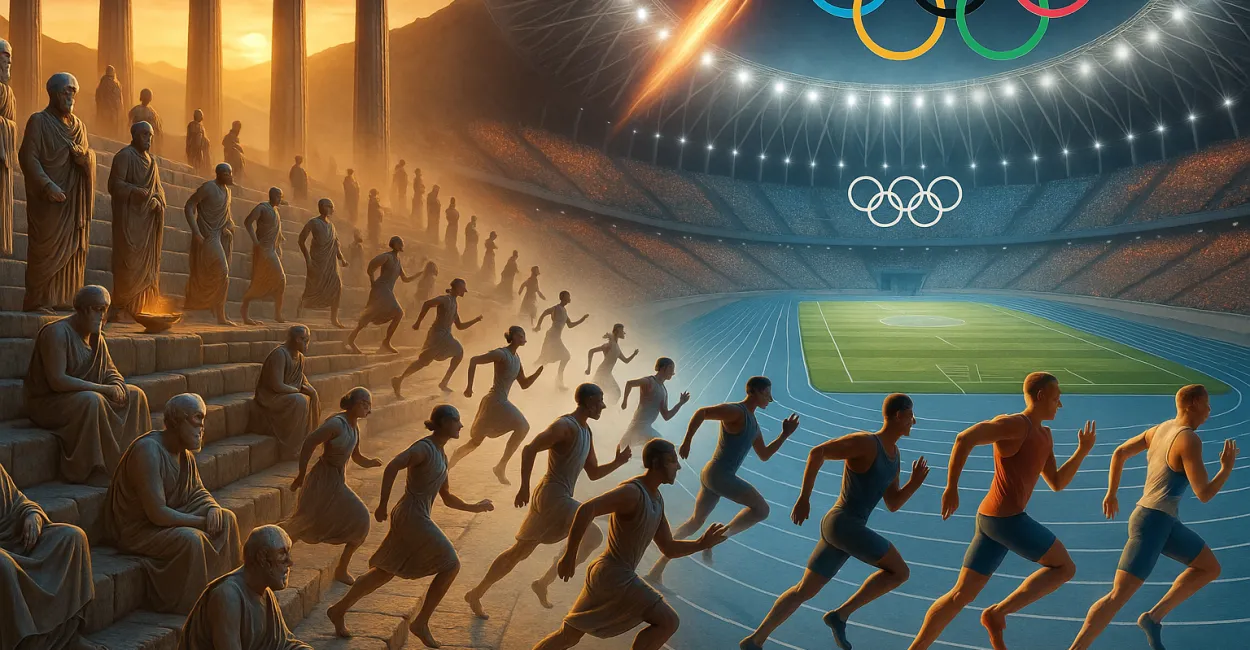
The Olympic Games didn’t begin as a televised spectacle or a commercial showcase. They began as a Greek ritual tied to religion, city-states, and public honor. The history of the Olympic Games is, in practice, the story of how a local celebration of Zeus became the world’s biggest sporting event.
To understand the origins of the Olympic Games, it helps to follow the timeline without skipping steps: from ancient Greece and the competitions at Olympia to the modern revival led by Pierre de Coubertin in the late 19th century. This journey explains why the Olympic Games, history, culture, and politics remain intertwined today.

The Essentials
- The ancient Olympic Games were a religious festival at Olympia dedicated to Zeus, not just an athletic competition.
- The Olympic Games originated in ancient Greece, with 776 B.C. traditionally recognized as the date of the first recorded organized events.
- The modern Games began in the 19th century with Pierre de Coubertin, inspired by educational models and the ideal of international cooperation.
- The key difference between the ancient and modern Games is their purpose: civic and religious worship at Olympia versus global competition governed by the International Olympic Committee.
- The Games remain relevant because they bring together sports, diplomacy, media, and historical memory.
What Are the Olympic Games, and Why Does Their History Matter?
The Olympic Games are an international multisport event held on a regular cycle, with standardized rules, national representation, and strong symbolic significance. Put simply, they bring athletes from around the world together to compete in the spirit of sport. But their importance goes beyond medals: the Games serve as a reflection of the era in which they take place.
In practice, following an Olympic edition means seeing more than results. There’s competition for prestige between countries, the creation of national identity narratives, debates over public funding and urban impact, and pressure on sports federations and organizing committees.
That’s why discussing the history of the Olympic Games also helps us understand the present.
What separates the ancient Olympic Games from the modern ones isn’t the idea of competition, but its social meaning: at Olympia, competition served religious worship and civic honor; today, it creates a global arena for performance, diplomacy, and media.
The International Olympic Committee (IOC) is the organization that oversees this contemporary version of the event. The IOC’s institutional history and that of the Olympic Movement are documented on the organization’s official website, which you can visit at Olympics.com, the International Olympic Committee’s website.
The Origins of the Olympic Games in Ancient Greece
The Olympic Games originated in the sacred city of Olympia, on the Peloponnese peninsula. The traditional date of 776 B.C. is often cited as the first recorded edition, although competitive and ritual practices likely began earlier. The event belonged to a Greek world in which sports, religion, and public life were not separate as they are today.
Olympia, Zeus, and the Sacred Truce
Olympia was not a political capital. It was a Panhellenic sanctuary, meaning a shared space for Greeks from different city-states. The competitions were held in honor of Zeus and accompanied by sacrifices, processions, and religious ceremonies. During the Games, the ekecheiria, or sacred truce, was observed, suspending conflicts to allow athletes and spectators to travel safely.
Who Took Part and What Events Were Held?
In the early centuries, participation was limited to free men of Greek origin. The events changed over time, but included running, wrestling, boxing, the pentathlon, and chariot racing. Winners received an olive wreath, not a cash prize. The real reward was public honor, the reputation of their home city, and a place in history.
The Library of Congress offers accessible historical material about ancient Greece and its civic rituals at loc.gov, which can help put this cultural context into perspective. The Encyclopaedia Britannica also provides a useful overview of the relationship between festivals, city-states, and religion in the origins of the Games.
The Religious and Cultural Significance of the First Games

The ancient Olympic Games were a form of collective expression. They conveyed devotion, symbolic power, and a sense of Greek identity in a world divided by rivalries among city-states. Victorious athletes were celebrated almost like local heroes, and their triumph enhanced the reputation of the city they represented.
More Than Sports: Ritual, Identity, and Prestige
The Greeks didn’t see competition as mere entertainment. Victory had moral and religious significance because it demonstrated discipline, strength, and the favor of the gods. At the same time, the festival brought people together from different regions, helping to reinforce a sense of shared Greek identity beyond internal rivalries.
A Brief Glimpse of Life at Olympia
Imagine a young athlete arriving at Olympia after weeks of travel, trained but also anxious about being judged in public. Nearby, priests, spectators, and representatives of other cities make their way through the sanctuary. The race takes place in intense heat, a herald announces the winner, and the athlete’s city becomes associated with glory. This kind of scene shows why the origins of the Olympic Games can’t be reduced to a sports calendar.
Historical research isn’t always straightforward, though. Scholars disagree about the exact date of the first festival and how broad participation really was in earlier periods. This matters: records from antiquity are fragmentary, so any overly definite claims about the details should be treated with caution.
In ancient Greece, sports were inseparable from religion: competing at Olympia meant honoring Zeus, affirming one’s home city, and earning a place in the collective memory.
How the Modern Olympic Games Began
The modern Olympic Games emerged in the late 19th century as an effort to reinterpret the Greek Olympic ideal. The central figure in this revival was Pierre de Coubertin, a French educator who championed sports as a teaching tool, a means of moral development, and a way to bring nations closer together. In 1894, he helped found the International Olympic Committee; in 1896, Athens hosted the first modern Games.
Why Coubertin Championed the Idea
Coubertin saw sports as a tool for education and social discipline. His goal wasn’t to copy antiquity exactly, but to adapt the Olympic symbol to an industrialized, nationalistic, and increasingly interconnected world. The modern revival introduced standardized rules, federations, an international calendar, and the idea of “amateurism,” which was later abandoned or relaxed in many sports.
1896: A Turning Point
Athens 1896 marked the official return of the Games after centuries of interruption. The event was nowhere near the scale of today’s Olympics, but it demonstrated the power of the idea: national delegations, ceremonies, medals, and international interest. From then on, the Games grew in complexity, media coverage, and political impact.
The IOC documents this historical transition and its institutional changes on its page about the Olympic Games. For a broader academic perspective on the relationship between sports, education, and modernity, university research and historical archives can help put the story in context.
From Ancient Greece to a Global Event: Key Changes
The Olympic Games evolved from a regional ritual into a global mega-event in several stages. Their religious purpose has almost entirely disappeared, but their symbolic structure remains. What changed was the scale: from a small number of Greek athletes at Olympia to thousands of competitors in dozens of sports, governed by international rules and followed by a massive media audience.
Aspect
Ancient Games
Modern Games
Symbolic center
Zeus and Olympia
Olympic Movement and IOC
Participation
Free Greek men
Athletes from nearly every part of the world
Main purpose
Worship, honor, and civic prestige
International competition and sporting exchange
Prizes
Olive wreath and public acclaim
Medals, recognition, and a sports career
Scale
Regional/Panhellenic
Global
The Role of Media and Politics
Today, the Games are inseparable from news coverage, sponsorships, and geopolitical debates. Hosting an edition requires investment in infrastructure, diplomatic negotiations, and a bid to boost a country’s international reputation. Anyone who works in sports event management knows that the Olympic legacy is rarely just about sports: it can improve transportation, tourism, and public facilities, but it can also bring high costs and underused venues when planning falls short.
Where Comparisons with Antiquity Work—and Where They Don’t
Historical comparisons are useful for understanding the enduring ideal of excellence, but they fall short when they romanticize the past. The ancient Games excluded women from competition, restricted participation based on origin, and combined sports with religious worship. The modern Games have expanded inclusion and created a universal language, although they still contend with unequal access, doping, commercial interests, and power struggles.
A Brief Timeline of the Olympic Games
If you want to remember the key milestones in the history of the Olympic Games, this summary can help. It shows how the idea began, disappeared, and returned under a different model.
- c. 776 B.C. — Traditional date of the first recorded edition at Olympia.
- Ancient centuries — The Games become established as a Panhellenic festival in honor of Zeus.
- A.D. 393 — Emperor Theodosius I bans pagan worship and festivals, bringing the ancient tradition to an end.
- 1894 — The International Olympic Committee is founded at Pierre de Coubertin’s initiative.
- 1896 — Athens hosts the first edition of the modern Olympic Games.
- 20th and 21st centuries — The Games expand globally, gradually including more countries and sports and attracting greater media coverage.
This overview highlights an important point: the history of the Olympic Games isn’t an unbroken story. It involves disruption, reinvention, and changing ideas about what the Games mean.
Why the Olympic Games Still Matter Today
The Olympic Games remain relevant because they bring together three things that rarely coexist on such a scale: athletic excellence, a shared narrative, and global visibility. No other event can bring athletes, governments, the press, and the public into the same conversation for weeks at a time.
They also put values to the test. When competition upholds diversity, integrity, and transparency, the event gains credibility. When the system faces a crisis—doping scandals, boycotts, or excessive public spending—its reputation suffers. That tension is part of the Games’ history, not an accident.
The best way to understand the origins of the Olympic Games and their modern form is to look at their social role in each era. At Olympia, the focus was on honor and religion; today, it’s on performance, sports diplomacy, and global impact. The symbol has remained powerful precisely because it has changed without losing its historical weight.
Next Steps
If you want to study the topic in depth, compare primary historical sources, official IOC pages, and university materials on ancient Greece. It also helps to watch a current edition through a historical lens: what has changed in the protocols, participation, and media coverage? This comparison shows more clearly than any summary why the Olympic Games remain one of the world’s great rituals.
Frequently Asked Questions
What Are the Origins of the Olympic Games?
The Olympic Games originated in ancient Greece, specifically at Olympia, where athletic festivals were held in honor of Zeus. The traditional date is 776 B.C., the year of the first recorded edition. They began as a religious and civic event, not an international spectacle.
How Did the Olympic Games Begin in Ancient Greece?
They emerged from the culture of the Greek city-states, which brought together athletic competition, religious worship, and public prestige. Olympia served as a Panhellenic sanctuary, and the sacred truce allowed athletes and spectators to travel there. The festival grew to become one of the most important institutions of the ancient Greek world.
What Was the Purpose of the Ancient Olympic Games?
The main purpose was to honor Zeus and strengthen the identity of the Greek cities. Winning meant gaining honor, reputation, and a place in collective memory. The material prize was modest; the symbolic value was immense.
Who Revived the Modern Olympic Games?
The leading figure was Pierre de Coubertin, a French educator who spearheaded the Olympic revival movement in the late 19th century. He helped found the International Olympic Committee in 1894 and championed the Athens Games in 1896. The revival modernized the tradition without copying the ancient model exactly.
What’s the Difference Between the Ancient and Modern Olympic Games?
The ancient Games were religious and civic festivals with restricted participation, while today’s Games are a global sporting event governed by international organizations. Today, thousands of athletes compete in numerous sports, with worldwide broadcasts. In the past, there were fewer sports and participants, and the Games were directly tied to the worship of Zeus.
Why Are the Olympic Games Still So Important?
Because they combine elite sports with historical significance and cultural impact. Each edition brings countries, athletes, and a worldwide audience together around a shared story. Few events unite tradition, politics, and emotion on the same scale.
Artigos Relacionados
 Educational Games: How Games Are Transforming Modern Education
 Modern Cosmetic Procedures: Key Social and Psychological Effects
 3D Printing: The Technology Revolutionizing Modern Manufacturing
 Working From Home: The Complete Guide to an Ideal Workspace
 Assessing Learning: Modern and Innovative Methods for Students
 Technology in Agriculture: Innovation Transforming Modern Farming
