
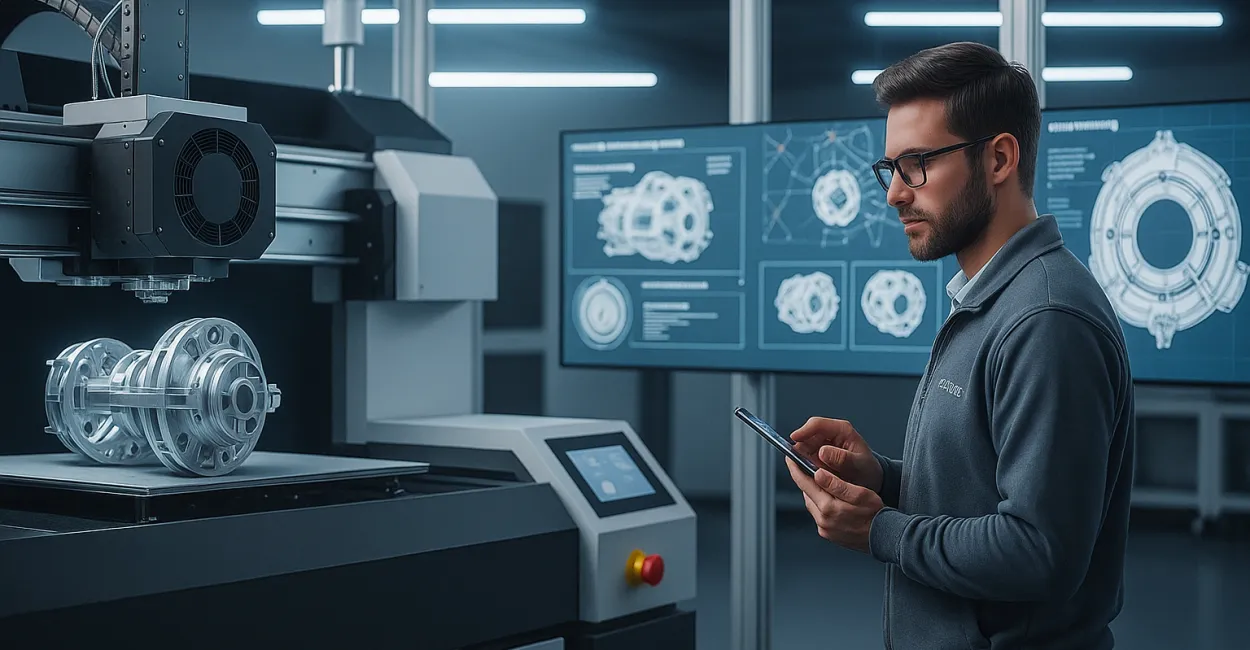
Digital manufacturing is no longer just a promise; it’s now part of everyday work in prototyping, medicine, education, and even industrial maintenance. 3D printing has become part of this landscape because it cuts steps, shortens testing cycles, and makes room for geometries that would be costly or impractical with traditional methods.

In practice, its impact goes beyond “the object coming out of the machine.” What really changes is the production model: fixed molds give way to digital files, and dependence on large batches gives way to on-demand customization. Read on to learn what this technology does, where it works best, where it falls short, and how to decide whether it makes sense for real-world projects.
What You Need to Know
- Additive manufacturing builds parts layer by layer from a 3D model, making it possible to create complex shapes with little material waste.
- FDM, SLA, and SLS solve different problems: low cost, high detail, and mechanical strength don’t come together equally easily.
- The technology’s biggest advantage isn’t “printing anything”; it’s speeding up validation, customization, and low-volume production.
- 3D printing isn’t the best fit for every project: high volumes, tight tolerances, and industrial-grade finishes still favor processes such as injection molding and machining.
- Choosing the right material, part orientation, and post-processing methods reduces failures and significantly improves the final quality.
3D Printing and Additive Manufacturing: What Really Happens Layer by Layer
Technically, 3D printing is the popular name for additive manufacturing: a process in which a machine reads a digital model and deposits material in successive layers to form a physical object. This is the opposite of subtractive manufacturing, which removes material through cutting, milling, or machining.
One detail many people overlook is that “printing” doesn’t mean “ready to use.” The result depends on three decisions made at the outset: geometry, material, and deposition technology. The same model can turn out beautifully with FDM and poorly with SLA, or vice versa, depending on the goal.
The real benefit of additive manufacturing isn’t replacing all industrial production; it’s making things better when shape, lead time, or customization matter more than volume.
The Technical Definition, in Plain English
Formally, it’s a digital manufacturing process based on CAD files, usually exported as STL or 3MF and processed by slicer software, which divides the model into layers. Put simply: you create or receive a file, adjust the settings, and the machine turns data into an object.
That may sound straightforward, but this is exactly where the difference lies between a functional prototype and a fragile part. Layer orientation, infill, nozzle temperature, and print speed directly affect strength, finish, and production time.
When FDM, SLA, and SLS Deliver Different Results
The three best-known technologies solve different problems. FDM is the most affordable and common option for home users and small businesses; SLA delivers much finer surface detail; and SLS stands out when a part needs mechanical strength and geometric freedom without support structures.
| Technology | Key strength | Typical limitation | Most common use |
|---|---|---|---|
| FDM | Low cost and simple maintenance | Visible layer lines and anisotropy | Prototypes, functional parts, education |
| SLA | High resolution and smooth surfaces | More sensitive resins and required post-curing | Dental work, jewelry, miniatures |
| SLS | Strong parts with no supports | Expensive equipment and an industrial process | Technical components and short runs |
Why Does the Finish Vary So Much?
Because each technology deposits material differently. In FDM, melted filament leaves visible layer lines; in SLA, resin is cured with light, producing much cleaner surfaces; in SLS, powder is sintered by a laser, resulting in strong parts with a grainier texture.
Anyone who works with 3D printing knows that the wrong technology choice often becomes clear only at the end, after the part has already used up machine time, material, and labor. A classic mistake is using FDM for a high-end cosmetic part or trying to meet a heavy-load requirement with an unsuitable resin.
Materials, Properties, and the Mistake of Choosing on Price Alone

Filaments and resins aren’t interchangeable. PLA prints easily and works well for visual prototypes; PETG balances convenience and strength; ABS handles higher temperatures; and nylon is often used when a part needs more serious mechanical performance. Resins come in rigid, flexible, dental, water-washable, and casting-specific formulations.
The problem with choosing based on the price of a spool or bottle is that a cheap material can end up costing more. If a part cracks, warps, or can’t withstand heat, rework can cost more than the initial savings. In industry, that matters.
Read also: Gene Therapies: A Revolution in Treating Inherited Diseases
The right material isn’t the strongest one in the catalog; it’s the one that suits the part’s function, its operating environment, and the machine available.
Practical Selection Criteria
- Operating temperature: Parts near a motor, in direct sunlight, or exposed to friction need more temperature-stable materials than PLA.
- Flexibility: Joints, seals, and snap-fit components may require TPU or flexible resins.
- Surface detail: Miniatures, molds, and dental applications are a good fit for SLA.
- Chemical resistance: Contact with oil, solvents, or moisture can completely change which material is suitable.
One thing to keep in mind: experts disagree on when a printed part is “strong enough.” It depends on layer orientation, wall thickness, load type, and even the expected failure mode. There’s no universal answer outside the context of use.
From File to Object: A Workflow That Prevents Rework
The process starts in CAD, moves to the slicer, and ends on the print bed, but success depends on what happens between those steps. STL is still widely used, though 3MF is gaining ground because it can store more project information. After that, factors such as layer height, supports, retraction, infill density, and speed come into play.
In practice, what most often undermines quality isn’t a “bad” machine; it’s a poorly prepared file. The part may come out in one piece but have weak walls, a warped base, or supports that are hard to remove. This comes up all the time in prototyping.
A Real-World Workshop Example
A small automotive products company needed to validate an internal bracket that customers would never see. The first version was printed in FDM, with walls that were too thick and a fit that was too tight. The team revised the model, reduced its mass, changed the orientation, and switched to PETG. The result was a functional, lighter part ready for testing in less than 24 hours.
This kind of rapid iteration is exactly where 3D printing creates value. The savings don’t come just from the finished part; they come from catching and correcting mistakes early, before they turn into a mold, a production run, or scrap.
Where the Technology Delivers Real Value
The automotive industry uses the technology for prototypes, jigs, assembly fixtures, and validation parts. In healthcare, it’s used for prosthetics, orthotics, anatomical models, and surgical guides. In education, it helps turn abstract concepts into tangible objects. And in industry, it cuts lead times for maintenance and tooling.
Usage and regulatory data help show how mature the market is. The FDA’s guidance on 3D-printed medical devices makes clear that healthcare applications require technical controls and rigorous validation. In Brazil, Anvisa, Brazil’s health regulatory agency, is the regulatory authority for many applications involving devices and materials. The technology’s industrial potential is also evident in analyses from McKinsey on advanced manufacturing, which describe digital production as part of the reorganization of manufacturing supply chains.
Where It Makes a Difference Fastest
- Functional prototyping: Validates shape, fit, and assembly without waiting for the mold-making cycle.
- Low-volume production: Short runs avoid large tooling investments.
- Customization: Prosthetics, orthotics, and made-to-measure products can be produced faster and more precisely.
- Auxiliary tooling: Jigs and internal fixtures make repetitive operations less expensive.
Limitations, Hidden Costs, and Where the Hype Goes Too Far
Not every application benefits in the same way. If the goal is to produce thousands of identical parts at the lowest possible unit cost, injection molding remains more efficient. If the part needs a mirror finish straight off the machine, it may be time to reset expectations. And if the application requires critical certification, the entire process needs more extensive validation.
There are also costs that marketing often leaves out: nozzle and resin maintenance, energy use, wear parts, post-processing, washing, UV curing, training, and operator time. In many operations, these combined costs matter more than the price of the machine.
3D printing works best when the goal is to speed up decisions, reduce inventory, or customize production; it loses ground when the only criterion is the cost per part at large scale.
Technical sources such as the NIST emphasize the importance of standardization, reproducibility, and process control in additive manufacturing. This matters because the same printer can produce very different results with two different profiles. Without a method, the technology becomes a lottery.
How to Choose a 3D Printer Without Falling for Empty Marketing
Choosing equipment doesn’t start with the brand; it starts with the application. An entry-level FDM machine can meet 80% of a beginner’s needs, as long as it’s suited to the application. Professional environments, on the other hand, need to consider build volume, accuracy, repeatability, technical support, and parts availability.
What to Consider Before Buying
- Main application: Prototype, finished part, cosmetic model, or tooling.
- Material required: PLA, PETG, ABS, TPU, resin, or polymer powder.
- Build volume: Will the whole part fit, or will it need to be split?
- Local support: Service, replacement parts, and documentation make a difference over the long term.
- Workflow: Is there space for post-processing and curing?
Getting started the right way tends to prevent problems later. The difference between an expensive hobby and a useful operation often comes down to the initial decision: matching the machine to the job. Buying more capability than you need can lead to frustration; buying a machine that’s too cheap for a critical part can, too.
The Near Future of Digital Manufacturing
The strongest trend isn’t a single machine taking over everything; it’s the combination of additive manufacturing with automation, generative design AI, and integration with hybrid production. That means printing part of a component, machining another part, testing digitally before manufacturing, and shortening the entire development cycle.
The most promising applications are those where time, customization, and fine-tuning matter more than traditional scale. In these cases, 3D printing stops being a novelty and becomes a tool for engineering, healthcare, and business. The next step for anyone looking to benefit from this technology is to assess a real application, compare total costs, and test a low-complexity part before taking on larger projects.
Frequently Asked Questions
Is 3D printing only for prototypes?
No. It first took off in prototyping, but today it’s also used for finished parts, tooling, orthotics, anatomical models, and low-volume production. The technology and the project’s requirements determine the best fit.
Which technology is best for beginners?
For most people, FDM is the most logical starting point because of its cost, availability, and ease of maintenance. If surface detail is the priority, SLA may make more sense. For industrial applications that require strength, SLS is worth considering.
Is a 3D-printed part as strong as a traditionally manufactured part?
It depends on the application. In some cases, yes; in others, not even close. Strength varies with the material, layer orientation, infill, and the forces applied to the part.
What are the biggest mistakes beginners make?
The most common mistakes are choosing the wrong material, ignoring print orientation, and expecting a perfect finish without post-processing. Another frequent mistake is buying a machine before defining its intended use.
Is 3D printing cost-effective?
It’s cost-effective when the goal is customization, low-volume production, shorter lead times, or rapid validation. For mass production, traditional processes usually offer a lower cost per part. A proper cost comparison always includes time, rework, and post-processing.
Which industries use this technology the most today?
Healthcare, automotive, engineering, education, dentistry, and jewelry are among the most active sectors. Each uses the technology differently, but all value faster development and greater design freedom.
Artigos Relacionados
 Technology in Agriculture: Innovation Transforming Modern Farming
 The 5 Most In-Demand Careers in Technology
 Assessing Learning: Modern and Innovative Methods for Students
 Educational Games: How Games Are Transforming Modern Education
 Healthcare Professions: Their Evolution and Impact on Modern Society
 Technology in the Workplace: A Complete, Practical Guide
