
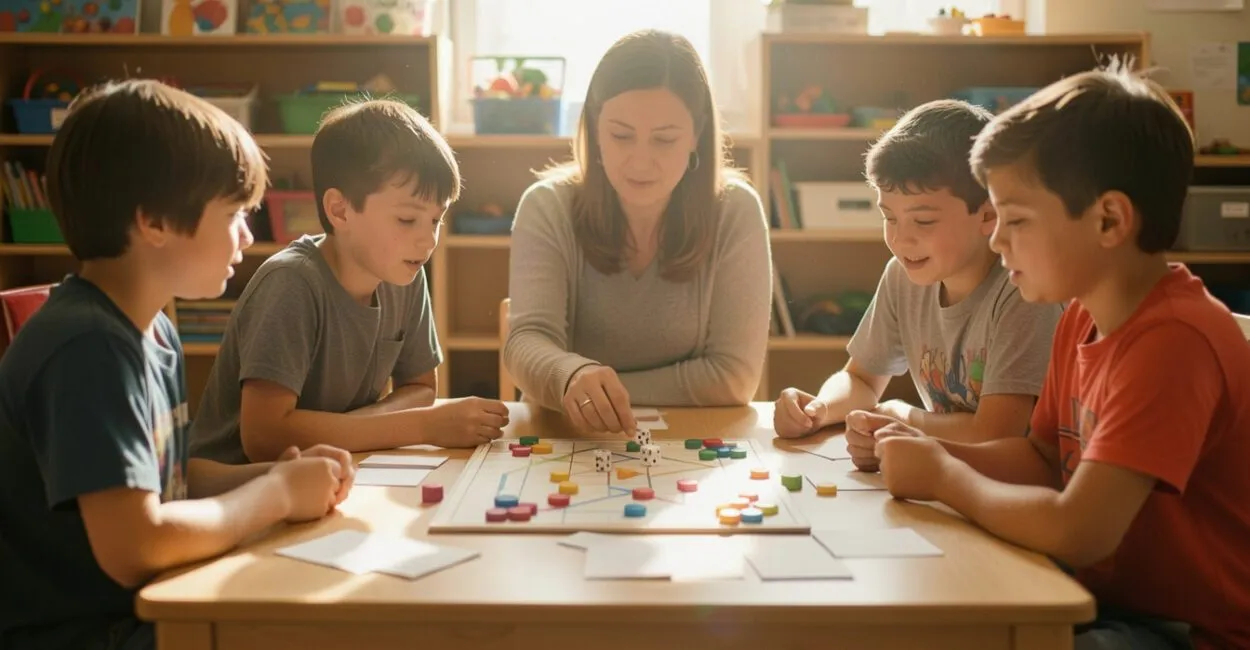
A class might get an answer right on the game board and still be unable to explain why a strategy works. That’s why math games need a clear learning objective: they help students practice concepts and reveal their thinking in grades 1–9. To choose an appropriate activity, consider the topic, students’ prior knowledge, age, and available resources. Then pair simple rules with questions that prompt students to explain their choices, compare strategies, and correct mistakes.
Before You Begin
- Identify the skill you want to observe, such as mental math, proportional reasoning, or pattern recognition.
- Check what students have already learned and what support they may need.
- Choose accessible materials: cards, dice, paper, pencils, or digital resources approved by the school.
- Plan how to form groups and monitor each student’s participation.
1. Understand What Math Games Help Students Develop
Math games are structured activities with rules, goals, and challenges that engage mathematical concepts and procedures. In the classroom, they help students practice content, develop strategies, and make their thinking visible, as long as the teacher connects the game to a learning objective. A round might focus on counting, mental math, estimation, reasoning, spatial awareness, or problem-solving. A game alone doesn’t guarantee that everyone will learn: some students may focus only on winning, while others need more time to understand the rules. Teacher guidance turns the experience into an opportunity for reflection.

Brazil’s National Common Curricular Base (Base Nacional Comum Curricular, or BNCC) organizes math learning into content areas such as Numbers, Algebra, Geometry, Quantities and Measurement, and Probability and Statistics. Use these guidelines to connect the activity to what students need to learn. To consult the official guidance, visit the BNCC page on the Ministry of Education website.
The educational value of a game becomes clear when a student can explain the strategy they used.
2. Choose an Activity Based on Your Goal and Class
Start with what you want students to do, not with the most entertaining materials available. A card game can help students practice basic addition facts; a fraction number-line game can prompt comparisons and explanations. Also consider the duration, class size, and students’ prior knowledge. A game with too many rules can take up class time before students get to the math skill. In large classes, stations with brief instructions and rotating roles help distribute participation.
Goal
Game idea
What to observe
Counting and operations
Number path with a die and calculation spaces
How the student counts and checks answers
Patterns and algebra
Sequences to complete or explain
Whether the student identifies and describes the rule
Geometry and measurement
Challenge to build shapes with pieces
How the student compares shapes, sides, and dimensions
Probability and statistics
Dice experiment with a record of results
How the student organizes data and interprets frequencies
A useful test is to ask whether students need to use the target concept to make decisions. If they can win without using the planned skill, revise the rules or choose a different activity.
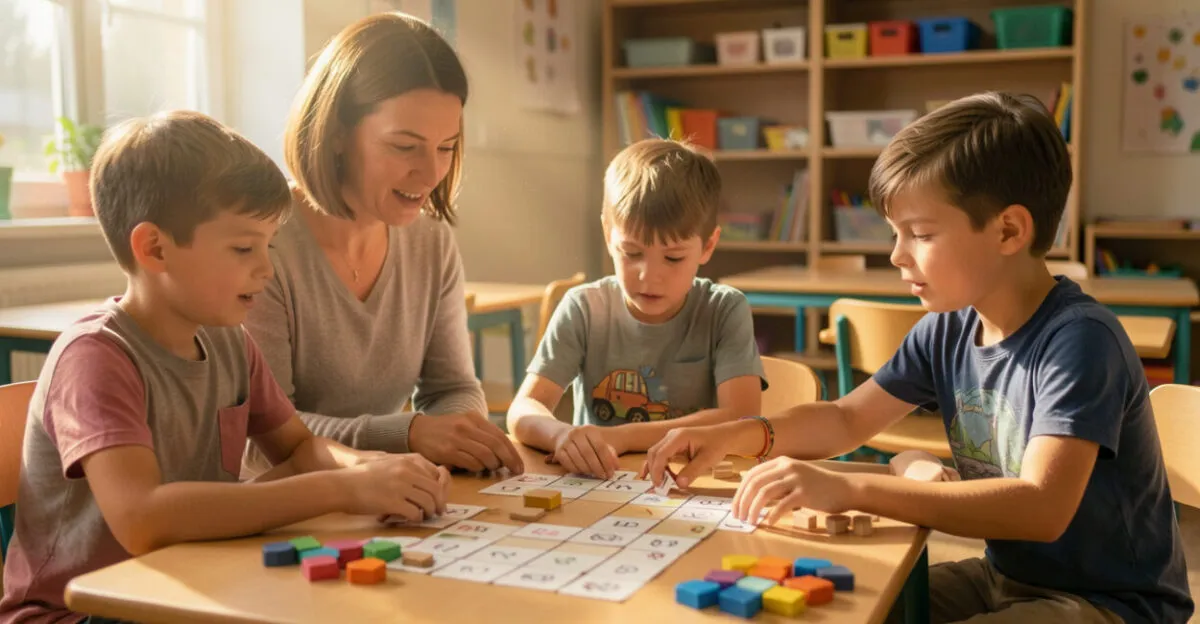
3. Plan Games for Grades 1–5

In the elementary grades, short, hands-on activities can support students’ understanding of quantities, operations, patterns, measurement, and problem-solving. Manipulatives help students represent ideas, but discussion about what they did is still essential.
Counting, Operations, and Patterns
To teach place value, give students digit cards and ask groups to make the largest number they can, explaining the value of each digit’s position. A number path with addition or subtraction spaces lets students practice mental math. To keep the die from determining nearly the entire outcome, add strategic choices or estimation challenges.
For sequences, present shapes or numbers and ask students to find the pattern and create another one for their classmates to solve. The correct answer is only part of the evidence: notice whether students can explain the repeating rule.
Measurement and Problem-Solving
A challenge to estimate and then measure classroom objects can become a collaborative competition: the group that best explains its estimates and records appropriate units wins. This activity connects measurement to familiar situations without requiring specialized materials.
Educational activities that combine movement and learning can also inspire adaptations, as long as each step has a clearly defined math question.
Read also: Multiplication Games: How to Practice Times Tables in Class
4. Raise the Challenge for Grades 6–9
In middle school, games can cover rational numbers, proportional reasoning, geometry, algebra, probability, and statistics. Increase the complexity of decisions, not just the number of calculations: older students also need to justify procedures and evaluate whether an answer makes sense.
- Rational numbers: In a fraction-path game, students must find an equivalent representation or compare values to move forward.
- Proportional reasoning: Recipe or scale challenges ask teams to adjust quantities and explain the relationship between them.
- Algebra: Cards with expressions and values let students explore equivalence and test conjectures.
- Geometry and statistics: Construction or data-collection games can end with a representation and interpretation of the results.
For example, a team gets a recipe for four servings and needs to adapt it for six.
Team members discuss which quantities change and calculate the new amounts.
Read also: Fraction Games: Fun Activities for Learning
Then another team checks whether the proportions remain consistent.
The final discussion shows whether students understood the ratio or simply multiplied numbers by trial and error.For more ideas that encourage exploration and creativity, see these creative education activities with hands-on experiences. Adaptations for teens should align with curriculum goals and students’ background knowledge.
5. Adapt Rules, Difficulty, and Accessibility
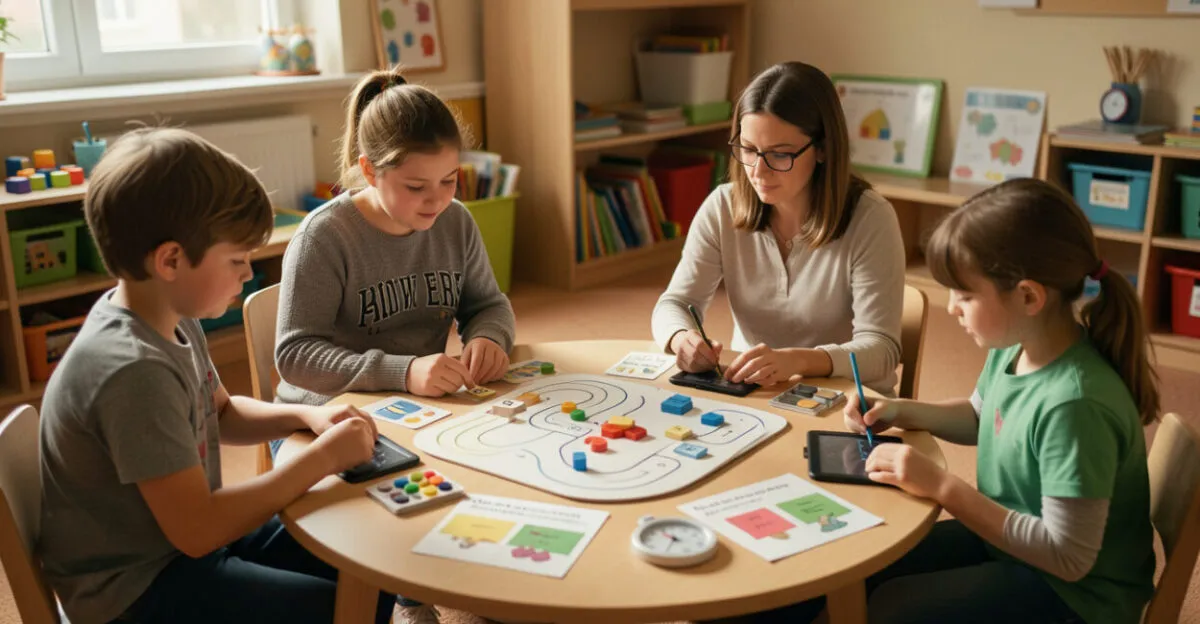
You can adapt the same activity for different skill levels by varying the numbers, visual supports, time, or number of steps. In a number-path game, for example, some students might solve addition problems with smaller numbers, while others explain operations involving rational numbers.
Avoid permanently grouping students by performance level. Pairs with rotating roles—one student calculates, one records, and one checks—can encourage participation, but monitor them to make sure no one always gets the easiest task.
For students who benefit from more explicit instructions, present the rules in steps, demonstrate a round, and keep visual references available. You can find more accessibility strategies in these resources on adapting materials for students with dyslexia. Individual adjustments should take the student’s needs and school guidance into account.
A well-adapted rule preserves the mathematical thinking while reducing barriers to participation.
6. Lead the Game and Assess What Students Learned
Before handing out materials, explain the goal, demonstrate a turn, and check that students understand how to win and record their answers. During the activity, circulate and listen: questions like “How did you decide?” or “Is there another way?” help distinguish understanding from a lucky guess.
A common mistake is to interrupt the game every time a student gives a wrong answer. Instead, ask the student to check their strategy, compare it with a classmate’s, or test their idea with an example. If the rules are causing widespread confusion, pause and explain them again; continuing the round won’t provide useful evidence.
Make brief notes: who explains procedures, who relies on counting one by one, who recognizes patterns, and who participates less. At the end, ask students to write a short individual response or explain their thinking aloud. Assessment combines performance during the game with this final check, because winning doesn’t prove mastery of the content.
7. Create, Print, or Find Games Using Clear Criteria
To make a simple math game, choose a skill, define a winning condition, and write a few rules. You can make a number path with paper, numbered spaces, a die, and question cards. Before using it with the class, test a round to identify unclear rules and check that the questions actually require the intended skill.
Math games you make yourself can be reused with new cards or difficulty levels. When looking for printable activities, check that the instructions are legible, that the materials work without relying on color, and that answers or teacher guidance are available.
For online math games, check for ads, data collection, compatibility with school devices, and accessibility. Searches like “Poki math games” may lead to entertainment options, but accounts or number challenges alone don’t make a resource educational. Check whether the game aligns with the planned skill and can be used safely.
Educational math games work best when the activity leaves a record of students’ thinking: an explained strategy, a written calculation, or a justified decision. Choose an activity, try it in class, and note what evidence you see; use those notes to adjust the next round.
Continue reading in this series
Frequently Asked Questions
How Do You Choose the Right Game for Each Grade?
Start with the curriculum skill and what the class already knows. Adapt the rules, numbers, and materials to students’ age, but make sure the challenge requires the thinking you want them to develop.
How Can You Adapt an Activity for Different Skill Levels?
Vary the difficulty of the numbers, offer visual supports, or allow more time while keeping the same central goal. Rotating roles in pairs or groups can also help, as long as everyone has a chance to think and explain.
How Can You Tell Whether Students Learned During the Game?
Observe students’ strategies and explanations, not just who won or got the answer right. Ask each student to explain their thinking at the end and compare it with your notes from the game. If a student can’t explain the procedure, you may need to revisit the concept.
Artigos Relacionados
 Fun First-Grade Math: Games, Activities, and Hands-On Ways to Explore Numbers, Shapes, and Logic
 Literacy Games for Third Grade: How to Use Them
 Math Homework: 9 Strategies to Guide Your Child
 Math Workshops: Hands-On Games for Understanding Concepts
 Multisensory Method: A Guide to Teaching Literacy with Purpose
 Educational best practices: A complete guide to transforming teaching
