
Fraction Games: Fun Activities for Learning
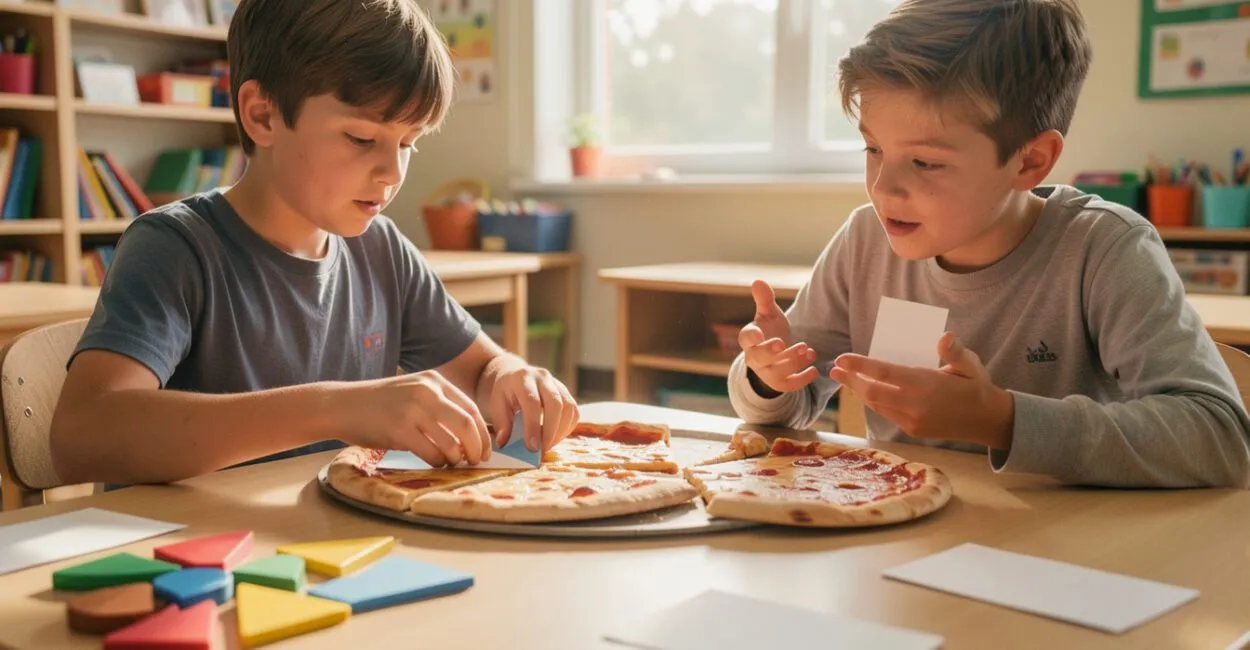
A slice of pizza can show why 1/4 isn’t always smaller than 1/3: it depends on the size of the whole being divided. Fraction games make ideas that can seem abstract on paper—such as parts of a whole, equivalence, and comparison—easier to see. With paper, tokens, or cards, you can set up activities for fourth, fifth, and sixth graders.
Fractions represent rational numbers and can indicate one or more parts of a whole divided into equal parts. The numerator tells how many parts are being considered; the denominator tells how many equal parts the whole was divided into. The activity works best when the child needs to explain what they made, rather than simply give an answer.

How Do You Choose Fraction Games Based on Grade and Skill?
Choose an activity based on the knowledge you want to assess and what the class has already studied. In fourth grade, focus on dividing a whole and using visual models; in fifth grade, move on to equivalence and comparison; in sixth grade, include operations with like and unlike denominators, based on the curriculum and students’ progress.
These grade-level steps aren’t strict boundaries: some fifth graders are ready to add fractions with unlike denominators, while some older students still need to compare concrete pieces. Brazil’s BNCC (National Common Curricular Base) guides the development of math skills throughout basic education, but a diagnostic assessment of the class should guide the choice of challenge. Consult the Base Nacional Comum Curricular, Brazil’s national curriculum standards, to connect activities to the expected learning goals.
Grade and focus Suggested challenge Fourth grade: representation Build and name equal parts of a whole. Fifth grade: equivalence and comparison Find different representations of the same value. Sixth grade: operations Add and subtract, explaining the common denominator when needed.
Which Games Help Represent Fractions with Pictures and Simple Materials?

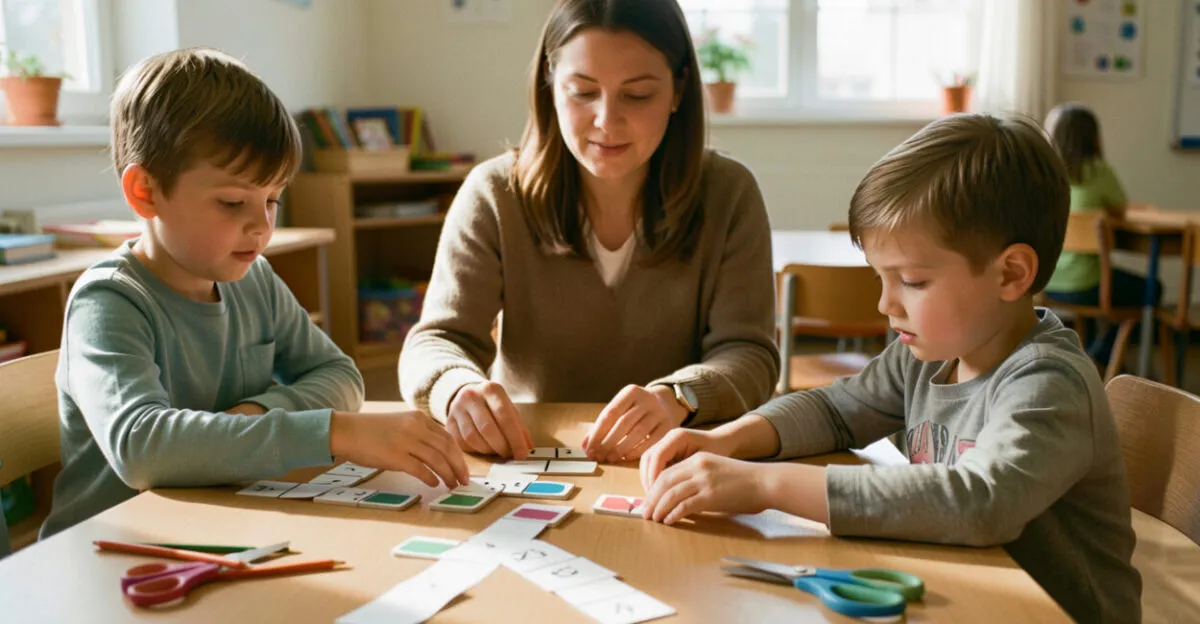
Picture dominoes and a fraction number line help connect numerical notation to the amount it represents. To get started, all you need is paper, a pencil, scissors, and strips of the same size; hands-on materials are useful because students can check whether the parts have equal areas.
Parts and Symbols Dominoes
Make cards with matching pairs: one side has a picture divided into equal parts, with some shaded; the other has a fraction, such as 3/4. Hand out the cards and have each player connect a picture to the matching fraction. If there’s a disagreement, the player must point out the numerator and denominator in the picture before continuing.
Floor Fraction Number Line
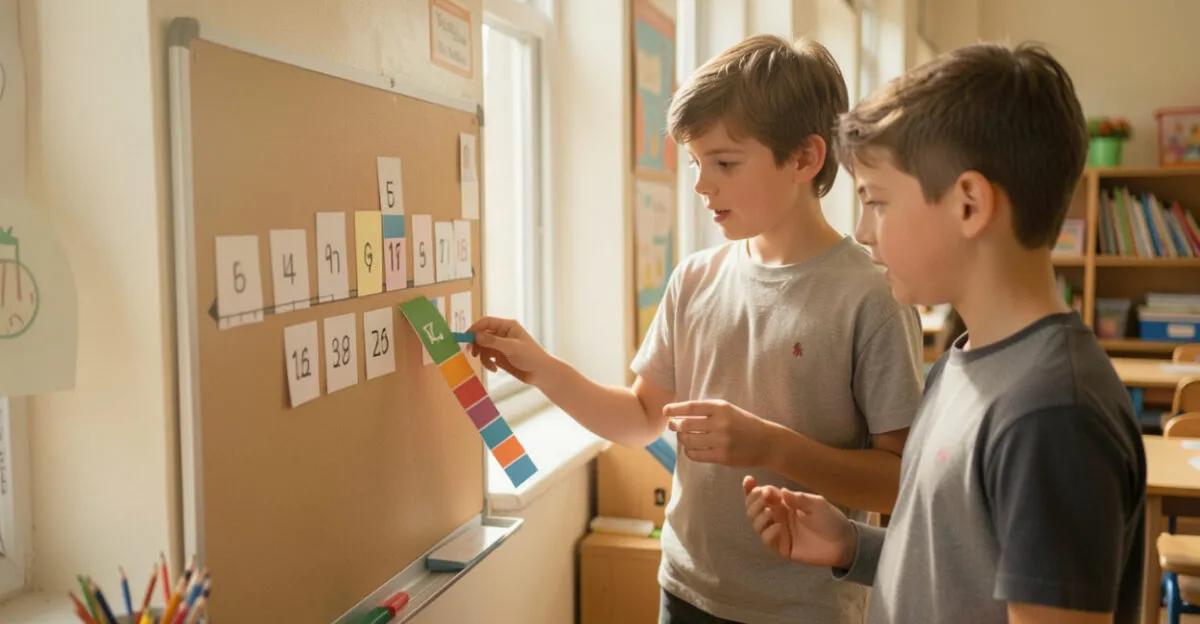
Draw a line from 0 to 1 on paper or mark one on the floor with tape. Hand out cards with fractions such as 1/2, 1/4, and 3/4; players place each one and explain their choice. In fourth grade, use small denominators and pictures; in fifth grade, add equivalent fractions such as 2/4.
One detail that often reveals an important misconception: a child may count the shaded parts correctly but accept a picture with unequal pieces as a representation of a fraction. Ask them to compare the size of each piece. To change things up and add movement, adapt ideas from educational games that make learning fun.
A fraction model only works when the whole is defined and divided into equal parts.
How Can You Teach Equivalence with a Card Game?
The “Equivalent Fractions Battle” game teaches students that different fractions can represent the same amount. Prepare cards with pairs such as 1/2 and 2/4, as well as fractions that aren’t equivalent, such as 1/3 and 2/3.
- Deal five or six cards to each player and put the rest in a draw pile.
- Each round, everyone plays a card and says whether it’s equivalent to any card already on the table.
- To validate the pair, the player must explain the relationship using a picture, paper strips, or by multiplying the numerator and denominator by the same number.
If the class hasn’t learned how to multiply a fraction’s numerator and denominator by the same factor, start with paper strips: fold one strip in half and another into four equal parts. When you compare 1/2 and 2/4, the covered areas line up. This visual check gives meaning to the numerical procedure instead of turning it into a rule to memorize.
Which Games Help Compare and Order Fractions?
“Fraction Auction” teaches comparison without relying on speed: the most convincing explanation wins, not the fastest answer. Prepare fraction cards and a number line from 0 to 1; each player chooses a card and places it where they think it belongs.
Read also: Multiplication Games: Practicing Times Tables in Class
To compare 3/8 and 5/8, for example, the class can see that the parts are the same size and that five of them represent more than three. But with 1/3 and 1/4, the parts of equal-sized wholes aren’t the same: dividing a whole into thirds makes larger pieces than dividing it into fourths. This distinction is a common stumbling block.
When denominators differ, use strips of the same length to support comparisons. In fifth grade, ask students to estimate where fractions fall between 0 and 1; in sixth grade, explore the number line and strategies such as finding common denominators, without requiring one method for every situation.
Complete guide: Math Games: A Guide to Teaching Grades 1–9
How Can You Practice Fraction Operations Through Games?
An operations game board turns sixth-grade fraction exercises into decisions students must explain. Use a die, game pieces, and cards with problems; each correct answer moves a player ahead one space, while an incomplete explanation gives them a chance to revisit their reasoning with a visual model.
Sample game board cards:
- 1/5 + 2/5 = ?
- 5/6 − 1/3 = ?
- 2/3 + 1/4 = ?
Answer key: 3/5; 1/2; 11/12. In the second problem, 1/3 is equivalent to 2/6, so 5/6 − 2/6 = 3/6 = 1/2. In the third, 2/3 is equivalent to 8/12 and 1/4 to 3/12, so the sum is 11/12.
When adding and subtracting, you can combine the numerators directly only when the denominators are the same, because the parts must be the same size. For unlike denominators, first find equivalent fractions with a common denominator. The Khan Academy offers math resources that can help review models and calculations before you prepare the cards.
When working with fractions, explaining the size of the parts is just as important as writing down the answer.
How Can You Prepare Activities to Print or Use in Wordwall?
A printed worksheet can become a game when it includes instructions, pictures, and space to explain answers. To create printable fraction games, arrange cards on a page, cut them out, and store each set in an envelope; you can also make them in black and white, using patterns instead of relying on color.
For a Wordwall activity aimed at fifth graders, choose the matching-pairs template and put fractions on one side and pictures or equivalent fractions on the other. Allow unlimited time if the goal is reasoning, and ask students to write in their notebooks why each pair matches. The tool organizes the interaction, but math discussions are still essential.
A quick-to-adapt worksheet could include six pictures divided into halves, thirds, and fourths; six matching fraction cards; and a final question: “How did you check?” This is a way to make fraction games available as a printable PDF without relying on a ready-made file. You can also copy the same instructions into a word processor, such as Microsoft Word, and save them as a PDF. For students who need extra support reading instructions, see these strategies for adapting materials for dyslexia.
How Can You Assess Learning and Turn Mistakes into Clues?
Observe whether students identify the whole, represent equal parts, explain equivalence, and choose a sound strategy. Getting one problem right doesn’t prove understanding: ask them to show the same answer with a drawing or explain how they checked it.
Record mistakes by the type of reasoning behind them, rather than marking only “right” or “wrong.” If someone adds the numerators and denominators in 1/4 + 1/4 and answers 2/8, revisit what the parts mean: two parts of a whole divided into fourths make 2/4, which is also equivalent to 1/2. If the difficulty is reading symbols and instructions, it may help to pair the game with teaching methods suited to the child’s needs.
There’s an important limitation: a game alone can’t show that a student understands all fractions. Performance may depend on reading skills, familiarity with the materials, and interactions with classmates. Combine observation during play with a short individual task, and revisit the concept when the explanation doesn’t support the answer.
What’s the Best Next Step for Using These Activities?
Choose one skill, try a short game, and note an observable sign of learning—for example, whether the student can explain why 2/4 and 1/2 occupy the same point on the number line. Then adjust the next challenge based on that evidence. This simple cycle helps keep play connected to math learning.
Question Quick answer Where should I start? Visual models with equal parts in fourth grade. How can I teach equivalence? Compare strips, pictures, or positions on the number line. How can students practice operations? Use cards with an answer key and ask for explanations. How can I assess learning? Look at the strategy, model, and explanation—not just whether the answer is correct.
How Long Should a Classroom Game Take?
A 10- to 15-minute round usually fits well into a class period, as long as the rules are brief and the goal is clear. Set aside a few minutes at the end to compare strategies and review mistakes.
Is It Better to Play in Pairs or Groups?
Pairs make it easier to hear each student’s thinking and reduce wait time. Larger groups can work if students have defined roles, such as organizing the cards, calculating, and checking the explanation.
Can I Use Pizza Pictures to Teach Any Fraction?
They’re useful for fractions of a whole, but can limit understanding when the whole changes or the fraction is greater than 1. Pair pizza pictures with strips and a number line to expand the range of models.
How Can I Include Students Who Haven’t Mastered Multiplication Facts?
Start with foldable materials, drawings, and small denominators, allowing students to check equivalence visually. Then introduce multiplication as a more compact way to record what they’ve already observed.
What Should I Do When a Student Gets an Answer Right by Guessing?
Ask for an explanation or a visual model before validating the answer. If the student can’t explain it, treat the correct answer as a starting point: redo the problem with pieces or drawings and ask what changed between attempts.
Artigos Relacionados
 Science Games for the Classroom: 5 Activities That Work
 Nature Games: 10 Ideas for Preschoolers
 Colors and Shapes Activities: Learning Through Play
 Fun Middle School Activities to Engage Students and Make Learning Stick
 Fun First-Grade Math: Games, Activities, and Hands-On Ways to Explore Numbers, Shapes, and Logic
 Language-Building Play: 10 Activities to Get Kids Talking
