
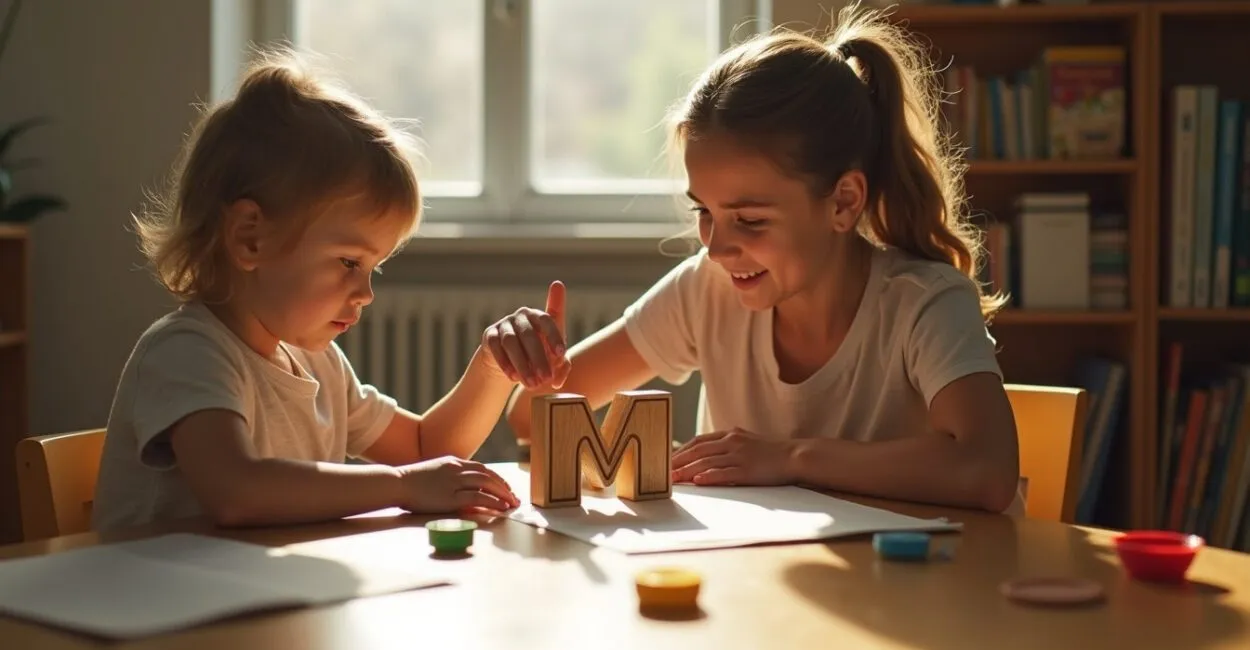
A child may recognize the sound of a letter when they hear it but hesitate when asked to identify it on the page. Multisensory activities help bridge these steps by combining sight, hearing, touch, and movement in reading and writing tasks.
When teaching literacy to children with dyslexia, this approach offers different ways to practice letters, sounds, and syllables. The ideas in this guide use accessible materials and can be adapted to a child’s pace. They support instruction but do not cure dyslexia or replace specialized educational interventions.

Key Takeaways
- A multisensory activity connects a learning goal with more than one sensory channel.
- Working on one relationship at a time, such as the /m/ sound and the letter M, helps keep the task manageable.
- Everyday materials, such as paper, modeling clay, and bottle caps, are enough for many activities.
- Progress shows up in accuracy and independence, not just speed.
What Are Multisensory Activities in Literacy Instruction?
Multisensory activities are teaching activities that intentionally and systematically engage two or more sensory channels to introduce and practice content. In literacy instruction, this might mean looking at a letter, hearing its sound, tracing it with a finger, and saying it while moving a game piece.
The child works on the same relationship in different ways.
This approach can support phonological awareness—the ability to notice and manipulate the sounds of speech—and learning the connections between graphemes (letters or groups of letters) and phonemes (speech sounds). For a child with dyslexia, explicit, structured practice with these connections is important.
Using sensory input alone does not guarantee learning: the task needs a clear objective and accurate feedback.
A good multisensory activity makes every action help the child notice, remember, or use the connection between a letter and its sound.
The National Center for Improving Literacy, affiliated with the U.S. Department of Education, offers resources on reading difficulties and literacy instruction. Its guidance can complement activity planning with explicit, systematic instruction: National Center for Improving Literacy.
How to Combine Sight, Hearing, Touch, and Movement
Choose a specific letter-sound connection, such as the letter F and its sound, and pair it with simple actions. The child looks at the printed F, listens to an adult model its sound, traces the letter with a finger, and says the sound. Movement should reinforce learning, not become a separate task that distracts from it.
One possible sequence is to introduce the material, model it, practice together, and then invite the child to try independently. If the child confuses the letter’s name with its sound, explain both explicitly: “This is the letter F; the sound we’re practicing is /f/.” In English, some letters can represent different sounds depending on the word, so choose an appropriate example and pronunciation for the context.
Consider a child who mixes up B and D during a writing activity. The adult presents one large letter at a time, says its name and relevant sound, and invites the child to trace it with a finger. Then the child finds the same letter among a few choices and says a word that starts with that sound.

Principles for Planning Activities for Children with Dyslexia

Planning works best when it builds on what the child already knows and advances one step at a time. A short session might focus on one letter, one syllable pattern, or one sound-segmentation skill. Practicing the same connection in different words helps show whether the child has learned it, rather than memorized a single answer.
Read also: Assessment Methods: How to Apply and Understand Them
- Set an observable goal: for example, identifying the first sound in familiar words.
- Model the response: explain what to do and demonstrate before asking the child to try.
- Reduce distractions: keep only the materials needed for that step in view.
- Give clear corrections: revisit the letter or sound, model it again, and offer another try.
Reading Rockets, an education and literacy initiative supported by educational organizations in the United States, offers materials on reading and learning difficulties. Families planning a child’s literacy journey may also find it helpful to consult guidance on when and how to begin teaching children to read and write.
Simple, Affordable Materials to Get Started
You don’t need to buy special kits. Paper and pencil can be used to draw large letters; modeling clay can be shaped into letters; grains or yarn can form outlines; and bottle caps can help separate sounds or organize syllables. A tray of flour can be used for tracing letters, as long as the child likes the texture and the surface is stable.
Complete guide: Activities for Dyslexia: 12 Literacy Practices
For some children, sand, glue, sticky textures, or overlapping sounds can be uncomfortable. If so, switch materials: the child can trace on paper for the tactile component, and the auditory component can be limited to the adult’s voice. Engaging multiple senses does not mean activating all of them at once.
Families looking for other ways to learn through play can try ideas from educational games using everyday objects, adapting each one to a language or reading goal.
Activities for Practicing Letters, Sounds, and Phonological Awareness
Build and Trace a Letter
Choose a letter the child has already been introduced to. Have them shape it with modeling clay or yarn, trace its outline with a finger while saying its name, and then say the sound being practiced. Finally, have them write the letter on paper and find a familiar word that contains that sound.
Beginning-Sound Hunt
Set out three or four familiar objects or pictures. Say a sound, such as /s/, and ask the child to find the item whose name begins with it. The child can touch the object, repeat the word aloud, and tap the table once when they identify the beginning sound. If the task is difficult, offer two choices and stretch out the word’s initial sound without distorting its pronunciation.
Words in Steps
Choose a short, familiar word. Have the child say it slowly, move one game piece for each sound they can identify, and then try to blend the sounds to say the whole word. Start with simple words and adjust the goal if segmenting them takes too much effort.
These activities don’t need to become a long sequence. A short game inspired by educational activities for different stages can provide an opportunity to practice, as long as the adult keeps the focus on the chosen skill.
How to Adjust the Difficulty and Prevent Frustration
When a child makes repeated mistakes, reduce the number of stimuli or return to a step they have mastered. Instead of asking them to identify a letter among eight cards, show them two; instead of segmenting a long word, choose a short, familiar one. The goal is to maintain a challenge without turning practice into a string of failures.
Also look for less obvious signs: taking a long time to get started, guessing, becoming irritated by a texture, or losing focus when there is noise. Sometimes the activity format—not the child’s understanding of the material—is the problem. Offer a simple choice, such as tracing on paper or shaping the letter with modeling clay, while keeping the same learning goal.
Every child has different needs. Some benefit from more repetition; others need breaks or a less cluttered visual presentation. Sensory activities may not be appropriate if they cause discomfort, and no activity at home can replace an evaluation or professional support when difficulties persist.
How to Track Progress and Keep Practice Meaningful
Record the skill being practiced, the type of help provided, and how the child responded. For example: “Identified the beginning sound in four out of five words with two visual choices.” This kind of note is more useful than simply writing “did well,” because it helps you see whether the child is responding with fewer prompts.
Revisit the activity in different situations: recognize the letter on another card, find the sound in a new word, or write the letter-sound connection without a model. If the child only gets it right with the same materials and in the same order, keep varying the examples before increasing the difficulty. The goal is to transfer learning, not accumulate tasks.
Multisensory literacy instruction is most meaningful when it is integrated with regular instruction and the needs identified by the family and school. To learn more about development and appropriate learning opportunities at each stage, see the article on child development and age-appropriate activities. Choose one skill for the next practice session, note how the child responds, and adjust the activity based on what you observe.
Do You Need to Use All Four Senses in Every Activity?
No. An activity should combine the channels that support its goal without adding unnecessary stimuli. For some children, two well-coordinated channels work better than a task with lots of sounds, textures, and movement.
How Long Should an Activity Last?
There is no single ideal duration for every child. Wrap up while the child is still willing to try, or take a break if their attention or accuracy drops; short sessions can be resumed later.
Can Multisensory Activities Replace Specialized Support?
No. These are instructional resources that can be part of a structured plan, but they do not replace an evaluation or educational or clinical support when needed.
What If the Child Doesn’t Like Modeling Clay or Sand?
Replace the texture with a comfortable option, such as tracing a letter on paper or following its outline with a finger on a card. A child does not need to overcome sensory discomfort to learn the connection between a letter and its sound.
How Can You Tell If the Child Is Making Progress?
Notice whether the child gets answers right with fewer prompts, recognizes the same connection in new examples, and can explain or demonstrate what they have learned. Record the skill practiced and the level of support needed instead of judging progress by speed alone.
Artigos Relacionados
 Dyslexia Activities: 12 Literacy Practices
 Science Games for the Classroom: 5 Activities That Work
 Literacy Games for Third Grade: How to Use Them
 Homework: How to Help Your Child Without Doing It for Them
 Diagnostic Literacy Assessment: 7 Activities to Try
 Interpretation Answer Key: Common Errors and How to Fix Them
