
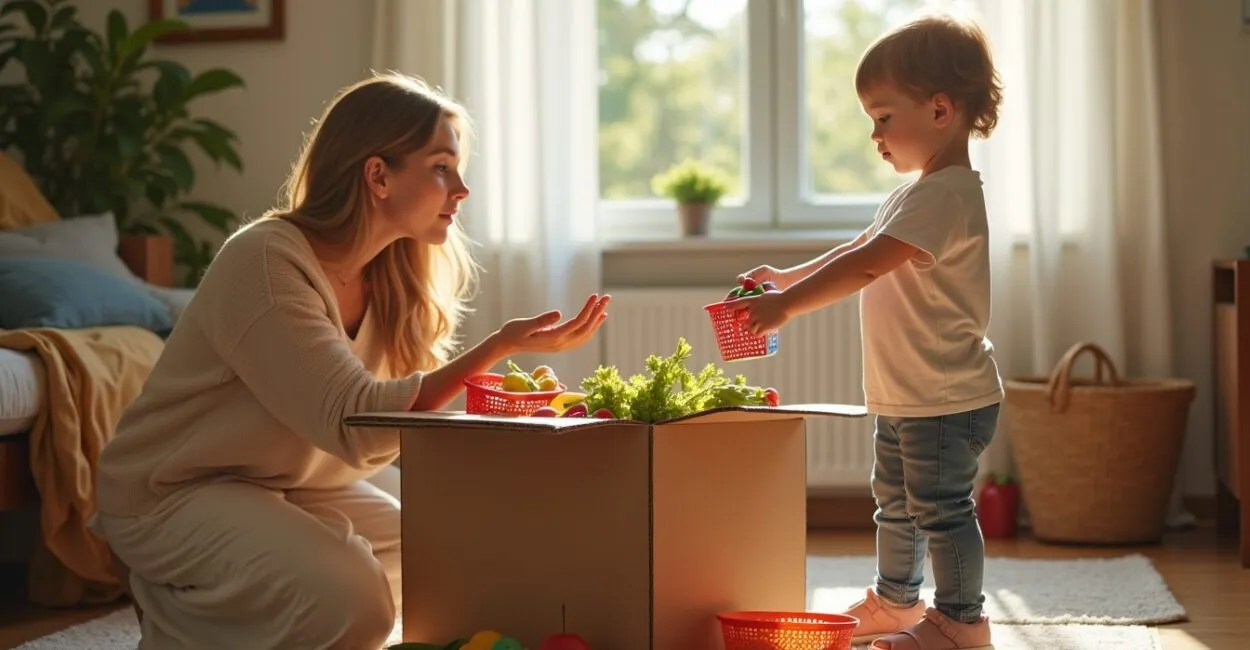
A cardboard box can become a grocery store, a spaceship, or the setting for a story in just a few minutes. Educational play uses simple materials and everyday situations to encourage language, reasoning, movement, and social skills—without making children feel like they’re following a disguised lesson.
To get started, try a color hunt, telling a story with objects, a pillow obstacle course, or hopscotch with numbers. Choose an activity based on the child’s age, available space, and interests. Learning happens through conversation, trial and error, and rules agreed on during play.

At a Glance
- For children ages 3 to 5, short activities and simple rules make it easier to participate.
- Household items like containers, socks, and boxes can support games that build language, sorting, and counting skills.
- Play has educational value when children explore, make choices, and interact—not when they have to get every answer right.
- In school, a connection to Brazil’s BNCC (National Common Curricular Base) depends on the educational purpose of the activity and on observing what children do.
Educational Play for Learning Through Play
Educational play includes playful experiences that are planned or adapted to support learning and child development, including communication, motor coordination, imagination, and social interaction. At home or at school, a few simple materials are all you need: a scavenger hunt, an invented story, or a game with a path can all create opportunities to think, talk, and move.
Here’s a familiar example: while sorting lids by color, a child may start counting them, switch to sorting by size, and then mix them all up again. That doesn’t mean the activity has gone wrong; it shows the child is exploring possibilities. Try not to interrupt every discovery to correct the child or turn play into a worksheet exercise.
If a child is interested in words, rhyming games and stories can complement activities that introduce reading and writing, without creating pressure to start formal reading instruction too early.
How to Choose Activities for Children Ages 3, 4, and 5
Age can help you tailor an activity, but it doesn’t determine what every child can or wants to do. Pay attention to how well the child understands the directions, their interest, and how comfortable they are with movement. If they get frustrated, simplify the steps or offer help. If the activity feels easy, invite them to make up a rule.
Age Activity to try Possible adaptation 3 years Sort toys by color or size Use just a few categories and large objects 4 years Make up a story using pictures Take turns choosing the next picture 5 years Set up a path and count the steps Invite the child to create and explain a rule
For 3-year-olds, one direction at a time is usually clearest: “Find something round.” At age 4, you can add choices and short sequences. Many 5-year-olds can negotiate more complex rules, though children develop at different rates. Information about child development at different ages can provide context, but shouldn’t be used as a rigid benchmark.
Stories, Rhymes, and Pretend Play to Build Language Skills

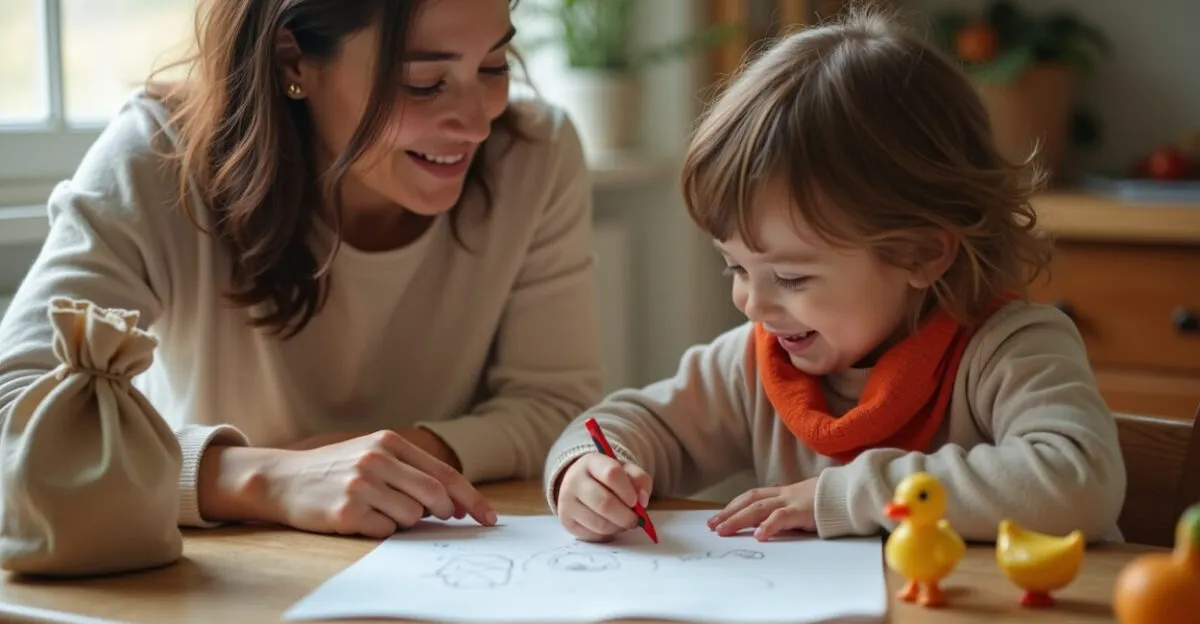
To play with words, put three objects in a bag and invite the child to make up a story that includes them all. An adult can start with a sentence, and the child can continue the story, draw a scene, or choose an ending. The goal is to encourage expression and listening, not to demand a complete or “right” story.
Rhyming games fit easily into everyday moments, too. Say a word like “cat” and look for other words that rhyme or sound similar. If the child can’t think of one yet, offer two choices. In a shared drawing, each person adds an element and explains what they imagined. Vocabulary and creativity grow through this exchange.
Read also: Recycling Activities for Kids: 8 Games That Teach Sustainability
When children can invent, explain, and change the story, language becomes part of play itself.
Pretend play gives children a chance to practice roles and social situations. A grocery store game, for example, offers opportunities to talk about requests, taking turns, and making choices. The adult can join in without controlling the whole story.
Read also: Cooperative Games for Kids Bring the Whole Group Together
Movement Games That Teach Numbers, Colors, and Shapes
Movement and learning can happen at the same time, as long as the directions don’t overwhelm the child. Set up a course with pillows on the floor, then ask the child to go through an imaginary hoop, take a certain number of steps to a marker, or find a blue object at the end. Use stable materials and keep the path clear of sharp corners and other hazards.
- Hopscotch with a twist: Draw squares with chalk and ask the child to say the number they land on. If they’re still working on their balance, they can walk through the squares instead of hopping.
- Shape hunt: Look for circles, squares, and rectangles on safe objects around the house or yard. The child can point to, draw, or group the shapes they find.
- Color delivery: Carry balls made from rolled-up socks to containers of the same color. To accommodate different motor skills, let children carry the object in their hands, on a tray, or roll it across the floor.
In a small space, replace hopscotch with squares made from sheets of paper secured firmly to the floor. Supervise the use of small objects, especially with children who still put things in their mouths.
Simple Games for Home, the Yard, and Outdoors
At home, you can set up a fishing game with large paper cutouts, play bowling with empty bottles, or make a trail of clues leading to a toy. Outdoors, hopscotch, tag, hide-and-seek, and duck-duck-goose combine movement with observation and social skills. Choose permitted areas away from traffic, and adapt the space to suit the group.
If you’re looking for a list of classic games or ideas for outdoor play, start with games that don’t require equipment: tag, freeze dance, and pass the ring. You can add a variation to any of them. In tag, for example, a child who gets tagged can rejoin the game after naming a color or choosing a classmate to help them.
Traditional rules vary by region and family. Rather than trying to recreate an “official” version of each game, ask children how they know it and agree on a safe way to play together.
Brazil’s BNCC, Early Childhood Education, and Intentional Teaching
In Brazil, the Base Nacional Comum Curricular (BNCC), or National Common Curricular Base, sets out learning rights and fields of experience for early childhood education, including “The Self, the Other, and Us,” “Body, Gestures, and Movement,” and “Listening, Speaking, Thinking, and Imagining.” An activity can connect to these fields when the educator decides what to observe and considers children’s actions and interactions. That doesn’t automatically make every game an activity aligned with the BNCC.
For example, hopscotch can involve movement, counting, and taking turns, depending on how the activity is led. Planning should account for the context, age group, accessibility, and meaningful participation by the whole group. The official reference is the Base Nacional Comum Curricular, from Brazil’s Ministry of Education.
For more guidance on routines and experiences at this stage, see these recommendations on supporting children in early childhood education. Activities may need adjustments: children of the same age have different interests and paces, and an activity that works for one group may not work for another.
How to Organize Group Games or an Inclusive Field Day
A field day can be cooperative: instead of rewarding only the first person to finish, the group can work together to meet challenges, such as finding shapes in the space or carrying balls to a basket. Explain the rules first, demonstrate the course, and offer more than one way to participate. When planning a field day, choose just a few activities and alternate between movement, observation, and creativity.
Check the floor and materials before starting, mark the boundaries, and make sure an adult is supervising. Avoid blindfolds, pushing, running on slippery surfaces, and small objects that children might swallow. If the group is large, split into small teams and allow breaks for water and rest.
Choose one activity to try this week and notice what sparks the children’s curiosity. Their responses can help you decide whether to repeat it, simplify it, or come up with a new rule.
How Can You Adapt a Game to Build Language Skills?
Add opportunities to name objects, describe actions, or make up what happens next. Ask open-ended questions and accept answers through speech, gestures, or drawings.
Which Classic Games Work Best Outdoors?
Hopscotch, tag, hide-and-seek, and duck-duck-goose are familiar options that require little equipment. Adapt the space and rules to the safety and abilities of the children playing.
Does an Activity Have to Follow the BNCC to Be Educational?
No. Brazil’s BNCC guides teaching in early childhood education, but a game at home doesn’t need a curriculum label to support learning. At school, educators are responsible for planning and observing these experiences.
Artigos Relacionados
 Colors and Shapes Activities: Learning Through Play
 Play-Based Learning in Elementary School: Learning Through Play
 Nature Games: 10 Ideas for Preschoolers
 Water Activities: Teach Sustainability Through Play
 Play-Based Activities and Child Neuroscience: 5 Effective Ideas
 Hands-On Learning Workshops: 12 Ideas for Schools
