
With pillows, boxes, and masking tape, you can set up a compact motor skills course and change the challenge without buying anything. The key is to adapt the route to the child and clear a safe area before you begin.
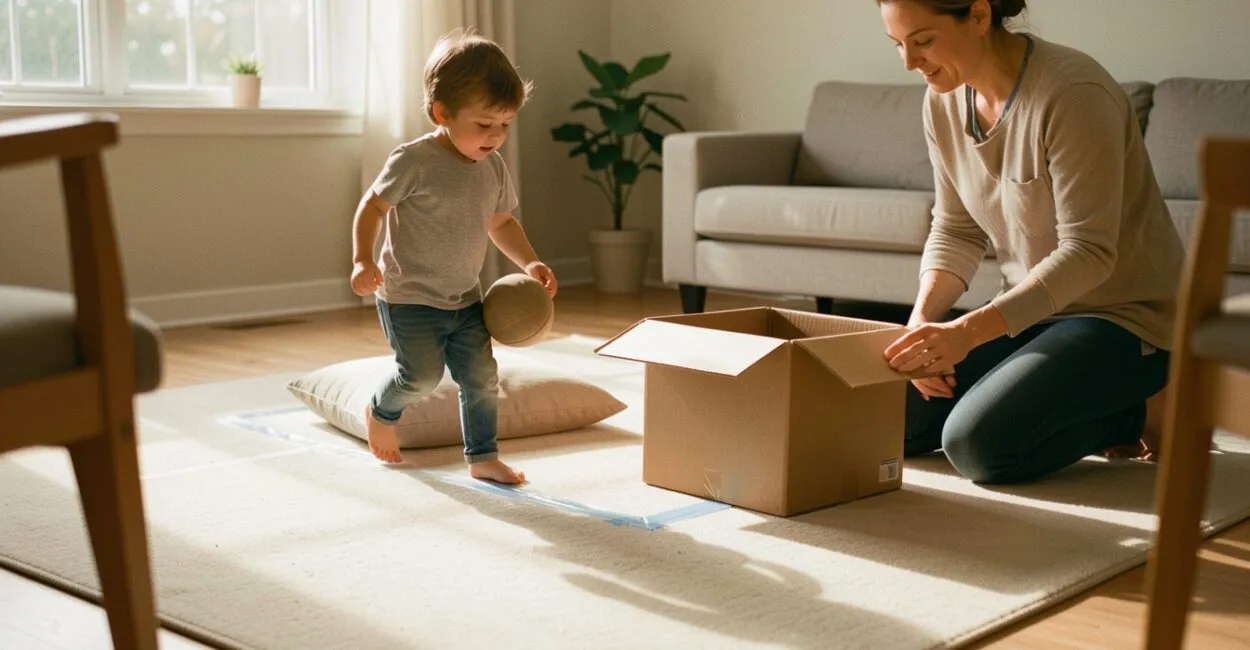
For Kids’ Day, the living room can become a course for practicing balance, movement, and coordination. A pillow works as something to walk around; an open box can be a target for carrying a lightweight ball to; and a line of tape on the floor becomes a path to follow.

You don’t need to add more steps to make the course harder. Increasing the distance between markers, changing the order, or asking the child to follow the path sideways can change the game. Start with just a few stations and supervise the child at all times.
How to Set Up a Safe Motor Skills Course With Household Items
A motor skills course is an organized sequence of movement tasks that invites children to practice skills such as balance, coordination, and moving from place to place. To set one up at home, choose low, sturdy objects, move furniture with sharp corners out of the way, and leave space between stations. The route should allow children to walk without slipping, bumping into things, or squeezing through tight openings.
Use masking tape that sticks firmly to the floor to draw a line or mark spots. Firm pillows can show where to stop or turn, while open boxes without staples can be used as targets for placing objects. Avoid using boxes to climb on, stack, or crawl through if they could tip over.
Complete guide: Kids’ Day in Early Childhood Education: Ideas by Age Group
Imagine a child who loses interest after two laps because the course has too many steps. By removing a station and leaving more space between the others, an adult makes the route clearer, so the child can choose how to proceed. A short, predictable, and stable route often works better than one packed with obstacles.
- Don’t use chairs, unstable boxes, or furniture as platforms.
- Remove loose rugs and make sure the floor is dry.
- Avoid running, high jumps, and any challenge without close supervision.
To expand your games with other types of sensory input, ideas for multisensory activities can inspire activities involving perception and movement.
Read also: Technology in Early Childhood Education: Innovations That Transform Children’s Development
Adapt the Challenge to the Child, Not Just Their Age
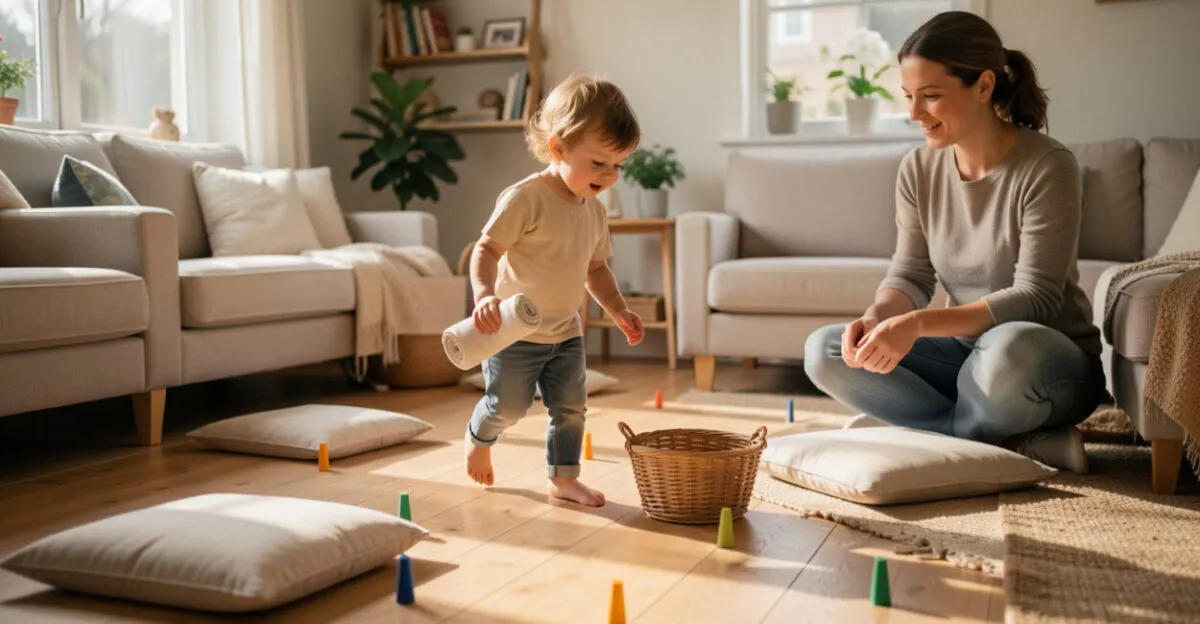
To vary the course, change one thing at a time: the distance between markers, the sequence of stations, or how children move through them. A young child might follow a wide line and walk around a pillow; another child with better balance and more confidence might walk along a narrow line of tape or carry a lightweight object while following the route.
Age is a useful guide, but it doesn’t tell you everything a child can do or wants to do. Notice whether the child can keep their balance, understands the instructions, and wants to try again. If they hesitate, trip often, or get frustrated, simplify the course: move the markers closer together, remove a task, or let them watch first.
It’s also worth giving children choices. For example, they can decide whether to walk around the pillow or follow the path. For ideas that use different materials and senses, see these creative early childhood education activities. Adapt the course to the child’s energy and interest in the moment; there’s no single progression that works for everyone.
The guidance from Brazil’s Ministry of Health on health and childhood can complement general care for children’s well-being. For play at home, the practical rule is simple: stay close and choose challenges that suit the space and the child’s observed abilities.
When to Simplify and When to Add a Station

Add a task when the child can complete the course safely and still seems interested. They could carry a rolled-up sock to a box or pause at each marker. If the space is small, shorten the route instead of placing obstacles too close together; narrow hallways and paths alongside furniture increase the likelihood of bumps.
If the child is tired, restless, or not interested, stop or turn the course into free play. Breaks are part of the activity. The goal is to make movement enjoyable, not to test performance or insist on practicing a particular skill.
If you’d like to try other educational activities, you can also find ideas for creative activities for kids. This kind of course doesn’t guarantee developmental outcomes; its effects depend on the child, the activity, and the supervision. Walk through the route yourself before inviting the child to try it. If you can’t get through easily, rearrange the room.
What Objects Can I Use in a Motor Skills Course?
Firm pillows, masking tape, and open boxes can serve as markers and targets, as long as they’re stable and free of sharp edges or staples.
How Can I Adapt the Course for Children of Different Ages?
Use age as a guide and observe each child’s balance, coordination, confidence, and interest. Change one variable at a time and supervise all children.
Does the Child Have to Complete Every Station?
No. They can skip a step, ask for a break, or end the game; insisting may turn movement into a frustrating experience.
Artigos Relacionados
 Industry-Recognized Online Course Certificates: How to Choose Trusted Platforms, Prove Your Skills, and Strengthen Your Resume Fast
 Treasure Hunt for Kids: Easy Clues for a Celebration
 Cooperative Games on Kids’ Day Bring Everyone Together
 Syllable Games for Dyslexia: 7 Ideas to Build Reading Skills
 Kids’ Reading: How to Support Portuguese Homework
 Early Writing: 7 Activities to Build Spelling Skills
