
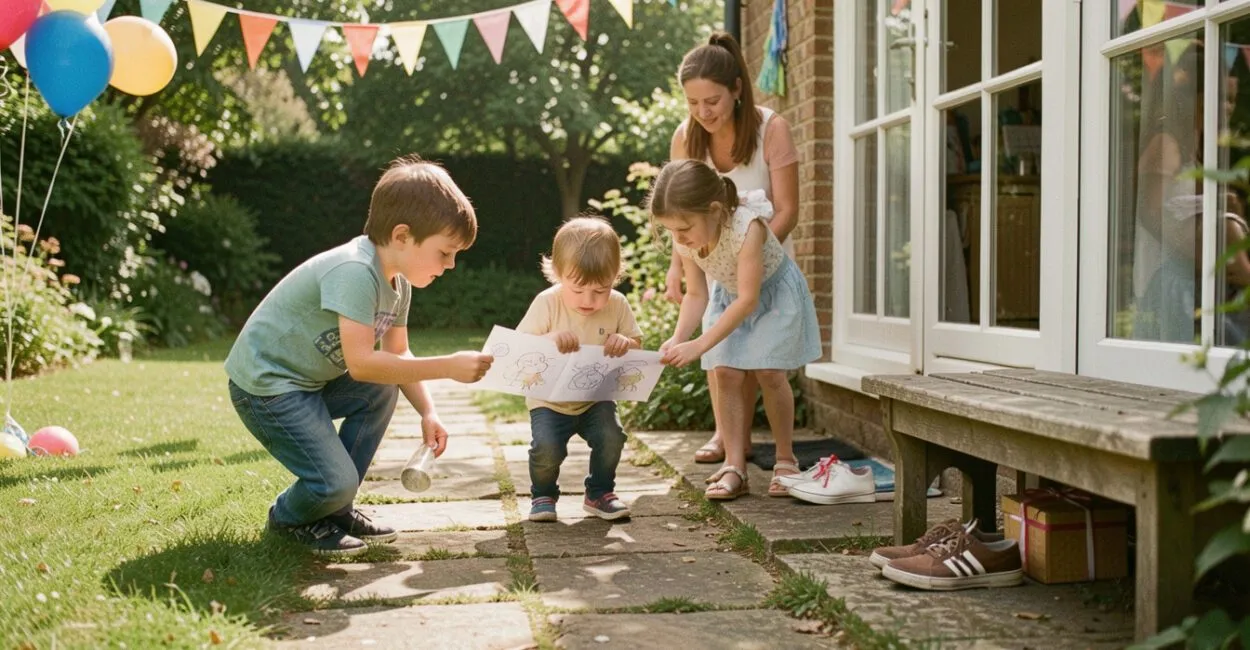
With a safe route and age-appropriate clues, a treasure hunt can turn a celebration into a series of small discoveries. The prize is just the final destination: observing, talking, and searching together keep the game engaging.
To get started, choose a simple treasure, decide where the children can go, and prepare clues they can understand. For kids who aren’t reading yet, a picture of a cup can point to the kitchen; in a small space, the hiding spots can be limited to a few rooms. The activity can be adapted for a home, backyard, or park.

Treasure Hunts Work Best with Age-Appropriate Clues
To put together a treasure hunt for young children, choose a final object, set a safe route, and use visual, spoken, or written clues suited to their age. A clue like “look where we keep our shoes” helps kids who aren’t reading yet; older children can solve a short riddle. An adult stays with the group and adjusts the pace.
This series of short challenges is a guided exploration game: each clue directs attention to the next place or object. In early childhood education, the activity can encourage observation, language, and cooperation without requiring special materials. Paper, drawings, and familiar objects are all you need.
Complete guide: Children’s Day in Early Childhood Education: Ideas by Age Group
Imagine a party where everyone races to find the prize. One child falls behind and loses interest; when the adult pauses and invites the group to describe the clue’s picture, that child joins in again. The pace of the game should follow the children, not the clock.
To mix things up, pair the treasure hunt with creative early childhood education ideas or activities that explore shapes and positions, such as geometry games.
Read also: How to Build Emotional Resilience in Children from an Early Age
From an Apartment to the Park: Adapt the Route and Clues
In indoor spaces, use nearby, accessible spots: a cushion, a low bookshelf, or the living room table. In the backyard, mark clear boundaries and use safe features, such as a bench or a sturdy planter. At a park, choose a defined area and keep the group within sight at all times.
You can change the format of the clues without changing how the game works. For children who don’t read, show them a photo or drawing; for those who understand spoken instructions, give a verbal hint; to include auditory cues, use a familiar sound, such as clapping near the next spot. Describing the clue also lets each child take part in their own way.
- Don’t hide objects in high, fragile, or hard-to-reach places.
- Avoid areas near stairs, outlets, cleaning products, or exits to the street.
- Don’t make reading, speed, or mobility a requirement for moving on.
- Set a clear boundary for the game and agree on a signal to bring everyone together.
If children have different ways of communicating or getting around, plan alternatives from the start: one child can point to a picture, describe what they see, or help choose between two clues. Ideas for multisensory activities can inspire clues using images, sounds, and tactile objects.
A good clue makes room for every child to contribute to the discovery.
The Treasure Can Be Shared, and Safety Comes First

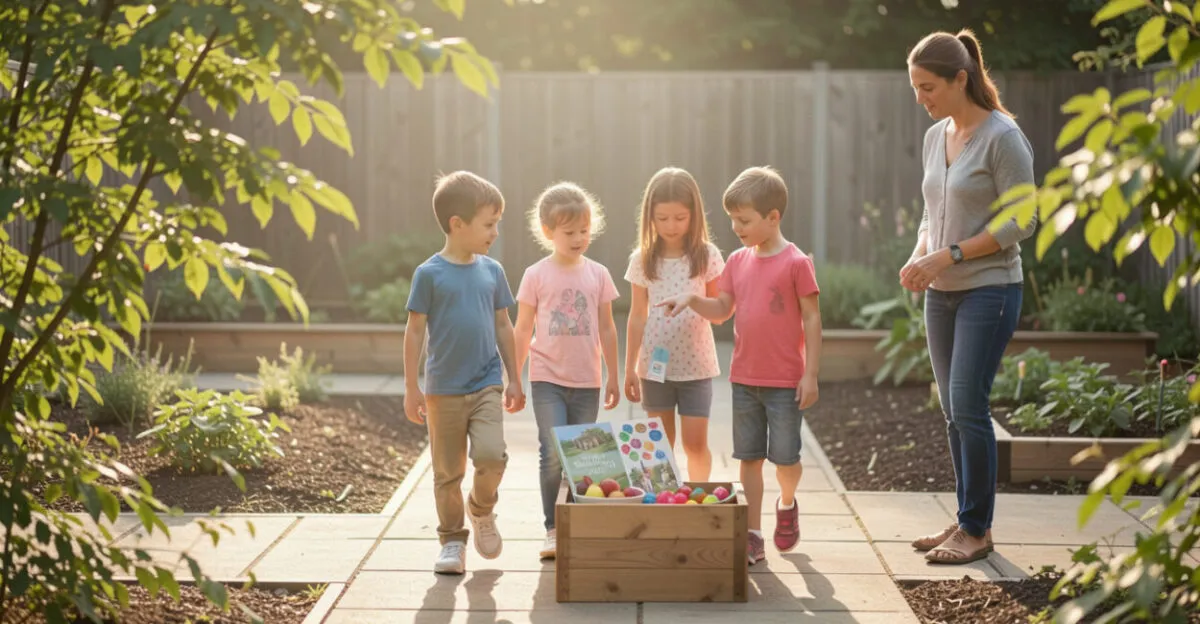
The treasure doesn’t have to be an individual gift. A book to share, fruit for a snack, or a box of stickers for everyone can keep the game from ending in a comparison between who finished first. You can also make the discovery itself the reward: a final message, a song chosen by the group, or a picture everyone puts together.
Agree on a few simple rules before you begin: walk, stay within the marked area, and get an adult if a clue isn’t visible. Brazil’s Base Nacional Comum Curricular (National Common Core Curriculum), from the Ministry of Education, emphasizes interaction and play in early childhood education; this can help you approach the activity as an opportunity to participate, not a test. Adaptations, however, depend on the children taking part and the space available: a clue that works at home may not be suitable for a busy park.
For children who are just starting to read, drawings can serve the same purpose as a written sentence. If the activity also sparks an interest in words, syllable games can complement the fun without turning the hunt into a required exercise.
Before the celebration, walk through the route once without the children. Check that every clue is within reach, the next hint makes sense, and there’s room for everyone to gather. A well-planned treasure hunt ends with the group finding something together—and eager to come up with the next one.
How Many Clues Should You Use in a Treasure Hunt?
Use only as many as needed to hold the children’s interest and fit the celebration’s schedule. A short sequence is usually easier for young children to follow.
How Do You Play with Children Who Can’t Read Yet?
Replace written sentences with drawings, photos, familiar objects, or spoken instructions. An adult can present the clue to the group.
What Can the Treasure Be?
A shared surprise, such as a book, a snack, or an activity chosen by the children, works well without rewarding whoever arrives first.
How Can You Adapt the Game for Different Needs?
Offer clues through images, sounds, or descriptions, and welcome different ways to participate, such as pointing, narrating, or helping choose the next spot.
Artigos Relacionados
 Cooperative Games on Kids’ Day Bring Everyone Together
 Kids’ Reading: How to Support Portuguese Homework
 School Garden: Simple Planting Activities for Kids
 Water and Energy Conservation: Hands-On Projects for Kids
 How to Teach Elementary School Kids About Money
 What Age Should Kids Start School in Europe? A Guide
