
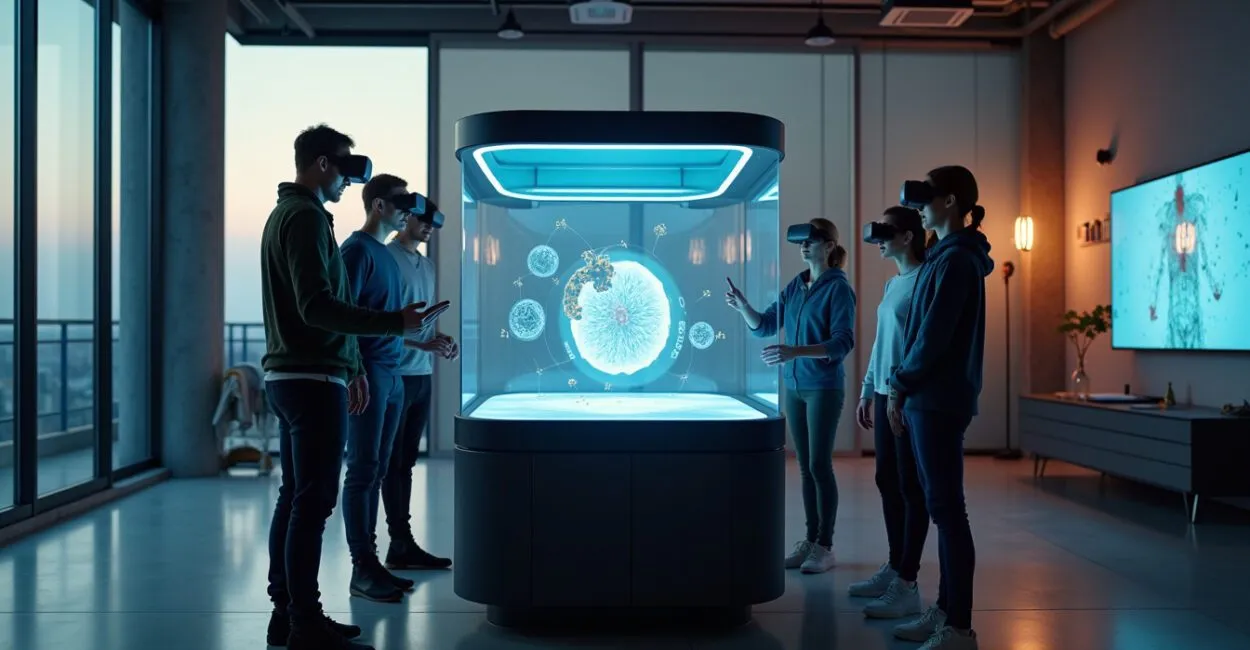
Educational metaverse refers to the use of immersive virtual environments to teach, learn, and collaborate with more presence, interaction, and context than a standard video conference can provide. The goal isn’t to “replace school with avatars,” but to enhance learning through simulations, virtual labs, guided tours, and real-time activities.

In practice, the right question isn’t whether this technology seems futuristic; it’s whether it solves a specific educational problem. In some cases, it does so very well: technical training, risk simulations, science education, communication training, and collaborative learning. In others, it becomes just another expense with little adoption. The focus here is separating real value from hype.
The Essentials
- The educational metaverse is an experiential layer, not an automatic replacement for in-person classrooms or traditional online learning.
- Educational benefits emerge when there are simulations, guided practice, social interaction, and immediate feedback.
- Without infrastructure, teacher training, and clear goals, the technology can become an expensive frill.
- Virtual reality in education and augmented reality in education are parts of the ecosystem, but they don’t encompass the entire concept.
- The best approach is usually hybrid: virtual learning environments combined with in-person or asynchronous activities.
What Is the Educational Metaverse, and Why Does It Matter in Digital Education?
The educational metaverse is a collection of persistent, interactive, and immersive digital environments where students and teachers meet through avatars, 3D objects, and shared spaces. Put simply, it’s a richer virtual classroom where the experience can include manipulating objects, running simulations, and collaborating in real time.
It matters because digital education has evolved from “watching content” to “taking part in activities.” When students enter an immersive experience, they stop being mere spectators and start taking action, testing hypotheses, and making mistakes safely. That’s where immersive learning makes a difference.
The metaverse works best in education when the goal is to practice, simulate, or explore something that would be expensive, dangerous, rare, or hard to access in the physical world.
This definition helps avoid overstatement. Not every subject needs a 3D environment, and not every course benefits from avatars, persistent worlds, or headsets. The value lies in the instructional design, not the visuals.
How the Educational Metaverse Works in Practice
In practice, it works like a virtual learning environment with layers of presence, interaction, and simulation. The class accesses a platform, enters a virtual classroom, interacts with classmates and digital objects, takes part in activities, and receives guidance from the teacher in real time or through a blended format.
The key is how the activity is designed. Anyone who works with this knows that a successful experience usually has a clear sequence: objective, task, challenge, feedback, and assessment. Without that sequence, immersion becomes a sightseeing trip.
A Typical Immersive Lesson
- The teacher sets a learning objective, such as understanding the water cycle or practicing customer service.
- Students enter a virtual space with avatars and interactive resources.
- They complete a hands-on task: solve a case, build a model, explore a scenario, or make decisions.
- The system records participation, time, choices, and performance.
- The teacher leads a closing discussion and connects the experience to the formal course content.
This can happen with a headset, browser, mobile app, or even educational augmented reality tools. In a low-cost project, for example, students can access a virtual lab on a computer and use QR codes to overlay 3D models in the classroom. The essential factor isn’t the most expensive device; it’s the relationship between the activity, its context, and learning.
A Real-World Example
In a nursing course, a class could practice triage in an emergency department using a virtual scenario. The teacher changes the patient’s symptoms and introduces noise, time pressure, and time limits. At the end, students review the decisions they made. This makes learning more closely resemble the realities of the job than a standalone lecture.
Key Benefits for Students and Teachers

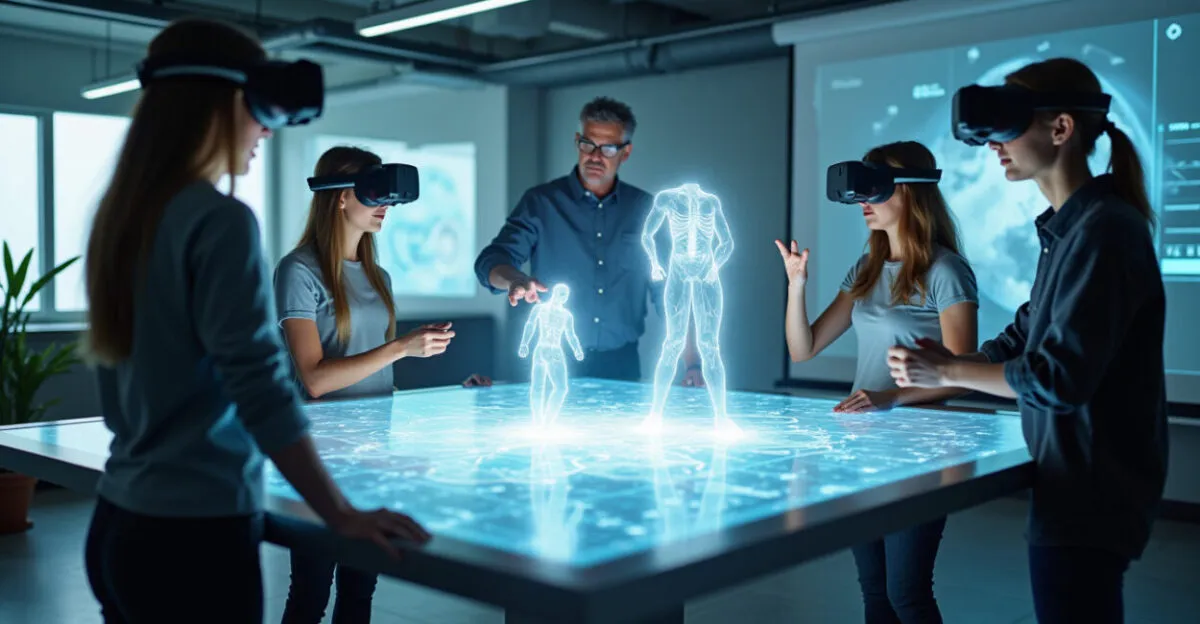
The benefits of the metaverse in education are most apparent when content requires practice, context, and interaction. For students, the advantage is learning by doing. For teachers, it expands instructional options beyond relying solely on slides, video lectures, or discussion boards.
What Changes for Students
- Greater engagement: Activities are more likely to hold students’ attention when they have to take action.
- Experiential learning: Simulations and 3D models make abstract concepts more concrete.
- A safe space to make mistakes: Virtual environments reduce risks in technical or emergency training.
- Meaningful collaboration: Students negotiate, discuss, and solve problems with other people, not just with the platform.
What Changes for Teachers
- More evidence of participation: Activities generate useful data for assessment.
- More instructional variety: You can combine immersive remote learning, case study, and guided practice.
- Clearer explanations of complex phenomena: Anatomy, architecture, physics, and history benefit from interactive models.
The greatest benefit of the educational metaverse isn’t that it “looks modern”; it’s that it narrows the gap between content, practice, and real-world context.
There is, however, an important nuance: this approach works well for objectives involving application and simulation, but is less effective for tasks that rely more on close reading, original writing, or thoughtful debate. Immersion doesn’t benefit every subject; in some cases, it can even make things worse if the environment distracts more than it teaches.
Examples of Use in Schools, Universities, and Businesses
How the educational metaverse is used varies considerably by audience. In schools, the priority is usually engagement and visualization. In universities, the focus is more on labs, applied research, and professional simulations. In businesses, the emphasis is on training, standardization, and safety.
| Setting | Typical use | Main benefit | Common limitation |
|---|---|---|---|
| Schools | Virtual field trips, science, history, geography, and interactive projects | Engagement and visualization | Uneven infrastructure |
| Universities | Virtual labs, clinical practice, architecture, engineering, and simulations | Application and practice | Teacher adoption curve |
| Businesses | Onboarding, workplace safety, sales, customer service, and compliance | Standardization and repetition | Costs and LMS integration |
Schools
In schools, a good use case is exploring ecosystems, museums, or historic sites in 3D. Instead of just “learning about” a topic, the class moves through the environment and makes guided discoveries. For younger students, this builds spatial understanding and helps them retain concepts.
Read also: School Curriculum: Effective Design and Structure
Universities
At the undergraduate and graduate levels, the metaverse tends to be most effective in courses where mistakes can have serious consequences: medicine, nursing, engineering, design, and applied law. Universities such as edX and institutions that use advanced simulations show that hybrid learning tends to be more effective when the virtual environment complements the physical lab rather than trying to replace it.
Businesses
In corporate training, immersive remote learning helps recreate scenarios that are difficult to scale in person. A customer service team can practice conversations with customers; a safety team can simulate an evacuation; new employees can learn processes in a safe, repeatable environment. For this use, integration with the LMS and HR system is critical.
Read also: Environmental Activities to Color
Technologies That Make the Educational Metaverse Possible
The educational metaverse doesn’t depend on a single technology. It comes from combining virtual reality, augmented reality, 3D modeling, graphics engines, reliable connectivity, and collaboration platforms. In many projects, the web already provides much of the experience without requiring powerful hardware.
The most common ecosystem includes:
- Virtual reality (VR): Creates full immersion, useful for simulations and training.
- Augmented reality (AR): Adds digital objects to the physical environment.
- WebXR: Enables immersive experiences in a browser on compatible devices.
- 3D engines: Such as Unity and Unreal Engine, used to build environments and interactions.
- LMS: Learning management systems that organize content, attendance, and assessments.
- Avatars and motion capture: Enhance social presence and expressiveness.
For infrastructure, the difference between a viable project and a frustrating one usually comes down to three factors: bandwidth, device compatibility, and technical support. The OECD’s work on education and technology emphasizes this point: educational innovation depends less on gadgets and more on aligning infrastructure, teachers, and objectives.
Challenges, Risks, and Limitations of Adoption
The biggest mistake is treating the metaverse as a universal solution. It doesn’t replace good teaching, fix a poorly designed curriculum, or make up for a lack of teacher training. In some settings, costs rise faster than educational results.
Key Obstacles
- Upfront costs: Development, licenses, devices, and maintenance put pressure on budgets.
- Accessibility: People with visual or motor impairments, or sensitivity to VR, may face barriers.
- Teacher training: Teachers need to understand both the tool and the method.
- Privacy and data: Immersive environments can collect a wide range of usage data.
- Technological distraction: The visual experience can compete with the learning objective.
Experts disagree about how quickly adoption should advance. Some advocate rapid expansion; others recommend short pilots and careful evaluation of results. The safest position is in the middle: test against clear criteria, measure learning, and scale only when there is evidence of improvement.
For a more regulatory and rights-focused perspective, it’s worth following the data protection guidance of ANPD (Brazil’s National Data Protection Authority) and international discussions about digital inclusion. This matters in education because immersive platforms handle identity, behavior, and sometimes students’ sensitive data.
Virtual reality projects in education are more likely to fail because of poor implementation than a lack of technology.
How to Successfully Implement the Educational Metaverse
The safest approach is to start small, with a clear problem and defined metrics. Instead of “adopting the metaverse,” choose a use case: clinical simulation, virtual field trip, sales training, science lab, or collaborative activity for a challenging topic.
A Practical Step-by-Step Guide
- Define the learning objective and success metric.
- Choose content where the experience can make a real difference.
- Test the technology with a small group.
- Train teachers or facilitators before opening it up to the full class.
- Measure engagement, learning, and accessibility.
- Revise the plan based on the results.
In practice, simpler projects are more likely to become part of the routine. A virtual lab that runs in a browser can deliver more value than a sophisticated experience that’s difficult to access. This is especially true in public schools, institutions with tight budgets, and distributed corporate teams.
Before scaling up, it’s worth asking four straightforward questions:
- Does this format help students learn better?
- Can the teacher guide the activity with confidence?
- Can the current infrastructure support it?
- Is there a less expensive alternative that would deliver similar results?
If the answer is “no” to two or more questions, the investment needs to be reconsidered. If the benefits are clear, adoption makes sense as part of a broader education innovation strategy, not as a standalone trend.
The Future of the Metaverse in Education
The most likely future isn’t an entire school inside a virtual world. It’s a mix of physical environments, online platforms, and occasional immersive experiences used when they make educational sense. The real trend is integration, not total replacement.
Progress is expected in three areas: lighter browser-based experiences, integration with artificial intelligence for tutoring and feedback, and greater interoperability between platforms. This should reduce access barriers and make it easier to create virtual classrooms that are more useful for digital education and professional development.
The educational metaverse is likely to grow where there is a clear purpose, well-designed lesson plans, and basic infrastructure. Where there is only technological curiosity, it is likely to lose ground. The difference between lasting adoption and a passing experiment will continue to be educational, not aesthetic.
Next steps: Choose one use case, compare two solutions, run a short pilot, and evaluate whether the experience actually improves learning. If there’s no measurable benefit, the right decision is to simplify the strategy, not double down on the technology.
Frequently Asked Questions
What is the educational metaverse?
It’s the use of immersive virtual environments for teaching and learning. These environments allow interaction through avatars, simulations, collaboration, and exploration of 3D content. The goal is to improve the quality of the experience, not just make it feel new.
What are the benefits of the metaverse in education?
The main benefits are engagement, safe practice, visualization of complex concepts, and real-time collaboration. It can also help with technical training and simulations that would be expensive or risky in the physical world. The actual benefits depend on the activity’s objective.
Does the educational metaverse replace the traditional classroom?
No. It works best as a complement to the traditional classroom, hybrid learning, and virtual learning environments. In many cases, combining in-person and immersive learning produces better results than trying to replace everything with a single platform.
What technologies are needed to use the metaverse in education?
The technologies vary, but usually include virtual reality, augmented reality, 3D engines, a browser compatible with WebXR, an LMS, and reliable connectivity. For some projects, a computer or smartphone is enough; for others, a headset makes a difference. It all depends on the desired level of immersion.
What are the main challenges of implementing this solution?
The most common challenges are cost, accessibility, teacher training, data security, and infrastructure maintenance. There’s also a risk that a project will focus on the technology and lose sight of its educational purpose. That’s why short pilots and clear metrics are the best place to start.
Is it worth adopting the metaverse in education now?
It’s worth considering when there’s a clear use case and an institution willing to test, measure, and adjust. If the goal is just to follow a trend, the chances of disappointment are high. Adoption makes sense when the immersive environment improves something that other formats can’t address as effectively.
Artigos Relacionados
 Environment and Education in the 21st Century: Pathways to a Sustainable Future
 Bilingual Education: Benefits, Challenges, and Impact on Learning
 Assessing Learning: Modern and Innovative Methods for Students
 Early Childhood Education: The Importance of Play in Child Development
 Childhood and Learning: How They Shape Adult Life
 Automated Learning Tools: A Complete Guide to Better Learning
