

A child who confidently reads “duck,” “table,” and “ball” isn’t just getting short words right; they’re building a solid grasp of the alphabetic principle, the foundation for decoding any text more independently. When activities with simple syllables are thoughtfully chosen, they can speed up this process by helping children recognize sound and letter patterns that recur in everyday words.
In practice, what helps most isn’t repeating the same worksheet. It’s combining phonological awareness, reading CV syllables (consonant + vowel), word building, and small, real-world opportunities to use these skills. That’s what this article covers: what simple syllables are, why they work, which activities to try, and how to adjust the difficulty without holding a child back.

The Essentials
- Simple syllables are generally short, regular patterns such as PA, ME, BO, LU, making them ideal for starting or reinforcing decoding skills.
- Children get the most out of activities when they read, build, compare, and write syllables instead of just marking answers on a worksheet.
- Short activities with varied repetition and immediate feedback tend to work better than long, tiring sessions.
- Children progress at different rates. If a child’s phonological foundation is shaky, it’s worth taking a step back before increasing the complexity.
- Decodable books, card games, and guided reading of short words tend to build more confidence than isolated lists of syllables.
Simple Syllable Activities to Build Reading and Writing Skills
To define the term precisely, simple syllables are units with relatively regular structures, often of the CV type, where the relationship between letters and sounds is more predictable for a child. In everyday terms, these are words that are “easier to break into sounds,” such as pa, mesa (table), lobo (wolf), and fuma (smokes).
This kind of practice helps because it reduces the demands on memory and lets students focus on the relationship between graphemes and phonemes.
What These Activities Include
In literacy instruction, these activities include reading syllables, building words, matching pictures to short words, syllable dictation, and rhyming or alliteration games. Anyone who works with young readers knows that children don’t learn just by “looking at” a syllable; they need to manipulate the sound unit repeatedly until they recognize the pattern effortlessly.
Why This Works So Well at the Beginning
Children’s brains learn patterns through repetition with variation. When a child sees PA, PE, PI, PO, PU in different contexts, they begin to recognize regularities and read with greater confidence.
This progress is consistent with what literacy research calls early reading fluency: less effort spent decoding and more attention available for comprehension.
The real benefit of simple syllables isn’t the number of exercises; it’s the quality of the repetition. Before a child can respond automatically, they need to read, combine, and test what they’ve heard.
For readers interested in comparing this approach with reference materials, the MEC website (Brazil’s Ministry of Education) offers broad educational guidelines, while resources from the Ayrton Senna Institute, a Brazilian education nonprofit, discuss learning and efforts to help students catch up on reading skills. Research on reading development at Brazilian universities also helps explain why a strong phonological foundation matters so much in the early years.
How to Choose Syllables and Words Without Confusing Kids
Not every short syllable is right for every stage. In an early literacy classroom, the safest progression usually moves from familiar to new: individual vowels, common CV syllables, two-syllable words, and then combinations that require greater independence.
Introducing patterns like “QUE,” “GUE,” “NH,” or consonant blends too early can create confusion when the goal is to build confidence.
Practical Ways to Choose the Right Level
- Choose syllables with consistent sounds that appear often in the child’s vocabulary.
- Use concrete words with clear images before introducing abstract terms.
- Mix reading aloud with visual recognition to avoid rote learning.
- If a child stumbles on three or more attempts in a row, the level is too difficult.
An Example of a Realistic Progression
Start with PA, PE, PI, PO, PU; then move on to PÁ, PÉ in words such as pato (duck), pipa (kite), and polo (polo). Only then move on to longer words, such as papel (paper) and pipoca (popcorn). This sequence isn’t rigid, but it works because it gives children time to consolidate patterns before adding too much variation.
Children make fewer mistakes when activities follow a progression in complexity. A lot of early mistakes don’t necessarily signal a learning difficulty; often, they mean the activity moved too fast.
Reading Games That Really Work

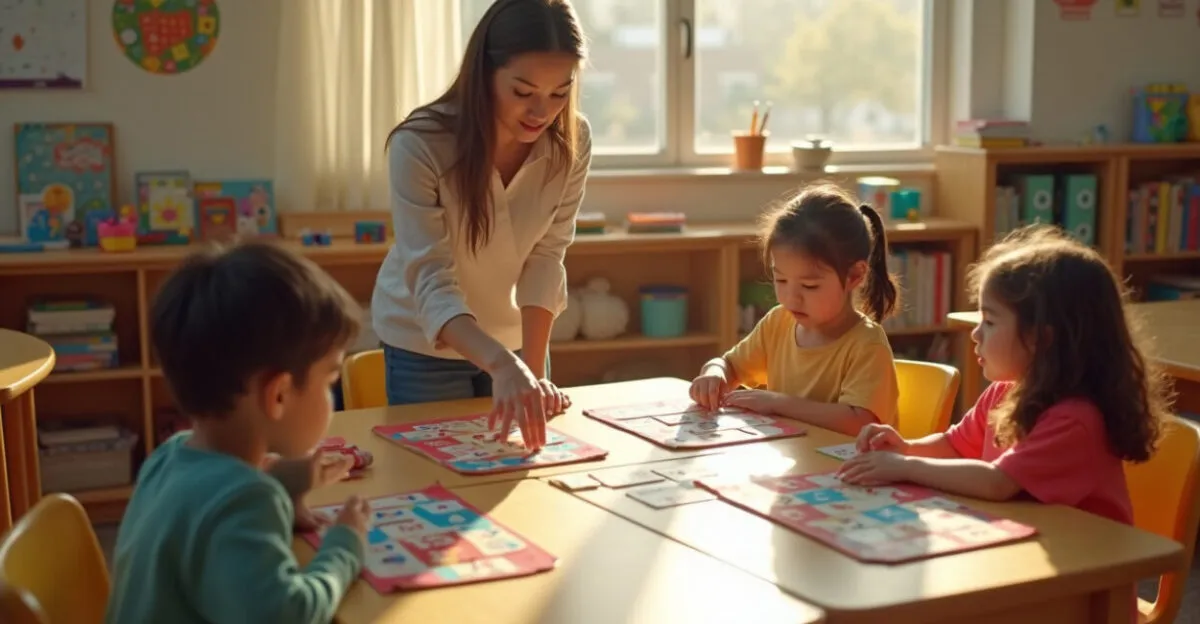
A good literacy game isn’t the one that’s most entertaining; it’s the one that gets children to read carefully. In practice, card games, syllable dominoes, board paths, bingo, and memory games work because they require children to compare, choose, and respond quickly. Reading becomes active, with a clear goal.
1. Syllable and Picture Dominoes
This format helps children connect a syllable to a matching picture. A child sees BO and needs to match it with bolo (cake), bola (ball), or another word they’ve learned at school or at home. The key is to limit the choices at first; too many options can turn the game into guesswork.
2. Syllable Bingo
In bingo, children find syllables on a grid, practicing visual attention and quick reading. It’s a useful way to review syllable families without getting stuck in a rut. Depending on the goal, a teacher or caregiver can call out a syllable or show a card for a few seconds.
Read also: First Aid: What to Do in Common Situations
3. Memory Games with Syllables and Short Words
This version works best when a child already recognizes some of the words and syllables. Match MA with mala (suitcase), PE with pé (foot), and BO with bolo (cake). The game reinforces reading and retention at the same time, but it loses its value if the cards are much too easy or too hard.
Here’s a common scenario: a first-grade class spent weeks on repetitive worksheets and made little progress. After replacing two worksheets with syllable dominoes and partner read-alouds, students began recognizing patterns with less resistance. It wasn’t a miracle. It was a change in approach.
Word-Building and Writing Activities That Reinforce Sounds
If a child only recognizes syllables on a screen or worksheet, their learning remains fragile. Building and writing words require students to retrieve information, and that effort can strengthen long-term memory. That’s why cut-and-paste activities, matching games, guided writing, and practical dictation tend to work better than exercises that only ask children to mark answers.
Building Words with Moveable Cards
Give the child cards with syllables and ask them to build words such as casa (house), pato (duck), mala (suitcase), and boneca (doll). The teaching benefit is clear: children see that syllables aren’t isolated pieces; they combine to form meaningful words.
Dictation with Visual Support
Dictation doesn’t have to feel punitive. When a picture is shown alongside the word, children can connect the sound, object, and spelling. This approach reduces anxiety and helps distinguish between spelling errors caused by weak visual memory and those related to phonological awareness.
Reversals and Immediate Feedback
When a child switches letters or reverses their order, feedback needs to be quick and concrete. Showing a model, asking the child to compare it with their work, and having them rewrite it often works better than simply crossing out the mistake. The goal isn’t to catch the child doing something wrong; it’s to make the pattern clear to them.
Activity
Skills Practiced
Best For
Moveable cards
Word building
Getting started and building mastery
Picture-supported dictation
Sound, memory, and writing
After basic recognition
Guided writing
Letter sequencing and attention
When letter reversals are frequent
How to Adjust the Difficulty Without Stalling Progress
This is where many people go wrong. A child may be able to read simple syllables, but if an adult increases the difficulty too quickly, the child’s confidence can suffer. Progress isn’t always linear: some students advance quickly with oral reading but take longer with writing, while others progress in the opposite order.
Signs the Activity Is Too Difficult
- The student guesses more than they read.
- They need help with almost every word.
- They confuse similar sounds, such as p and b or t and d.
- It takes longer to understand the activity than to complete it.
How to Take a Step Back Without Discouraging Them
Go back one step, not ten. If a long word is too difficult, switch to more regular two-syllable words. If oral reading turns into guessing, add picture cues and shared reading. The key is to keep the task manageable but still challenging.
Experts differ on how much explicit practice each child needs, but classroom experience points to a useful consensus: when the foundation is solid, moving on to longer words takes much less effort. The reverse is also true. A weak foundation comes with a cost.
Materials, Routines, and the Adult’s Role
Materials matter, but guidance matters more. Decodable books, syllable charts, movable alphabets, whiteboards, cards, and pictures can all help, as long as the adult knows when to ask the child to read, when to model, and when to wait for a response. Without that guidance, even a well-designed activity can fall flat.
What to Keep on Hand
- Cards with common syllable families.
- Pictures of familiar, concrete objects.
- Short words printed in a clear font.
- Short activity blocks with breaks in between.
How to Set Up an Effective Routine
A good session usually has three parts: recognition, hands-on practice, and reading in context. First, the child identifies the syllable; then they build or compare words; finally, they read the word in context. This sequence fits into 10 to 15 minutes and usually works better than a tiring 40-minute marathon.
Adults don’t need to overexplain; they need to organize the activity well. When instructions are brief and the task is clear, children can spend their energy learning instead of trying to guess what to do.
Documents from Brazil’s National Institute for Educational Studies and Research and literacy guidance from UNESCO reflect the same principle: consistent learning depends on progression, deliberate practice, and appropriate support. This doesn’t replace the teacher, but it confirms that instruction needs to be intentional.
When Simple Syllables Are No Longer Enough
There’s a clear limit. Once a child can read regular words well, spending too long on the same patterns can delay their next step. At that point, it’s worth moving on to more complex syllables, consonant blends, digraphs, and short texts with simple sentences. The goal isn’t to stay at the most comfortable stage; it’s to build a bridge to the next one.
Next steps: Observe whether the child reads accurately without relying on guesswork, and choose the next level of difficulty based on the mistakes they actually make. If they’ve mastered many syllable families, move on to short decodable texts and activities that build comprehension, not just recognition of word parts. The best measure of progress isn’t speed alone; it’s steady independence.
Frequently Asked Questions
What’s the Difference Between a Simple and a Complex Syllable?
A simple syllable tends to have a more regular structure, usually a consonant followed by a vowel, as in PA, ME, and BO. A complex syllable includes consonant blends, digraphs, or less predictable patterns, such as PR, LH, and NH. Simple syllables are taught first because they reduce the demands of decoding and make it easier for children to get started with reading.
At What Age Does It Make Sense to Try These Activities?
There’s no single right age. These activities are generally more common in the later years of preschool and the early grades of elementary school, when children begin connecting sounds and letters more independently. What matters isn’t age by itself, but phonological readiness and the reading skills the child has already developed.
Are Lots of Worksheets a Good Strategy?
It depends on the worksheets. If they only ask children to repeat things mechanically, the benefits are usually limited, and kids can get tired quickly. Worksheets work better when they include reading, picture matching, writing, and some decision-making, because these tasks require students to think about the word instead of just copying it.
What Should I Do If a Child Confuses Similar-Looking Letters?
First, figure out whether the difficulty involves the sound or the letter shape. Confusions such as p and b or t and d call for combined listening, visual, and writing practice with short, repeated examples. If the difficulty continues, reduce the complexity of the words and return to guided reading before moving on.
Do These Activities Help with Reading Comprehension?
Yes, but indirectly at first. Comprehension improves when children can read words with less effort because they have more attention available to understand their meaning. If decoding is still very slow, comprehension suffers. That’s why mastering simple syllables is an important step in supporting future reading.
Artigos Relacionados
 Building Reading Fluency in Children: Daily Routines and Activities to Improve Speed, Expression, and Comprehension in Elementary Students
 Phonological Awareness in Early Literacy: Playful Techniques and Exercises to Build Sound Recognition and Reading Fluency in Children
 How to Improve Reading Skills in Elementary School: Practical, Proven Ways to Build Fluency and Comprehension in the Classroom
 Phonological Awareness: 10 Activities for Better Reading Instruction
 Collaborative Group Activities: 5 Creative Ways to Build Teamwork and Communication Among Middle School Students
 Reading to Babies: How Books Build Speech and Vocabulary
