
A child can memorize the entire alphabet and still get stuck trying to read “house” without help. That’s because reading doesn’t begin with individual letters; it begins with hearing the sounds of speech.
Phonological awareness in early literacy is the ability to notice, compare, and manipulate sounds, syllables, and rhymes—a foundation that often makes the difference between steady reading progress and repeated stumbling blocks.

In the classroom, anyone who teaches beginning readers knows that this skill doesn’t replace teaching letter-sound relationships; it prepares students for it. When children identify rhymes, break words into syllables, and hear a word’s first sound, they gain a cognitive shortcut that helps them decode with more confidence.
Below, you’ll learn what phonological awareness really means and find 10 simple activities you can use without making the lesson feel artificial.
What You Need to Know
- Phonological awareness is the ability to think about the sound structure of speech. It includes rhymes, alliteration, syllable segmentation, and, at more advanced levels, phonemes.
- It helps children understand that spoken language can be broken into smaller parts, making it easier to connect sounds with written letters.
- Short, frequent oral activities tend to work better than long, mechanical exercises.
- Not every reading difficulty is caused by weak phonological awareness; vocabulary, working memory, and explicit instruction also matter.
- The greatest gains come when this skill is taught alongside the alphabetic principle, not in isolation.
Phonological Awareness in Early Literacy and the Role of Sounds in Beginning Reading
Technically, phonological awareness is the metalinguistic ability to notice and manipulate the sound units of speech without relying on print. Put simply, it means noticing that “cat” and “cat” sound the same, that “house” starts with a different sound than “vase,” that “banana” can be broken into syllables, and that “sun” rhymes with “fun.”
This concept is central because alphabetic writing represents speech sounds. Children who notice the sound structure of spoken language often make faster progress with grapheme-phoneme correspondence—the relationship between letters and sounds.
The reverse is also true: when children can’t hear meaningful differences between sounds, they tend to guess at words for longer.
What speeds up learning to read isn’t memorizing whole words; it’s noticing that speech can be broken into smaller parts and mapped to print according to a set of rules.
There’s an important nuance, though: phonological awareness isn’t a single skill. Rhyming and alliteration usually develop first, followed by syllable segmentation. Manipulating phonemes is harder and requires greater language maturity.
That’s why asking a child to work with phonemes before they’ve mastered syllables is more likely to cause frustration than progress.
Rhyme, Alliteration, and Segmentation Vary in Difficulty
You can see this very quickly in the classroom. Some children catch on to rhyming games but get stuck when asked to clap for each syllable. Others can break words into syllables but still confuse the first sounds in “fan” and “van.” Noticing these differences helps teachers plan their next steps instead of using the same activity with everyone.
How to Identify Your Class’s Skill Level
Before choosing an activity, it helps to see exactly where your class is. A simple check-in can tell you a lot: Can a child recognize rhymes? Say how many syllables are in a word? Hear its first sound? Replace the first sound in a word with another one?
In practice, many difficulties look like “inattention” but are actually problems with hearing speech sounds. I’ve seen children do well orally when an adult provides a visual cue, then get completely lost without that support.
That doesn’t mean they aren’t trying. It usually means the task is beyond their current processing level.
Quick Observation Checklist
- Rhyme: Can the child identify words that “sound alike” at the end?
- Alliteration: Can the child hear when words begin with the same sound?
- Syllable segmentation: Can the child clap or mark the parts of a word?
- Initial sound: Can the child identify the sound a word begins with?
- Phoneme manipulation: Can the child change one sound and recognize the new word?
If your class can’t yet handle short oral tasks, take a step back. Pushing children to write complex words at this stage can look like progress without building reading skills. The safest approach is to observe, adjust, and then gradually raise the difficulty.
Useful Sources for Background
For a reliable foundation, consult materials from Brazil’s Ministry of Education on literacy and research from universities on the relationship between spoken and written language. To compare evidence, you can also visit the UNESCO portal on early learning and browse the INEP, Brazil’s National Institute for Educational Studies and Research, for educational assessment resources.
10 Activities to Develop Sound, Rhyme, and Syllable Skills

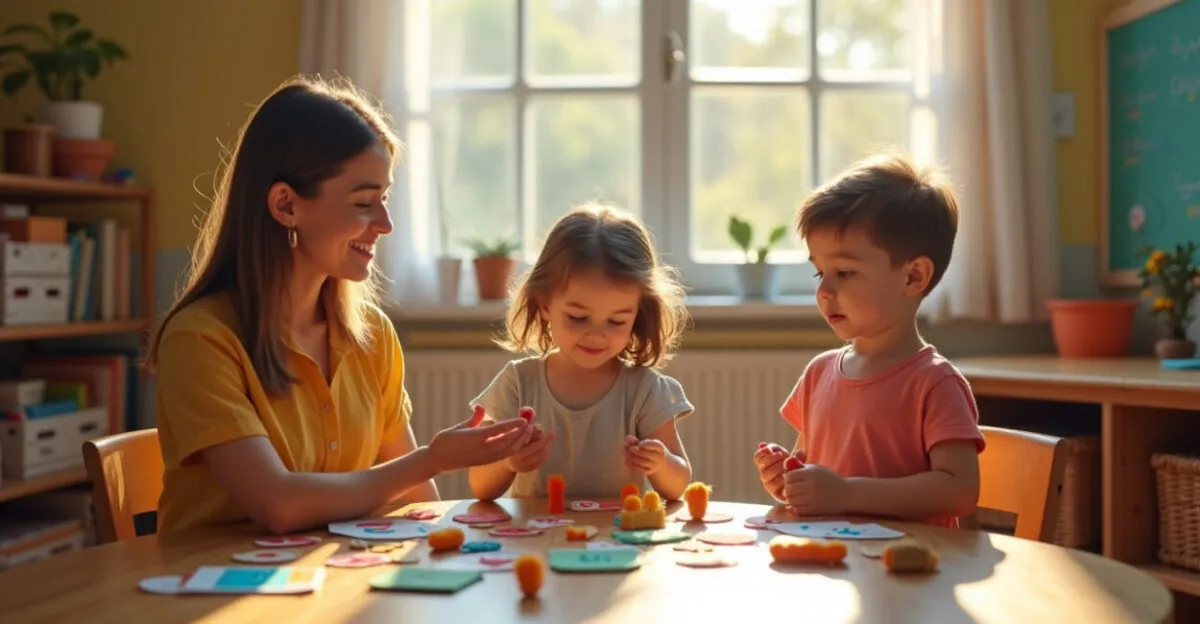
The good news is that simple activities are easy to find. The key isn’t to create elaborate materials; it’s to repeat short activities with different words, rhythms, and levels of challenge. Here are ten practices that work well in preschool and the early elementary grades.
1. Rhyme Hunt
Say three words and ask the child to find the ones that “sound alike at the end.” For example: cat, hat, and sun. Then ask the child to come up with another rhyming word. This activity builds sound awareness without requiring reading.
2. Clap the Syllables
Ask the class to clap once for each part of a word. Start with students’ names, classroom objects, and animals. Using the body helps at this stage because it makes segmentation concrete.
3. Which Ones Start the Same?
Use word pairs such as cat, cap, and ball. Children need to figure out which words start with the same sound. It’s an effective bridge to alliteration and listening comparisons.
4. The Initial Sound Box
Put pictures in a box and choose a target sound. Children sort out the pictures that begin with that sound. This is a great way to build careful listening without the added demands of writing.
5. The Word Train
Each syllable becomes a train car. The child “loads” the word’s parts onto the train in time with the spoken word. This works well with small groups because it allows for immediate feedback and teamwork.
6. Change the Sound
Say “cat” and ask the child to replace the first sound with /b/. The new word is “bat.” This activity introduces phonemic awareness and should come after the previous ones.
Read also: Eco-Education: Learn to Care for the Environment with Joy and Awareness
7. Word Echo
Say a word and have the child repeat it, emphasizing the last syllable or final sound. The focus is on careful listening, not speed. It’s simple and even works during transitions between activities.
8. Rhymes with a Pause
Use familiar rhymes and pause at key points for the class to fill in the missing words. Rhyming text reinforces sound patterns and keeps students engaged.
Read also: Reading Difficulties and Early Intervention: How to Identify Them
9. Picture and Sound Dominoes
Make domino pieces with pictures that share the same initial sound or rhyme. Children match the correct pairs. The game provides review without feeling like a worksheet.
10. Reverse Oral Dictation
Instead of writing, the child listens and answers aloud: How many syllables are there? What’s the first sound? Which word rhymes? It’s a good way to assess learning without putting pressure on children to write too soon.
The key here is pacing. Five focused minutes are worth more than twenty exhausting ones. One practical tip: when the class starts getting answers right from memory rather than by analyzing the sounds, change the words and context. Otherwise, the activity loses its value as an assessment.
How to Choose the Right Activity for Each Stage
Sequence matters. Rhymes and alliteration are often a good starting point because they’re easier to hear. Next comes syllable segmentation. Only then does it make sense to expect children to manipulate phonemes consistently.
Stage
Focus
Activity example
Difficulty level
Beginning
Rhyming and recognizing sound similarities
Rhyme hunt
Low
Intermediate
Syllables and speech rhythm
Clap the syllables
Medium
Advanced
Phonemes and sound manipulation
Change the sound
High
This doesn’t mean every class needs to follow the same sequence on the same day. Some children move more quickly through syllable segmentation, while others need much more time with rhymes. A good rule of thumb: if most of the class gets an activity wrong, it’s beyond the group’s current level.
When a task is too difficult, children guess. When it’s at the right level, they analyze.
This distinction matters because it helps avoid a common mistake: confusing apparent performance with real learning. One correct answer doesn’t prove mastery. What matters is whether children keep getting it right when you change the words, rhythm, and context.
What Works Best in the Classroom
Anyone who teaches beginning readers knows that routines work best when activities are short, oral, and repeatable. A phonological awareness session doesn’t need to be a big “event.” In fact, the more naturally it fits into the lesson, the more likely the class is to participate without resistance.
In the classroom, a particularly effective combination is a rhyming warm-up, a syllable-segmentation activity, and a wrap-up using words familiar to the class. In larger classes, teachers can work with small groups while the rest of the class works on another activity. In smaller classes, oral activities can take just a few minutes a day and still make a noticeable difference over the weeks.
Phonological awareness in early literacy also grows when children hear words from their everyday lives. Familiar names, classroom objects, foods, animals, and well-known rhymes get more participation than abstract word lists. It may seem like a small detail, but it changes the quality of children’s attention.
A Realistic Classroom Example
In a first-grade class, the teacher began with rhymes using students’ names. “Lee” became a starting point for “see,” “bee,” and “key.” Then she asked the class to clap the syllables in “banana,” “ball,” and “notebook.” Within two weeks, children who had previously guessed began explaining why two words “seemed to start the same way.” The progress wasn’t magic; it came from intentional repetition.
Mistakes That Slow Progress
Not every exercise labeled “phonological” is actually helpful. Some can get in the way. When teachers combine sound analysis with too many new letters, children become overwhelmed. When a task calls for quick answers before children understand what to do, they guess. And when everything is done on a worksheet, the listening experience gets lost.
- Too abstract: Asking children to manipulate sounds without enough oral support.
- Rushing instruction: Moving on to phonemes before syllables are secure.
- Unfamiliar materials: Using words the class doesn’t know.
- Confusing feedback: Giving too many clues and taking away the child’s chance to think.
- No variation: Repeating the same activity until it loses meaning.
Experts may disagree about the exact weight of each component, but there’s strong agreement on one point: phonological awareness is most helpful as part of systematic instruction in alphabetic writing. On its own, it doesn’t solve everything. Combined with explicit instruction, it can make a real difference.
When to Seek More Specialized Support
If, despite well-designed activities and repeated practice, a child still can’t recognize rhymes, syllables, or initial sounds, it’s worth taking a closer look. Other factors may be involved, including oral language, attention, auditory memory, prior exposure to reading, or developmental issues that call for a specialist’s evaluation.
This calls for an honest assessment. Not every delay in learning to read is a phonological awareness problem, and not every difficulty can be solved by doing more of the same. If a child continues to fall behind for many weeks, the best approach is to combine classroom observations with a broader evaluation. Resources and guidance on learning difficulties are available from UNDIME, Brazil’s National Union of Municipal Education Directors, and in academic publications on literacy and language development.
The sensible approach isn’t to intensify practice without a clear purpose; it’s to adjust the target. Sometimes the class needs to go back to oral activities; sometimes it needs fewer tasks and more precision; sometimes it needs additional support. An attentive teacher can tell the difference between a slower learning path and a more persistent difficulty.
What to Do Next in Your Teaching Routine
The best next step is to try a short sequence for two weeks: rhyming, syllables, and initial sounds, in that order. Notice who responds easily, who needs support, and who is still guessing. Then adjust the difficulty of the words and the length of the activities. This kind of monitoring is more useful than following a fixed list of exercises.
If the goal is to help children become better readers, shift the focus from “more activities” to “the right activity at the right time.” Phonological awareness in early literacy grows when schools treat sound as a living part of language, not as an isolated drill. Start with what the class can hear today, and move forward only when they have a solid foundation.
Frequently Asked Questions
What’s the Difference Between Phonological Awareness and Phonemic Awareness?
Phonological awareness is the broader term: it includes noticing rhymes, syllables, and sound segments in speech. Phonemic awareness is one part of it, focused on phonemes—the smallest sounds that distinguish words. In the classroom, children usually develop rhyming and syllable skills first, and then become more confident manipulating phonemes. Trying to reverse that order often leads to confusion and memorized responses.
At What Age Should Children Start This Work?
This work can begin early in preschool, as long as activities are oral, playful, and appropriate for the class’s developmental level. It doesn’t make sense to expect very young children to analyze individual phonemes closely, but rhyming, alliteration, and movement-based segmentation can be useful preparation. The goal isn’t to introduce formal instruction early; it’s to strengthen sound awareness before writing takes center stage. This can make early reading instruction smoother.
Do These Activities Replace Letter Instruction?
No. They prepare children to understand how writing works, but they don’t replace explicit instruction in letters and their relationship to sounds. The most consistent progress happens when children learn to hear sounds and represent them with graphemes at the same time. Separating these two areas completely weakens the literacy process.
How Can I Tell if an Activity Is Really Helping?
See whether the child improves when you change the set of words, not just when they repeat the exact same exercise. If they identify rhymes, break words into syllables, and begin to recognize initial sounds with less help, they’re making real progress. Another sign is fewer random answers and more oral explanations of what they heard. Consistency matters, not an occasional correct answer.
What if a Child Still Makes Mistakes After Several Weeks?
In that case, review the difficulty level and explore other possible causes. The child may have difficulty with oral language, limited exposure to reading, inconsistent attention, or a need for a specialized evaluation. Repetition alone doesn’t always solve the problem; sometimes the issue is the sequence, vocabulary, or language foundation. If mistakes persist, adjusting the support is more useful than increasing the pressure.
Artigos Relacionados
 Phonological Awareness in Early Literacy: Playful Techniques and Exercises to Build Sound Recognition and Reading Fluency in Children
 Effective Literacy Instruction for Young Learners Today
 Letter Activities in Early Childhood Education
 Activities for Early Childhood Education: Practical Ideas
 Activities About Jobs in Early Childhood Education
 Mother’s Day in Early Childhood Education: 7 Memorable Activities
