
Phonological Awareness: How to Accelerate Literacy Development
When a child hears sounds before reading them, words start to make sense.

Phonological awareness is an oral language skill: noticing, separating, and manipulating the sounds of speech—rhymes, syllables, and phonemes. It may sound technical, but the practice is simple: the better children hear the sound structure of words, the more confidently they can decode them while reading. That can make all the difference in learning to read.
In the classroom, progress often shows up before fluent reading: a child who used to guess at words starts to notice that cat and hat rhyme, that sunset can be broken into sun-set, and that changing one sound can change everything. That’s when phonological awareness stops being theory and becomes a bridge to independent reading.
How Phonological Awareness Supports Reading
It teaches the brain to see a word as an organized sequence of sounds. That matters because reading isn’t just recognizing letter shapes; it means turning letters into sounds, then turning those sounds into meaning. When children understand this process, decoding becomes more reliable and predictable.
In practice, anyone who teaches early reading knows that children who explore sounds, rhymes, and word parts are less likely to guess at words. They start testing ideas. Instead of looking at house and saying any word that seems close, they notice its sounds and match them to the letters.
This progress doesn’t happen by magic. Phonological awareness strengthens auditory memory, attention to detail, and the connection between speech and writing. It’s a workout in precision—and precision is invaluable when learning to read and write.
Rhymes: The Shortcut That Feels Like Play
Rhyming isn’t just a fun activity. It helps children recognize sound patterns. When a child notices that light, night, and right sound alike, they begin to notice the ends of words—an important step from hearing words as a whole to analyzing their sounds.
A teacher told me about a familiar scenario: one student struggled to read simple words. After two weeks of rhyming games, the student became much quicker at reading words with similar ending sounds. It wasn’t a “teaching miracle.” It was focused listening practice.
Read also: Phonological Awareness: 10 Activities to Support Early Literacy
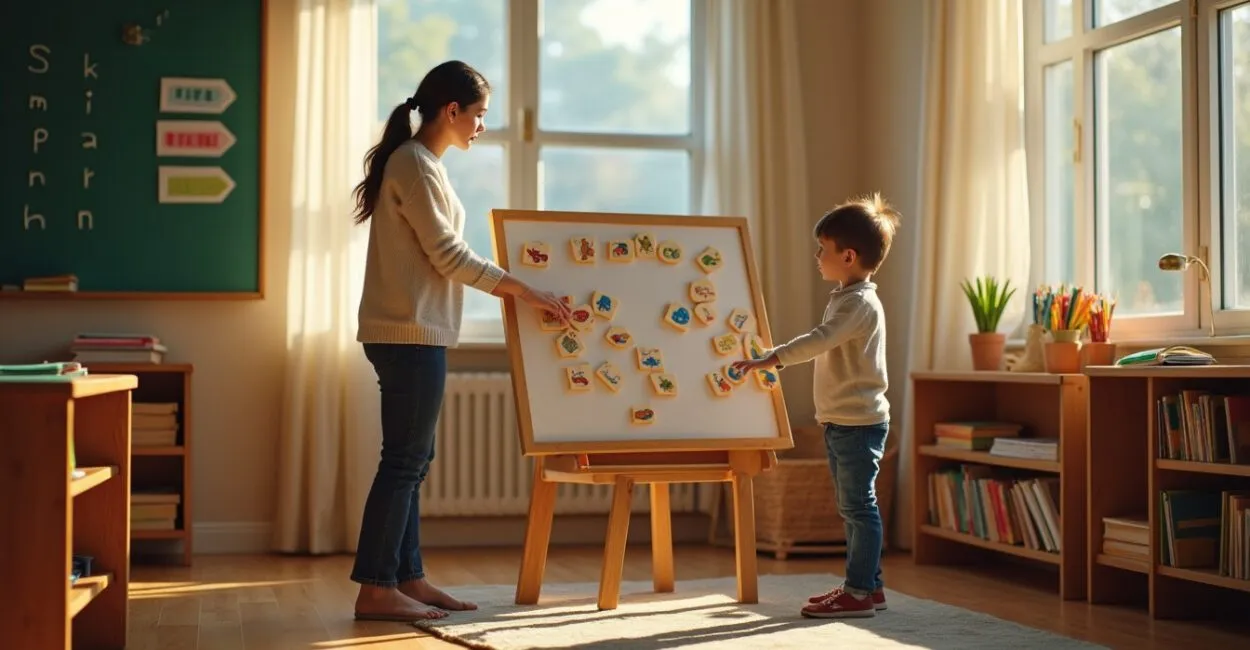
- Ask the class to complete rhyming pairs.
- Use short songs with repeating end sounds.
- Create cards with pictures of rhyming words.
Rhyming works because it builds confidence. And confidence makes room for the next step: noticing smaller parts of a word.
Syllable Segmentation: The First Cut That Brings Order to the Chaos

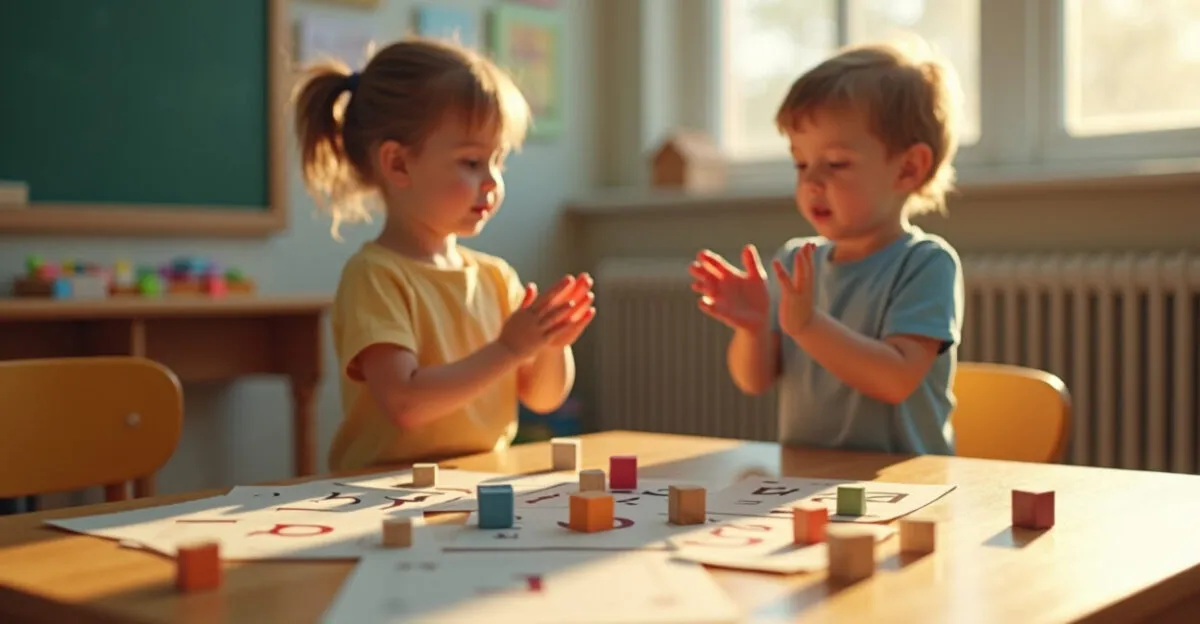
Breaking words into syllables helps children see them in chunks. Instead of facing window as one huge block, they hear win-dow. This reduces the mental load and gives reading a rhythm. Here, phonological awareness becomes a stepping stone.
Read also: The Family’s Role in Helping Children Learn to Read and Write
This is one area where schools can make a big difference without making things complicated. Clap, take a step for each syllable, stack bottle caps, or mark boxes on a page. It seems simple because it is—and it works because it gives sound a concrete form. A common mistake is treating syllable segmentation as a mechanical exercise. It works better when it’s meaningful and playful.
Activity
What it practices
Example
Clapping
Syllable segmentation
win-dow, ta-ble, pen-cil
Sound train
Order of parts
cat → c / at
Empty boxes
Matching spoken and written words
one box per syllable
Phonemes: When Children Notice the Smallest Part of a Word
A phoneme is the smallest sound that can change a word’s meaning. Changing /p/ to /g/ turns pat into gat. Recognizing this difference is a major turning point in learning to read and write with confidence because it connects speech to the logic of the alphabet.
Children don’t all reach phoneme awareness at the same pace, and that’s okay. Experts disagree about the best time to introduce this work explicitly, since it depends on the group’s readiness, oral language skills, and prior experience. What usually doesn’t work is jumping straight to phonemes without first establishing rhyming and syllable awareness.
Children who master individual sounds guess less and use more strategies when they read.
In recent weeks, this kind of difficulty has been showing up more often in classrooms where students have significant learning gaps after the pandemic: children recognize letters but can’t connect sounds to letters. That’s where phonological awareness helps address the underlying issue—not just provide “a little extra practice.”
4 Mistakes That Quietly Hold Back Progress
If an activity seems fun but doesn’t encourage careful listening, it becomes just a way to pass the time. There’s no room for fluff when children are learning to read and write. Here are some common mistakes:
- Starting with phonemes before working on rhymes and syllables.
- Correcting too quickly without giving children time to think about the sound.
- Using words that are too long for students who are still learning the basics.
- Focusing only on writing and forgetting that the foundation is oral language.
The biggest mistake is treating phonological awareness as a standalone lesson. It works best as part of a short, frequent, engaging routine. Ten well-planned minutes are often more valuable than one long, tiring activity.
Simple Classroom Activities That Really Help
You don’t need expensive materials. You need purposeful repetition. According to Brazil’s Base Nacional Comum Curricular (BNCC), the Ministry of Education’s national curriculum guidelines, oral and written language instruction should be intentional and follow a progression. That aligns closely with phonological awareness.
- Rhyming box: children pick a picture and find another one with a matching ending sound.
- Syllable staircase: each step represents one part of a word.
- Sound swap: change one phoneme and ask children to notice the new meaning.
- Word hunt aloud: pick out words from a class discussion and compare their sounds.
In practice, the best results come when an activity takes just a few minutes and is repeated throughout the week. That builds familiarity, and familiarity reduces the fear of making mistakes—a major hurdle at the beginning of learning to read and write.
To learn more about the connection between language development and learning, you can also consult NIH resources on phonological skills and reading, which highlight the link between phonological awareness and reading performance.
When Literacy Development Starts to Move Faster
The turning point comes when children stop seeing a word as a picture and start hearing it as a structure. At that point, reading stops being a guessing game. It starts to follow a method.
Phonological awareness doesn’t accelerate literacy through pressure; it accelerates it through clarity. Clarity helps children move forward without relying so much on guessing, vague visual memory, or endless trial and error. It’s a quiet but decisive shift.
If you look closely, the difference between children who make progress and those who get stuck is almost never “talent.” It’s access to the sounds—and that can be practiced.
1. Is Phonological Awareness the Same as Learning to Read and Write?
No. Phonological awareness is the ability to notice and manipulate speech sounds. Learning to read and write also involves connecting those sounds to letters and developing reading and writing skills. It’s a powerful foundation, but it doesn’t replace systematic instruction in the alphabetic system. Children tend to make more confident progress when both go hand in hand.
2. What’s the Best Activity to Start With?
For most classes, rhyming and syllable segmentation are great places to start. They require less abstract thinking than working with phonemes and help children understand sound patterns before dealing with smaller units. The best starting point, however, depends on the group’s level and what children can already hear accurately.
3. Can You Work on This with Young Children?
Yes, and it makes a lot of sense. For children in early childhood education, it’s best to use playful activities with songs, nursery rhymes, word echoes, and comparisons of ending sounds. The goal isn’t to introduce formal instruction too early, but to strengthen listening skills. Phonological awareness develops best through frequent, playful activities.
4. What if a Child Mixes Up Sounds Often?
This is common at first. The answer isn’t to rush, but to take a step back: speak more slowly, repeat, break words into smaller parts, and use visual or physical cues. If the difficulty continues for a long time, consider whether other factors, such as oral language or attention, may be involved.
5. How Long Does It Take to See Results?
There’s no set timeline. Some children make progress in a few weeks with a well-structured routine; others need more time and repetition. Consistency, not the length of a single activity, usually makes the difference. Short, frequent practice almost always beats long, occasional sessions.
Ultimately, teaching children to read and write well isn’t about making them memorize words. It’s about teaching them to hear what a word is saying.
And when that happens, reading stops being a leap into the dark and becomes a path lit from within.
Artigos Relacionados
 Phonological Awareness in Early Literacy: Playful Techniques and Exercises to Build Sound Recognition and Reading Fluency in Children
 Phonological Awareness: 10 Activities for Better Reading Instruction
 Brain Development: Practices for Early Literacy
 Guided Reading in Early Literacy: How to Use It in Class
 Elementary School Literacy: 9 Practical Strategies
 Does Creative Education Develop Critical Thinking? An Analysis
