
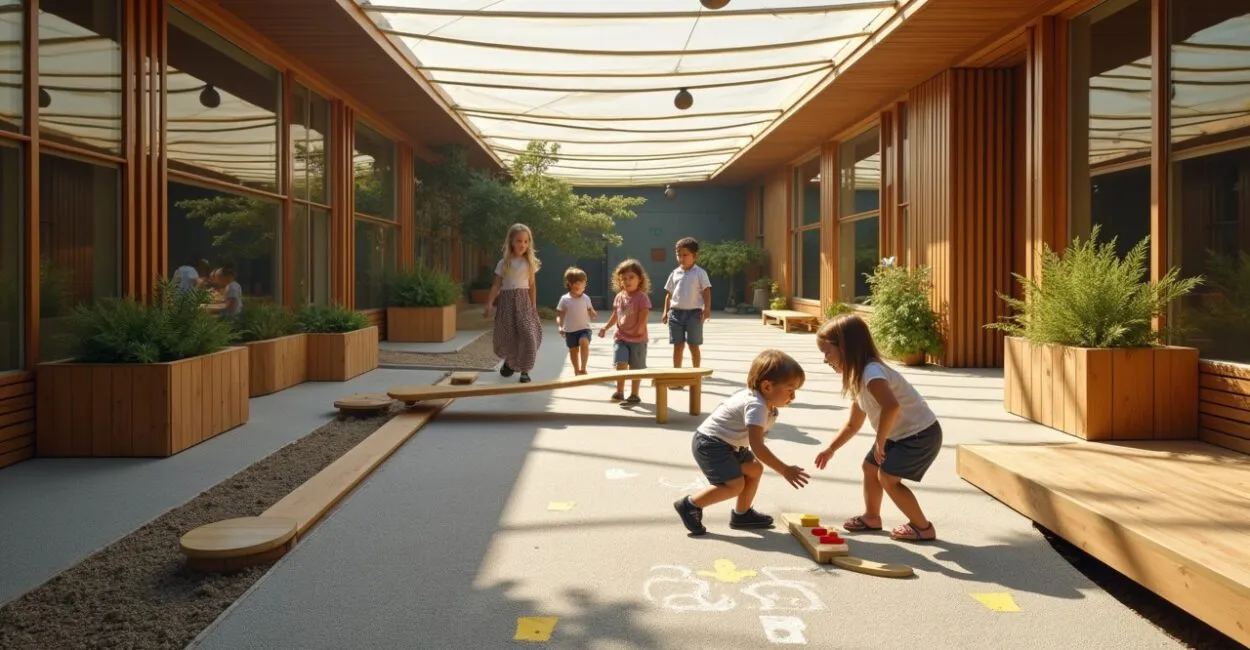
A playground without a clear educational purpose can become just a place to pass through. A thoughtfully designed space, on the other hand, encourages active learning. When we talk about playful spaces for whole-child education, we mean environments that support physical activity, relationships, independence, imagination, and social interaction all at once—not just “a pretty corner” at school.
In practice, these spaces change children’s behavior and improve the quality of their interactions: children explore more, negotiate rules, test ideas, and move with purpose. This article explains how to plan these environments around architecture, safety, learning goals, and everyday use—without relying on decorative solutions that work only on opening day.

What You Need to Know
- A playful space isn’t the same as a playroom. It can be in a playground, hallway, garden, multipurpose room, or even a transition area, as long as it has a clear educational purpose.
- High-quality playful environments combine accessibility, safety, freedom of choice, and gradually increasing challenges, because play takes thoughtful planning, too.
- Whole-child education calls for spaces that encourage movement, language, socialization, and self-regulation—not just recreation disconnected from the curriculum.
- The best spatial design prevents predictable problems, such as lines, competition for materials, excessive noise, and disorganized traffic flow.
- A poorly planned playful space falls short when it looks good but can’t support regular use, adequate supervision, and different ways to play.
Playful Spaces for Whole-Child Education: What They Are and How They Work
Technically speaking, playful spaces for whole-child education are learning environments designed to encourage play, sensory exploration, movement, social interaction, and learning across different areas of development. Put simply, they’re places where children learn by acting, experimenting, negotiating, and transforming the space with their own bodies.
Play Isn’t a Break from Learning
The most common mistake is treating play as a break between “serious content.” In whole-child education, play is part of the learning approach. It helps children develop language, motor coordination, spatial awareness, problem-solving skills, and social-emotional competencies.
Anyone who works in education knows that spontaneous play can teach much more when the environment doesn’t stifle children’s initiative.
Whole-Child Education Takes More Than Extended Recess
Whole-child education isn’t just about keeping students at school longer. It’s about expanding their horizons, relationships, and experiences. That’s why the environment needs to align with the educational approach. The right space invites exploration while also allowing educators to observe, document, and step in with purpose.
What sets an ordinary playground apart from an educational play space isn’t the decor—it’s the ability to encourage choice, challenge, and ongoing learning.
Educational Architecture: How Space Design Teaches
Educational architecture is the way an environment’s physical layout influences learning. It includes scale, visibility, traffic flow, the height of features, material textures, and the relationship between open areas and quiet retreats. In well-designed schools, the space doesn’t get in the way of the educational approach; it helps move it forward.
Traffic Flow, Visibility, and Activity Zones
A good design separates high-energy play, focused activities, and rest areas without isolating them. When everything happens in the same space, noise rises, conflicts increase, and adults end up constantly managing behavior. That’s why it helps to plan for three zones: free play, structured play, and breaks or self-regulation. This approach works well in playgrounds, but falls short when the space is too small to accommodate several activities at once.
Materials That Invite Hands-On Use
Durable, accessible materials are usually more useful than purely decorative features. Treated wood, safely repurposed tires, modular boxes, foam mats, ropes, sensory panels, and natural elements all create more possibilities. For schools on tight budgets, versatility matters more than cost. Ideally, test how materials will be used before installing anything permanently.
Safety, Accessibility, and Standards You Can’t Ignore

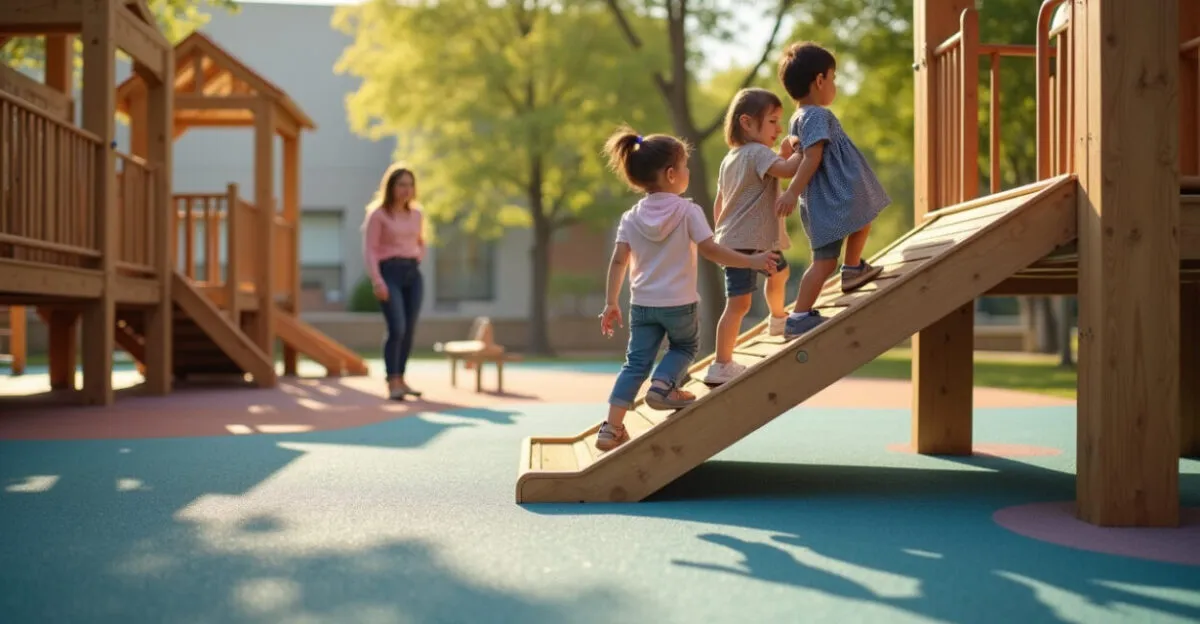
A good play space doesn’t have to feel like an adventure every minute of the day; it needs to allow for managed risk. Safety doesn’t mean eliminating challenges. It means reducing foreseeable accidents, planning for supervision, and adapting the environment for different bodies and ages. For general guidance on accessibility and environmental design, consult the Ministry of Human Rights and Citizenship portal, Brazil’s federal government resource, and applicable technical standards issued by ABNT, Brazil’s standards organization.
Educational Risk Is Different from Acceptable Risk
There’s an important difference between danger and challenge. Climbing, sliding, jumping, and balancing are valuable activities when the ground, heights, and surrounding area are designed with them in mind. The problem isn’t that a child might fall; it’s when the school hasn’t considered what could happen. The same approach won’t work in every situation—age, school culture, and the type of activity all affect the acceptable level of risk.
Accessibility Needs to Be Practical, Not Symbolic
Ramps, clear pathways, tactile signs when needed, appropriately sized furniture, and inclusive activity areas aren’t “extras.” They’re essential to making the experience truly shared. A playful space that excludes children with limited mobility, neurodivergence, or sensory sensitivities is incomplete from the start. UNICEF Brazil offers useful resources on inclusion and more equitable learning environments.
Read also: Social-Emotional Competencies: Effective Practices in Whole-Child Education Today
True safety doesn’t eliminate challenging play; it organizes the environment so children can take on challenges without turning exploration into a preventable accident.
How to Plan a Space Around Learning Goals
Planning starts before you buy toys. First, the school needs to decide what it wants to develop: independence? Cooperation? Motor coordination? Creative thinking? Self-regulation? Then the space can be designed to make those experiences happen regularly, not by chance.
Read also: School Recreation Areas: What to Plan For
Start with the Right Questions
- What ages will use the space, and when?
- What kinds of play does the school want to encourage?
- Will one class use the space, or will it serve mixed-age groups?
- Who will supervise, and how will they move between areas?
- What needs to stay in place, and what should be movable?
Start with the Curriculum, Not the Other Way Around
If the goal is to build vocabulary, the environment might include areas for dramatic play, reading, and storytelling. If the goal is motor development, the design should include obstacle courses, balance activities, low climbing structures, and open areas for movement. If the focus is social interaction, the school needs shared materials and simple rules for using them. Spatial design becomes a curriculum tool when it’s tailored to specific goals.
Learning goal
Most useful spatial feature
Sign of meaningful use
Independence
Accessible, organized materials
Children get materials and put them away without constant adult help
Movement
Obstacle courses, ramps, and open areas
Regular use without excessive crowding
Social interaction
Group tables and cooperative games
Less competition for objects and more peer negotiation
Meaningful Play: What Makes an Experience Lead to Learning
Meaningful play is play that children can sustain, return to, and transform. It doesn’t depend on one “right” object, but on an environment with open-ended possibilities. In practice, this often happens when the space lets children combine building, pretend play, movement, and rule-making.
An Example from Everyday School Life
I’ve seen simple playgrounds with large boxes, ropes, fabric, and low logs spark much more engagement than expensive, enclosed playground equipment. Children built forts, assigned roles, negotiated who could come and go, and adjusted the rules as the group grew. The teacher documented the vocabulary children used, their conflicts, and their solutions. This kind of environment generates real educational insights—not just “time spent.”
When an Activity Falls Flat
If a material offers only one way to use it, play quickly loses steam. Toys with overly prescribed uses, spaces packed with instructions, and environments where everything requires permission all limit children’s creativity and ownership. The ideal balance is enough structure to ensure safety and enough freedom for children to invent.
Day-to-Day Management: Maintenance, Routines, and Guidance
A beautiful space that isn’t part of the daily routine won’t last. Maintenance includes cleaning, inspecting equipment, replacing materials, checking screws, monitoring floor wear, and keeping storage organized. Without it, the environment gradually loses its value until it becomes a static backdrop. Many schools underestimate this at the outset.
What Keeps the Space in Regular Use
- Materials that are easy to clean and replace.
- Clear rules for movement and borrowing materials.
- An organized system for putting materials out and away.
- Rotating activities to prevent children from losing interest.
Adult Guidance Makes a Difference
A playful space doesn’t work on its own. Adults need to observe without restricting play, step in without controlling everything, and document what happens. Good guidance protects the experience without disrupting it. In well-organized environments, educators spend more time reading the situation and less time acting as constant hall monitors.
When a space has clear rules and accessible materials, adults can stop putting out fires and start strengthening interactions.
Common Mistakes and How to Avoid Them on a Budget
Many schools focus too much on aesthetics and not enough on use. They add color, stickers, and an expensive piece of play equipment, but don’t plan for traffic flow, a variety of activities, or maintenance. Another common mistake is copying ideas from photos without considering children’s ages, the climate, the number of students, or how long they’ll spend in the space.
The Most Common Missteps
- Turning the space into a showpiece instead of a learning environment.
- Choosing equipment without considering age, height, and supervision.
- Ignoring shade, ventilation, and thermal comfort.
- Setting up areas without clear paths for movement.
- Failing to consult teachers and children before finalizing the design.
Where to Cut Costs Without Sacrificing Quality
Smart savings often come from modular solutions, safely repurposed materials, and versatile design. Don’t cut corners on unsuitable flooring, poor installation, dangerous edges, or accessibility. Cheap choices can cost more in the long run if the space can’t withstand heavy use. Data from IBGE, Brazil’s national statistics agency, can help schools assess demand, local context, and the school community’s profile, preventing designs that don’t fit reality.
Next Steps for Bringing the Project to Life
The best place to start is with a simple assessment: observe where children already play, where they get stuck, where conflicts happen, and which areas are underused. Then prioritize high-impact, low-risk improvements: circulation, shade, storage, flexible furniture, and open-ended materials. In whole-child education, the space isn’t just a backdrop; it’s part of the learning approach.
To move forward thoughtfully, run a pilot in a small area before expanding the project. Observe how it’s used for a few weeks, document what works, and adjust the design. If the environment doesn’t improve children’s independence, movement, and quality of play, it’s still just an idea—not a solution.
Frequently Asked Questions
Is a Playful Space the Same as a Playroom?
No. A playroom is a specific type of space, usually centered on a collection of toys and adult-guided play. A playful space can be anywhere in the school, as long as it has an educational purpose, allows freedom of use, and invites exploration. In whole-child education, it tends to be broader in scope because it connects with movement, social interaction, independence, and the curriculum—not just entertainment.
Can You Create Playful Spaces on a Tight Budget?
Yes, as long as the space is thoughtfully planned. The most important investment isn’t an expensive item; it’s spatial organization, safety, versatility, and maintenance. Carefully repurposed materials, natural elements, movable furniture, and storage bins can go a long way. Adequate supervision and clear guidelines for using the space are essential, because improvising without a plan leads to disorder.
How Can You Tell if the Space Is Really Working?
Look for three signs: children use the environment on their own initiative, predictable conflicts decrease, and play becomes longer and more varied. It’s also worth tracking whether the space is accessible, materials are easy to share, and educators can guide play without constantly interrupting it. When the environment works, it becomes a positive part of the daily routine, not a recurring problem.
Which Ages Benefit Most from These Environments?
Children of all ages can benefit, but the design needs to change as they develop. In early childhood, the focus is usually on sensory exploration, movement, and pretend play. In the early elementary years, rules, collaborative building, games, and child-led ideas become more important. The same space can serve different groups as long as its height, complexity, and materials are appropriate.
What Should Every Well-Designed Project Include?
Three things are nonnegotiable: safety, accessibility, and a clear educational purpose. Without them, the space is just decoration. Maintenance, supervision, and a range of possible uses are also essential, because a playful environment needs to hold up to school routines, the elements, and heavy use. When these pieces come together, the space stops being an accessory and starts teaching alongside the staff.
Artigos Relacionados
 A Guide to Early Childhood Education: Best Practices, Play-Based Activities, and Innovative Approaches to Whole-Child Development
 School Political-Pedagogical Project for Whole-Child Education: A Practical Guide
 Whole-Child Education: Strategies for Thriving Today
 Social-Emotional Skills: Effective Practices in Whole-Child Education Today
 A Complete Guide to Entrepreneurial Education: Build Leadership Skills, Create an Effective Business Plan, and Start a Successful Career
 Fun Women’s Day Activities: 10 Playful Ways to Celebrate Women’s Strength in Early Childhood Education
