
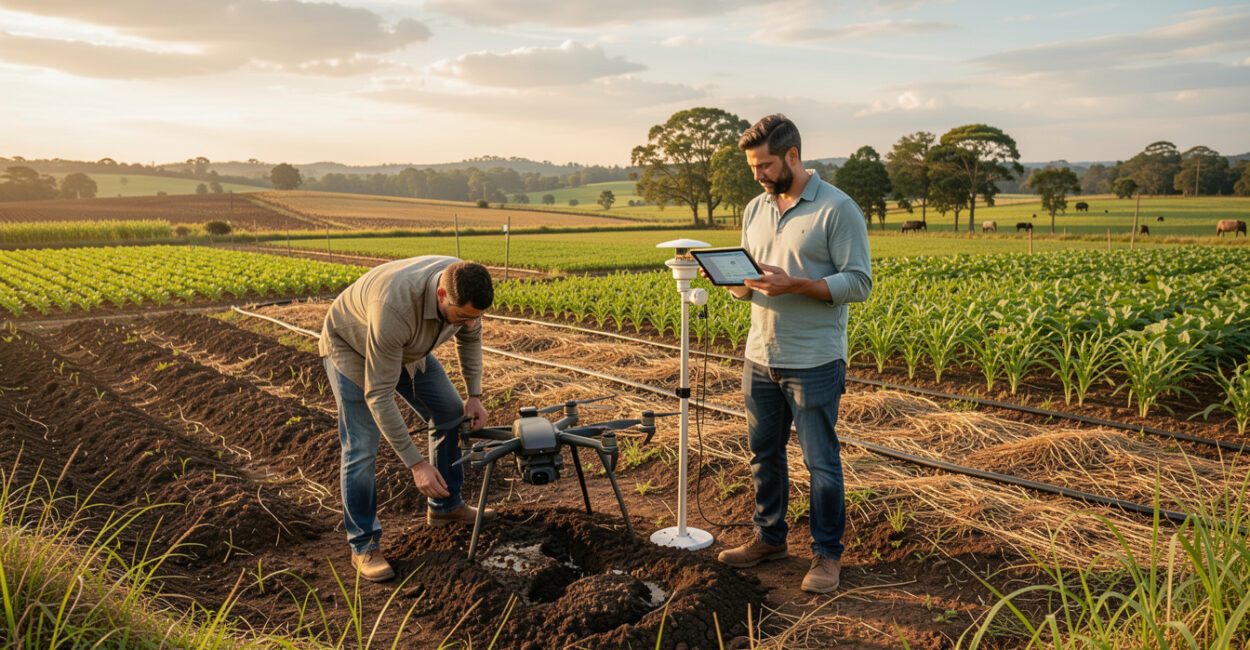
A farm can maintain production while losing fertile soil or using water unnecessarily; a single season’s yield doesn’t reveal these costs. Agriculture sustainability helps assess a system based on its results over time: production, natural resource conservation, and economic viability need to go hand in hand. That assessment depends on choices tailored to the farm. Cover crops, crop rotation, water management, and pest control are all options, but their effects vary depending on climate, crop, soil, and available investment.
To decide where to start, focus on the biggest challenge on the farm and track indicators before and after making a change. This way, a practice earns its place based on the results it delivers, not just because it seems right in theory.

Before you start, establish a baseline
- Identify the farm’s main constraint: erosion, water scarcity, input costs, or inconsistent production.
- Gather available data, such as soil tests, yield records, and expenses by field.
- Consider labor, machinery, access to credit, and technical assistance.
- Choose an area or practice to evaluate before expanding the change.
What is sustainable agriculture, and how can you recognize its results?
Sustainable agriculture is a production system that aims to maintain productivity and economic viability while conserving natural resources and taking the social conditions of farming into account. Simply put, it seeks to produce today without reducing the ability to produce tomorrow. The FAO links agricultural sustainability with resilience, food security, and responsible resource use.
Recognizing sustainable agriculture requires looking at results over time, not just at a single technique. No-till planting, irrigation, or certification alone doesn’t prove that a farm is sustainable. You need to verify that management reduces problems without shifting costs to another stage, another resource, or the future.
For example, a farm might save water through irrigation and still face erosion because of inadequate ground cover. A sound assessment must consider the whole system: soil, water, production, costs, and working conditions.
Why sustainable management matters for the environment and income
Management affects both natural resources and the economic risks of production. Bare soil can increase erosion; poorly managed irrigation can drive up costs and waste water; and reliance on only a few crops can make income more vulnerable to pests, weather, or market fluctuations.
- Soil: Ground cover and appropriate management help reduce the impact of rainfall and preserve soil structure.
- Water: Measuring crop needs and checking irrigation distribution helps prevent unnecessary water use.
- Costs and risks: Diversifying crops and monitoring pests can reduce dependencies, although financial results vary.
- Community: Working conditions, safety, and the long-term viability of the operation are also part of sustainability.
There are limitations: a practice may require machinery, expertise, or investment that isn’t immediately available. And improving one indicator doesn’t guarantee higher profits; returns depend on prices, weather, scale, and how well the practice is implemented.
Which sustainable practices to use on the farm, and under what conditions

Start with the problem you’ve identified. Practices work best when they complement one another and the farmer can track what has changed.
Soil: cover crops, rotation, and targeted fertilization
No-till planting reduces soil disturbance and leaves crop residue on the surface. For it to work, there must be adequate ground cover and a planned rotation; without residue or diversity, it may not deliver the expected benefits and could allow specific problems to build up. Soil tests, meanwhile, guide amendments and fertilization based on the needs of the field, instead of repeating the same application rates out of habit. Embrapa Solos, a Brazilian soil research agency, provides technical information on soil management and conservation.
Read also: Gardening at Home: How to Grow Your Own Food Sustainably, Affordably, and Healthfully
Pests: monitoring and integrated pest management
Integrated pest management (IPM) combines field scouting, pest identification, and appropriate control measures. Applying pesticides on a set schedule without checking for pests or tracking their spread can drive up costs and reduce control effectiveness. Monitoring requires consistency and the expertise to distinguish significant damage from an occurrence that doesn’t warrant intervention.
Water and integrated systems
For irrigation, check crop needs and equipment performance. Uneven pressure or clogged emitters can leave some parts of a field overwatered and others with too little water. Integrated crop-livestock-forestry systems (ILPF, a Brazilian approach that combines these activities) bring different operations together on the same land through rotation, intercropping, or succession. They can diversify production, but require planning for species, livestock management, and compatibility with available infrastructure.
Read also: African Mahogany Planting: A Complete Guide to Sustainable, Profitable Growing
How to apply sustainable practices on different farms in Brazil
Sustainable agriculture takes different forms in Brazil because soil, climate, scale, and market conditions vary widely across regions. Production data by activity and territory from IBGE, Brazil’s national statistics agency, can help put this diversity in context, but each decision needs to be assessed on the farm itself. On a grain farm where soil is left bare after harvest, it may make sense to evaluate cover crops and rotation, tracking residue levels, erosion, and establishment costs. In a livestock system with degraded pasture, the priority may be to restore the pasture and adjust stocking rates; adding crops or trees makes sense only when there’s a plan and the capacity to manage the whole system.
On a family farm, adoption can start on a smaller plot with crop diversification, composting suitable waste, or more efficient water use, depending on available resources and the local market. Labor, technical assistance, and sales channels influence the choice just as much as the technique itself. A common mistake is to copy a model from another region without checking the growing calendar, soil, water, and operating costs.
Conventional and sustainable agriculture: differences depend on management
The comparison is most useful when it considers goals, decisions, and risks, without assuming that all conventional farms operate the same way or that a sustainable practice works equally well in every context.
Aspect Conventional management Sustainability-oriented management Input decisions May follow standardized recommendations or established local practices. Aims to tailor applications to test results, monitoring, and crop needs. Soil The level of soil disturbance and ground cover varies with the system used. Often prioritizes conservation, ground cover, and crop diversification. Costs Depend on inputs, operations, scale, and prices. May include upfront investment, learning, and new management costs; recurring expenses may also change. Risks and results Vary with weather, markets, management, and reliance on inputs. May improve conservation and resilience, but don’t guarantee higher yields or profits in every situation.
Is sustainable agriculture more expensive or more profitable? There’s no universal answer. The transition may raise costs at first, for example, if it requires equipment, seeds, or technical assistance. In other situations, returns may come from less waste or less vulnerable production. Compare costs and revenue per unit of land and per growing season, including setup and maintenance expenses.
How technology, technical assistance, and policies can support the transition
Sensors, satellite imagery, yield maps, and precision agriculture can help identify differences within a field and guide interventions. Technology is useful only when it supports a concrete decision; collecting data without the ability to interpret it doesn’t replace diagnosis or good management.
Technical assistance helps adapt recommendations to the soil, climate, and production system. Credit and public policies can also support investment, but access and terms depend on current rules and the farmer’s circumstances. The Ministry of Agriculture and Livestock, Brazil’s federal agriculture ministry, publishes official information about sector initiatives and policies. The ABC+ Plan is a Brazilian program focused on practices and technologies for adaptation and emissions reduction in agriculture and livestock. Before assuming a support program is available, check the current official eligibility criteria and terms.
How to get started and track results on your farm
Start with a straightforward assessment and choose a change you can measure. If erosion is the main problem, assess ground cover and soil conservation. If water costs are the issue, check irrigation distribution and management. If pest control is driving up costs, record pest activity and interventions before changing your strategy.
Use indicators tied to the problem, compare equivalent periods, and record the costs of the change as well. A practice may improve ground cover without immediately increasing yields; record that result, but don’t confuse it with profit.
- Soil cover: Check how much of the surface remains protected between growing seasons.
- Water use: Record the volume of water or irrigation time per unit of land, if measurements are available.
- Crop diversity: Track the crop sequence and the use of cover crops or intercropping.
- Production costs: Record inputs, operations, labor, and maintenance costs per unit of land.
- Production: Compare yields and quality under similar conditions, accounting for weather differences.
The next step is to choose a priority indicator, record current conditions, and test a practice at a scale that matches the farm’s resources. If you don’t see results, investigate why before expanding: implementation may be flawed, the practice may not suit the site, or the evaluation period may be too short to see the expected effect.
Frequently asked questions
Can I adopt sustainable practices without buying new machinery?
Yes. Some changes depend more on planning and monitoring than on equipment, such as organizing crop rotation or keeping records of applications. Feasibility depends on the production system and available labor.
How long does it take to see effects in the soil?
The timeline varies with soil type, climate, initial conditions, and the practice used. Changes in ground cover may be visible during a growing cycle, while changes in soil properties may require longer-term monitoring and comparable measurements.
Does a farm need to use all these techniques?
No. The right combination depends on each farm’s problems and goals. It’s safer to choose compatible practices, measure their effects, and expand only when management capacity allows.
Artigos Relacionados
 Agroforestry: Techniques for Healthy, Productive Soils
 Sustainable Agriculture: A Path to Sustainable Social Development
 Organic Fertilizer: Recipes and Uses for More Fertile Soil
 Climate Change: Causes, Impacts, and Solutions for the Future
 Professional Training in Agriculture: Advance Your Rural Career
 AI in Agriculture: A Revolution Transforming Global Food Security
