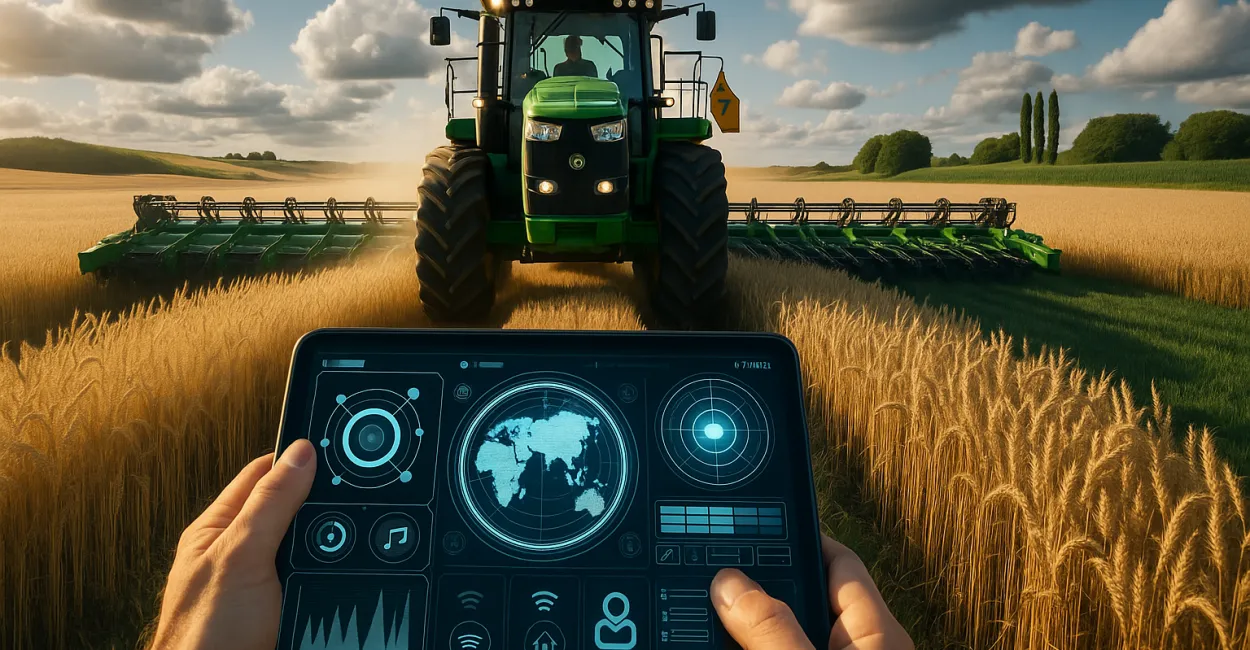
Artificial intelligence is already making decisions in the field that, until recently, depended entirely on a grower’s experience and a lot of trial and error. In practice, AI in agriculture helps predict pest outbreaks, adjust irrigation, reduce waste, and increase efficiency without requiring more land, water, or inputs.

This matters because pressure on food production continues to grow: a larger population, a less predictable climate, and tighter margins. In this article, you’ll learn what AI actually does on the farm, where it delivers real results, what limitations remain, and how to determine whether it makes sense for your operation.
What You Need to Know
- AI in agriculture doesn’t replace agronomic expertise; it expands decision-making capabilities with data from satellites, sensors, machinery, and farm records.
- The most consistent gains come from crop monitoring, precision agriculture, yield forecasting, and targeted input application.
- AI projects work best when a farm already has reliable data. Without it, models learn poorly and produce weak recommendations.
- Financial returns usually come from saving water, fertilizer, crop protection products, and operating hours—not from “technology for technology’s sake.”
- Not every grower needs to start with complex algorithms. In many cases, a good computer vision or weather forecasting system can address the main bottleneck.
How Artificial Intelligence Is Changing Agriculture From End to End
When people talk about AI in agriculture, the technical concept is simple: algorithms identify patterns, predict events, and recommend actions based on data from the production environment. Put plainly, this means turning images, measurements, and farm records into faster, more precise decisions.
The goal isn’t to “automate everything,” but to reduce uncertainty. Growers still make the decisions, but with more context. Systems using machine learning combine soil, weather, NDVI, machine telemetry, and crop history data to estimate yields, detect anomalies, and guide crop management.
The difference between using data and using AI in the field is the system’s ability to learn from historical data and adjust its recommendations as conditions in the crop change.
Where the Technology Is Already Delivering Results
- Computer vision: Identifies gaps in planting, weeds, water stress, and early signs of disease in images from drones or onboard cameras.
- Predictive models: Estimate yield, the optimal harvest window, and infestation risk based on weather, soil, and historical data.
- Agricultural automation: Adjusts application rates, machine routes, and irrigation based on real-time variables.
Sources such as the FAO and Embrapa, Brazil’s agricultural research corporation, have highlighted the role of digitalization in boosting productivity while reducing environmental pressure. This isn’t futuristic speculation; it’s a practical response to a concrete challenge: producing more with fewer mistakes.
Applications That Deliver the Most Value in Day-to-Day Farm Operations
Anyone who works in agriculture knows that not every innovation delivers results. I’ve seen farms buy a complete technology package but start saving money only after getting the basics in order: well-mapped fields, reliable records, and clear management goals. Without those, artificial intelligence becomes an expensive showpiece.
1. Near Real-Time Crop Monitoring
Satellite and drone imagery help teams identify stressed areas before problems become visible to the naked eye. This makes it possible to act on a field-by-field basis instead of treating the entire farm, reducing costs and avoiding unnecessary applications.
2. Precision Agriculture
Machines equipped with sensors and telemetry enable targeted application of seeds, fertilizers, and crop protection products. The benefit comes from fine-tuning: each area gets what it needs, at the right rate and at the right time.
3. Smart Irrigation
Algorithms combine soil moisture, weather forecasts, and crop growth stages to determine when and how much to irrigate. In water-stressed regions, these decisions matter as much as grain prices.
AI may seem like a sophisticated layer of technology, but in practice, it works well only when farm data is organized, up to date, and georeferenced.
The Data Behind the Models—and Why It Matters So Much

Good models require good data. Many technology companies try to soften this rule, but in agriculture, it’s impossible to ignore. Agricultural data comes from soil sensors, weather stations, satellite imagery, farm management software, connected machinery, and manual operating records.
The challenge is integration. Farms often have information scattered across spreadsheets, apps, machine files, and field notes. For AI to deliver value, these data sources need to work together. That’s where data platforms, data lakes, and equipment integration tools come in.
| Data source | What it measures | Practical use in decision-making |
|---|---|---|
| Soil sensor | Moisture, temperature, conductivity | Determines irrigation needs and water stress risk |
| Satellite / drone | Vegetation vigor, gaps, anomalies | Detects problem areas before losses spread |
| Weather station | Rainfall, wind, solar radiation, evapotranspiration | Helps select application and harvest windows |
| Machine telemetry | Speed, fuel use, route, performance | Reduces rework, soil compaction, and operational waste |
IBGE, Brazil’s national statistics agency, maintains essential data on the country’s production structure, helping put technology adoption in context. The Embrapa Agricultural Informatics Center is also a useful resource for understanding how agricultural research is addressing interoperability and data analysis in the sector.
Read also: Food Security: 7 Trends That Will Shape 2025
Why Some Projects Succeed While Others Stall
The main difference isn’t the software. It’s the problem you choose to solve. Projects that try to fix everything at once often fail because they skip the basics: Which problem is urgent? What data is available? Which decision will actually change the outcome?
Experts often disagree: some advocate for rapid adoption to achieve scale, while others recommend getting data systems in shape before making a major investment. Experience shows that both sides have a point, depending on the starting point. Larger farms can benefit from short pilot projects. For smaller operations, operational discipline matters more than any sophisticated model.
Common Mistakes in Practice
- Buying technology without setting a goal for productivity, savings, or risk reduction.
- Collecting too much data and using almost none of it.
- Training models with poor, incomplete, or inconsistent historical data.
- Ignoring the field team, which will operate the system day to day.
Connectivity is another deciding factor. In areas with unreliable internet, cloud-based solutions can lose effectiveness unless they offer offline functionality or asynchronous syncing. This is one of those cases where the sales pitch may fall short, but the right solution can still work well.
The Economic Impact: Where Returns Usually Show Up First
ROI from AI in agriculture rarely comes as a single big leap. It shows up across several smaller gains that add up to a meaningful impact on the bottom line: less wasted input, fewer machine hours, fewer incorrect applications, and fewer areas affected by poor management.
In large-scale crops, savings on crop protection products and fertilizer are often among the first signs of a return. In systems more sensitive to weather, reducing operational risk may be worth more than direct cost savings. In either case, calculations should include training, integration, and maintenance.
How to Determine Whether It’s Worthwhile
- Define a measurable problem: excessive spending, lost productivity, operational delays, or lack of visibility.
- Map available data and how often it’s updated.
- Run a pilot on one field, one crop, or one farm.
- Compare before and after using clear metrics.
- Only then consider scaling up.
The Role of Sustainability and Food Security
Productivity is no longer the only consideration. Sustainability has become part of doing business. The United Nations Food and Agriculture Organization has warned that food production needs to generate less waste and become more climate-resilient. Its FAO reports on climate and agriculture offer more information.
In practice, AI helps reduce poorly timed input applications, identify water losses, and cut emissions associated with unnecessary operations. It doesn’t eliminate environmental impacts, but it can significantly improve efficiency. For export-oriented supply chains, that efficiency has become a business requirement, not just a talking point.
The smartest use of AI in the field isn’t producing more at any cost; it’s protecting margins, soil, and water at the same time.
What’s Next for Connected Farms
The next major leap will likely come from combining AI, robotics, and autonomous systems. Selective spraying, image-based monitoring, and agricultural vehicles with assisted navigation are already advancing. Cost, integration, and operational trust are still holding back widespread adoption.
Generative models will likely see greater use in agricultural technical support, but with one important caveat: they can help organize knowledge, but they don’t replace agronomic validation. Mistakes involving crop protection products, weather, and plant health can be costly. That’s why people remain at the center of decision-making.
The most practical outlook for the coming years is this: the farms that succeed won’t be the ones with the most technology, but the ones that use technology to make better decisions sooner and with less waste.
Next Steps for Applying AI in Your Operation
If you want to move from talk to action, start small and set a clear goal. Choose an operational problem, check data quality, and test a solution that addresses one specific step in crop management. This approach reduces risk and quickly shows whether the technology makes a difference in your situation.
The best next step is to assess a farm process that currently relies too heavily on manual observation—irrigation, pest monitoring, yield forecasting, or input use—and measure the results before expanding. With AI in agriculture, scaling up makes sense only after validation.
Frequently Asked Questions
Is AI in agriculture only for large farms?
No. Small and midsize farms can benefit too, as long as they choose applications suited to their level of digitalization. In many cases, a simple monitoring or forecasting system can already deliver meaningful gains.
Which crops make the most use of artificial intelligence?
Soybeans, corn, sugarcane, cotton, coffee, and fruit crops are among the sectors with the greatest adoption. These supply chains already rely on large volumes of data, mechanization, and precise control.
What’s the biggest obstacle to adopting AI in agriculture?
The biggest obstacle is usually data quality, not the technology itself. Without reliable historical data, integrated systems, and a trained team, projects tend to lose momentum.
Does AI replace agronomists?
No. It supports agronomists with analysis, alerts, and forecasts, but technical interpretation and final decisions still depend on the specific field context.
Is it worth starting with drones and satellites?
It is if you have a clear problem to solve, such as monitoring stress, gaps in planting, or differences between fields. These tools make sense when they inform a practical decision.
How do you measure the success of an AI project in agriculture?
Compare metrics before and after: yield, cost per acre, input use, response time, and operational losses. Without metrics, the impression of improvement can be misleading.