
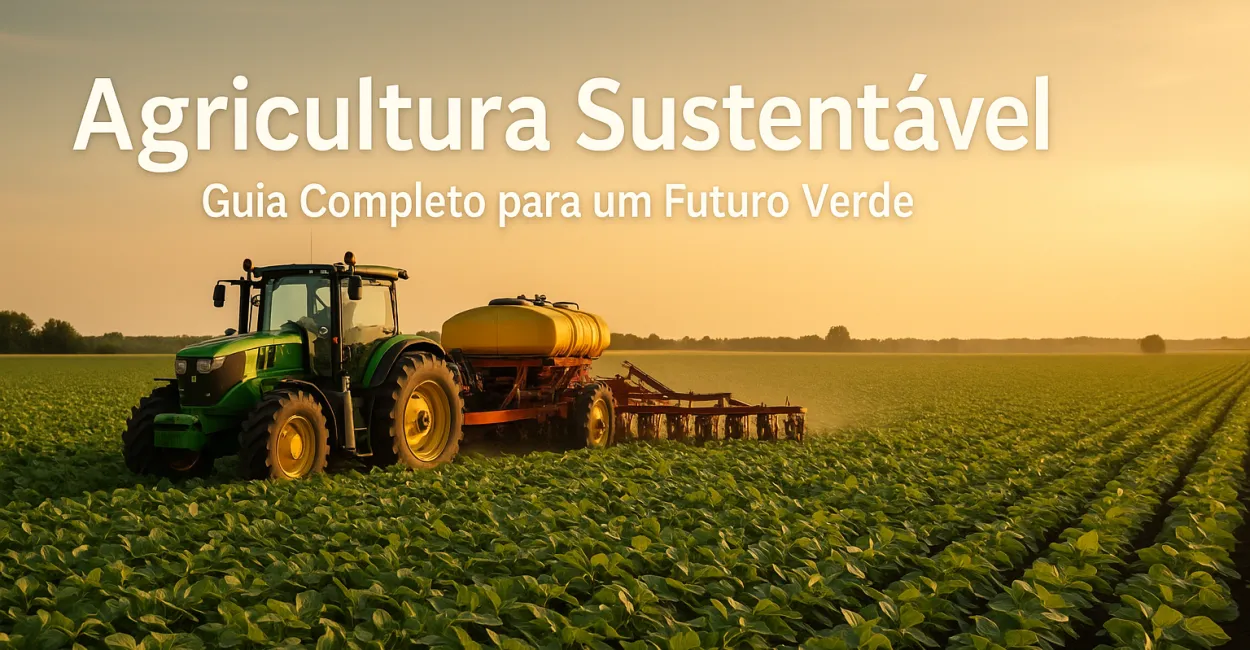
Sustainable agriculture is a production model that keeps soil healthy, reduces waste, and preserves the land’s ability to produce over the long term. When that balance breaks down, the effects show up quickly: lower yields, higher input costs, and greater pressure on rural families, cooperatives, and entire food supply chains.

The goal isn’t to produce less in order to preserve more, or to use everything up for a bigger harvest today. The real challenge is to produce well without depleting the resources production depends on.
That means managing soil, using water wisely, diversifying crops, using biological pest control, and making sound economic decisions for people working in agriculture.
What You Need to Know
- Sustainable agriculture brings together three goals that need to work in tandem: economic viability, environmental conservation, and social responsibility.
- Soil with organic matter, year-round ground cover, and crop rotation tends to hold up better during droughts and cost fluctuations.
- Sustainable practices work best when built into a farm’s management plan, rather than introduced as a quick fix after yields fall.
- Not every system needs to start with expensive technology. In many cases, changes to farm management pay off before major investments are needed.
- The social impact is felt first on small farms, where rising input costs and lower yields per acre hit hardest.
What Is Sustainable Agriculture, and Why Has It Changed the Conversation in Farming?
Technically, sustainable agriculture is a production system that aims to meet today’s demand for food, fiber, and energy without compromising the productive capacity of ecosystems or future generations. In practice, that means using soil, water, biodiversity, and energy more intelligently to reduce losses and build resilience.
The definition may sound broad, but it has direct consequences for day-to-day work. Anyone who farms knows the problem is rarely just “low productivity”; often, it’s the quiet deterioration of the system. Compacted soil, erosion, excessive reliance on fertilizers, and climate vulnerability all cut into margins and increase risk.
What separates high productivity from lasting productivity isn’t the volume of inputs, but the system’s ability to regenerate after each growing season.
That’s why the issue has moved beyond environmental concerns and into the heart of farm management. For an institutional perspective, see materials on sustainable systems from Embrapa, Brazil’s Agricultural Research Corporation, and the FAO’s guidance on agricultural sustainability.
Three pillars underpinning the concept
- Environmental: Conserve soil, water, wildlife, plants, and natural cycles.
- Economic: Maintain profit margins, predictability, and the ability to reinvest.
- Social: Protect decent work, rural incomes, and food security.
Living Soil: The Foundation That Shapes Each Harvest
If one factor captures the difference between stable and fragile production, it’s the soil. Organic matter, water infiltration, soil structure, and biological activity determine how much stress a crop can withstand before yields fall.
In practice, degraded soil comes with a cost that compounds over time. First, it holds less water; then, it responds less effectively to fertilizers; eventually, it needs more amendments and costs more to maintain the same results. Those who focus only on the harvest often overlook the damage accumulating along the way.
Practices that improve the system
- Crop rotation: Breaks pest cycles and reduces reliance on a single crop species.
- No-till farming: Conserves moisture and protects the soil surface from erosion.
- Cover crops: Reduce nutrient loss and support microbial life.
- Organic fertilizers and composting: Return carbon to the soil and improve its physical structure.
One thing many people underestimate: covering the soil is usually cheaper than restoring bare soil. It may seem minor, but it isn’t. Uncovered soil loses water faster, overheats, and creates a harsher environment for roots and microorganisms.
Bare soil isn’t neutral; it’s eroding, losing carbon, and becoming less productive.
Water, Climate, and Resilience: The New Measure of Efficiency

Sustainable agriculture has gained momentum because weather is no longer predictable. Longer droughts, concentrated rainfall, and extreme events are changing crop calendars and putting pressure on water management. In this reality, water efficiency isn’t just environmental rhetoric; it protects the bottom line.
Using water wisely involves well-calibrated irrigation, choosing adapted crop varieties, protecting springs, and retaining moisture in the soil. Agroforestry systems and strips of vegetation also help by creating more stable microclimates and reducing the impact of wind and direct sunlight.
Where resilience shows up first
- Smaller yield losses during droughts.
- Less need to replant after heavy rains.
- More stable responses to temperature swings.
A concrete example helps illustrate this. A mid-sized farm in the interior of Paraná State adopted crop rotation with cover crops, reduced the amount of bare ground between growing seasons, and adjusted irrigation based on soil moisture monitoring. The first benefit wasn’t a jump in output; it was fewer losses during critical weeks of drought. Only later did the farm improve fertilizer and water efficiency.
Read also: Agriculture and Technology: Innovations Transforming Farming
For data and climate context, follow materials from Conab, Brazil’s National Supply Company, and climate and production analyses from Brazil’s Ministry of Agriculture.
How to Cut Costs Without Sacrificing Production Scale
Many people still treat sustainability as synonymous with extra costs. That’s a common mistake. On many farms, the real gains come from reducing waste, improving efficiency, and relying less on emergency fixes.
Not every situation is the same, and that’s the nuance one-size-fits-all advice often misses. A well-managed farm with fertile soil can respond quickly to changes in management; degraded land may take years to recover. The economic logic is the same, but the timeline can differ considerably.
| Decision | Typical effect | When it works best |
|---|---|---|
| Crop rotation | Less pest pressure and better soil structure | When crop planning and markets for alternate crops are in place |
| Biological pest control | Less reliance on pesticides for some crops | When monitoring is continuous |
| No-till farming | Moisture conservation and reduced erosion | When cover crops are managed well |
Total costs need to be assessed per acre, per growing season, and across the full soil management cycle. Looking only at immediate expenses hides the long-term savings that add up over time. That’s why better-managed farms tend to track efficiency metrics, not just input prices.
Not every sustainable practice pays off in the same growing season, but almost any well-chosen practice can reduce operational risk over time.
Biodiversity, Biological Pest Control, and Less Reliance on Chemicals
Biodiversity isn’t just for show. In productive systems, it helps regulate pests, support pollinators, and balance nutrients. When the environment becomes too simplified, crops lose natural protection and become more reliant on outside interventions.
Biological pest control has gained ground precisely because it shows that productivity and ecological balance aren’t at odds. Using natural enemies, biological inputs, and integrated pest management can reduce chemical pressure in some situations and make results more predictable. But there’s no silver bullet: these methods work best when introduced early, with consistent monitoring and disciplined field management.
Key approaches and practices
- IPM (Integrated Pest Management): Bases decisions on pest damage thresholds, not a fixed schedule.
- Biological inputs: Include microorganisms, extracts, and biological agents applied within the system.
- Pollinators: Increase yields in crops that depend on biological pollination.
The transition can be harder in some cases, especially in areas with a long history of monoculture and heavy pest pressure. Even so, experts at Embrapa, Brazil’s Agricultural Research Corporation, have shown that integrated management is one of the most reliable ways to reduce production vulnerability.
The Social Role of Sustainable Agriculture in Rural Families’ Lives
The social impact begins before consumers notice any change on store shelves. When production becomes more stable, rural families gain more predictable incomes, reduce debt after bad harvests, and can better plan to stay on the land.
This matters because agriculture is more than a business; it shapes communities, jobs, and the flow of income in small towns. For family farms, repeated yield losses affect schools, local spending, credit, and succession planning. The social costs emerge quickly.
People who live and work in rural areas know that sustainability also means less exposure to cycles of “one good year followed by two bad ones.” A more balanced system doesn’t eliminate risk, but it reduces the chances that farmers will have to rely on one emergency after another just to make it to the next harvest.
How to Get Started Without Changing Everything at Once
The best starting point isn’t to overhaul the entire operation at once. A safer approach begins with an assessment of soil, water, yield history, pest pressure, and costs per acre. Then it makes more sense to choose two or three changes with the greatest potential impact.
A practical order for implementation
- Map the most vulnerable areas of the farm.
- Address what’s dragging down results: erosion, compaction, bare soil, or excessive pesticide costs.
- Test a crop rotation, a cover crop, and an adjustment to irrigation or fertilization.
- Measure results by growing season, not by impressions.
This approach works well when progress is monitored consistently, but it falls short when it becomes a one-off effort without measurable indicators. Sustainable farming requires good management. Without measurement, a farmer may spend more and improve less than expected.
For a deeper look at official data, IBGE, Brazil’s Institute of Geography and Statistics, maintains important data series on agricultural production and land structure that can help compare trends and understand where the sector is gaining ground or losing efficiency.
The Next Step Is to Measure What Truly Sustains Production
Markets tend to reward volume, but farms survive on consistency. That’s where sustainable agriculture moves from concept to management principle: less volatility, better use of resources, and a greater ability to weather poor growing conditions, high prices, and operational pressures.
The smartest next step is to choose one impactful variable and track it over a full production cycle. It could be organic matter, water infiltration, input costs, or net yield per acre. What doesn’t work is continuing to produce blindly and calling it efficiency.
Frequently Asked Questions
What’s the difference between sustainable and conventional agriculture?
The difference lies in the long-term goal. Conventional agriculture often prioritizes immediate output, while sustainable agriculture aims to maintain productivity without degrading soil, water, and biodiversity. In practice, this changes farm management, input use, and how results are measured.
Does sustainable agriculture always cost more?
No. In many cases, costs drop after an adjustment period because farms reduce waste and rely less on emergency fixes. There may be upfront costs for assessments, soil cover, or changes to farm management.
Which practices deliver results fastest?
Crop rotation, year-round soil cover, and integrated pest management are often among the first changes to show visible effects. Results vary depending on the condition of the land and its history of degradation. More vulnerable areas take longer to respond.
Do biological inputs completely replace chemical pesticides?
Not always. For some crops and situations, they greatly reduce reliance on chemicals; in others, they’re part of a combined approach. It’s better to focus on the system’s overall efficiency than assume one input can automatically replace another.
How can you tell if a farm is becoming more sustainable?
Track indicators such as organic matter, erosion, water infiltration, costs per acre, yield stability, and pesticide use. If these numbers improve over successive growing seasons, the system is becoming more resilient. If they worsen, the farm’s productive base is eroding.
%%AGPTRH9%%
Artigos Relacionados
 Socio-Environmental Change Through Education: Paths to a Sustainable Future
 Home Gardening: How to Grow Your Own Food in a Healthy, Affordable, and Sustainable Way
 African Mahogany Planting: A Complete Guide to Profitable, Sustainable Growing
 Education and Sustainability: Pathways to Responsible Development
 Rural Technical Courses: A Reliable Path to a Successful Agribusiness Career
 AI in Agriculture: A Revolution Transforming Global Food Security
