
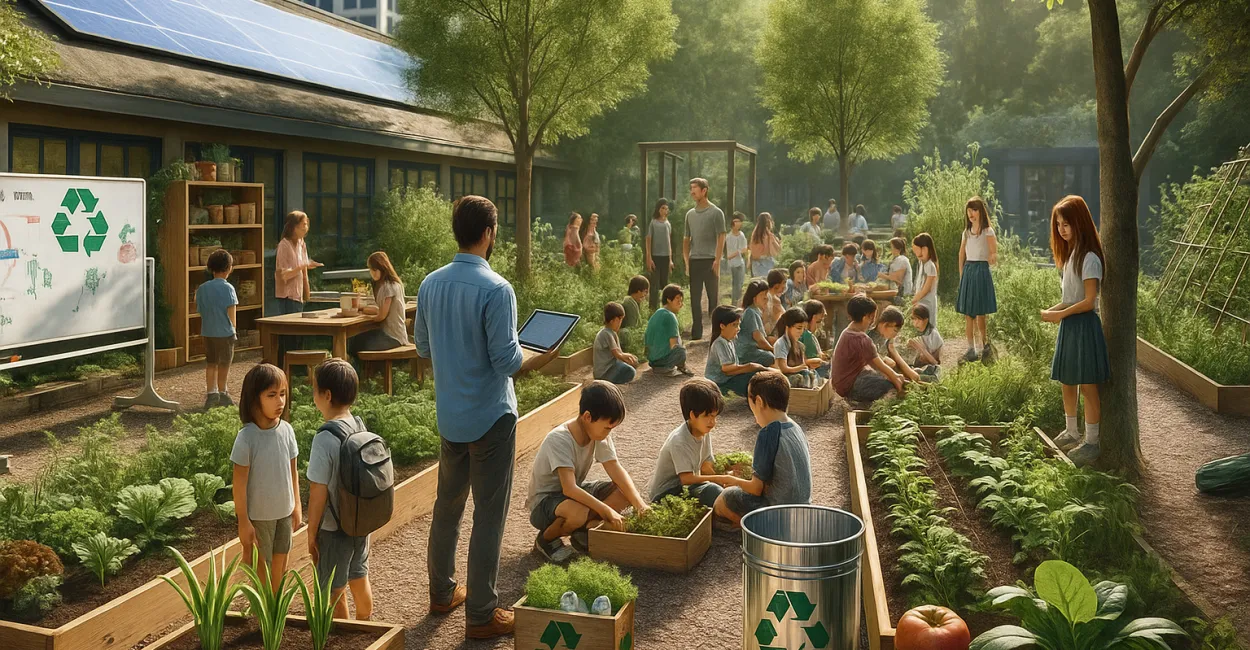
When a school reduces waste, rethinks purchasing, and changes consumption habits, it’s doing more than saving resources: it’s shaping how people make decisions. That’s the connection between education and sustainability—a learning process that influences attitudes, internal policies, and even how children, young people, and adults manage money, energy, and the world around them.

In practice, this topic goes far beyond recycling or sorting waste. It involves the curriculum, school management, institutional culture, and citizenship. It also touches on a sensitive point: teaching conservation doesn’t mean much if the school operates in ways that contradict what it preaches. That’s why sustainability in education needs to show up in the classroom, the building, the materials, and everyday choices.
What You Need to Know
- Sustainability in education brings together content, practice, and management to foster environmental and social responsibility.
- Schools that address this topic consistently often reduce waste and strengthen student engagement.
- One-off projects can help, but lasting impact depends on continuity, adults setting an example, and measurable goals.
- The topic works best when it connects ecology, consumption, climate, inequality, and the efficient use of resources.
- Without institutional consistency, the educational message loses its impact and becomes empty rhetoric.
How Education And Sustainability Fit Into Everyday Life
Here’s a straightforward technical definition: education for sustainability is a teaching approach that develops the skills to understand environmental, social, and economic impacts, make responsible decisions, and act with a long-term perspective. Put simply, it means teaching people to think about the consequences of their choices before they consume, dispose of things, build, travel, or produce.
This connection takes shape on three levels. The first is cognitive: understanding concepts such as ecological footprints, product life cycles, the circular economy, and climate justice. The second is behavioral: turning knowledge into habits. The third is institutional: aligning the school with its message so that practice doesn’t contradict theory.
Sustainability education isn’t an extra subject; it’s a way of organizing learning so students can recognize the consequences, interdependence, and responsibility involved in everyday decisions.
Anyone who works in this area knows that the most lasting effects rarely come from a single campaign. In practice, behavior changes through consistent routines: sorting waste, using water thoughtfully, reviewing purchasing practices, reducing food waste, and involving the community in projects.
When sustainability becomes part of everyday life, it no longer feels abstract.
What Changes When A School Truly Commits To This Topic
The curriculum becomes more than window dressing
When the topic comes up only on special occasions, it’s quickly forgotten. But when it runs across subjects, students see real connections between science, geography, math, and language arts.
For example, an energy-use problem can lead to reading data, interpreting graphs, and proposing solutions.
School management becomes more efficient
The impact isn’t just educational. Schools often waste paper, water, food, and energy without realizing the scale of the problem.
At many schools, simply tracking monthly consumption can reveal operational problems that also become learning opportunities.
The wider community changes, too
When students take what they learn home, the effects spread. I’ve seen school composting projects start small and, within a few months, involve families, staff, and neighborhood groups. The result wasn’t just less trash; it was more conversation about shared responsibility.
One important point: not every school project automatically leads to change. Without continuity, follow-up, and clear goals, the effort fizzles out. Experts disagree about the best format—a dedicated class, a cross-curricular approach, or interdisciplinary projects—but they agree on one thing: without regular practice, learning loses its impact.
For institutionally grounded guidance, consult UNESCO, which provides guidelines on education for sustainable development and the skills needed for the 21st century.
Projects That Work Because They Connect To Everyday Life

School gardens and mindful eating
School gardens work because they connect science, daily routines, and food. Students observe germination, soil, water, and cultivation, while also learning about food waste and where food comes from. It’s not just “planting to make things look nice”; it’s using food as a teaching tool.
Recycling with a clear destination
Sorting waste without explaining where it goes leads to frustration. The project becomes meaningful when the school shows the full chain: recyclable materials, a cooperative, logistics, and reuse. Without that follow-through, the activity becomes an empty ritual.
Water and energy use audits
Tracking monthly consumption makes a difference because it moves the topic beyond moral arguments and into concrete evidence. Students begin to see numbers, seasonal patterns, and waste. This helps them understand why efficiency matters just as much as good intentions.
Read also: Rural Sustainability: 9 Practices That Can Fail
- A clear goal for each class or grade level.
- A simple metric for tracking results.
- Participation from students, teaching staff, and custodial staff.
- Public updates for the school community.
This kind of work aligns with the global agenda set by the United Nations Sustainable Development Goals, especially SDGs 4, 11, 12, and 13, which connect education, cities, consumption, and climate.
The Role Of Teachers, School Leaders, And Families
This responsibility can’t fall solely on the science teacher. Education for sustainability works best when responsibilities are shared. Teachers turn the topic into learning; school leaders provide structure; families reinforce habits; and the community extends the effort’s reach.
Read also: Agrinho 2026 Essay Contest: 5 Tips to Succeed
| Participant | Main role | Practical example |
|---|---|---|
| Teacher | Turn content into understanding | Explore waste through graphs, writing, and discussion |
| School leadership | Provide structure and continuity | Set goals for reducing waste |
| Families | Reinforce habits outside school | Sort trash and review household consumption |
| Community | Expand the social impact | Connect the school with cooperatives and local projects |
The key here is consistency. A school may have a great-looking project, but if it buys excessive amounts of disposable products or ignores food waste, the learning loses credibility. Sustainability in education also means consistent administrative practices.
What separates symbolic environmental education from transformative learning isn’t the number of posters on the wall—it’s the continuity of practices and the consistency between what a school says and what it does every day.
Where School Projects Often Fall Short
The most common mistake is treating sustainability as an event. A school holds a themed week, puts on a presentation, and moves on. But habits don’t form through one-off activities; they develop through repetition, feedback, and example.
Another mistake is moralizing the topic. When everything becomes about individual blame, the discussion narrows. Sustainability does involve personal choices, but it also involves infrastructure, budgets, public policy, and supply chains. Not every problem can be solved with “awareness”; sometimes what’s missing is materials, training, or support from the school system.
A classroom story
An elementary school class started counting how many disposable cups were used each week. The number seemed small on the first day. After a month, the class realized that most of the cups were used at school events and meetings. The school leadership then replaced some of them with reusable bottles and reviewed purchasing practices. Learning moved off the page and into everyday routines.
For information on laws and public policy, Brazil’s Ministério da Educação (Ministry of Education) provides programs and documents that can help schools align their practices with national guidelines.
How To Measure Whether Education Is Advancing Sustainability
Without metrics, a school can only assume it has improved. And assumptions aren’t enough. Ideally, track simple data that’s easy to record and hard to manipulate: water use, energy use, paper consumption, student participation, engagement with initiatives, and reductions in food waste.
- Environmental metrics: water, energy, paper, and waste.
- Educational metrics: participation, understanding, and continuity.
- Social metrics: family engagement and local partnerships.
- Management metrics: cost savings, maintenance, and internal organization.
This tracking helps distinguish intentions from results. Many schools say they address the topic, but few can show measurable progress over the school year. When the data is available, the conversation becomes more serious—and more useful.
Education And Sustainability In The Future Of Learning
The strongest trend isn’t to create a stand-alone subject, but to integrate the topic across the curriculum. That makes sense because environmental challenges don’t exist in a separate box, apart from the rest of life. Climate, consumption, transportation, health, and inequality are constantly interconnected.
The ideal scenario is one in which students learn to think in terms of systems. They understand that a seemingly small choice can have ripple effects. They also learn that a good solution isn’t the one that sounds best in theory, but the one that works in the real world of the school, family, and community.
What To Do Now
To turn intention into action, start small and set a clear measure: choose a real problem at the school—paper, water, waste, or food—and track it for 30 days. Then compare the before and after, discuss the results with the class, and adjust what didn’t work. This kind of method is more valuable than a grand project with no follow-up.
For those looking to make steady progress, it’s worth working on three fronts at once: the curriculum, daily routines, and management. That combination is what turns education and sustainability from feel-good rhetoric into observable change.
Frequently Asked Questions
Is education for sustainability the same as environmental education?
Not exactly. Environmental education focuses more on the relationship with nature and ecological impacts, while education for sustainability takes a broader view that includes social, economic, and governance issues. In practice, the two fields overlap considerably.
Does starting a sustainability project at school require a large budget?
No. Many projects start with an assessment, changes to everyday habits, and simple goals. Tracking waste, reducing disposable items, and improving waste sorting can already make a difference without a major investment.
What’s the biggest mistake schools make on this topic?
Treating sustainability as a one-time campaign. When an effort lasts only a week, its educational impact is usually limited. What works is continuity through routines, metrics, and participation from the school community.
How can students get involved in practical ways?
Bring the topic into real problems at the school. Students are more engaged when they measure consumption, observe waste, propose solutions, and track results. They learn better when they can see the concrete effects of their actions.
Does sustainability need to be addressed in every subject?
Not necessarily in every subject at the same time, but it should be integrated consistently across the curriculum. If it’s confined to a single subject, it can seem peripheral. A cross-curricular approach gives learning greater impact.
%%AGPTRH6%%
Artigos Relacionados
 Environment and Education in the 21st Century: Pathways to a Sustainable Future
 Early Childhood Education: The Importance of Play in Child Development
 Rural Education: Transforming Lives and Driving Development in Rural Communities
 Education: The Essential Role Parents Play in Child Development
 The Importance of Play in Childhood for Whole-Child Development
 Inclusive Education in Schools: Transformative Paths for Every Student
