
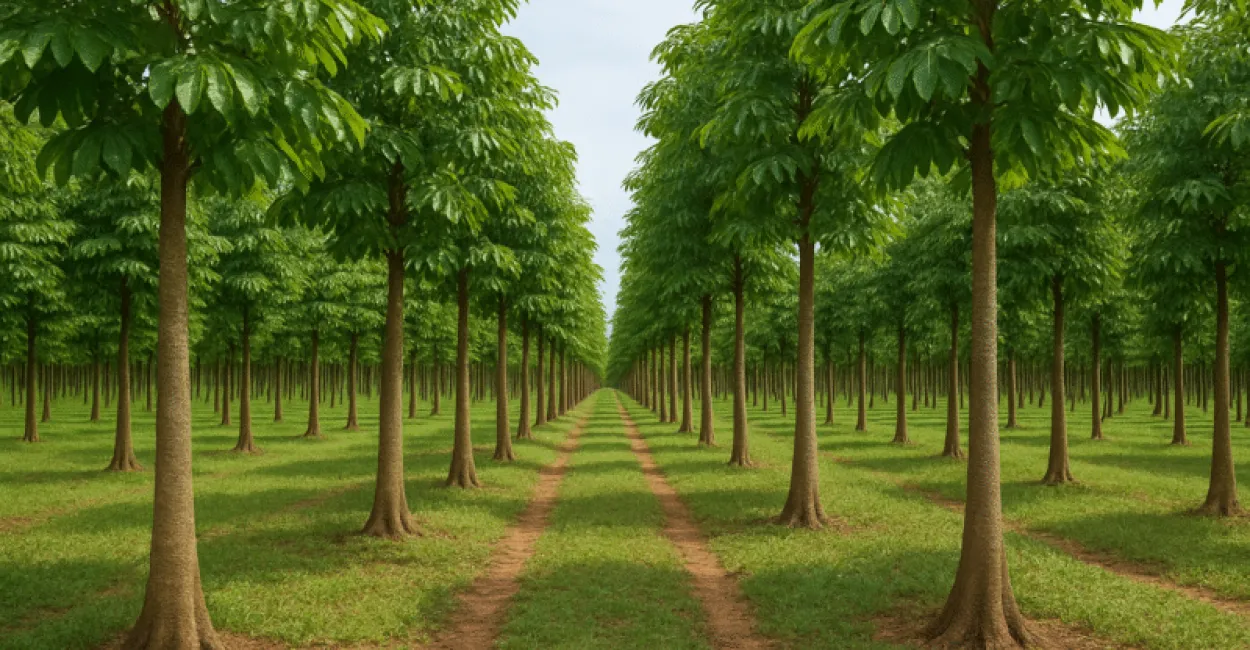
African mahogany stands out because it brings together two things that are rare in forestry: high-value timber and relatively predictable management when a project gets off to the right start. The problem is that many people enter the business focused only on log prices, overlooking what really determines the outcome: soil, seedlings, spacing, pruning, and rotation length. In practice, what separates a promising planting from an expensive loss is not the species itself, but the quality of the establishment. This article explains what it means to grow Khaya spp., which conditions help the species perform best, where mistakes most often occur, and how to structure a project that makes sense both in the field and on paper.
The Essentials
- Commercial cultivation of Khaya spp. depends more on proper establishment than on the wood’s reputation.
- Deep, well-drained soil with corrected pH has a greater impact on early growth than excessive fertilization.
- Spacing, pruning, and branch removal directly affect final diameter and trunk quality.
- Financial returns take time; growers who need quick cash flow are often disappointed with the project.
- Markets, logistics, and consistent management matter just as much as yield per acre.
African Mahogany Planting: Decisions That Determine the Outcome
Technically, African mahogany refers to species in the genus Khaya used in forestry plantations to produce high-value timber. In practical terms, this means a tree that can produce a straight trunk, quality sawn timber, and high added value, provided it receives sound management from the nursery through harvest. The most common mistake is treating the crop as if it were “plant it and wait.” That’s not how it works. A quality forestry planting requires soil planning, careful selection of genetic stock, weed control, canopy development, and a marketing decision made before the first seedling goes into the field.

African mahogany often appeals to growers looking to diversify their assets, integrate trees with other rural activities, or build a long-term forestry asset. The key point is this: the species can be profitable, but profitability comes from designing the project to produce valuable timber, not just biomass volume.
What separates a profitable forestry planting from one that merely looks good is not the species, but disciplined management during the first three years.
Where the Species Performs Best in the Field
Soil, Drainage, and Effective Depth
Khaya spp. tends to perform best in deep, well-drained soils with good physical structure. Well-managed Oxisols and Ultisols can work well, provided there is no severe compaction or prolonged waterlogging. In areas with a compacted layer, roots become restricted early and tree growth slows.
The preferred working pH is usually slightly acidic, around 5.5 to 6.5, with amendments determined by soil testing. For management and soil interpretation guidance, consult technical resources from Embrapa, Brazil’s agricultural research corporation, which offers useful recommendations for tropical soils and forestry systems.
Climate, Rainfall, and Stress Risk
The species does best in tropical climates with a well-defined rainy season and no severe cold. In regions prone to long dry spells, growers need to plan for water collection after planting, ground cover, and the right planting season. Seedlings planted at the wrong time face stress early on, and that lost time is rarely recovered completely.
Annual rainfall is usually adequate in areas with moderate to high precipitation, but its distribution matters more than the yearly total. An area receiving 1,600 mm of poorly distributed rainfall may be less suitable than one receiving less rain more consistently.
Before Committing to a Site, Check Three Things
- Any physical barriers in the soil profile.
- Risk of wind, frost, and waterlogging.
- Access for management and future harvesting.
How to Grow Vigorous Seedlings Without Wasting Time in the Nursery

Seedling quality determines much of the crop’s early performance. Viable seed, well-aerated potting mix, balanced irrigation, and suitable containers help prevent root deformities and early mortality. Anyone who works in this field knows that a leggy seedling may seem like a bargain on purchase day, but it becomes very costly later.
In well-planned projects, an ideal seedling has a sturdy root collar, a well-developed root system, and a top that is not excessively elongated. When seedlings arrive “stretched out,” they may survive planting, but early growth is usually slower and less uniform.
Genetic Origin and Uniformity
Not every seed lot performs the same way. There is variation among seed trees, which affects vigor, trunk form, and stand uniformity. That’s why growers aiming to scale up need to consider provenance, germination rates, and field performance—not just the price per thousand seedlings.
If the goal is to produce higher-grade timber, prioritize material from a known source and more uniform lots. Uniformity makes management easier, helps with pruning schedules, and can even improve future negotiations with buyers.
In forestry plantations, poor seedlings rarely ruin the whole site at once; instead, they gradually undermine the entire stand, making the problem more expensive to fix.
Spacing, Branch Removal, and Pruning for Quality Trunks
Planting layout changes tree architecture. Wider spacing delays canopy closure and makes it easier for growers to move through the stand, but can reduce early competition and uniformity. At closer spacing, trees tend to reach for light and grow straighter, but branch management and competition require closer attention.
Read also: Sustainable Farming: Practices That Increase Profits
In practice, a balanced approach tends to work better than either extreme. The right choice depends on the goal: larger-diameter timber, a longer rotation, an agroforestry system, or faster volume production.
What to Do in the First Few Years
- Control competing vegetation during the first 24 months.
- Remove forks early, before the defect becomes part of the tree’s structure.
- Prune gradually, without exposing too much of the trunk to sunlight.
- Track straightness, health, and growth by stand, not just by individual tree.
This is where many projects stall: growers let the trees grow “naturally” and then try to fix crooked trunks later. That rarely works well. Trunk form is shaped early; later, you can only manage the damage.
Pest and Disease Management: The Most Costly Mistakes
African mahogany can be affected by pests and diseases, but the most common field problem is not a single pest—it’s accumulated stress. Poor soil, compaction, untimely pruning, and competing weeds all make trees more vulnerable. Issues to watch for include leaf-cutting ants, foliar attacks, mechanical damage, and rot associated with excess moisture. In areas where problems are becoming more common, the most useful first step is usually to improve site conditions and management, not to apply a one-size-fits-all treatment.
When Chemical Controls Aren’t Enough
Chemical control can help in some cases, but it does not replace balanced nutrition or sound forestry practices. This approach works well for specific problems, but it fails when the planting was unbalanced from the start. Trees weakened by poor management continue to show up as problem areas in production, even after treatment.
For regulatory information and official guidance on agricultural production and forestry supply-chain monitoring, consult Brazil’s Ministry of Agriculture and Livestock. For biodiversity, climate, and restoration, the FAO provides a helpful overview of the role planted forests play around the world.
Real Profitability: Where the Project Makes or Loses Money
Anyone who looks only at timber prices is seeing only half the picture. The profitability of a Khaya spp. planting depends on establishment costs, annual maintenance, survival rate, diameter growth, trunk quality, and the sales channel at harvest.
Returns also vary depending on the grower’s objective. High-grade sawtimber follows a different economic model from a planting intended as an asset, an agroforestry system, or a medium-term store of value. There is no magic number that applies to every situation.
Costs to Include in the Budget from the Start
- Soil amendments and site preparation.
- Seedlings and replacement planting.
- Weeding, clearing around trees, and competition control.
- Pruning, branch removal, and technical oversight.
- Harvest logistics and marketing.
I’ve seen growers celebrate early growth, only to lose their profit margin at sale because the stand was uneven, had too many knots, or had trees with smaller diameters than planned. That’s when premium timber stops being a promise and becomes a bottom-line calculation.
Decision
Technical Effect
Economic Impact
Well-amended soil
Deeper roots and steady growth
Fewer failures and lower replanting costs
Pruning at the right time
Cleaner trunks and better log quality
Sale price is likely to increase
Delayed management
Permanent defects in the wood
Lower prices at harvest
Timber Markets, Certification, and Sales Strategy
Markets reward consistency. That applies to volume, form, provenance, and documentation. Well-organized projects are better positioned to work with sawmills, specialized buyers, and supply chains that require traceability.
In some cases, forest certification can offer an advantage; in others, it may not do much to increase the final price, but it can improve market access. The right choice depends on the sales channel, scale, and long-term strategy. Growers do not all agree on the immediate return from certification, and that makes sense: the benefits are more likely to show up in market access and reputation than in quick cash flow.
Plan Your Exit Before Harvest
Ideally, decide early whether the project is aimed at selling standing timber, logs, sawn lumber, or a forestry asset intended to appreciate in value. Each option requires different management standards and documentation. Waiting until the end of the rotation to decide can weaken your bargaining position.
For general information on the country’s agricultural and forestry sectors, follow reports from IBGE, Brazil’s national statistics agency, which help show the importance of rural industries to the economy and land use.
What to Do Now to Get Your Project Underway
If you want to get started with confidence, the smartest path is simple: test the soil, define your sales goals, choose reliable seedlings, and design a management plan for the first three years. This is the stage when a project gains or loses value.
Before making a major investment, confirm that the site is suitable and identify a sales channel that makes sense for your situation. The best planting is not the one that looks best in a photo; it’s the one that reaches harvest with marketable timber, controlled costs, and a sales strategy already in place.
Practical next step: create an establishment plan for each stand, review your soil test, and compare two spacing scenarios before buying seedlings. This simple check can prevent costly decisions that might not become apparent for years.
Frequently Asked Questions
How Long Does African Mahogany Take to Generate a Return?
Returns depend on the sales goal and management standards, but they usually take time. Plantings intended to produce quality timber have a long rotation and require financial planning. Growers expecting quick returns are often disappointed.
What Is the Best Soil for Planting African Mahogany?
Deep, well-drained soil with good physical structure is ideal. Compacted, shallow, or waterlogged soils reduce performance. A soil test determines what amendments are needed before planting.
Can I Grow African Mahogany Alongside Other Crops?
Yes, especially early in the planting cycle, while there is still space between rows. The system needs to account for light, water, and root competition. An aggressive companion crop can hinder tree growth.
Does African Mahogany Need a Lot of Fertilizer?
It responds well to balanced nutrition, but excess fertilizer cannot make up for poorly prepared soil. Soil amendments and physical condition come first; fertilization then supports growth. Without that sequence, your investment delivers less than it could.
Does Pruning Really Increase Timber Value?
Yes, because it reduces knots and improves the usable length of the trunk. The results, however, depend on pruning at the right time. Late or poorly performed pruning can cause damage and cancel out some of the gains.
Artigos Relacionados
 Logistics Director: A Complete Guide to the Role and Its Demands
 Gardener: The Complete Guide to Mastering the Profession and Advancing Your Career
 Vehicle Insurance: A Complete Guide to Protecting Your Car Today
 User Experience (UX/UI) Designer: A Complete Guide for Professionals and Enthusiasts
 Cybersecurity Analyst: The Complete Guide to Protecting Your Business
 Storytelling Techniques for Children: A Complete, Practical Guide
