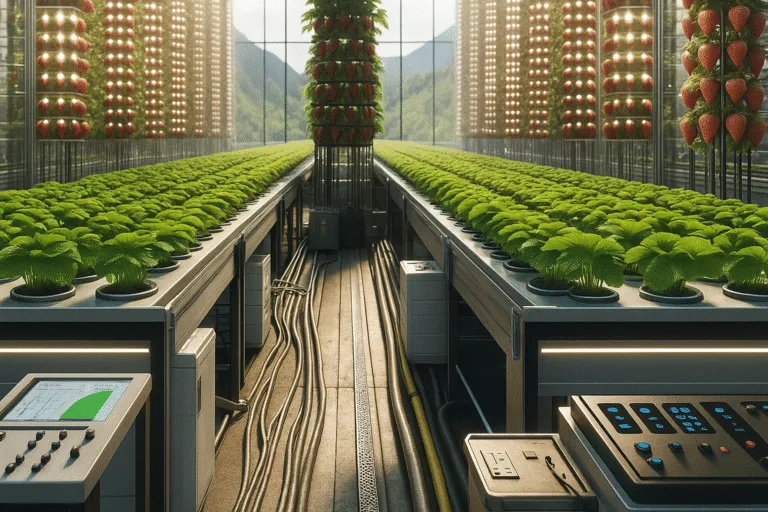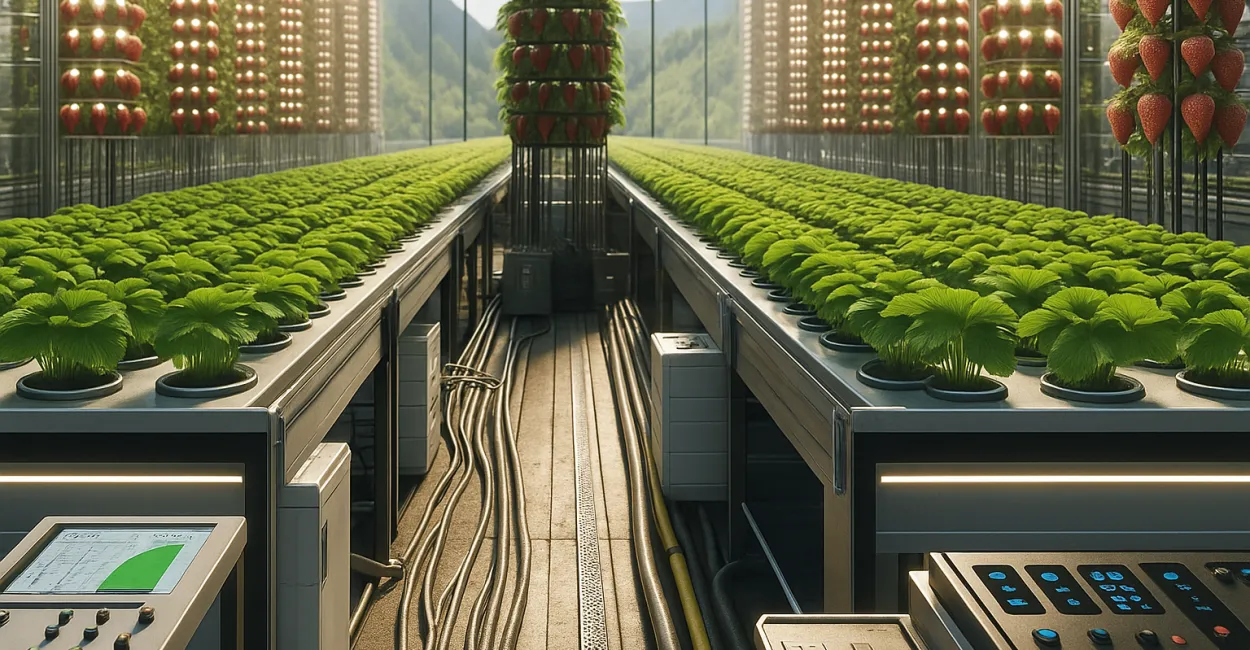
A vertical farm can take up little floor space and still consume a lot of energy to light and climate-control plants. Vertical farming arranges crops in layers, inside controlled or partially protected structures.
To determine whether it makes sense, you need to consider the crop, production system, energy costs, and consumer market together.

Strawberries are appealing because of their commercial value and suitability for protected cultivation, but they are not an automatic choice: they require careful management of light, temperature, humidity, and pollination. Technology helps control these variables; on its own, it does not guarantee better-tasting fruit or a profit.
This guide covers available systems, criteria for assessing costs, and the first steps for home or commercial projects, with a focus on the specific needs of strawberry production.
What vertical farming is and how it works
Agriculture is produced vertically when plants are arranged in stacked levels or planes, making use of vertical space and, in many cases, controlling factors such as light, water, nutrients, temperature, and humidity. These systems may include hydroponics, aeroponics, or substrate growing, but those terms describe techniques, not the vertical arrangement itself.
An urban vertical farm is a production operation designed to supply crops to the market. A vertical garden, by contrast, can be a small-scale home setup, such as pots mounted on a wall. Hydroponics grows plants without soil, supplying nutrients through a solution; it can be used in either a vertical or horizontal setup.
There is no single universal classification that covers every type of agriculture. Some of the best-known methods and approaches include conventional, organic, greenhouse-protected, precision, urban, and vertical farming, as well as agroforestry systems. No-till farming is a soil management practice, not a synonym for growing crops in layers.
In a commercial operation, pumps, reservoirs, lighting, and sensors can work together to maintain set conditions. This requires planning for automation and monitoring systems; the technology needs to suit the operation’s scale and the grower’s ability to maintain it.
Choosing a system and crop for your goals
The choice of system depends on the crop, available space, the team’s experience, and the level of control required. Leafy greens and herbs often adapt well to compact setups. Strawberries can also be grown in tiers, but their training and fruiting require more attention.
System How it works Uses and limitations Vertical hydroponics Roots receive a nutrient solution that circulates or is delivered through channels and containers. Suitable for leafy greens and some fruit crops; requires management of the solution, pumps, and flow between levels. Aeroponics Roots are suspended and receive nutrients as a mist. Can work well with compact structures, but depends on equipment and a rapid response to failures. Substrate growing Roots grow in materials such as coconut fiber, with water and nutrients supplied through irrigation. Used for crops such as strawberries; requires management of irrigation, drainage, and substrate quality.
Hydroponics and aeroponics do not eliminate the need for sanitation or make crops immune to disease. A small leak or clogged emitter can leave some plants without water while the rest appear normal. That is why checking roots, flow rates, and irrigation uniformity is part of routine operations, not just system setup.
Tip
Before buying a multilevel structure, test water circulation and light distribution on every level. A shelf that works on top may shade the plants below or irrigate them poorly.
How LED lighting and the environment affect strawberries

LEDs make it possible to adjust light intensity and spectrum, but results depend on the cultivar, the plant’s growth stage, photoperiod, and the amount of natural light reaching the crop. Supplemental lighting can make up for periods of low light; in an enclosed facility, it is also an energy expense and a source of heat that must be taken into account.
For strawberries, light, temperature, and humidity interact with flowering and fruit development. There is no LED schedule that works for every cultivar and region. Management should be adjusted with technical guidance and close observation of the plants, without assuming that more hours of light mean higher yields or better flavor.
Protected growing environments can help schedule harvests at different times of year, but year-round production is not automatic. Feasibility depends on climate control, cultivar, plant availability, management, and energy costs; pollination problems and disease can also affect quality.
Growing recommendations need to reflect local conditions. Brazil’s Ministry of Agriculture and Livestock (Ministério da Agricultura e Pecuária) provides official information on crop production and applicable regulations, while Embrapa, Brazil’s agricultural research corporation, publishes technical guidance on strawberries and production systems. Lighting can refer to different solutions, so assess equipment specifications for agricultural use rather than relying on rated wattage alone.
Benefits, sustainability, and limits of growing in layers
Stacking plants can increase growing area per square foot of floor space, which is useful in expensive urban locations or where space is limited. Protected environments can also make pest management and standardizing conditions easier. That does not mean every project uses fewer resources overall: electricity, climate control, materials, and equipment replacement all factor into its environmental and financial costs.
Water use can be reduced through recirculation and irrigation control, but the results depend on system design and nutrient-solution management. Recirculated water can also spread pathogens among plants if the system is contaminated. The FAO provides guidance on good practices in protected cultivation, including water management, sanitation, and crop care. Its principles can help organize procedures, but they do not replace crop-specific recommendations.
A vertical farm’s environmental performance depends on what it saves in water and space and what it uses in energy, materials, and maintenance.
These systems also depend on pumps, sensors, and controls. In facilities without backup systems or contingency plans, a power failure can interrupt irrigation or ventilation and quickly affect plants. Controlled-environment growing reduces exposure to weather, but does not eliminate biological risks or the need for supervision.
How much does it cost to set up a vertical farm, and how do you assess feasibility?
The cost of a vertical farm varies with its scale, facility, structure, crop, automation, and climate-control needs; without those assumptions, there is no reliable figure to quote. Upfront investment includes preparing the space, shelving, reservoirs, pumps, piping, lights, sensors, and installation. Operating expenses include energy, water, nutrients, seedlings, labor, packaging, maintenance, and distribution.
To compare proposals, separate setup costs from monthly expenses and estimate marketable yield, not just the number of plants. Account for losses, discarded product, downtime, and the price your sales channel will actually pay. LED and climate-control costs deserve special attention: production may look promising on paper but become unviable once those expenses are included.
Here is an example of an analysis, not a representation of market prices or yields: if a project plans to sell fresh strawberries to restaurants, list the expected revenue per batch and subtract packaging, delivery, losses, and growing costs. Then include investment payments and months with lower sales. If the margin is positive only when energy or labor is left out, the model has not yet been validated.
The business model also affects the decision. Direct sales may bring in more per unit, but require customer outreach, logistics, and a consistent supply. Supplying retailers may require volume, uniform standards, and packaging. A large-scale project should not be chosen simply because there is demand for locally grown food.
Planning a vertical garden or starting a commercial operation
For a home vertical garden, start by assessing available light, access to water, and ease of cleaning. A wall-mounted garden, hanging garden, or PVC structure can work for herbs and leafy greens, provided the materials are suitable and the support can bear the weight of the structure when wet. Home hydroponics also requires monitoring the nutrient solution and preventing leaks.
A commercial vertical farm needs market validation, a technical plan, and a pilot growing operation before expansion. A prudent approach is to:
- Define the crop, scale, and likely buyer before choosing equipment.
- Check the facility, electrical capacity, water supply, ventilation, and sanitation conditions.
- Compare systems and estimate capital investment and operating expenses separately.
- Test a small batch, recording consumption, losses, quality, and labor hours.
- Expand only once the crop and sales channels show consistent results.
The common mistake of starting by buying shelving usually comes from getting the steps backward: the structure is chosen before anyone knows how much room a mature plant needs, what kind of light it requires, or how the product will be sold. Instead, size the growing operation around the crop and buyer, then select equipment.
For training, look into local agricultural extension services, courses offered by agricultural schools, and Embrapa publications. Production, traceability, and sales requirements may vary by product and sales channel; consult Brazil’s Ministry of Agriculture and the relevant authorities before setting up sales.
Technology, quality, and routine crop management
Temperature, humidity, pH, and electrical conductivity sensors help track the growing environment and nutrient solution. Automation can trigger irrigation or alert you to changes, but it needs calibration and verification. Monitoring systems do not replace plant inspections or a procedure for responding when a sensor fails.
Artificial intelligence can help analyze images and growing records, but its alerts depend on data quality and need to be validated by someone who understands the crop. For strawberries, observations of flowers, leaves, fruit, and roots remain essential: changes in irrigation or ventilation may first show up in one part of the structure.
Care matters at harvest, too. Bruised fruit or fruit stored improperly loses quality and can compromise an entire batch. Standards for harvesting, sorting, packaging, and refrigeration should be part of the production system. Information on vertical strawberry farming is available, but the chosen technique should be confirmed with agronomic guidance suited to the region and cultivar.
Before turning a pilot into a business, record energy and water use, inputs, losses, and labor hours for each growing cycle. These data make it possible to compare cultivars and adjust management without mistaking an unusually good harvest for consistent performance.
Frequently asked questions
Are a home vertical garden and a vertical farm the same thing?
No. A home garden is small-scale and often intended for personal use; a vertical farm is designed as a production operation, with established routines, cost controls, and sales channels.
What is the most common mistake when choosing a system?
Buying the structure before defining the crop and growing conditions. The crop determines spacing, irrigation, lighting, and management needs, and those requirements should guide the design.
How can I tell if energy costs make a project unviable?
Include the projected energy use of lights, pumps, and climate control in the cost per batch, along with labor, losses, and distribution. Compare that cost with revenue from marketable product and the price actually negotiated, not a retail price observed without context.
Where can I get guidance on growing strawberries in a protected environment?
Consult Embrapa’s technical publications, local agricultural extension services, and agronomists with experience growing strawberries. For official crop-production regulations and requirements, check the channels of Brazil’s Ministry of Agriculture and Livestock.