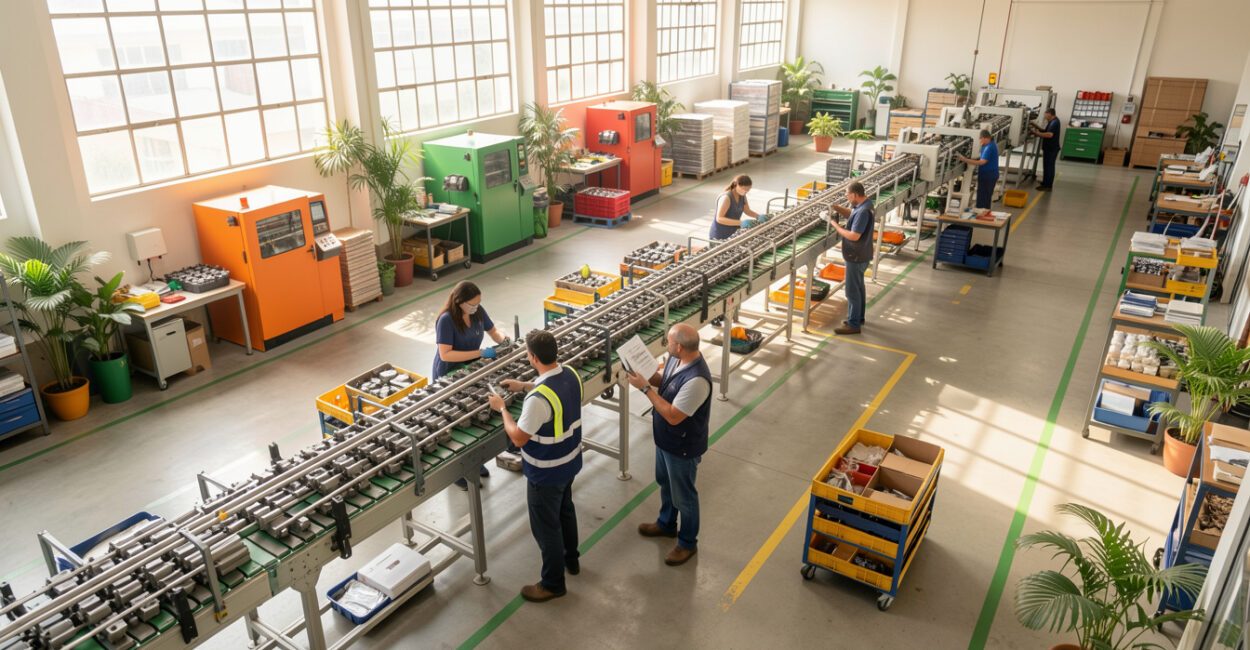
A factory can meet its daily production target and still fall behind on orders, waste materials, or expose workers to safety risks. A production manager coordinates operations to balance output, quality, deadlines, costs, and safety.
The role combines decisions about resources and priorities with people leadership and performance monitoring.

The scope varies depending on the industry, plant size, and company structure. That’s why evaluating an opportunity means looking beyond the title: it’s important to know what results you’ll be responsible for, which team you’ll manage, and how much authority you’ll have to make decisions.
What does a production manager do, and what results are they expected to deliver?
A production manager plans, coordinates, and oversees industrial operations to ensure products are made according to schedule, quality standards, and safety requirements, using available resources. In practical terms, they decide how to organize people, equipment, and materials when the plan meets the real-world constraints of the factory. Responsibilities include aligning priorities with Production Planning and Control (PPC), overseeing supervisors, and addressing issues that could jeopardize orders. Metrics may include schedule attainment, productivity, scrap, rework, machine downtime, and unit costs. The right metrics depend on the process: a make-to-order factory shouldn’t be evaluated in exactly the same way as a continuous operation.
A dashboard of metrics is only useful when it leads to action. For example, if production drops, the manager needs to determine whether the cause is a material shortage, equipment failure, or a bottleneck in one stage. Increasing the pace without identifying the cause can shift the problem to quality or maintenance.
Production results depend on decisions that keep deadlines, quality, costs, and safety within acceptable limits.

How do you plan production and respond to issues?
Planning starts with comparing demand against the operation’s actual capacity. Production Planning and Control (PPC) organizes work orders, deadlines, materials, and resources; management checks whether the schedule can be met with the available machines, scheduled staff, and received supplies.
When an order falls behind, moving it up can push another order past its deadline. The decision should account for the impact on the customer, material availability, product changeover time, and existing commitments. Priorities then need to be communicated to the teams involved so the factory isn’t working from different versions of the plan.
A common scenario is a production line losing pace because a component hasn’t arrived. Overtime may seem like a quick fix, but it won’t solve the shortage and will increase costs. The manager needs to confirm the cause, consider alternatives with procurement and PPC, and update the schedule before making commitments on other orders.
Changing priorities with every new delay is also a recurring mistake: instability leads to more machine changeovers and makes delivery dates harder to predict. A change makes sense when the impact on the customer justifies the cost and the affected teams know what will be rescheduled.

How do production, quality, maintenance, procurement, and safety work together?

Production depends on coordination between teams. Quality sets inspection criteria and handles nonconformances; maintenance reports equipment condition and scheduled work; procurement tracks incoming raw materials; and the safety team recommends controls to reduce operational risks.
If an inspection finds a recurring defect, continuing to chase volume targets without addressing the cause can multiply rework. If a machine has repeated failures, discussing its availability with maintenance can help distinguish an isolated problem from the need for planned work. The same principle applies to supplies: production shouldn’t assume materials are available until their arrival has been confirmed.
Safety must be part of decisions about capacity and operating pace. NR-12, issued by Brazil’s Ministry of Labor and Employment, covers workplace safety for machinery and equipment. Changes to methods, pace, or setup shouldn’t bypass safeguards or replace risk assessments with pressure to increase output.
To learn more about the regulation, consult NR-12 through Brazil’s Ministry of Labor and Employment. Its application depends on the equipment and working conditions; questions about compliance should be addressed with the company’s technical specialists.

What’s the difference between a manager, boss, team leader, supervisor, and director?
Titles don’t mean the same thing at every company. The table shows a practical distinction based on decision-making scope, but the job description and organizational chart are more reliable than the title alone.
Role Typical scope Primary focus Production team leader Team or workstation Assign tasks, guide execution, and flag problems to the supervisor. Production supervisor Shift, line, or area Monitor shift targets, schedules, incidents, and team routines. Production chief Area or facility, depending on the company Coordinate execution and own operational results; the title varies widely. Production manager One or more production areas Coordinate resources and teams, set priorities, and own operational metrics. Director of production Broad production strategy Set policies, investments, and objectives for facilities or larger operations.
So, the answer to “What does a production team leader do?” usually involves directly coordinating work at a workstation or within a team. A manager typically handles decisions with a broader impact, though some companies assign managerial responsibilities to roles with different titles.

What education, skills, and experience can help you become a manager?
There’s no single degree that fits every industry. Production Engineering, Mechanical Engineering, Business Administration, and related degrees can be useful, but the right fit depends on the production process and the employer’s requirements. Courses in PPC, quality, people management, and safety can also complement work experience.
Knowing the operation matters. People who understand the workflow, recognize bottlenecks, and know how to interpret metrics are better equipped to assess the consequences of changing priorities. Experience in supervision or coordination is often helpful, but it’s not a universal requirement: companies structure career paths differently.
Can someone working in HR move into this role? Skills such as recruiting, team development, and conflict management can transfer, but they don’t replace knowledge of the industrial process. To become a stronger candidate, you need to build operational experience and learn how capacity, costs, quality, and deadlines are connected.
For technical training or professional development, Brazil’s SENAI, a national vocational training organization, offers industry-related courses; availability and content vary by location. Spreadsheet, metrics, and management system skills can also be useful, as long as they’re connected to factory decisions.
How much does a production manager make, and how should you evaluate a job?
There’s no single salary that represents all production management roles. Pay varies by industry, region, company size, number of shifts, team size, level of autonomy, and benefits package. In apparel manufacturing, for example, complexity may involve product variety, seasonality, and process control; the title alone isn’t enough to estimate a reliable salary.
For a reference point, compare recent listings in the same region and industry, and check whether they describe similar responsibilities. Official sources such as RAIS, Brazil’s Annual Social Information Report, can help analyze reported employment and pay, but its data doesn’t necessarily reflect a current job offer or account for every difference in scope. That’s why it’s not safe to present a general figure as though it were a guaranteed salary range.
It’s also worth comparing production supervisor, production coordinator, and industrial manager roles without assuming they’re equivalent. A job titled “manager” may offer little autonomy, while a differently titled role may be responsible for a large operation. The criteria below can help you spot the difference before applying:
- Responsibilities: Is the role responsible for one line, one area, or the entire facility?
- Metrics: Which targets will you be accountable for, and how often?
- Team: How many employees and team leads will you manage?
- Autonomy: Can you change priorities, schedules, and processes, or only report issues?
- Conditions: What are the shifts, benefits, work location, and availability requirements?
When speaking with the company, ask how results will be measured and which decisions you can make without higher-level approval. This helps you compare offers and negotiate pay based on the role’s scope rather than relying only on the position title.
How do you look up the CBO and determine whether you’re a good fit for the role?
The Brazilian Classification of Occupations (CBO) organizes occupations for administrative and reference purposes; it doesn’t determine a company’s internal job title or guarantee that different openings are equivalent. The code associated with production and operations manager is CBO 1412-05, but the job description and actual duties need to be considered together.
On the website of Brazil’s Ministry of Labor and Employment, look for the official CBO search tool and search by code or related terms. “Industrial manager” and “general manager” may appear in related search results, but shouldn’t automatically be treated as synonyms: a general manager may oversee areas beyond production. When searching for jobs, try “industrial production manager” too, and compare the responsibilities in each listing.
Before submitting your resume, make sure it highlights results and responsibilities that match the opportunity. Describe the work context, processes you know, and metrics you’ve tracked; don’t claim targets or authority that belonged to another role. If you’re looking for openings, search terms like “production manager jobs” and “industrial manager jobs” can broaden your search, as long as you evaluate each listing by its scope.
- Identify the production processes you know.
- List the teams or shifts you’ve coordinated.
- Describe the metrics you’ve monitored and decisions you’ve made.
- Compare the listing’s requirements with your operational experience.
- Confirm the level of authority, targets, and reporting structure during the interview.
Knowledge of management systems can complement this background, especially when the role involves production data and coordination across teams. When choosing your next step, start with the job listing: if it calls for broad accountability for results, your resume should demonstrate decisions and their impact, not just participation in tasks.
Frequently asked questions
How do you say “gerente de produção” in English?
A common translation is production manager. In industrial settings, the title used by a company may vary depending on the position’s scope.
Is PPC required for a production management role?
There’s no universal requirement. Understanding production planning and control is often helpful, but formal requirements depend on the company, industry, and complexity of the operation.
Will a production manager course guarantee that I get the job?
No. Courses can develop specific skills, but they don’t replace relevant experience, knowledge of the process, or the ability to take responsibility for the decisions and results described in the job listing.
What’s the difference between an industrial manager and a production manager?
The scope depends on the company’s structure. An “industrial manager” may oversee areas beyond production, while a “production manager” usually focuses more directly on production operations. Check the responsibilities in the listing and the organizational chart.