
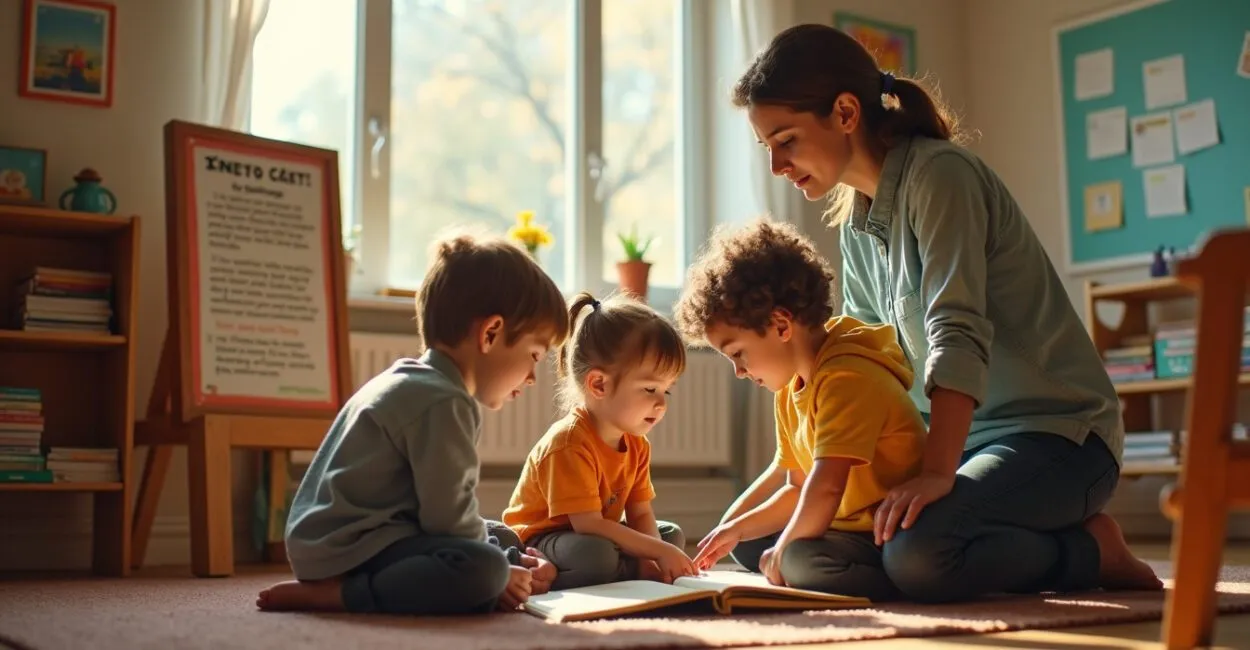
The best reading strategies for elementary and middle school don’t start with the text. They start before, during, and after reading.
When a child learns to predict, infer, and review, comprehension stops being a guessing game and becomes a process. That changes everything—from 2nd through 9th grade, each stage calls for a different kind of support.

Here’s the point that’s most often overlooked: reading well isn’t just about decoding words. It’s about building meaning with a method.
In practice, teachers who establish this routine see students participate more, make more productive mistakes, and return to the text with less anxiety.
1. Before Reading, the Brain Is Already at Work
The first reading strategy for elementary and middle school is prediction: activating what students already know before they open the text. This can start with the title, an image, a subtitle, the text’s genre, or a quick conversation about the topic.
The technical term for this is building knowledge schemas: readers connect new information to what’s already in their memory. Put simply, it’s like packing your bag before a trip. Students who approach a text without any background knowledge often read line by line without seeing the bigger picture.
In the classroom, this works best when the question is specific: “What do you expect to find here?” or “What clues does this image already give you?” In 1st and 2nd grade, students can answer aloud. Starting in 4th grade, it’s worth having them write down their predictions.
2. Inference: What the Text Doesn’t Spell Out
To infer is to read between the lines. It’s not guessing; it’s using clues in the text to fill in meaning. This skill makes the biggest difference between students who simply skim the page and those who truly understand it.
Strong readers don’t expect the text to explain everything. They connect information, recognize intent, and identify relationships that aren’t stated explicitly. This is where reading strategies for elementary and middle school become especially powerful: students begin to think like readers instead of just repeating what they’ve read.
Here’s a simple example: if a character arrives soaked and shivering, with dark skies in the background, the conclusion doesn’t need to be written out. Readers can infer that it rained, the character got wet, and the scene has a tense mood. By 5th grade, students can practice this with a quick game of making predictions.

3. Reviewing Isn’t Backtracking: It’s Checking for Meaning

Many people treat review as error correction, but it’s more than that. In reading, reviewing means pausing, going back, confirming, and adjusting your understanding. It’s when students realize they’ve lost the thread and know how to find it again.
Anyone who works with literacy instruction knows this starts early: a child reads a sentence, notices something seems off, and rereads it. In elementary and middle school, students need to do this intentionally. Questions like “Did that make sense?” or “Which part made you think that?” help readers develop self-monitoring skills.
This step prevents a common problem: students finish a page without understanding the content but pretend they do because they read quickly. Reviewing breaks that illusion. Honestly, it’s one of the reading strategies for elementary and middle school that can make the biggest difference in assessments.
Read also: Literacy Activities for Elementary and Middle School
4. The Most Effective Trio: Before, During, and After
The best lessons don’t rely on just one technique. They link three steps: predict before reading, infer while reading, and review afterward. This sequence is easy to remember and useful from 1st through 9th grade.
The difference between classes that make progress and those that get stuck often comes down to the sequence. Without prediction, the text feels disconnected. Without inference, students get stuck on the literal meaning. Without review, comprehension falls apart by the end of the page.
Good reading isn’t fast reading. It’s reading that checks and adjusts along the way.
This trio also helps teachers identify where students are actually struggling. If the class has trouble making predictions, students may need more background knowledge. If they struggle with inference, they may need help identifying clues in the text. If they don’t review, they may need to build metacognition—the ability to think about their own thinking.
5. What Changes from Grade to Grade
Not every strategy works the same way in every grade. In the early literacy years, the focus is on making students’ thinking visible through images, shared reading, oral retelling, and guided questions. By the upper grades, students need to work with denser texts, opinions, points of view, and implied meaning.
In practice, what works well for one class may fall flat in another. 2nd graders need plenty of guidance; 7th graders can work on discussions, highlighting evidence, and comparing passages. The core strategy stays the same, but the approach changes.
This aligns with the Brazilian National Common Curricular Base (Base Nacional Comum Curricular, or BNCC), which treats reading as a language practice and a way to construct meaning. For more information, see the BNCC from Brazil’s Ministry of Education and the literacy instruction resources on the Ministry of Education website.
6. Common Mistakes That Block Comprehension
Three mistakes come up again and again. The first is assigning reading without preparing students. The second is asking questions that test only memory, as if comprehension meant repeating sentences. The third is not returning to the text after the activity.
- asking students to read without activating prior knowledge;
- expecting a ready-made answer without evidence from the text;
- treating review as a waste of time;
- using the same kind of activity for every grade;
- confusing fluency with comprehension.
That last mistake can be misleading. A child may read quickly and still understand very little. That’s why reading strategies for elementary and middle school need to focus on meaning, not just pronunciation. Fluency helps, but it can’t replace thinking.
7. A Simple Plan to Try Tomorrow
For a practical sequence, start here: 1) show the title and image; 2) ask for brief predictions; 3) read a passage, pausing along the way; 4) prompt students to make inferences; 5) wrap up by reviewing what changed in their original predictions.
With younger students, this can be done aloud. With older students, it can become a chart in their notebooks:
Before
what I think the text will be about
During
which clues confirm or change my thinking
After
what I actually understood
For a simple measure of progress, see if students can change their minds based on the text. That’s valuable. Students who are willing to revise their own predictions are truly learning to read.
Wrapping Up
Reading instruction gets stronger when we stop treating comprehension as a gift. It takes practice, guidance, and routine. The good news is that these reading strategies for elementary and middle school don’t require magic—they require a method.
When schools teach students to predict, infer, and review, they do more than build stronger readers. They help children and teens think more precisely about any text, including the ones they’ll encounter outside the classroom.
Frequently Asked Questions
What Are Reading Strategies for Elementary and Middle School?
They’re teaching practices that help students better understand a text before, during, and after reading. They include prediction, inference, review, guided questions, and returning to evidence. The goal isn’t just to read aloud, but to build meaning with increasing independence as students move through the grades.
Which Strategy Works Best in the Early Grades?
In the early grades, prediction often works especially well because it gives children concrete support as they approach a text. Images, titles, characters, and a brief conversation activate what they already know and make reading feel less mechanical. Inference can be introduced gradually, with teacher guidance and short texts.
How Can You Teach Inference to Students Who Don’t Read Much?
Start with visual clues and short passages. Ask students to explain what’s happening based on details in the text, such as actions, emotions, and repeated words. The key is not to demand an instant answer. Instead, help them connect evidence to conclusions step by step, without turning the activity into a guessing test.
Why Is Reviewing Your Reading So Important?
Because reviewing shows students that comprehension is a process, not an on-or-off switch. When they reread, they confirm their predictions, correct their interpretations, and notice where they lost the thread. This builds metacognition and prevents that “I read the whole thing, but didn’t understand any of it” feeling.
Do These Strategies Work for Every Grade in Elementary and Middle School?
Yes, with adjustments. The core idea is the same in every grade: predict, infer, and review. What changes is the level of guidance, the type of text, and the complexity of the questions. In 1st grade, reading may be more oral; in 9th grade, the focus may shift to argument, point of view, and evidence.
Artigos Relacionados
 Inclusive Strategies for Students with ADHD: Practical Accommodations and Academic Outcomes for Elementary School Teachers
 Reading Comprehension Strategies for Children: Guided Questions, Mind Maps, and Summaries to Improve Interpretation and Retention in Elementary School
 How to Improve Reading Skills in Elementary School: Practical, Proven Ways to Build Fluency and Comprehension in the Classroom
 Mother’s Day Cards in Elementary School: Practical Ideas
 Elementary School: A Complete, Practical Guide
 Elementary School Activities: Creative, Practical Ideas
