
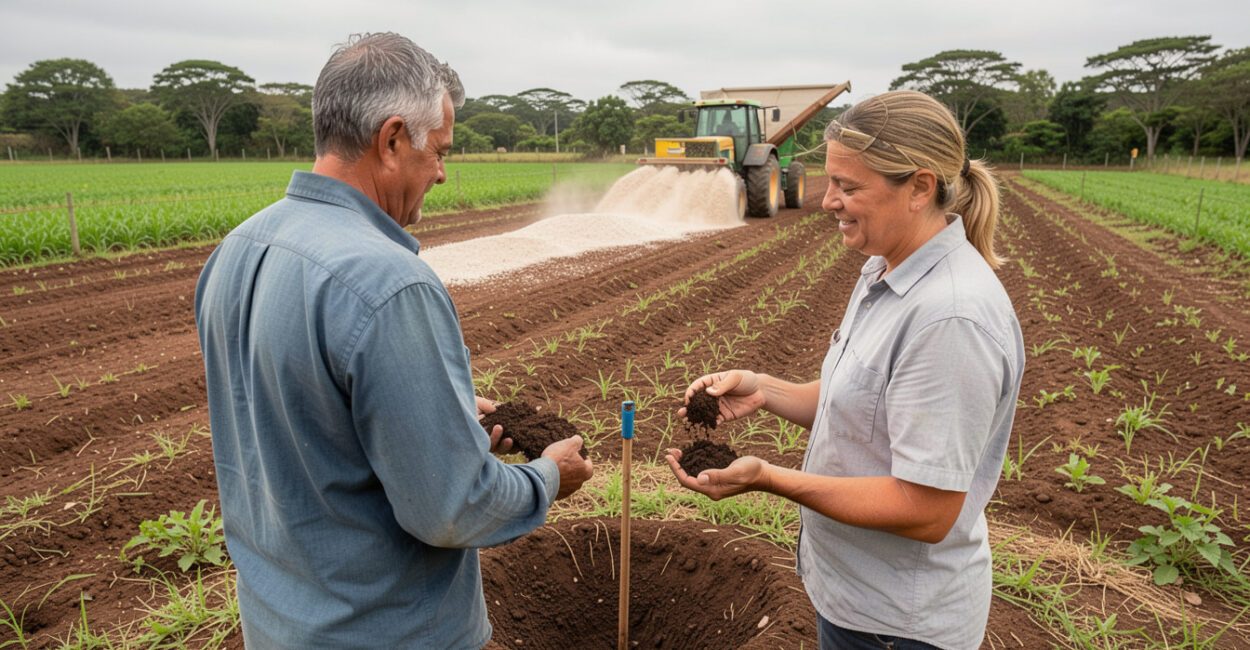
A crop can receive fertilizer and still make poor use of some nutrients if the soil is acidic. Soil liming corrects this condition by applying limestone-based materials, but the rate depends on soil test results, the crop, and the recommendation method used in the region. The safest approach starts with properly collected samples and ends with an even distribution of the product. Choosing a “standard” rate or copying the recommendation from another field can leave some areas untreated and others over-limed.
What is soil liming, and what is it used for?
Liming is the application of acidity-neutralizing materials, usually agricultural lime, to raise soil pH and reduce acidity according to a technical recommendation. It can also supply calcium and magnesium. In simple terms, liming adjusts the soil’s chemical environment so roots have more favorable conditions for growth and nutrients are more available.

In acidic soils, toxic levels of aluminum can limit root growth, while the availability of some nutrients changes. Lime reacts with acidity, but its effectiveness depends on factors such as particle size, moisture, contact with the soil, and reaction time. This practice does not replace fertilization or, by itself, correct compaction or water shortages.
What are the benefits of liming?
When soil test results indicate a need and liming is done properly, correcting acidity can promote root growth and improve conditions for crops to take up nutrients. However, yields also depend on factors such as fertility, weather, cultivar, weed management, and water management.
- Raises pH and reduces acidity at the recommended rate.
- Can reduce the toxic activity of aluminum in the treated soil layer.
- Supplies calcium and, in the case of dolomitic lime, magnesium as well.
- Can increase the availability of nutrients whose uptake is hindered by acidity.
Soil correction does not happen instantly or uniformly throughout the soil profile. A common mistake is to apply the product in strips or with uneven equipment settings. Crops may then show differences in vigor within the same field because some areas received more lime than others.
How can you tell if soil needs liming?

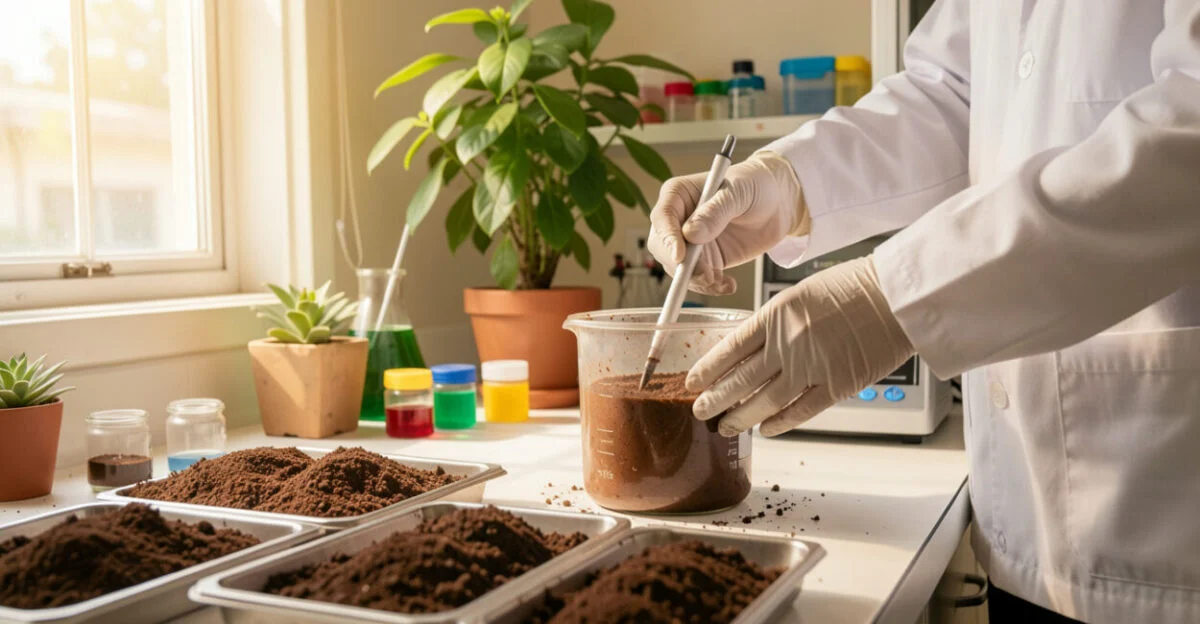
The need for lime is determined by laboratory analysis of soil samples collected representatively and at a depth appropriate for the crop and management system. The appearance of a field alone does not reveal its pH, base saturation, or whether aluminum levels are high enough to warrant correction. Divide the area into fields with similar characteristics, considering topography, management history, soil type, and land use. Do not combine samples from areas that differ significantly. For more on why sampling matters so much to the recommendation, see this guide on how soil testing helps prevent losses.
The lab report may include pH, calcium, magnesium, aluminum, cation exchange capacity (CEC), and base saturation (V%), among other indicators. Recommendations should take regional criteria and the crop into account, so an isolated test result should not be converted into an application rate without knowing which method was used.
When should you lime the soil?
The best time is when lime can be applied and, if recommended, incorporated before planting, allowing time for it to react with soil moisture. This interval varies depending on the product, particle size, environmental conditions, and cropping system; use local recommendations to guide your schedule. Rain affects the reaction because water promotes contact and reactions between the lime and soil, but that does not mean every condition is suitable for application. Waterlogged soil or heavy rain can make the operation difficult, move the product, and compromise uniformity. Check the forecast and avoid spreading lime in strong winds, which can also carry it beyond the field.
Read also: Hydroponics: How to Start Growing Without Soil
How long after liming can you plant?
There is no single timeframe that applies to every field. Planting should follow technical recommendations and account for the type of lime, application method, and available moisture. If the lime needs to be incorporated, allow time for that operation and for the product to react. In no-till systems, the decision takes surface application and the cropping system into account. For example, if an annual crop is planned and soil test results show that correction is needed, planning should begin before the planting season. If the planting window is near, do not assume the lime will fully react in just a few days; an agronomist should assess the risk of planting before the expected correction takes effect.
Read also: Soil Conservation: Practices to Reduce Erosion
How do you calculate lime requirements?
The application rate is calculated from soil test results using the method adopted for the region and crop, with an adjustment for the quality of the liming material. A common equation using the base saturation method is LR = CEC × (V₂ − V₁) ÷ 100 × 100 ÷ PRNT, where LR is the lime requirement in tons per hectare, CEC is expressed in cmolc/dm³, V₁ is the current base saturation, V₂ is the target base saturation, and PRNT is the product’s total neutralizing value, expressed as a percentage.
This equation is a calculation reference, not a universal recommendation. Regional methods may use other criteria, and the assumed incorporation depth must match the soil test and management system. In Rio Grande do Sul and Santa Catarina, for example, consult the criteria in the Soil Liming and Fertilization Manual for the States of Rio Grande do Sul and Santa Catarina, published by the Soil Chemistry and Fertility Commission.
Factor What to check Soil test results Acidity and fertility indicators, as well as sampling depth. Regional method Criteria used for the crop and the state or region. Product PRNT Value on the label or certificate; it is used to adjust the required amount. Crop and management Crop requirements, planting system, and whether incorporation is possible.
To choose a liming material, compare the soil’s magnesium content with the crop’s needs. Dolomitic lime contains more magnesium than calcitic lime and may be recommended when this nutrient needs to be supplied. If magnesium levels are already adequate, another option may be more suitable. The decision should also take PRNT and technical recommendations into account, not just the product name.
How do you apply lime?
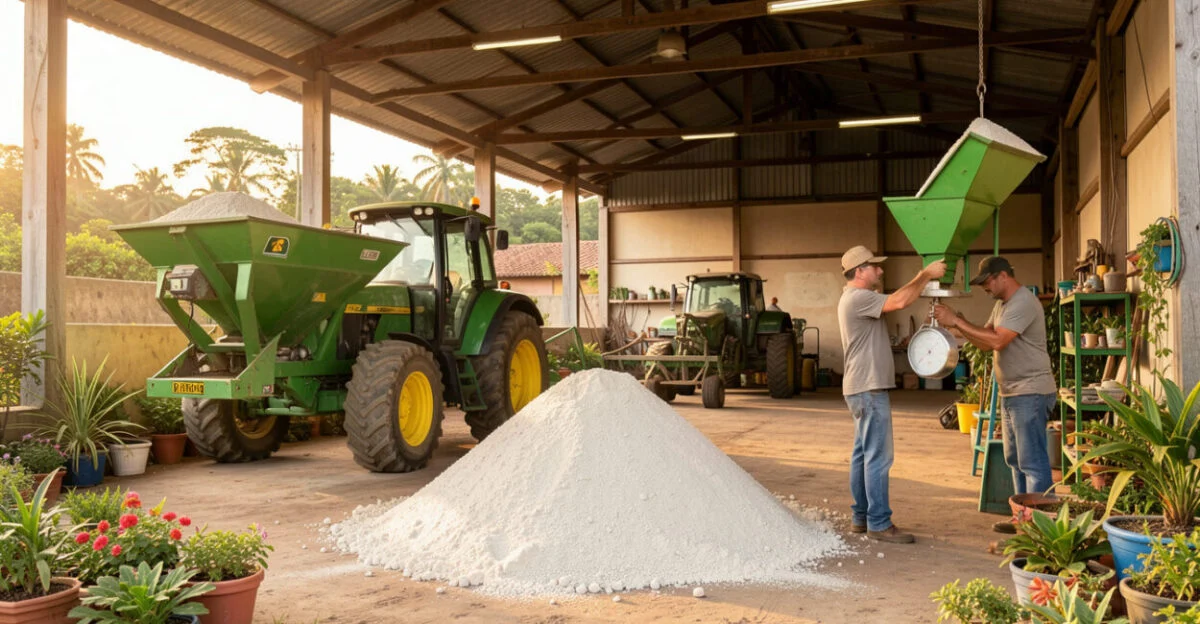
Apply the lime evenly across the area using calibrated equipment, and check the application rate before covering the field. Missed strips and excessive overlap create uneven correction that may be difficult to detect through a later composite soil sample.
- Confirm the recommendation and application rate per area using the lab report.
- Check the product label, PRNT, and storage conditions.
- Adjust the spreader and check the spreading width and application rate in the field.
- Incorporate the lime when the method and management system call for it.
When incorporating lime, the depth must match the recommendation. Mixing the product only into the surface layer will not correct deeper soil. In no-till systems, surface application may be part of the management plan, but the response at depth depends on time and soil conditions. Embrapa, Brazil’s agricultural research corporation, offers publications on acidity management that help explain these differences; the final recommendation should be appropriate for the region and crop.
Can you lime after a crop has been planted?
In some situations, lime can be applied after a crop has been planted, but this depends on the production system, application rate, crop growth stage, and technical recommendations. Surface application in an established field is not the same as incorporation before planting and should not be treated as an immediate correction throughout the soil profile.
If the crop is already growing, make sure the operation will not damage plants or interfere with other planned fieldwork. If you are unsure about timing or application rate, do not adapt a recommendation for preplant application on your own.
Liming and gypsum application: what’s the difference?
Liming corrects acidity in the layer where lime is incorporated or applied, and supplies calcium and, depending on the product, magnesium. Gypsum application uses agricultural gypsum to supply calcium and sulfur and may help improve the chemical environment of subsoil layers under specific conditions. However, gypsum does not replace lime for correcting surface soil acidity.
The two amendments serve different purposes. Soil testing and field diagnosis indicate whether one or both are appropriate and under what conditions. Applying gypsum just because aluminum appears on the lab report, without evaluating the soil profile and technical criteria, may not address the limitation you are trying to correct.
On farms with integrated production, soil planning is also connected to other management decisions, such as handling crop residues after harvest and reducing grain storage losses. These are separate steps, but both depend on planning that reflects the conditions in each area.
Summary: what should you decide before applying lime?
Question Short answer Does the soil need correction? Check the soil test and the recommendation for the crop and region. How much should you apply? Use the local technical method and adjust for the product’s PRNT. When should you plant? Consider reaction time, moisture, and the planned management system. Lime or gypsum? Choose based on the diagnosed problem; gypsum does not replace liming.
The next step is to confirm that the lab report accurately represents each field and use its results to get a recommendation suited to the crop, regional method, and planting system. Before buying the product, compare that recommendation with the PRNT listed on the label.
Frequently asked questions
Can lime be applied with any type of spreader?
The equipment must be suitable for the product and able to distribute it evenly across the planned working width. Calibrate the application rate and check the spread pattern before treating the entire area.
Is calcitic lime always better for soils low in calcium?
Not necessarily. The choice depends on calcium and magnesium levels in the lab report, crop requirements, PRNT, and regional recommendations. The type of lime alone does not determine the application rate or whether lime is needed.
Is there an official PDF with recommendations?
Technical manuals and institutional publications on correcting soil acidity are available, but the right document depends on the region and crop. Look for the recommendation manual from your state soil fertility commission or technical publications from Embrapa, and confirm that the material applies to the area’s production system.
Artigos Relacionados
 Internet of Things: A Complete Guide with Practical Examples and Applications
 Organic Certification: When It Pays Off for Herbs
 Soil and Pasture Management in Family-Based ILPF Systems
 Sustainable Agriculture: Techniques for Soil and Climate
 Organic Fertilizer: Recipes and Uses for More Fertile Soil
 Agroforestry: Techniques for Healthy, Productive Soils
