
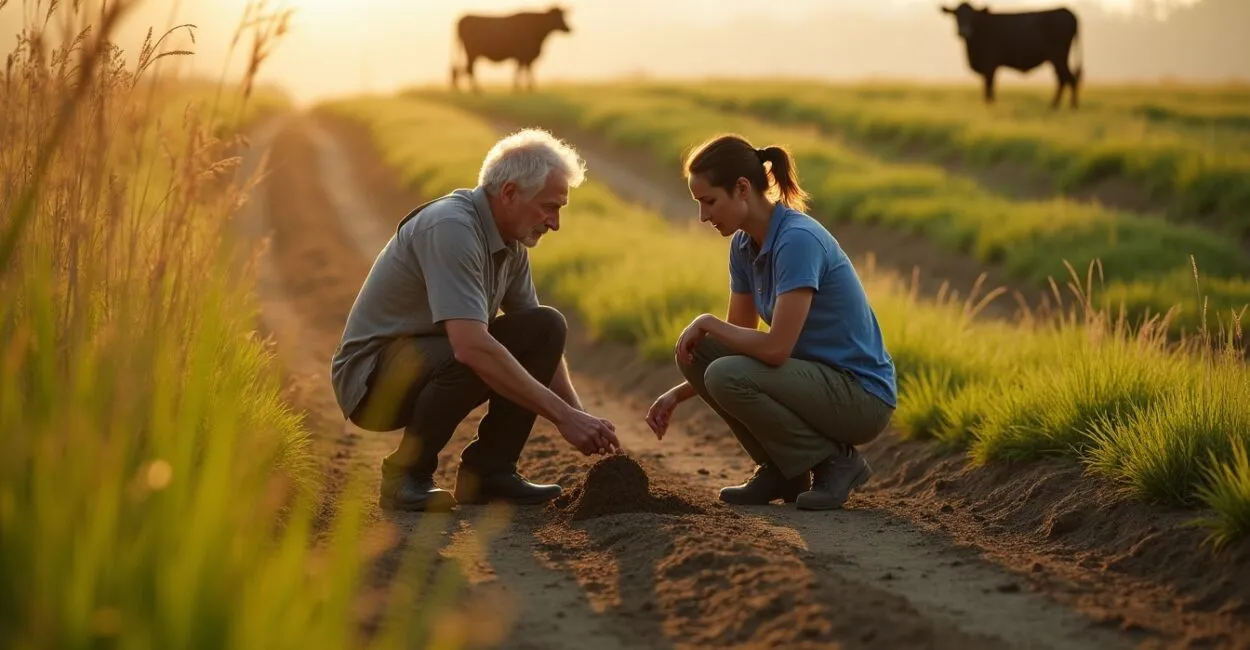
This refers to the set of technical practices applied to soil and pastures to promote sustainability, productivity, and resilience in integrated production systems. I view management as an ongoing technical decision-making process based on agronomic data, climate, and family goals.
Management plays a central role in family-based ILPF systems because resources must be optimized, soil preserved, and livestock fed. The complexity lies in the interactions among soil, plants, and animals, which call for accurate assessments, a range of tools, and both short- and long-term planning.

Key Takeaways
- Integrating soil and pasture management improves nutrient efficiency and water resilience
- Pasture rotation, strategic fertilization, and erosion control increase productivity per acre
- Grazing management and protein supplementation reduce pasture degradation and support sustainable weight gains
Fundamental Soil Management in ILPF Systems
I start with the physical and chemical foundations that support productive pastures on integrated family farms, focusing on soil structure, organic matter, and macronutrient availability. This includes strategies for soil amendments, conservation, and monitoring to ensure stable production and a sustainable cycle.
Physical and Chemical Soil Assessment
I’ve found that particle-size analysis and organic matter levels inform decisions about plowing, harrowing, and subsoiling, all of which affect water infiltration and retention in the root zone. This technical assessment helps prevent inappropriate field operations and promotes stable soil structure.
Lab results should be interpreted alongside management history, climate, and crop rotation. In my work, this approach helps determine when lime or gypsum is needed. The right intervention reduces compaction and increases productivity.
Understanding pH, base saturation, and phosphorus levels makes it easier to choose fertilizers and nutrient sources, as well as inoculants for legumes. These choices can lead to faster vegetative growth and higher levels of usable biomass for grazing.
Strategies for Increasing Organic Matter
I’ve found that gradually increasing organic matter improves cation exchange capacity and soil aggregate stability, reducing erosion risks on sloping fields and keeping more water available to plants during dry periods. Cover crops and organic amendments replenish carbon in the topsoil. In my view, this reduces the need for intensive mineral fertilization, supports balanced nutrition, and promotes active microbial life.
Management practices that preserve crop residues and minimize excessive tillage encourage carbon accumulation, contributing to balanced biogeochemical cycles and lower greenhouse gas emissions over the long term.
Correcting Soil Acidity and Improving Calcium Availability
In my experience, proper liming corrects soil acidity and improves calcium and magnesium availability, supporting root growth and fertilizer efficiency, especially in systems intercropped with legumes. Lime applications should account for reactivity, particle size, and incorporation efficiency. I’ve always matched these decisions with follow-up soil tests to avoid overapplication, which can cause cation imbalances or leaching losses.
Well-calibrated soil amendments produce consistent yield responses, increase forage production, and improve pasture nutritional quality, directly affecting animal performance and economic sustainability.
Pasture Management and Grazing Systems
Effective pasture management requires an understanding of plant development, regrowth rates, and the land’s carrying capacity. Grazing intensity, stocking rates, and rest periods must be coordinated to maximize pasture productivity and longevity while reducing degradation and weed encroachment.
Rotational Grazing Systems
I’ve found that rotational grazing makes better use of forage and gives plants time to recover between grazing cycles, easing grazing pressure and maintaining ground cover. These factors are essential to preventing erosion and compaction from animal traffic. When planning stocking rates and grazing periods, I consider species composition, growth stage, and water availability. In my experience, this balances forage yield and quality, leading to more predictable animal performance.
Regularly monitoring residual forage height and biomass allows for timely adjustments to the rotation plan. This ensures pastures get enough rest and prevents senescent plant matter from building up and lowering nutritional value.
Managing Species Mixtures and Intercropping
I’ve found that grass-legume mixtures increase protein availability and biological nitrogen fixation, reducing reliance on mineral fertilizers while improving pasture palatability and persistence during adverse conditions. When selecting cultivars, I assess their suitability for local soil and climate conditions and their resistance to pests. In my work, this guides species combinations that maximize annual production and provide stability in both wet and dry years.
Rotations and targeted reseeding renew degraded clumps, maintain a balanced plant community, and reduce the risk of undesirable species taking hold, protecting investments in pasture and land.
Grazing and Strategic Supplementation
I believe mineral and protein supplements should be used to address imbalances identified in forage analyses, correcting deficiencies that limit feed intake and weight gain, especially during critical breeding or finishing periods. Providing mineral salt and protein blocks at strategic locations can influence grazing patterns and encourage animals to use less-visited areas. I typically adjust supplementation based on body condition indicators and grass composition.
Nutrition programs coordinated with pasture management improve feed efficiency and reduce the time animals need to stay on the farm, increasing profitability without compromising pasture structure.

Soil Conservation and Erosion Control Practices

In family-based ILPF systems, it’s essential to reduce soil loss from water and wind through conservation practices. These include buffer strips, properly designed terraces, and continuous vegetative cover, as well as good management of farm roads and water inlets.
Buffer Strips and Contour Lines
I’ve found that native vegetation strips and trees planted along contour lines slow surface runoff and increase infiltration, protecting fine sediments and organic matter and directly benefiting topsoil fertility. Erosion-control projects should account for slope, soil type, and rainfall patterns. I always compare these factors with historical data to prioritize critical areas where interventions will prevent the greatest losses.
Well-executed projects restore the water balance of the micro-watershed, reduce sediment in nearby water bodies, and improve water quality on the farm and downstream.
Preventing Compaction from Traffic
I’ve found that poorly managed machinery and livestock traffic during wet periods causes deep compaction, reducing porosity and affecting root systems. This undermines forage production and water infiltration. Practices such as maintaining designated travel lanes, rotating paddocks, and limiting field operations on wet soil help mitigate compaction. I also monitor penetration resistance to determine whether targeted decompaction is needed.
Mechanical decompaction combined with organic matter incorporation restores soil structure and allows roots to reach deeper, improving water use during dry periods and supporting sustainable production.
Vegetative Soil Protection Practices
I believe living cover and cover crops with deep root systems contribute to soil stability, nutrient cycling, and microbial health, making the agroecosystem more resilient to extreme weather. Intercropping and winter cover reduce erosion and moderate soil temperatures. In my experience, these practices limit leaching losses and improve fertilizer use efficiency.
Keeping roots alive for longer improves water retention and biological activity, creating favorable conditions for seedlings to establish and degraded land to return to production at a lower cost.
Monitoring and Diagnostic Tools
Monitoring systems that combine soil tests, satellite imagery, and field observations support evidence-based decisions. They improve management efficiency and make it easier to adjust fertility, grazing, and conservation practices without relying on trial and error.
Satellite Imagery and Remote Sensing
I’ve found that satellite imagery and NDVI help detect water stress, yield variability, and pest outbreaks early. This spatial data can guide precision interventions in critical areas of the farm. Combining it with soil and climate information improves decision-making accuracy. I recommend cross-checking these sources with field inspections to validate signals and prioritize actions with the greatest technical and economic returns.
Practical applications include management-zone mapping and variable-rate seeding and fertilization, which reduce waste and improve the efficiency of agricultural inputs throughout the year.
Lab Testing and Practical Interpretation
I believe chemical and physical soil tests provide a sound basis for soil amendments and fertilization, making it possible to calculate application rates that balance nutrient supply without compromising long-term environmental health. Interpretations should account for management history and the previous crop. I always tailor recommendations to expected biomass response and cost-effectiveness for the farm family.
Read also: Family Agribusiness: Hidden Risks in Local Supply Chains
Regular monitoring builds response curves that guide future decisions, reducing the risk of under- or overapplication and providing a technical basis for optimizing input investments.
Grazing Monitoring and Field Indicators
I’ve found that simple indicators such as forage height and biomass per square yard provide valuable information about carrying capacity and the ideal time to move animals, preventing overgrazing and lost productivity.
Read also: Education and Family Farming: Transforming Agriculture Through Knowledge
Field tools combined with stocking and animal performance records create a database that supports rotation planning. I use this data to adjust short-term strategies in response to climate variability. Regular monitoring makes it possible to act before pastures collapse, helping maintain consistent ground cover and forage quality throughout the production cycle.
Economics and Technical Feasibility for Family Farms
Evaluating the costs and benefits of management practices is essential for helping families adopt technologies that increase productivity without straining cash flow. This means combining investments in soil amendments, pasture renovation, and management infrastructure with measurable technical returns.
Cost and Return Analysis
I’ve found that investments in soil amendments and well-calibrated fertilization often increase yield per acre, lowering the cost per pound of meat or milk and improving a family farm’s operating margin over the medium term. My analyses account for the time horizon and climate risk. I prioritize interventions with the best cost-to-return ratio and lowest capital requirements to make adoption feasible for small-scale producers.
Financing options and technical partnerships make larger interventions more feasible, allowing producers to implement structural changes with financial and technical confidence.
Management Infrastructure
I’ve found that modest improvements to fencing, water access, and paddock divisions make grazing more efficient and reduce forage losses from trampling and waste, directly improving animal performance and lowering supplementation costs. Modular, scalable infrastructure makes phased implementation easier. I recommend prioritizing improvements with quick returns that free up capital for subsequent soil and pasture upgrades.
Well-planned projects prevent cost overruns and ensure investments are recovered through increased production and product quality, strengthening the family’s economic sustainability.
Markets and Sustainability Certifications
I’ve found that management practices demonstrating lower environmental impact and better animal welfare can add value to products and open up niche markets and access to payment for ecosystem services programs, increasing farm income. Documenting sustainable practices on public platforms strengthens commercial credibility. I’ve worked with families who secured premiums and differentiated contracts thanks to verified, documented practices.
Financial returns come in the form of better prices and customer loyalty, reducing pressure to expand in ways that could compromise natural resources in the medium term.
What to Avoid and Common Mistakes
- Underestimating the importance of soil testing and applying amendments without an assessment
- Using excessive stocking rates without considering regrowth and forage biomass
- Ignoring ground cover between cycles and leaving soil exposed to erosion
- Investing in technology without technical training and monitoring
Common mistakes often stem from decisions made without data and can lead to lost productivity and environmental degradation. Continuous monitoring and gradually adapting practices to the system’s response help prevent these errors.
- Avoid tilling soil during rainy periods
- Avoid continuous grass monoculture on low-fertility land
- Avoid excessive fertilization before correcting soil pH
Simple preventive measures reduce immediate risks and protect pasture investments. Implementing sound technical practices means prioritizing actions that improve soil health and pasture carrying capacity.
- Keep records of management practices and production
- Prioritize the recovery of critical areas
- Use rotation and intercropping to stabilize production
Keeping records of field operations and agronomic responses makes it possible to learn from experience and turn uncertainty into better-informed decisions that strengthen the farm’s production resilience.
Comparing Soil Amendment and Fertilization Strategies
Here’s a technical comparison of soil amendment and fertilization options to guide short- and medium-term decisions. It considers cost, response time, and impact on organic matter, with the goal of balancing agronomic efficiency against the financial constraints common to farm families.
| Strategy | Response time | Relative cost | Impact on organic matter |
|---|---|---|---|
| Lime and gypsum application | Short to medium | Medium | Encourages gradual recovery |
| Balanced mineral fertilization | Fast | High | Low to medium |
| Organic amendments and cover crops | Medium to long | Medium | High |
Comparisons show that combined strategies often offer the best balance between immediate results and the groundwork for sustained productivity. Matching choices to technical goals and investment capacity maximizes returns.
Integrated Management of Pests, Weeds, and Diseases
Integrated pasture management aims to minimize losses from plant-parasitic nematodes, foliar diseases, and invasive plants. It combines cultural practices, diagnostics, and chemical or biological interventions to preserve forage production and maintain ecological balance in the production system.
Monitoring and Early Identification
I’ve found that regular inspections and early identification of symptoms reduce the need for broad applications and allow targeted treatments that preserve beneficial organisms and lower pesticide costs, keeping pastures productive for longer. Monitoring tools should include photographic records and lab samples when needed. I always compare findings with climate history to anticipate outbreaks and take preventive action.
Well-timed interventions prevent affected patches from collapsing and support natural plant recovery, preserving quality forage and reducing environmental impact.
Weed Management
I believe integrated weed management calls for preventive strategies such as rotation, carefully managed grazing, and reseeding. These practices reduce open space and conditions that favor undesirable species, helping avoid the high cost of widespread chemical control. In infested areas, I combine mechanical methods with targeted applications. I always consider the sensitivity of forage species to avoid collateral damage that could reduce productivity for an entire season.
Maintaining ground cover and healthy plant competition is the most sustainable way to limit weed spread and ensure that soil resources are used by species valuable for livestock production.
Disease Control and Resistance Management
I’ve found that management practices that prevent nutrient stress and excess moisture reduce the incidence of foliar and root diseases, lowering the need for pesticides and preserving pasture health in the long term. When chemical interventions are unavoidable, rotate products and use integrated resistance management. I always prioritize options with lower residual impact that align with sustainability goals.
Investing in genetic resistance and preventive practices creates more stable systems that depend less on inputs, lowering operating costs and the risk of production failures.
Sustainability, Certifications, and Market Access
Connecting management practices with sustainability and certification can give family farms a commercial advantage while supporting ecosystem services such as carbon sequestration and water protection, adding value to lower-impact production.
Environmental Indicators and Ecosystem Services
I’ve found that indicators such as ground cover, organic matter, and infiltration rates reflect a farm’s capacity for sustained production. They can also be measured for payment for ecosystem services programs that reward responsible practices. Aligning production goals with the protection of riparian areas and wildlife corridors makes farms more resilient to extreme events. I use these indicators to demonstrate environmental value in commercial negotiations and public policy discussions.
Measuring ecosystem services turns sustainable practices into assets that support strategic farm management and create new revenue streams for rural families committed to sustainability.
Certifications and Market Requirements
I’ve found that certifications for animal welfare and sustainable management require records and technical evidence. By meeting these requirements, producers can access value chains that pay premiums for differentiated products. Certification requires organized documentation and auditable practices. I recommend starting with simple technical improvements that deliver immediate operational gains before pursuing more complex certifications.
Certification expands commercial opportunities and strengthens a farm’s reputation. It also helps establish management practices that conserve natural resources and increase income.
Public Policies and Incentives
I’ve found that development policies and government programs can make investments in soil amendments and grazing infrastructure more feasible, reducing the financial barriers that keep families from adopting sustainable management and restoration techniques. Applying for specialized loans and technical assistance programs increases adoption of good practices. I always recommend that producers check for local opportunities and document their projects to access available funding.
Institutional support complements technical efforts and speeds the transition to more productive, resilient, and environmentally responsible systems.
Turn Strategy Into Results
I emphasize that applying technical knowledge to soil and pasture management takes disciplined monitoring, ongoing adjustments, and regular economic evaluation. This supports sustainable gains and reduces environmental risks in family-based ILPF systems with limited resources. My practical recommendation is to prioritize actions that deliver quick results while supporting long-term investments, strengthening the family’s production capacity and enabling continuous technical improvement.
I’ve included practical examples and recommendations to show how simple, focused, data-driven measures can produce visible operational improvements and increase productivity per acre while putting less pressure on natural resources. Technical, monitored management turns uncertainty into better control and decision-making, improving profitability and giving the next generation of family farmers greater security.
Frequently Asked Questions
How Often Should Soil Be Tested on Family-Based ILPF Farms?
I recommend testing every two years in established areas and annually in new areas or before making major management changes. Collect representative samples from each field at the appropriate depth. This practice reduces the risk of applying too much or too little lime or other amendments, helping optimize costs and productivity.
How Can You Set Stocking Rates Without Degrading Pastures?
I set stocking rates based on available forage biomass and the desired grazing period, using measurements of forage height and dry matter per square yard. I then adjust rates according to regrowth and weather conditions. This approach prevents overgrazing and preserves long-term carrying capacity.
Which Indicators Should You Prioritize When Monitoring the Recovery of Degraded Land?
Useful indicators include ground cover, organic matter, infiltration, forage species diversity, and soil structural stability. Regular monitoring provides evidence of progress and guides low-cost adjustments to restoration practices.
When Does It Make Sense to Use Mineral Fertilizers on Pastures?
I use fertilizers when tests show deficiencies that limit productivity and the expected return is favorable, especially during establishment or when aiming to increase production per acre. Combining fertilizers with organic matter improves the return on investment.
How Can Small Farms Incorporate Digital Technologies Into Management?
Simple sensors, record-keeping apps, and satellite imagery can make it easier to make decisions and prioritize interventions. Starting with low-cost tools and training the farm family supports gradual adoption and better technical and economic results.
Artigos Relacionados
 Integrated Livestock Farming: Efficient Management on Small Acreages
 How Family Farming Cuts Costs and Becomes a Trend
 From Tradition to Innovation: How Minas Gerais Specialty Coffee Is Transforming Family Farming
 Sustainable Agriculture: Techniques for Soil and Climate
 Organic Fertilizer: Recipes and Uses for More Fertile Soil
 Agroforestry: Techniques for Healthy, Productive Soils
