
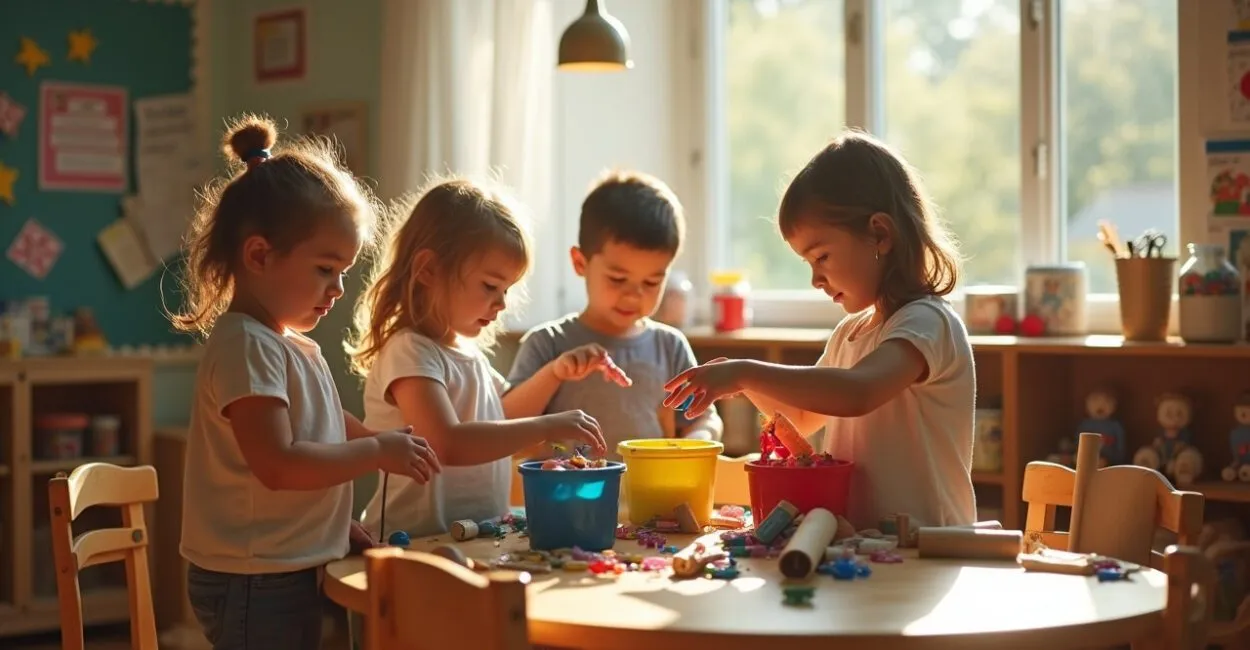
A classroom full of bottle caps, cardboard boxes, and paper rolls can teach more about consumption and responsibility than an entire lecture for adults. When thoughtfully planned, recycling activities in early childhood education turn everyday waste into opportunities for exploration, language development, motor skills, and environmental awareness—all in the same setting.
The goal isn’t to “make crafts out of junk” just for the sake of it. In practice, young children learn best when they can see, touch, sort, and repeat a concrete routine: sort, clean, reuse, and observe what happens to the trash.

Below, you’ll find safe, adaptable, easy-to-use classroom ideas focused on waste sorting, reuse, and age-appropriate habits.
What You Need to Know
- Recycling works best for young children when they understand the difference between reducing, reusing, and recycling, rather than memorizing labels without context.
- Materials such as cardboard, rigid plastic, bottle caps, newspapers, and clean packaging are the most useful for safe learning activities.
- Activities should be short, visual, and repeatable; young children learn more through routines than lengthy explanations.
- Sorting waste with colors, symbols, and physical bins helps reinforce classification skills and a sense of connection to the environment.
- The best results come when activities connect the classroom, home, and school routines—not when they’re limited to a special occasion.
Recycling Activities for Preschool: Turning Waste into Learning
From an educational perspective, recycling in early childhood education is an environmental education experience built around everyday materials. Children don’t need to understand the chemistry behind recycling; they need to recognize that certain objects can be sorted, cleaned, and reused for a different purpose.
This is where many activities fall short: adults want to teach “sustainability,” but 3- and 4-year-olds are still developing their understanding of color, shape, comparison, and sequence. That’s why activities need to be hands-on.
According to Brazil’s Base Nacional Comum Curricular on the MEC website, the National Common Curricular Base, Brazil’s national curriculum framework, early childhood education should prioritize experiences, interactions, and play—and those goals are better served by hands-on activities and sorting than by lectures.
What Children Actually Learn
Children develop fine motor skills by fitting bottle caps together, attention by sorting materials, and language skills by naming objects and categories. They also learn to care for shared spaces: “This goes in the right bin,” “This can become something else,” and “This needs to be clean before we use it.”
For young children, recycling isn’t a lesson about trash; it’s a routine of sorting, caring, and reusing that builds a practical connection to the environment.
Sort, Wash, and Label: A First Look at Waste
Before making toys or decorations, it’s worth teaching the basics: sort materials by type. Set up a table with clean, safe items—paper, cardboard, rigid plastic, metal with no sharp edges, and packaging with no food residue—and show how each group is different.
How to Keep It Simple
- Bring in materials that have already been cleaned at home or in the school kitchen.
- Show the difference between paper, plastic, metal, and glass as an observation exercise, without expecting children to memorize the categories.
- Ask children to place each item in a box with its own color or symbol.
- Reinforce the habit with weekly repetition, not with a single “special” activity.
With a group of 4-year-olds, I found that “the right bin” worked better than “the type of material.” Participation increased when the labels were visual—a drawing of a leaf for paper, a bottle for plastic. If the school wants a public resource, the Ministry of the Environment website can help guide conversations about waste and responsible consumption.
Sorting Games with Colors, Shapes, and Textures

Sorting is a core skill in early childhood education, and recycling offers a great way to practice it. The goal isn’t to rigidly label things as “right” or “wrong.” It’s to notice similarities and differences, test ideas, and make adjustments with an adult’s support.
Ideas That Work Well
- Sort bottle caps by color before using them in counting games.
- Group packaging by texture: rigid, flexible, smooth, and easy to crumple.
- Set up floor paths with collection boxes for each type of material.
- Use cards with pictures of waste items and ask children to match them.
This kind of activity also introduces the idea of recycling collection, because children see that items don’t simply “disappear” when they’re thrown away. They follow a path. Introducing this idea early makes responsible disposal more meaningful than one-off activities around Earth Day.
What makes a recycling game a meaningful learning activity isn’t the amount of material—it’s the intentional repetition of the same sorting routine.
Reusing Materials to Make Toys and Useful Objects
This is the most visible and popular part of recycling activities. Boxes become playhouses, paper rolls become characters, and plastic bottles become instruments or toss games. But reuse is worthwhile only when adults avoid overdecorating and keep the process simple enough for children to take part.
Read also: Environmental Education at School: Activities and Strategies
Safe Materials to Use
- Cardboard boxes with no visible staples.
- Paper towel or toilet paper rolls.
- Large, clean bottle caps.
- Newspapers, magazines, and packaging with no sharp edges.
- Plastic bottles with tightly closed caps and protected edges.
In practice, adults often start out wanting to make everything look “just right,” and the children end up watching. When the task is to divide, glue, crumple, or fit pieces together, children participate much more. I’ve seen classes turn a simple shoebox into an environmental awareness display, with each child gluing on a different piece of waste and explaining where it could be thrown away.
Learning Stations for Paper, Plastic, Metal, and Glass
A good strategy is to set up short stations, each focused on one type of waste. This prevents information overload and gives the teacher more control over timing, materials, and safety. For young children, four stations are plenty.
Read also: Environmental Education Trends for 2025: What’s New
How to Set Up the Stations
Station
Focus
Example Activity
Paper
Folding, tearing, and sorting
Make a collage with newspaper and torn paper
Plastic
Recognizing clean packaging
Sort containers and caps
Metal
Observing strength and weight
Identify cans with no sharp edges
Glass
Recognizing glass without handling it freely
The adult shows the item, but children don’t handle breakable pieces
There’s an important limit here: glass shouldn’t be passed around among young children. In many settings, it’s best to show only closed containers and not let children handle them. This adjustment prevents accidents and teaches an essential principle of early childhood education: safety is part of learning, too.
To explore the topic further, check out resources from CEMPRE, a Brazilian organization known for providing guidance on recycling and waste management.
Stories, Group Discussions, and Everyday Environmental Awareness
Not every activity needs to end with a finished object. Some of the most meaningful experiences happen when children hear a short story about waste, littering, or reuse. A group discussion afterward can help connect the story to routines at school and at home.
A Simple Sequence That Works
- Tell a short story about a character who sorts waste.
- Show three or four real objects from the classroom.
- Ask where each object should go after it’s used.
- End with a hands-on step: set up the right bin for the day.
This combination works because it brings together language, imagination, and action. When children only listen, the ideas fade quickly. When they take part in making a decision, they remember more. Every group responds differently—in some classes, children start talking first; in others, they need to handle the object before any discussion.
Materials, Safety, and Age-Appropriate Adaptations
Safety isn’t a minor detail. In early childhood education, every recycling activity should start with checking the materials: nothing sharp, nothing dirty, and nothing with pieces small enough to pose a choking risk. Teachers need to look at an object not as an adult, but with an eye toward how a child will actually use it.
What to Adapt for Each Age Group
- Ages 1–2: More observing and fitting objects together, less cutting and gluing.
- Ages 3–4: Simple sorting, gluing, and visual matching.
- Age 5: Short sequences of sorting, assembling, and explaining aloud.
This approach works well in mixed-age classrooms, but it falls short when teachers expect the same things from every age group. Younger children need sensory activities; older children can handle more organizational rules. The difference between a calm activity and a chaotic one often comes down to these adaptations, not the materials themselves.
How to Make It Part of School and Family Routines
The greatest benefit comes when a school doesn’t treat the topic as a one-time event. A collection box in the corner of the classroom, simple notes to families, and brief weekly updates help create continuity. Children begin to see that sorting waste is part of recess, classroom, and home routines.
If the school wants to take it a step further, set a regular routine: each class brings in clean materials one day a week, the group sorts them, and then uses some of them for a hands-on activity. This cycle reduces waste, keeps classroom materials organized, and helps the school community see that recycling is a behavior, not just a topic to learn about.
Children learn to care for the environment when schools make sorting waste a visible routine, not an occasional campaign.
Next Steps
If you want to move from talk to action, start small: choose one type of waste, one age group, and one weekly routine. Then observe what children can do on their own, what they need to see first, and where they get confused. That’s how the best early childhood sustainability experiences take hold.
Put it into practice: Try a sorting, reuse, or classification activity this week and note what worked best with your group. Then adjust the level of complexity instead of increasing the amount of material.
Frequently Asked Questions
What’s the Best Age to Start Recycling Activities in Preschool?
Simple sensory activities with boxes, large bottle caps, and clean objects can begin around 18 months. Between ages 3 and 5, children can take part more fully in sorting, matching, and simple reuse tasks. The key is to adapt activities to the group’s motor skills and attention span, without expecting too much abstract understanding. The more hands-on the activity, the more likely children are to learn from it.
Do I Need to Use Store-Bought Materials, or Can I Work Only with Recyclables?
You can use clean recyclables, and they’re often even more useful. Boxes, paper rolls, large bottle caps, and washed packaging can support plenty of worthwhile activities. Store-bought materials only make sense when they provide something the school can’t safely supply, such as specific glue, blunt-tip scissors, or storage organizers. What matters is that the materials serve an educational purpose, not just make the project look nice.
How Can I Prevent Accidents with Recyclable Materials?
Start by removing anything that could cut, puncture, break, or release pieces small enough to pose a choking risk. Glass, metal with sharp edges, and very small bottle caps require extra care and, in many cases, should only be shown by an adult. Check materials before the activity, never during it. It also helps to sort items by type and risk level, because safety in early childhood education depends more on adult preparation than on how children react.
Do These Activities Really Support Learning, or Are They Just for Fun?
They support learning when they have a clear goal. When children sort materials, compare sizes, name colors, organize categories, and repeat the process with an adult, they’re learning real language skills, early math concepts, and environmental awareness. The problem comes when an activity becomes nothing more than making decorations. Then it loses its educational value and becomes a one-off craft with no follow-through.
How Can I Involve Families Without Making It Feel Like a Chore?
The most effective approach is to ask for small, predictable contributions, such as sending in clean packaging once a week or sorting one type of material at home. Long lists of rules or highly specific requests are often ignored. Families are more likely to participate when the school explains why materials are being collected and how they’ll be used. They’re more engaged when they know the activity is simple, safe, and part of the class routine.
Artigos Relacionados
 Play-Based Activities and Child Neuroscience: 5 Effective Ideas
 Fine Motor Coordination Activities: 12 Easy Ideas
 Activities for Early Childhood Education: Practical Ideas
 7 Mother’s Day Bulletin Board Ideas for Preschool
 Women’s Day Cards for Early Childhood Education: Creative Ideas, Inspiring Messages, and Fun Activities to Celebrate Gender Equality
 Fun Classroom Activities: 8 Quick Ideas for School in 20 Minutes
