
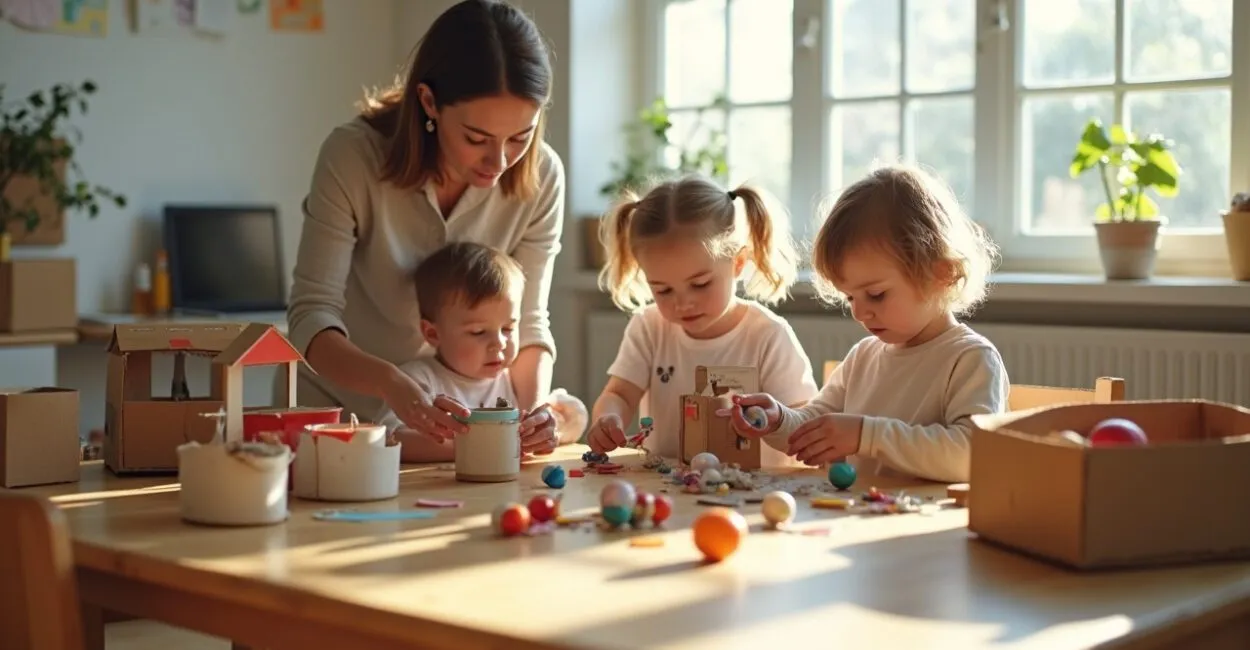
Recycled toys for early childhood education are more than an affordable alternative to store-bought toys: they’re a teaching tool that turns clean household discards into hands-on learning. When children cut, fit pieces together, glue, paint, and invent, they practice motor coordination, language, problem-solving, and environmental awareness all at once.
In practice, the value lies less in the “finished object” and more in the process. A cardboard box can become a kitchen, garage, or puppet; a bottle cap can become a puzzle piece; a paper roll can become a doll’s body.

This article explores what to make, which materials to prioritize, how to adapt activities for different age groups, and which safety precautions really matter to keep the activity safe and educational.
What You Need to Know
- In early childhood education, a recycled toy is any playful object made from reused materials for an educational purpose and safe use.
- The best activity isn’t the prettiest one; it’s one children can handle independently, safely, and with room to create.
- Cardboard, paper rolls, bottle caps, plastic bottles, and clean plastic containers go further when used in simple, open-ended activities rather than overly complicated projects.
- Educational benefits emerge when making the toy involves sorting, counting, fitting pieces together, balancing, cutting, and storytelling.
- Safety comes before appearance: check edges, glue, small pieces, and material cleanliness before starting.
Recycled Toys for Early Childhood Education: How to Make Them with Everyday Items
Here’s the straightforward technical definition: recycled toys for early childhood education are play-based learning tools made from reused, reusable, or clean disposable materials and designed to encourage sensory, motor, and cognitive experiences. Put simply, they’re toys made from “things that would otherwise go in the trash” but given a second life with an educational purpose.
The main goal isn’t to save money at all costs. It’s to create experiences suited to children’s ages. Young children learn through movement, repetition, and pretend play. If they can’t actually handle the materials, the activity becomes adult-made decoration. That’s why it needs to be hands-on, lightweight, sturdy enough, and open to the imagination.
A recycled toy is educational not because of the material itself, but because of the ways it encourages children to act, make choices, and use language.
What Counts
- Cardboard: boxes, tubes, and sturdy packaging for making playhouses, cars, mazes, and sensory boards.
- Plastic bottles: clean bottles for shakers, funnels, rings, and transfer games.
- Bottle caps: great for matching, counting, color activities, and fitting together.
- Paper rolls: useful for dolls, binoculars, tunnels, and simple structures.
- Containers and trays: useful for sorting, stacking, and organizing materials.
For educational guidance on child development, consult Brazil’s Ministry of Education, which provides recommendations for early childhood education. For hygiene and prevention, it’s also helpful to review guidance from Anvisa, Brazil’s health regulatory agency, especially when reusing packaging and cleaning materials.
Safe Materials, Cleaning, and What to Avoid—No Exceptions
Anyone who has prepared a recycled-material activity for a group of young children knows that the problem is rarely a shortage of supplies. The problem is what arrives without being checked: packaging with food residue, brittle plastic, staples, metallic tape, sharp edges, or peeling paint. In practice, sorting these items takes more time than making the toys. Before starting any activity, do a quick, focused check. Materials must be clean and dry, with no parts that could break off. In early childhood classrooms, small pieces are acceptable only with supervision and when appropriate for the age group; for younger children, pieces must be large enough not to pose a choking hazard.
Material
Recommended use
Most common risk
Thick cardboard
Structures, boards, and play settings
Loose fibers and sharp edges
Plastic bottle
Shakers and transfer games
Loose cap or sharp edge around the opening
Bottle caps
Counting, colors, and fitting together
Choking hazard for young children
Paper roll
Dolls, tubes, and binoculars
Can crush easily if damp
Public health guidance offers a useful rule of thumb: a good toy is one children can explore without needing constant adult intervention. This principle also appears in child development resources from the CDC, which connects play with motor, social, and cognitive skills.
If cleanliness and safety are still in question, the material isn’t ready to become a toy—it still needs to be sorted and checked.
Recycled Toy Ideas That Really Work in the Classroom

Not every idea makes for a good activity. Some look creative on paper but fall flat in practice because they require too much cutting, too much glue, or too much time for a result that isn’t very useful. Here are some options that tend to work well in the classroom, at home, or in academic support programs.
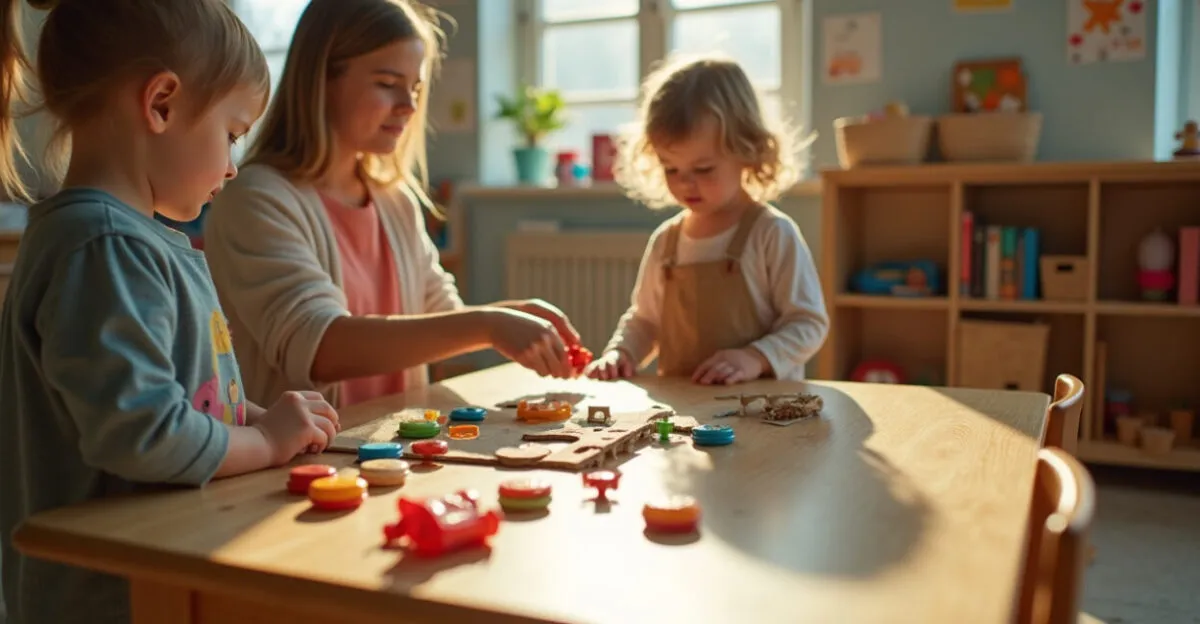
1. Bottle Cap Matching Game
Use a thick cardboard base and cut simple openings sized for similarly sized bottle caps. Children practice hand-eye coordination, color sorting, and grip strength. It’s a short activity, but a very effective one for ages 3 to 5.
2. Plastic Bottle Shaker
Put rice, beans, or large pebbles inside a small plastic bottle and seal it tightly. This activity develops listening skills, rhythm, and an understanding of cause and effect. The common mistake is adding too much filling; a lighter, more predictable sound is better for young children.
Read also: Andragogy: What It Is and How It Transforms Adult Education
3. Paper Roll Doll
Paper rolls can become characters with eyes, fabric, and colored paper. It’s a great activity for language, storytelling, and emotional expression. Anyone who’s done this knows that the conversation after the craft is just as valuable as the finished toy.
4. Cardboard Playhouse
A large box can become a store, house, garage, or doctor’s office. The educational value comes from pretend play, which builds vocabulary and the ability to organize a sequence of events. For children ages 4 to 6, this kind of play setting often offers more than closed-ended electronic toys.
5. Cup-and-String Phones
This classic still works because it demonstrates how sound travels in a concrete way. It’s more than fun—it’s an experiment. The activity won’t work if the string is too loose or the cups are too flimsy.
- For younger children, prioritize large pieces and fewer steps.
- For older children, add rules, sequences, and motor challenges.
- For groups, make building a collaborative activity rather than an individual one.
How to Plan the Activity Step by Step Without Too Much Improvising
A well-planned recycled-material activity doesn’t come from improvising the whole thing. Start with a clear goal: what should children develop? Fine motor skills, attention, counting, imagination, independence? With that focus in mind, it’s easier to choose materials and get better results.
- Set an educational goal — choose one main skill, not five at once.
- Sort materials by age group — what works for a 5-year-old may not work for a 2-year-old.
- Test the construction first — check stability, adhesion, and edges.
- Leave steps for the child to do — they need to take part in making it, not just watch.
- Finish with free exploration — that’s when the toy gains real educational value.
Here’s a real-world example: in a preschool class, a teacher set out small boxes, bottle caps, and craft foam scraps. The original idea was to make toy cars, but the activity improved when children could choose between making a “vehicle,” “house,” or “robot.” The results were less aligned with the adult’s mental picture and much richer for the group. The key point: learning increased when the project left room for children to make their own decisions.
What These Toys Develop Beyond Motor Coordination
Fine motor skills are the most visible benefit, but that’s only part of the story. Reuse-based play also requires planning, comparing, adjusting force, naming objects, and negotiating with peers. These activities support language, reasoning, and social skills.
Brazil’s National Common Core Curriculum (BNCC) treats early childhood education as a stage with learning rights, not as training children to perform tasks. This perspective helps explain why purposeful play makes sense. To consult the official framework, visit the BNCC portal.
Skills That Commonly Develop
- Fine motor coordination: through cutting, gluing, fitting pieces together, and stacking.
- Sensory perception: by exploring weight, texture, sound, and volume.
- Oral language: by naming pieces, characters, and actions.
- Logical reasoning: by comparing sizes, arranging sequences, and figuring out how pieces fit.
- Understanding of sustainability: by seeing that an object can be used in a new way.
Playing with discarded materials doesn’t teach sustainability through a lecture; it teaches sustainability when children see waste become a resource.
There’s an important nuance: this kind of activity works best when adults offer enough structure and enough freedom at the same time. Without structure, it becomes chaos. Without freedom, it becomes a decorative craft. The right balance is what makes it work.
Common Mistakes That Undercut the Educational Value
The most common mistake is confusing crafts with learning. A child may leave with a beautiful toy, but that doesn’t guarantee they’ve developed new skills. If they only paint a piece that’s already made, without making any decisions, the educational benefit drops considerably.
The Most Common Pitfalls
- Choosing materials that look nice but are flimsy or unsafe.
- Expecting cutting, gluing, and finishing skills that aren’t appropriate for the age group.
- Making toys too “perfect,” with no room for invention.
- Giving too many instructions and too little time for free exploration.
- Ignoring cleanup and disposal after the activity.
Not every situation is the same. With younger children, safety comes first; with older groups, you can raise the challenge. Professionals differ on how much adults should help with construction, but experience tends to show that the best activity is one where children take part without needing help at every step.
For guidance on making safer choices, consult child development resources from universities and public agencies, such as Harvard University’s content on early learning, which highlights the connection between play, language, and social-emotional development.
How to Make the Activity Part of the Routine, Not a One-Off Project
Recycled materials are most useful when they’re not limited to a “special art day.” They work best as part of the routine with a purpose: a week of building, an exploration corner, a recycled-material station, or a themed project. That way, the toy stops being a one-time event and becomes a way to learn and communicate.
The smartest next step is simple: choose one educational goal, set out three safe materials, and try a short activity. Then observe what the child does without help. If they come up with variations, the toy is doing its job. If they get stuck, the problem isn’t a lack of creativity—it’s too much complexity.
To make this approach consistent, put together a small collection of clean materials, sort them by type, and keep a quick reference card noting the age group, skill being developed, and level of supervision needed. This habit prevents poor last-minute planning and makes it easier to repeat what worked.
Frequently Asked Questions About Recycled Toys in Early Childhood Education
What’s the Best Age to Start Using Recycled Toys?
You can start early as long as the materials are large, safe, and very easy to handle. For babies and very young children, focus on exploring sounds and textures and stacking objects, with constant supervision. Gradually increase the complexity as motor coordination and understanding of rules develop. Avoid introducing small pieces or long sequences of steps too soon.
Which Recyclable Materials Are Safest for Young Children?
Thick cardboard, paper rolls, clean boxes, and sturdy plastic containers are usually the most versatile options. Bottle caps and other small pieces should only be used in supervised activities with children who are old enough, because of the choking risk. Plastic bottles are useful as long as you check the edges carefully and secure the cap firmly. Safe materials are clean, dry, and free of sharp parts.
Do These Toys Really Help Children Learn, or Are They Just Crafts?
They do, as long as the activity has a clear educational goal. When children fit pieces together, sort, compare, or describe what they made, they practice coordination, language, and reasoning at the same time. If the activity becomes a decorative craft, the benefits are much smaller. Learning happens in the process, not in achieving a perfect finish.
How Can I Adapt the Activity for Different Age Groups?
For younger children, reduce the number of steps, use larger pieces, and focus on sensory exploration. For older children, add rules, building challenges, and storytelling. The same material can work for different groups if you adjust the level of challenge. One group might stack boxes, while another uses them to make a playhouse.
Are Recycled Toys Worth Using at Home, Too?
Yes. They take up little space, cost very little, and encourage creativity with materials that would normally be thrown away. At home, adults can observe what interests the child and adapt the activity at a more relaxed pace. It’s a great way to encourage independence and imagination away from screens. The main concern is still material safety and appropriate supervision.
Artigos Relacionados
 Environmental Activities for Early Childhood Education
 Outdoor Pedagogy: The Swedish Model Explained
 What Age Should Kids Start School in Europe? A Guide
 The Montessori Method: How It Works in Europe
 Indigenous Education: Traditional Knowledge in Childhood
 Early Childhood Education in Japan: The Yōchien Method Explained
