
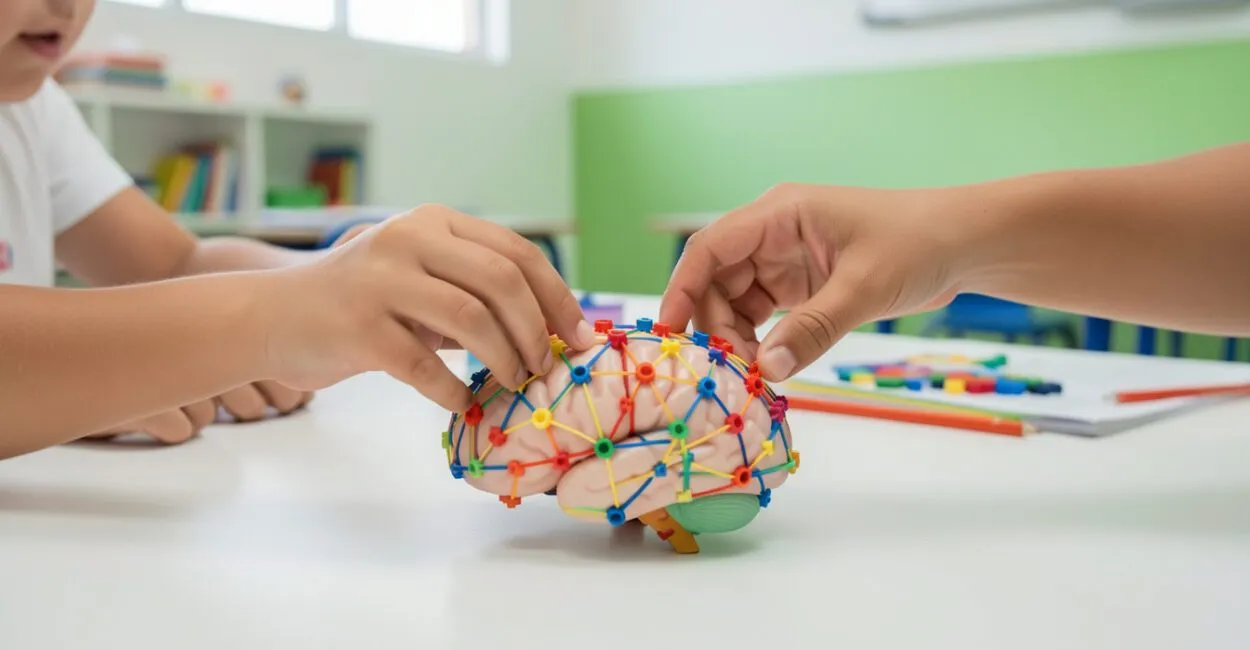
Someone may spend years performing a task automatically, then discover that learning a new skill takes deliberate practice to build precision. This gradual change helps explain neuroplasticity: the nervous system’s ability to alter its organization and function in response to experience, learning, and injury. In education, this explains why knowledge develops through opportunities to practice and receive feedback, but it does not promise that any technique will produce rapid changes or the same results for everyone. Consistent results start with distinguishing established brain mechanisms from the simplified interpretations that circulate about the topic.
What Is Brain Neuroplasticity, and How Does the Brain Change?
Neuroplasticity is the nervous system’s ability to change the strength of connections between neurons and, under certain conditions, its functional or structural organization in response to experience. In everyday terms, learning can make some processing pathways more efficient, while little-used connections may weaken. These changes happen on different scales and depend on the type of experience.

One well-known mechanism is synaptic plasticity: changes in how effectively one nerve cell influences another. Changes can also occur in circuit structure and network recruitment and, in some contexts, through reorganization after an injury. The idea that all learning creates new neurons, however, is an oversimplification; the formation of new cells alone does not explain everyday learning.
The brain does not change only during childhood. Plasticity continues into adulthood, although the pace and potential for change vary with age, health, the task, and the environment. BrainFacts, from the Society for Neuroscience, offers an accessible introduction to how the brain works and the processes that support learning.
What Are the Types of Neuroplasticity?
Classifications vary across research fields, but some distinctions help organize the topic. They describe related phenomena, not completely separate categories.
- Synaptic plasticity: Changes in the strength or efficiency of connections between neurons. Long-term potentiation and long-term depression are examples studied in brain circuits.
- Structural plasticity: Physical changes in circuit components, such as neuronal branches and dendritic spines, associated with specific experiences and conditions.
- Functional plasticity: Changes in how different networks contribute to a task, including when the brain reorganizes to compensate for an injury.
- Adaptive or maladaptive plasticity: Change can support a skill, but it can also reinforce unhelpful responses, such as persistent pain patterns or habits that are hard to break.
This distinction helps prevent a hasty conclusion: “the brain changed” does not automatically mean “there was improvement.” The effect depends on what was practiced, how the task was learned, and which measures were used to observe the change.

How Does Neuroplasticity Influence Learning?

Learning changes neural circuits when experience alters how the brain processes information or performs a skill. Practice creates opportunities for these changes, and feedback helps fine-tune responses. Still, observable progress does not let us directly infer a specific brain change in each student. Repeating an activity may reduce the effort it takes to do it, but repetition needs to involve attention to the goal and some opportunity for correction. Doing the same task without noticing mistakes can reinforce poor performance. That is why, in the classroom, it matters to plan what students retrieve from memory, how they receive feedback, and when they practice again.
A familiar example helps illustrate the difference. While studying vocabulary, a student reads a list several times and feels they recognize the words. The next day, they try to recall the meanings without looking at the material and notice gaps in their knowledge. The retrieval attempt makes those gaps visible and guides the next round of study.
This principle also applies to reading instruction: fluency practice can combine repeated reading, monitoring pace, and understanding the text, rather than making speed the only goal.
Complete guide: Neuropedagogical Practices: Methods, Limits, and Applications
How Does the Brain Consolidate Knowledge?
Consolidation is the process by which recent learning stabilizes and becomes integrated with existing knowledge over time. It does not happen all at once: it involves changes that occur after an experience, and its duration depends on the content, the learning conditions, and what happens afterward. Three factors have practical applications in education:
Read also: Early Childhood Assessment: Methods Without Tests
- Spaced practice: Revisiting material in separate sessions tends to support retention better than concentrating all practice in a single session. The ideal interval varies with the difficulty and the time until the assessment.
- Active retrieval: Trying to recall an idea without looking at the answer can strengthen the ability to access it later. That effort needs to be followed by correction: repeating a mistake without feedback can reinforce it.
- Sleep: Sleep plays a role in consolidating different types of memory. Staying up late and getting less rest can undermine the very conditions needed to learn and function well the next day.
Active retrieval works best when mistakes become useful information. A teacher might ask the class to solve a problem before showing the solution, review their reasoning, and later present a similar question with a small variation. The activity tests what students have learned without assuming everyone will consolidate the material on the same schedule.
There are important limits: laboratory findings do not automatically apply to every subject, age group, or school setting. The effect of a strategy also depends on prior knowledge, the quality of the questions, and the time between studying and assessment.

How Can You Encourage Neuroplasticity in Everyday Life?
No technique can guarantee brain changes or ensure learning. It is possible to create favorable conditions: offer appropriate challenges, provide purposeful practice, give specific feedback, revisit material over time, and protect sleep. To put these principles into practice, teachers and students can:
- Define what the person should be able to explain or do, rather than measuring only study time.
- Alternate exposure to material with retrieval attempts, problem-solving, or explanations in their own words.
- Review mistakes and adjust the difficulty: a task that is too easy provides little information, while one that is too hard without support can lead to frustrating repetition.
- Revisit material on different days and check whether learning transfers to new examples.
The environment matters, too. The National Institute of Neurological Disorders and Stroke (NINDS) provides information about the nervous system and neurological conditions. Too little sleep, intense stress, or health problems can interfere with attention and memory; when difficulties persist, a list of “brain exercises” is no substitute for professional evaluation.
An educational activity can include movement, art, or collaboration when it serves the instructional goal. For example, cooperative games create opportunities to follow rules and coordinate actions; that alone does not prove that a specific activity will improve academic performance.
Which Neuromyths About Neuroplasticity Still Confuse Education?
Neuromyths are incorrect or exaggerated interpretations of information about the brain. Neuroplasticity is real, but some popular claims turn limited evidence into universal promises.
- “The brain changes instantly”: A single session may produce temporary changes in activity or performance, but that is not the same as a consolidated skill. Lasting changes depend on processes and conditions that vary.
- “Every student learns best through a fixed style”: There is no strong evidence for classifying students as visual, auditory, or kinesthetic learners and teaching each one only that way. Different representations can be useful depending on the content, without requiring rigid labels.
- “An exercise activates one area and improves intelligence”: Brain tasks engage complex networks. Improving at a specific exercise does not guarantee transfer to math, reading, or other abilities.
- “Every brain can change without limits”: Plasticity has biological limits and depends on age, neurological condition, task type, and context. It can also reinforce unwanted patterns.
Brain imaging and performance measures answer different questions. Greater activity in a brain region during a task does not, by itself, show that a method caused better learning or that the result will be useful outside that situation.
Which Books on Neuroplasticity Can Help You Learn Better?
A good book about the brain distinguishes experimental findings from interpretations for education, explains limitations, and identifies the sources behind its claims. Among well-known options, The Brain That Changes Itself by Norman Doidge presents accounts of research and rehabilitation; it is best read as popular science, not as a guide that guarantees school outcomes. For a more academic approach, look for books on cognitive neuroscience and the psychology of learning that explain memory, attention, and research methods. When searching for “neuroplasticity book” or “brain book,” check the author, publisher, references, and date of the evidence cited. An interesting clinical account is not the same as a controlled trial and does not prove that the same intervention will work in a classroom.
If you search for “neuroplasticity PDF,” check whether the file comes from a university, publisher, library, or institutional repository and whether its distribution is authorized. A free PDF may be a legitimate publication, but it may also reproduce a copyrighted book without permission; favor open-access materials and documents from recognized institutions.
What Can You Apply from Neuroplasticity to Education?
The most useful contribution of this knowledge to education is guidance on creating experiences that let learners practice, receive feedback, and retrieve material at different times. Brain change is not a metric teachers need to promise; the goal is to see whether learners can understand, remember, and apply what they have studied.
Choose a topic you are teaching, space out the reviews, and include an attempt to retrieve the material without looking. Then note which mistakes persist and adjust the next activity. This cycle offers a concrete next step without turning brain science into a promise of automatic results.
Question
Answer in one line
What is it?
The nervous system’s ability to change connections and organization in response to experience.
What are the types?
Classifications include synaptic, structural, and functional plasticity.
How can you support it?
Use purposeful practice, feedback, active retrieval, spaced review, and adequate sleep.
Is it guaranteed?
No; results depend on the person, the task, and the learning conditions.
How do you choose a PDF?
Check its source, references, and authorization for distribution.
Can You Learn a New Skill as an Adult?
Yes. The ability to learn continues into adulthood, although the pace and conditions vary. Practice, health, prior experience, and the skill’s complexity all influence progress.
How Long Does It Take for Learning to Consolidate?
There is no single timeline. Content, learners, and practice intervals differ, so it is more useful to check retention at different points than to assume one night or one week is enough.
Is Repeating Something Many Times Always a Good Strategy?
No. Repetition can help when learners pay attention to the goal and have a chance to correct mistakes; repeating poor performance without feedback can reinforce the wrong pattern.
Do Brain-Training Games Improve School Performance?
Improvement at the game itself does not prove transfer to reading, math, or other tasks. To evaluate a claim, look for evidence that measures the intended academic skill, not just performance on the exercise being trained.
Does Sleep Help You Remember What You Studied?
Sleep plays a role in memory consolidation and also supports attention and cognitive function. It does not replace studying, but regularly sacrificing rest can undermine the conditions for learning.
How Can You Tell Whether a PDF Is Reliable?
Check who published it, whether the file is on an institutional or publisher website, and whether its distribution is authorized. Also review the references and see whether the material distinguishes scientific studies from personal accounts.
Artigos Relacionados
 Transformative Education: Practices That Change Lives Today
 Pedagogical Practices in Early Childhood Education
 The Montessori Method: What Does It Look Like in Practice?
 A Guide to Early Childhood Education: Best Practices, Play-Based Activities, and Innovative Approaches to Whole-Child Development
 Medieval Education: Practices and Institutions in the Middle Ages
 Active Learning Methods: 7 Practices That Are Transforming Education
