

A 4- or 5-year-old may recognize letters and ask to read signs without being ready for formal reading and writing lessons. Early literacy can build familiarity with books and support language development when it grows out of a child’s interest and respects their pace; under pressure, it can cause stress and turn them away from reading.
To decide what to do, pay attention to your child’s well-being during activities, not just how quickly they identify words. The difference between offering experiences with written language and demanding performance can help you distinguish encouragement from pressure.

Quick facts
- What it is: Exposure to or learning of reading and writing before the time many families expect.
- Age: There is no single age that determines when every child is ready.
- Early childhood education: Brazil’s BNCC, the national curriculum framework, emphasizes interactions and play at this stage.
- Elementary school: The BNCC makes literacy a focus in the early grades.
- Practical guideline: Interest, participation, and ease matter alongside the skills you observe.
Early literacy: benefits and risks for children
Early literacy is the start of learning to read and write before the point in a child’s schooling when formal literacy instruction typically becomes a stronger focus. It can support language development and independence when it follows the child’s interest and happens without pressure. The risk arises when assignments, goals, and comparisons replace playful exploration and disregard the child’s pace.
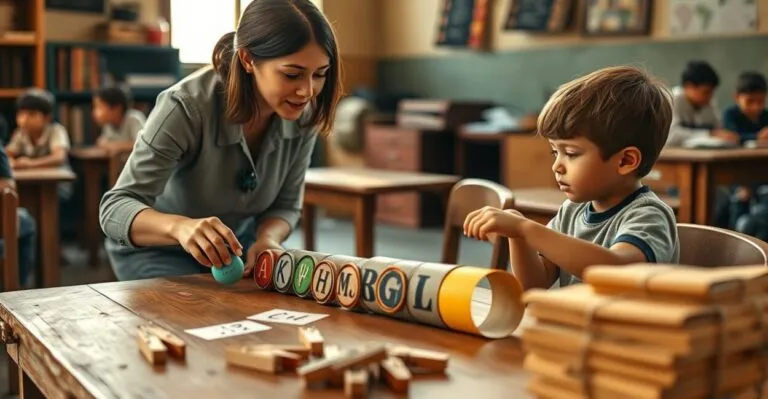
This definition covers different situations. Listening to stories, playing games to find letters, and noticing familiar words in the environment are ways to explore written language. Requiring a child to read passages or copy sentences to prove they are ahead is something else entirely.
This distinction matters because everyday exposure is not, by itself, the same as a formal literacy program.
What it means to learn to read before elementary school
The term can describe either casual exposure to print culture or systematic instruction introduced early. In the first case, the child takes part in age-appropriate activities, such as choosing a book or recognizing the first letter of their name. In the second, there is a sequence of exercises and expectations for mastery, which may or may not suit the child’s developmental stage. Child development includes cognitive, motor, social, and emotional dimensions that interact with one another. A child may be curious about letters but still prefer drawing to writing; that does not invalidate their interest or, by itself, indicate a problem. For example, drawing and handling objects also help exercise hand movements needed for writing, without turning play into mandatory practice.
Potential benefits: language, books, and independence

When children explore written language in an enjoyable way, they may expand their vocabulary, notice connections between sounds and letters, and become familiar with different kinds of texts. Access to stories and conversations about what happens in them also creates opportunities to develop communication and attention skills. These benefits vary; they do not guarantee better grades or a lasting academic advantage.
Reading a simple recipe together, recognizing a character’s name, or asking to write a note are examples of meaningful uses of writing. Problem-solving activities and logical reasoning can complement learning, but they do not replace conversations, stories, and play. The clearest sign of a benefit is that the child stays curious, even when they don’t get it right the first time.
Risks of pressure and signs of overload
When reading and writing become frequent tests, children may associate books with pressure, show anxiety, or avoid activities that once made them curious. This does not happen to every child, and a temporary difficulty does not predict future aversion. The risk grows when adults keep insisting despite ongoing signs of discomfort.
A common mistake is to treat quick letter recognition as proof that a child is ready for a formal routine. Recognizing symbols may be an isolated skill; children also need room to understand, talk, play, and participate without fear of making mistakes. In early childhood education, play should not be reduced to a disguised worksheet.
Read also: Literacy Difficulties and Early Intervention: How to Identify Them
- Signs of interest: Asks for stories, chooses books, asks about words, or tries to write on their own.
- Signs of well-being: Participates without fear, accepts help, and can stop the activity without conflict.
- Signs of overload: Repeatedly cries or gets upset during tasks, avoids books, or shows fear of making mistakes.
If discomfort keeps recurring, stop pushing and talk with the school about what happens in the classroom and at home. Input from psychology or education professionals can help when concerns persist, but a child should not be assumed to have a disorder based on a single sign.

Age, development, and guidance from the BNCC
The BNCC, Brazil’s national curriculum framework, organizes educational practice by stage: in early childhood education, it emphasizes learning rights, interactions, and play; in elementary school, it makes literacy a focus in the early grades. This does not establish a universal age for a child to become interested in letters, nor does it make all spontaneous learning before school inappropriate.
The Base Nacional Comum Curricular (BNCC), Brazil’s national curriculum framework, issued by the Ministry of Education, guides curricula and teaching practices. Schools need to consider it alongside the characteristics of each class and their educational plan. Brazil’s National Curriculum Guidelines for Early Childhood Education also support an approach centered on experiences, interactions, and play. Deciding when and how to teach requires context: age alone does not show whether a child is ready.
Families can ask the school what goals are being addressed, how activities accommodate different learning paces, and what signs of fatigue educators are noticing. The approach should support well-rounded development, not turn comparisons between classmates into a learning goal.
How to encourage reading without demanding performance
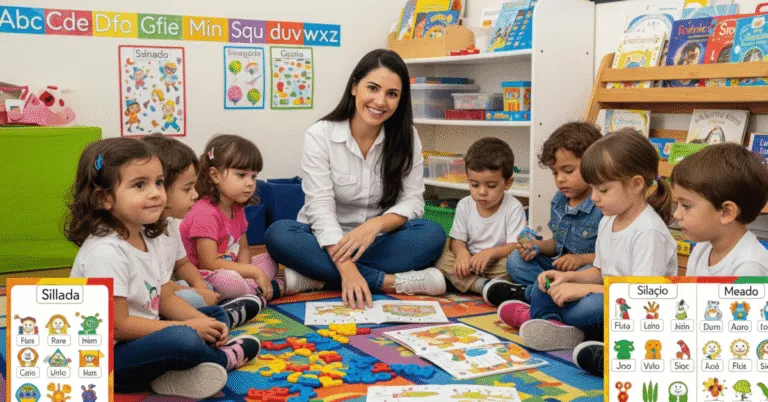
Keep books within reach, read aloud, and let your child choose when to join in. Talking about pictures, going on a walk to spot familiar letters, or playing with rhymes can create opportunities to explore language. Word games and matching games work best when the focus is participation, not getting the right answer fastest.
Aspect Playful encouragement Pressure to perform Goal Explore stories, sounds, and letters out of curiosity. Demonstrate mastery of a set goal. Pace The child can choose, repeat, or stop. The activity follows a rigid schedule, even when the child is tired. Response to mistakes The adult welcomes the attempt and offers clues. Mistakes lead to repeated correction or comparison. How to assess Notice engagement and whether the child wants to return to the activity. Count correct answers and speed as the main measures.
Here’s an everyday example: while listening to a story, a child asks what letter appears in a character’s name. The adult can point it out and keep reading without turning the question into a series of exercises. If the child loses interest, ending the activity is also a way to respect their pace.
Learning challenges, technology, and different approaches to literacy
Common challenges include differences in learning pace, limited access to books and conversation, activities that are not age-appropriate, and expectations that do not fit the child’s stage. Language, hearing, vision, or other conditions can also play a role, but they require an appropriate assessment; a delay on its own does not identify the cause.
Digital resources can offer narrated stories, expand access to books, and let children explore sounds and words with an adult nearby. Content quality, time spent using devices, and interaction all matter: a letter-learning app does not replace conversation, play, or guidance from educators. Technology is a resource, not a reason to speed up literacy instruction.
In The Importance of the Act of Reading, Paulo Freire connects reading the word with reading the world. This perspective values the meaning writing holds in a person’s life rather than treating literacy as simple repetition of symbols. There are different teaching methods and educational debates; no single formula works for every situation, and what is appropriate depends on the child, the context, and the school’s approach.
Next steps for families and schools
Choose a shared reading activity your child already enjoys and observe their response: Are they curious and asking to continue, or do they seem tense and try to get away? If they enjoy it, keep offering it without setting goals. If discomfort persists, ease up and talk with the school about specific examples of what is happening.
To check the curriculum guidance, consult the BNCC and ask the teaching team how its activities relate to the school stage. The most useful measure is not who reads first, but whether learning progresses with participation, understanding, and the confidence to try.
Frequently asked questions
Does reading stories to a baby help with literacy?
Reading together introduces a child to books, language, and the routine of listening to stories. It does not require a baby to recognize letters or guarantee they will learn to read early.
Is a child who recognizes their own name ready to learn to read and write?
Recognizing their name suggests familiarity with written language, but it is not a complete assessment of readiness. Also consider whether they are interested, understand the activities, and feel comfortable taking part.
What should I do if my child asks to learn to write?
Encourage their curiosity with paper, pencils, and freedom to experiment, without demanding conventional spelling. If they ask for help, show them how to write a word and let them decide whether to continue.
Can early instruction cause dyslexia?
There is no basis for claiming that starting early causes dyslexia. If difficulties persist, the family can talk with the school and seek a professional evaluation rather than trying to diagnose the child themselves.
Should I correct every misspelled word?
No. Correcting every attempt can discourage experimentation. Respond to what the child wanted to communicate, and naturally offer the correct spelling when it would be helpful.
Should schools teach letters in early childhood education?
The BNCC does not turn early childhood education into a stage of formal reading and writing drills. Children can encounter letters and texts through meaningful experiences and practices that respect the nature of this stage.
Artigos Relacionados
 Brain Development: Practices for Early Literacy
 Low-Cost Educational Games for Early Literacy
 Practical Early Literacy Strategies for Preschool Success
 Early Literacy Milestones and Games for Preschoolers
 How to Introduce Literacy in Early Childhood Education
 Phonological Awareness in Early Literacy: Playful Techniques and Exercises to Build Sound Recognition and Reading Fluency in Children
