
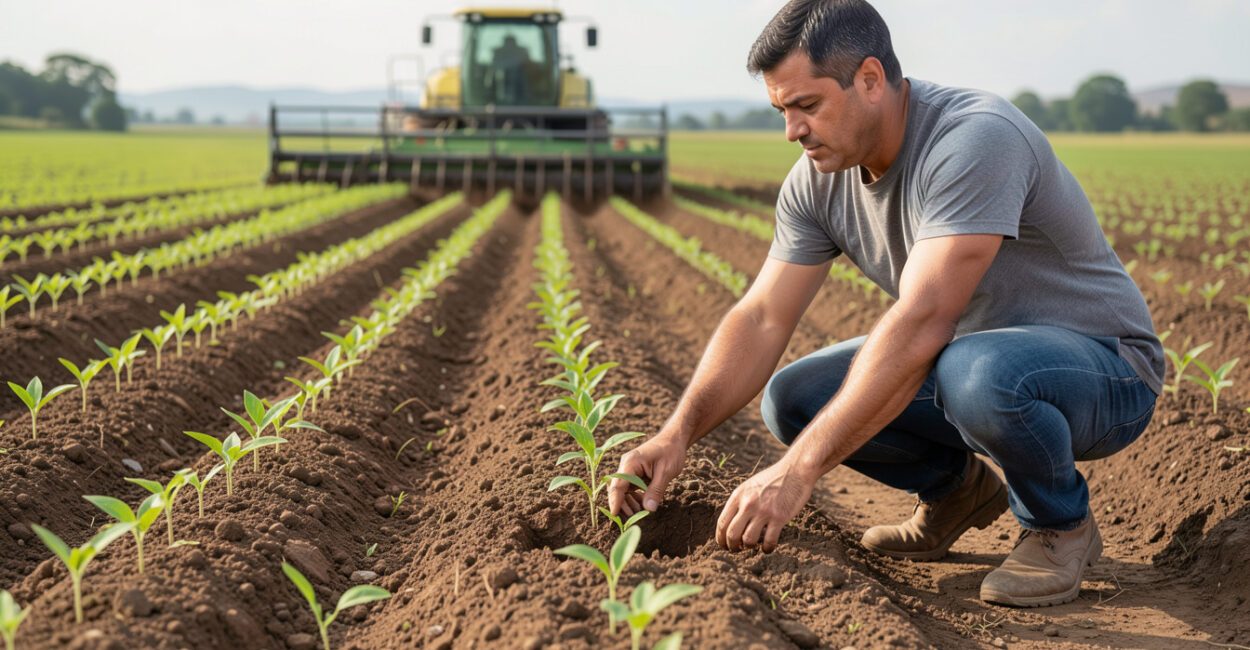
A soybean crop can lose yield before the plants even emerge because of insufficient moisture, uneven planting depth, or poorly inoculated seeds. Soybean farming encompasses the practices involved in growing the crop, from choosing a field to harvest, while taking climate, soil, cultivar, and crop management into account. Results depend on tailoring each decision to the region and growing season—not following a one-size-fits-all recipe.
The work starts before planting: check the official planting calendar, test the soil, and plan seed and input purchases. Next come planting, monitoring for weeds, pests, and diseases, and finally harvesting and storage.

The steps below can help you organize your plan. For local recommendations, consult your area’s agricultural extension services and Embrapa Soja (Brazil’s agricultural research agency specializing in soybeans), since climate, soil type, and pest pressure can affect recommended practices.
Before you begin, have these items ready
- Recent soil test results and the field’s management history.
- The planting calendar and current plant health regulations for your region.
- Locally adapted cultivars, seeds from a reputable source, and a seed-treatment plan.
- Cost estimates, access to machinery, and a marketing strategy.
How does soybean farming work, from planning to harvest?
Soybean farming is the agricultural production of Glycine max, managed to establish a uniform plant population, support crop development, and harvest quality grain. In general, the growing cycle includes planning, soil amendment and management, planting, crop care, maturation, and harvest.
The planting calendar and growing season vary by region, cultivar, and conditions during the growing season.
Performance starts to take shape during crop establishment. Uneven emergence can leave plants at different growth stages, making weed control and pesticide applications more difficult.
That’s why checking seed placement and moisture in the furrow soon after planting can help you spot problems while there’s still time to address them.
What should you assess before planting?
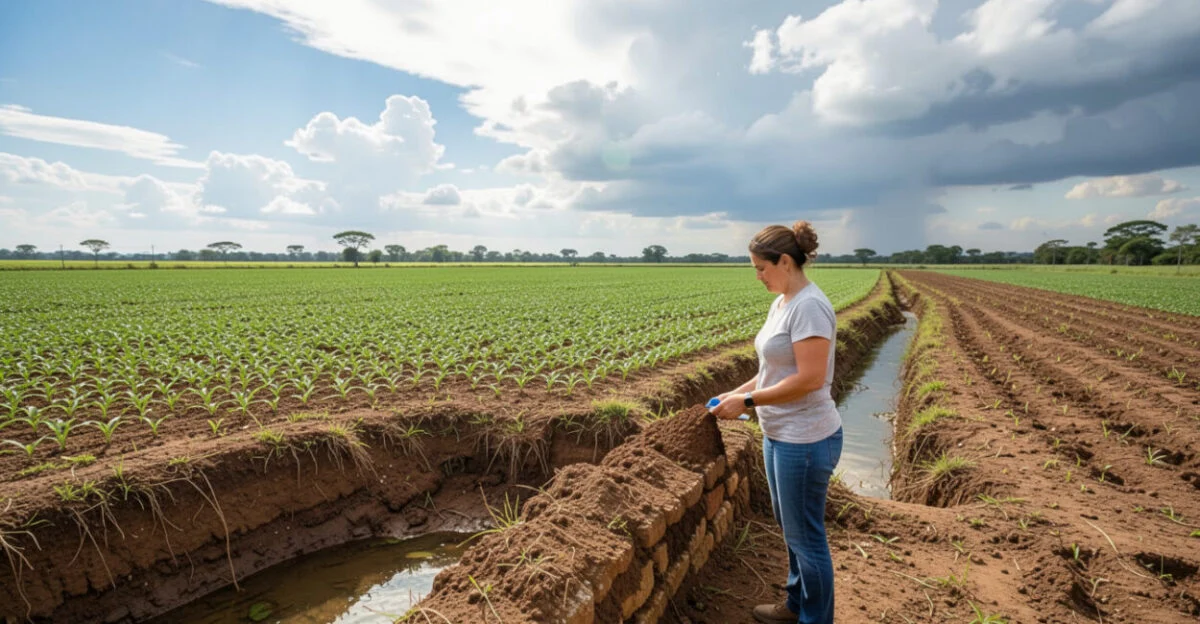
Start by assessing the growing environment: water availability, rainy season, risk of dry spells, drainage, and management history. Soybeans are sensitive to both water stress during critical growth stages and prolonged waterlogging.
Soil testing guides lime and fertilizer applications. Applying inputs without a diagnosis can increase costs without addressing the actual limitation.
Planting should follow Brazil’s Agricultural Zoning of Climate Risk (ZARC) and the state and federal regulations in effect for the growing season. ZARC identifies lower-risk planting periods by municipality, soil type, and cultivar maturity group; there is no single planting date that applies nationwide.
Check official information before finalizing your calendar, and review local plant health requirements as well.
How many times a year are soybeans planted?
In general, each field has one main soybean crop per year, but the calendar depends on the region and local regulations. Whether a second crop can be planted after harvest, such as second-crop corn, depends on the planting date, soybean maturity cycle, water availability, and climate risk.
Crop succession should not be confused with planting soybeans twice in the same field in one year.
The production system matters, too: crop rotation and soil cover help diversify the growing environment and can support weed and disease management. For more on planning, see these sustainable farming practices for soil and climate.
How do you choose soybean seeds and cultivars?

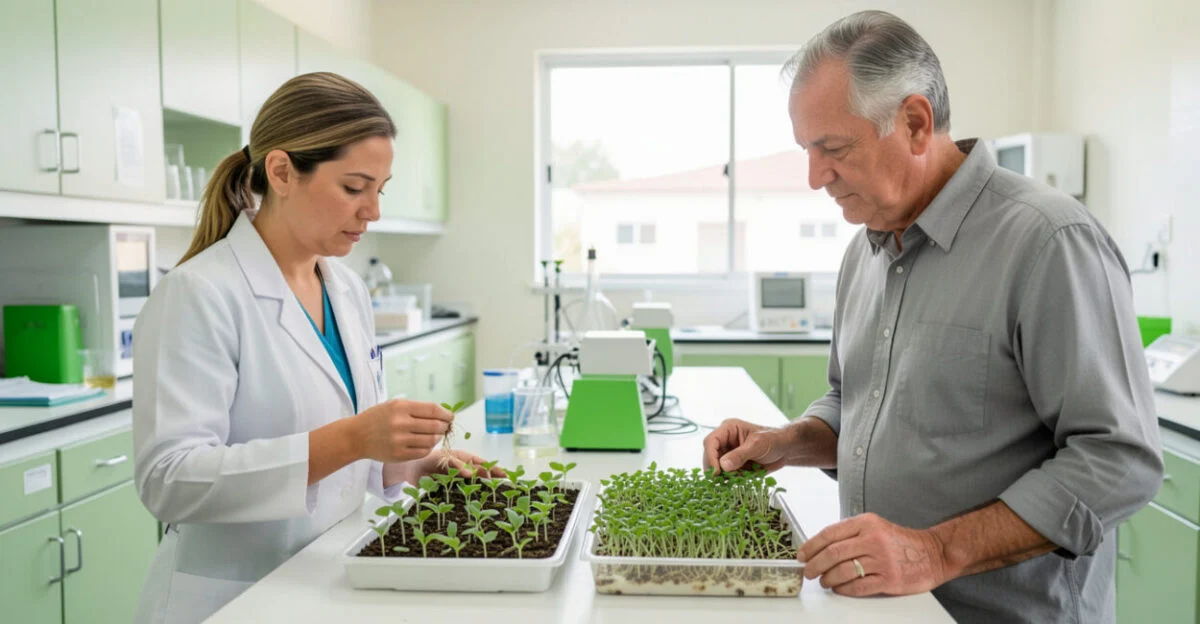
Choose cultivars recommended for your region and planting window, taking maturity cycle, adaptation, disease resistance, and production system into account. There is no fixed nationwide list of the “top three varieties”: availability and performance vary by season, location, and the producer’s goals. Compare available options with help from agricultural extension services and regional trial data.
Read also: Plant Diseases: How to Identify Them and Prevent Losses
- Adaptation: Check recommendations for your municipality or agroclimatic region.
- Maturity and timing: Match the maturity cycle to the planting window and the following crop.
- Disease resistance: Assess resistance or tolerance to diseases common in your area, without assuming immunity.
- Technology and management: Confirm which technologies the seed contains and what care they require.
- Seed lot quality: Check origin, vigor, germination, treatment, and storage conditions.
A cultivar tolerant to a particular disease still requires monitoring, crop rotation, and other management measures. Resistance may not cover every strain of the pathogen, and disease pressure varies from season to season. Consult technical recommendations from Embrapa Soja (Brazil’s agricultural research agency specializing in soybeans) and information from the cultivar developer for the varieties you’re considering.
How do you prepare the soil and plant soybeans?
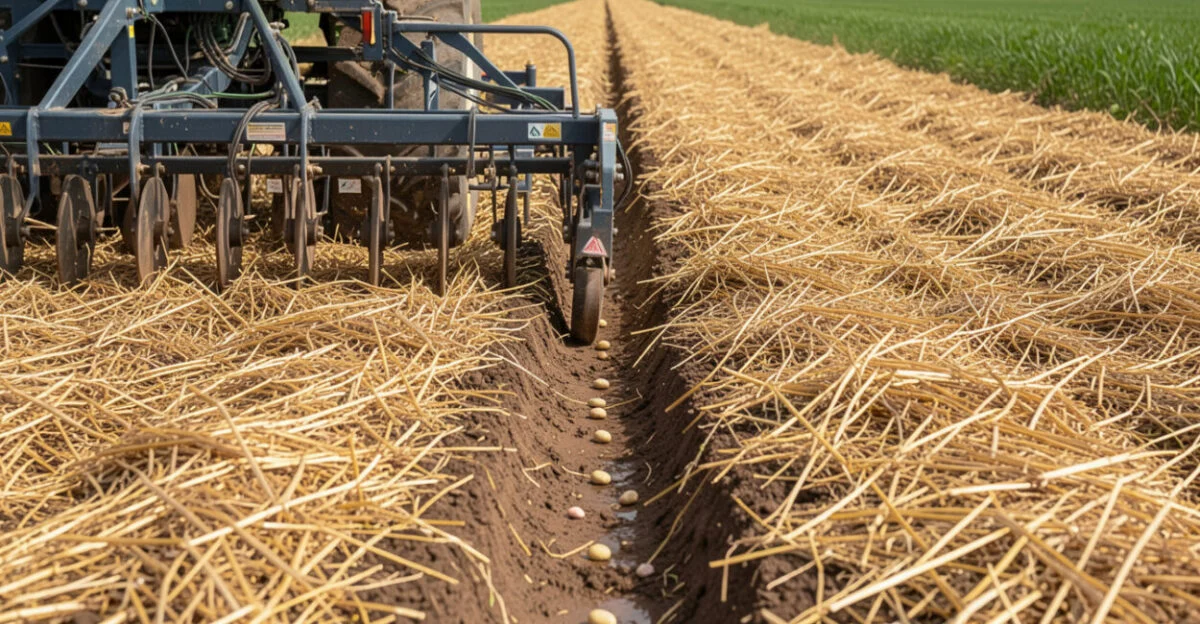
Planting should place viable seeds at a depth and spacing suited to the soil, equipment, and cultivar recommendations. In no-till fields, preserve soil cover and avoid operations that compact the ground. If you find a physical or chemical constraint, confirm the cause before deciding on an intervention. Soil test results should guide lime and fertilizer applications, with rates adjusted for soil fertility and expected yield.
Seed treatment protects against specific early-season risks; choose products and determine whether they’re needed based on technical guidance and label directions. Inoculating seeds with bacteria of the genus Bradyrhizobium supports biological nitrogen fixation, but requires an appropriate inoculant, proper storage, and attention to product compatibility. Exposure to heat or sunlight, or waiting too long between inoculation and planting, can reduce bacterial survival.
Read also: PND 2026 Registration: Steps, Deadlines, and Requirements
There is no single ideal plant population or planting depth for every field. Adjust planter settings based on the cultivar, row spacing, soil texture and moisture, and regional recommendations. After planting, dig up seeds in a few spots across the field: seeds planted too deep, dry furrows, or uneven distribution are signs that the planter may need adjustment.
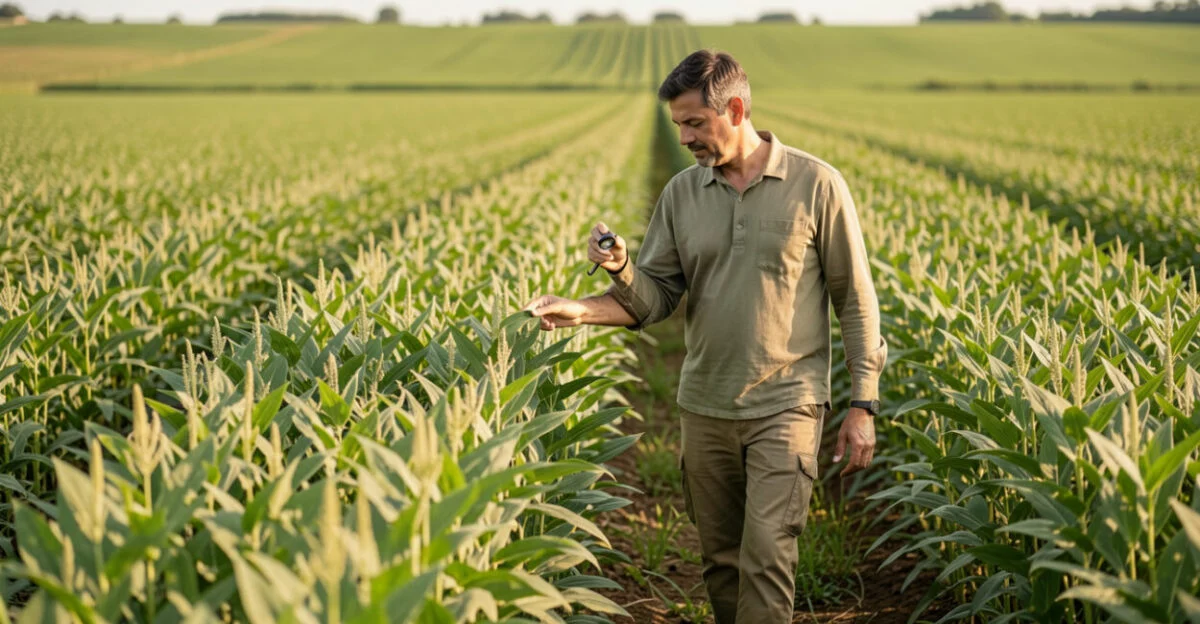
An agricultural technician’s work in the field may include monitoring crop establishment and recording issues, in coordination with the agronomist responsible for recommendations.
How should you care for a developing soybean crop?
Monitor the crop regularly, field by field. Control decisions should account for crop growth stage, infestation or damage levels, weather conditions, and authorized products. Spraying on a schedule without identifying the problem can waste resources and contribute to resistance.
Weeds, pests, and diseases
Integrated management combines prevention, monitoring, and control when needed. Crop rotation and rotating modes of action, well-planned burndown, and removing volunteer plants can help manage weeds. For pests and diseases, monitor the crop, identify the cause, and follow applicable action thresholds and technical guidance.
Water management deserves special attention during flowering and grain fill, when a lack of rain can limit yield. In irrigated fields, size and schedule irrigation according to crop demand, soil capacity, and water availability. Needs vary by soil, and excess water can also damage roots and interfere with field operations.
How do you identify harvest readiness and store soybeans?
Soybeans are ready to harvest when the plants reach maturity and the grain is at a moisture level compatible with the harvesting operation and available drying and storage facilities. Watch for changes in pod and leaf color, but also check grain condition in the field: lodged plants, uneven maturity, and green pods call for an assessment before you proceed with the combine.
Adjust the combine to reduce losses at the header and threshing system. Excessive speed, an incorrect cutting height, and overly dry pods can increase the amount of grain left in the field or damaged during harvest. A simple check is to examine the ground behind the machine at several points and measure losses. Repeat the check when moisture or field conditions change.
Before storing grain, clean and dry it according to the recommended limits for your storage system, and monitor temperature, moisture, and insects. Moist grain stored without proper aeration and monitoring can heat up and lose quality. Safe moisture levels depend on storage duration, facilities, and local conditions; follow technical guidance and applicable standards.
How much soybeans does Brazil produce, and which states lead?
Compare leading states using the same metric and growing season. Conab (Brazil’s National Supply Company) tracks grain crops, while IBGE (the Brazilian Institute of Geography and Statistics) publishes the Municipal Agricultural Production survey (PAM), with consolidated data. Crop estimates and consolidated municipal results are not the same data series.
To avoid mixing estimates with final results, consult Conab’s latest grain crop report and filter by soybeans, growing season, and the “production” variable. The IBGE PAM can be used to check consolidated municipal and state data. Since rankings may change between growing seasons and revisions, it’s not reliable to present a state ranking without specifying the exact publication and metric.
Mato Grosso usually leads the country in total production, but any official answer to “Which state produces the most soybeans in Brazil?” should specify the growing season consulted. Total production does not mean the highest yield per acre: to compare productivity, look at average yield, not just total tons harvested.
How much profit does one hectare of soybeans generate?
There is no universal profit per hectare. Results depend on yield, price received, production costs, land rent, freight, and marketing conditions. To estimate profit, subtract all relevant costs from the value of production, and make clear whether your calculation includes land costs, depreciation, and financing costs. A spreadsheet using local prices and expected yields is more useful than a national average.
Production also involves management and technology decisions. This article on agricultural technology for farms can help explain how digital tools support recordkeeping and decision-making without replacing agronomic analysis.
Common mistakes that reduce crop yields
Some problems keep recurring because they’re addressed too late or without a diagnosis. Fixing the cause is usually more effective than trying to cover up the symptoms with more inputs.
- Planting outside the recommended window: Increases exposure to climate risks and may jeopardize the following crop. Check ZARC and the regulations for the growing season.
- Ignoring soil test results: Can lead to poorly targeted amendments and fertilizer applications. Take representative soil samples and interpret the results with help from agricultural extension services.
- Failing to check emergence: Missed gaps in seed placement or depth can go unnoticed until they complicate crop management. Check the field a few days after planting.
- Applying pesticides without identifying the target: May fail to control the problem and drive up costs. Monitor the crop, identify the target, and use only products authorized for the situation.
- Harvesting without measuring losses: Header or threshing losses go unnoticed if no one checks the ground behind the combine. Inspect the field and adjust the equipment.
Frequently Asked Questions
What does soybean relative maturity group mean?
It’s a classification that helps compare the length of cultivar growing cycles in a given region. The value doesn’t translate into a fixed number of days everywhere, since latitude, temperature, and planting date affect development.
What is biological nitrogen fixation?
It’s the process by which bacteria associated with plant roots convert atmospheric nitrogen into forms the plant can use. In soybeans, proper inoculation with rhizobia can reduce the need for nitrogen fertilizer, in accordance with technical recommendations.
Does no-till eliminate the need for soil management?
No. No-till maintains soil cover and reduces soil disturbance, but still requires crop rotation, traffic management, and monitoring for compaction, acidity, and fertility. Whether to intervene depends on the field’s specific conditions.
What are volunteer soybeans?
They are plants that emerge from grain lost during harvest or transport, outside the planned planting operation. They can host pests and diseases and make weed management more difficult, so they should be monitored.
How can you tell if a seed lot is high quality?
Check the source, lot identification, germination and vigor results, and storage conditions. Appearance alone doesn’t confirm physiological quality; review supplier documentation and, if needed, get a laboratory analysis.
Artigos Relacionados
 Corn Farming: How to Plan Planting and Harvesting
 From Tradition to Innovation: How Minas Gerais Specialty Coffee Is Transforming Family Farming
 Rural Fish Farming: How to Plan a Fish-Raising Operation
 Free-Range Chicken Farming: Housing, Management, and Income
 Crop Rotation: How to Plan Planting on Your Farm
 Marketing Channels: From Farm to Store Shelf
