
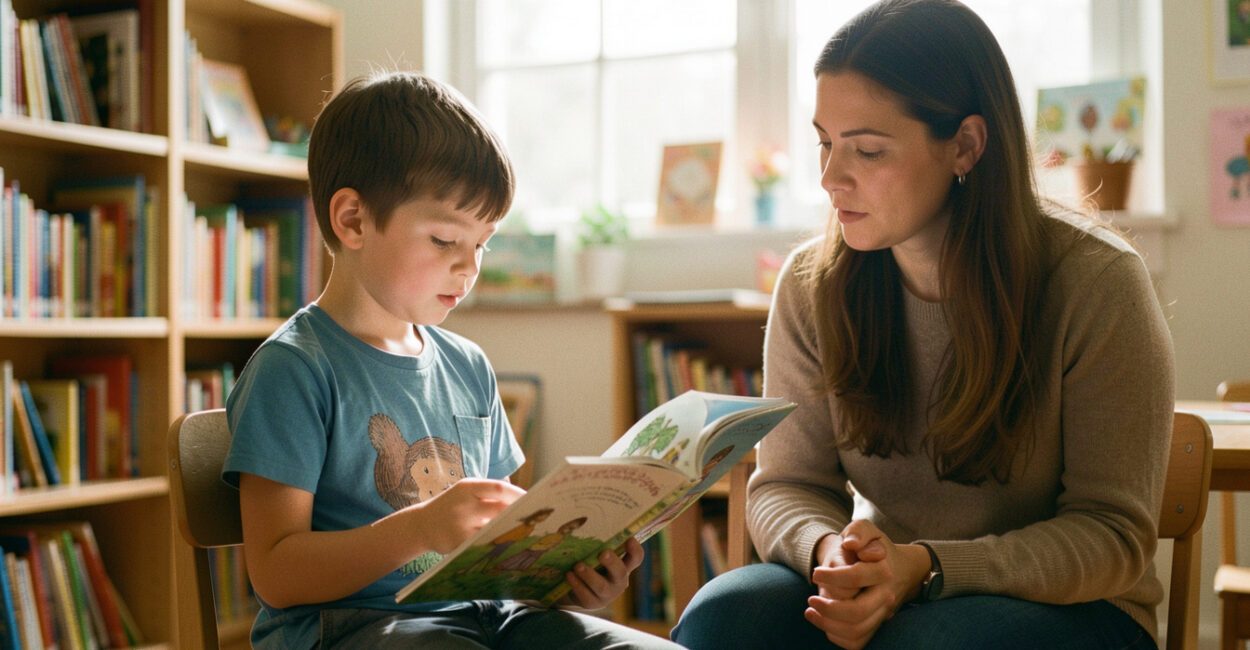
A child may take longer to finish a text and still understand what they read. Slow reading in elementary school deserves attention when it comes with frequent mistakes, excessive effort, difficulty explaining the text, or trouble completing schoolwork. Reading speed alone does not confirm a learning difficulty.
To decide what to do, observe how your child reads in different situations and track their progress without turning practice into a test. A brief record and a focused conversation with the school can help distinguish a variation in development from signs that call for guidance.

Start by looking at accuracy, fluency, comprehension, and the impact on daily routines. Taken together, these factors provide more useful information than the time spent on a single page.
At a glance
- Pace: Consider it alongside other aspects of reading.
- Observation: Compare your child with themselves across different texts and at different times.
- At home: Choose brief, shared reading without pressure.
- At school: Bring specific examples and ask how your child is keeping up with activities.
- Evaluation: Looking into a difficulty does not automatically mean getting a diagnosis.
What do slow reading and fluent reading mean?
Slow reading means a child reads aloud or silently at a measured pace. Reading fluency, in turn, is assessed by looking at pace, accuracy, and prosody—that is, smoothness and expression. A child who reads slowly may understand the text well, while another may move quickly but substitute words or lose track of the meaning.
That’s why speed should not be treated as a goal on its own. A child may slow down when they encounter unfamiliar words, long sentences, or a new topic. They might read more confidently from a familiar passage. Comparing different situations helps show what is taking extra effort.
Some frameworks describe four levels of reading, though the names and criteria vary by approach. One common teaching framework includes elementary, inspectional, analytical, and syntopical reading, progressing from basic decoding to comparing different texts critically. This classification, associated with the reading method presented by Mortimer J. Adler and Charles Van Doren, is not a clinical scale for assessing a child and does not replace a school or professional evaluation.
The process of learning to read also affects pace. Grade level, experience with books, and familiarity with the language and vocabulary all influence performance. Comparing siblings or classmates without considering these differences can lead to hasty conclusions.
Does reading slowly indicate a learning difficulty?
Reading slowly by itself does not indicate a learning difficulty. Ongoing problems with accuracy, comprehension, or the effort required deserve attention, especially when they interfere with schoolwork. Track progress over time and across different texts, while also considering what your child is learning and the conditions in which they read.
Unfamiliar words and new topics often require more attention. Changing schools, teaching methods, or the language used at home can also affect reading pace. Development does not follow the same timeline for every child.
Consider talking with the school if your child often avoids reading, becomes very frustrated, loses track of what they just read, or needs much more support than before to finish assignments. These signs do not confirm a specific condition, but they can help you decide whether it’s time to look into the issue. The Brazilian Society of Pediatrics (Sociedade Brasileira de Pediatria) discusses learning difficulties in its guidance materials; reading pace alone is not enough to make a diagnosis.
Brazil’s Law No. 14,254/2021 provides for comprehensive support for students with dyslexia, ADHD, or other learning disorders, including early identification and referrals for diagnosis and educational and health support. The law does not turn slow reading into a diagnosis; it guides coordination of care when signs need further investigation. You can read the text of Law No. 14,254/2021.
What should you look at beyond reading speed?

Notice whether your child recognizes words accurately, reads continuously, understands what they read, and completes tasks without disproportionate effort. Pace becomes meaningful when considered alongside these other signs.
Read also: Assessing Interdisciplinary School Projects: Criteria
- Accuracy: Do they frequently substitute, omit, or add words?
- Pauses and continuity: Do they stop to sound out familiar words or lose their place in the text?
- Comprehension: Can they retell what happened in their own words or explain an important detail?
- Effort: Do they show fatigue, tension, or frustration that doesn’t appear during similar tasks?
- Impact: Does reading interfere with completing activities or lead your child to avoid schoolwork?
A detail from everyday life can help make sense of these signs: after reading aloud, a child may answer a question correctly but be unable to explain the main idea without looking back at the text. This may suggest that decoding the words is using up much of their available attention. Note what happened without trying to determine the cause on your own.
Reading quality is reflected in the combination of word recognition, comprehension, and effort—not in the time on the clock.
For information about reading and written-language disorders, the American Speech-Language-Hearing Association (ASHA) publishes reference materials. Persistent reading difficulties can have different causes; the patterns you observe need to be interpreted by professionals who consider your child’s history and needs.
Read also: Reading Difficulties in Elementary School: How to Help

How can you track reading across different times and texts?
A simple record lets you compare your child with themselves without turning reading into a test at home. Note the context, type of text, perceived effort, and what they understood. Use short, varied passages without timing every attempt.
When and where
Type of text
What to observe
Comprehension
Reading together at home
Passage from a familiar story
Whether they read continuously and seem comfortable
Can they retell what happened?
School assignment
Informational text on a new topic
Which words or passages take more effort
Can they identify the main idea?
Another day, in a relaxed setting
Short text chosen by the child
Whether interest in the topic affects their willingness to read
Can they explain a piece of information or an opinion?
You don’t need to fill out a form every time your child reads. Record only situations that help reveal a pattern, such as repeatedly stumbling over familiar words or understanding more when someone reads a passage aloud. One difficult day after being tired or distracted does not necessarily reflect their usual reading.
If your child reads a paragraph with pauses and then explains what happened, note both the effort and the comprehension. This information is more useful in a conversation with the school than a one-time measure of words per minute.
How can you support reading at home without pressure?
Brief, supportive practice can help your child get comfortable with words and texts without making reading feel like an obligation. Choose materials that suit their interests and learning stage, take turns reading, and end the activity before frustration takes over.
Reading aloud can help you notice pauses, word recognition, and expression. Silent reading lets you observe comprehension without requiring your child to pronounce every word. You don’t need to use just one approach. Ask about the content and let your child go back to a passage if it helps them understand.
Correcting every mistake interrupts the meaning of the text and can increase tension. If a substitution changes the meaning, offer a brief clue or say the word correctly and move on. If the mistake doesn’t affect comprehension, it’s often better to talk about the story and come back to the word later.
Rereading the same book can help, especially if your child enjoys the story. Familiar vocabulary and events leave more attention available for reading. However, rereading does not replace exposure to new texts and shouldn’t become a required task. Playful activities, such as these educational games, can supplement learning without replacing reading instruction.
How should you talk with the school, and when should you seek specialized guidance?
Talk with the school when difficulties keep coming up or affect your child’s participation and schoolwork. Bring examples from your notes and ask how your child reads in class, which types of text are more challenging, and what teaching strategies have already been tried.
A productive conversation focuses on understanding what happens in different settings. Ask whether your child understands texts read aloud by an adult, how they answer comprehension questions, and whether word substitutions also happen in familiar activities. Share your observations without offering a diagnostic conclusion.
An evaluation is an investigation, not automatic confirmation of a diagnosis. A professional considers the child’s learning history, language and reading skills, and other relevant information. Depending on the situation, they may recommend support or additional evaluations. To understand what a specialized evaluation might involve, ask the school which professional or service would be appropriate.
The school can coordinate support strategies and guide the family on next steps. You can consult laws and official education information through Brazil’s Ministry of Education. If a more comprehensive evaluation may be needed, document the difficulties you’ve observed and share them with the recommended professional rather than trying to determine the cause yourself.

Next steps for your family
Choose two or three reading sessions in different settings and note the type of text, perceived effort, and what your child understood. Then share the examples with the school and ask how your child is doing in class. If the difficulty persists, causes distress, or interferes with schoolwork, talk with the school about a referral for specialized guidance.
This tracking helps organize observations; it is not meant to define an ideal pace or replace a professional evaluation. Progress takes different amounts of time, and interpretation depends on the child’s learning history and the conditions in which they read.
Frequently asked questions
Is it better for a child to read aloud or silently?
Both approaches provide different information. Reading aloud helps you observe accuracy, pauses, and expression; silent reading lets you assess comprehension without requiring your child to pronounce the words. Switch between them based on your goal and your child’s willingness.
Should I correct every word my child reads incorrectly?
No. Stopping for every substitution can interrupt comprehension and make the activity stressful. Briefly correct an error if it changes the meaning or blocks comprehension; otherwise, follow along and revisit the point without turning the moment into a test.
Does rereading the same book help?
Yes, it can help when a child enjoys the story because familiarity with the plot reduces some of the effort involved in understanding it. Combine rereading with different texts, while respecting your child’s choices and energy level.
Does an evaluation mean my child will get a diagnosis?
No. An evaluation gathers information to understand a child’s strengths and difficulties. The results may point to support needs, suggest follow-up, or recommend further investigation. A diagnosis depends on professional assessment, not reading pace alone.
What should I do if my child avoids all reading activities?
Start with a calm conversation and try to find out whether your child is tired, struggling with the text, or afraid of making mistakes. Choose a short reading that interests them, without pressure. If the avoidance continues or causes distress, share the pattern with the school.
Artigos Relacionados
 Inferential Reading: 5 Strategies for Elementary School
 Reading Comprehension in Elementary School
 Reading Strategies for Elementary and Middle School: 7 Practical Techniques
 Reading Comprehension Strategies for Children: Guided Questions, Mind Maps, and Summaries to Improve Interpretation and Retention in Elementary School
 How to Improve Reading Skills in Elementary School: Practical, Proven Ways to Build Fluency and Comprehension in the Classroom
 Why Reading Matters in Early Childhood and Elementary School
