
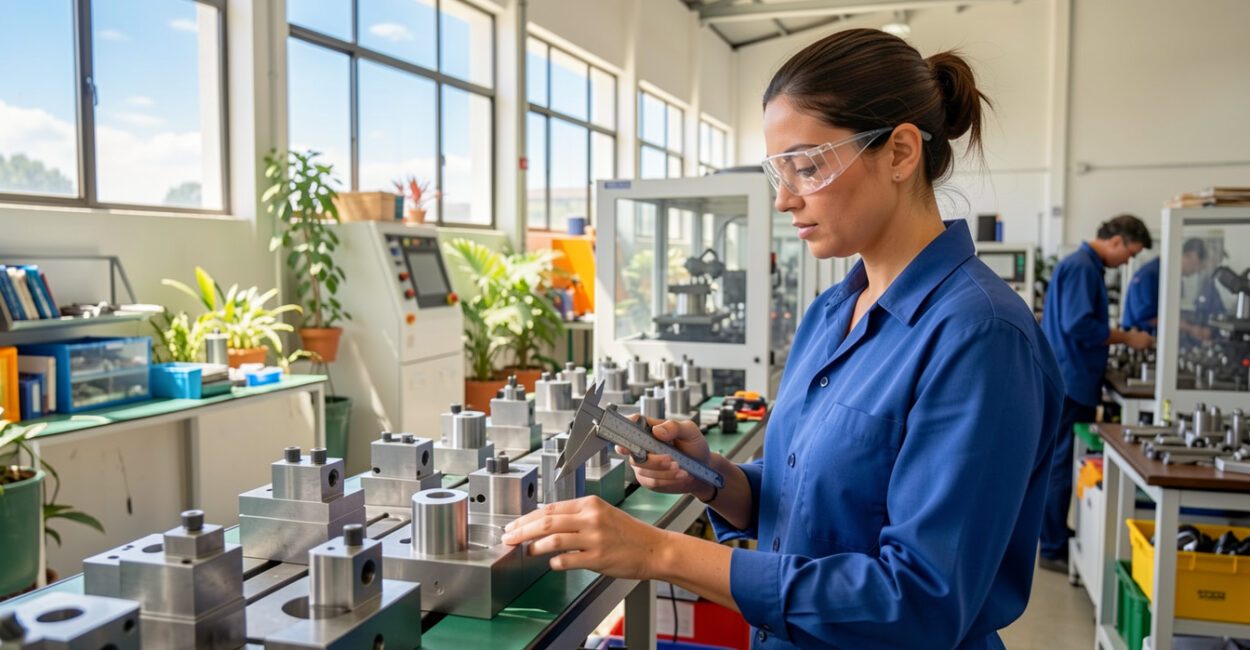
A defect caught at the end of the line has already cost time; one prevented during production may never happen at all.
Industrial quality control checks whether products and processes meet defined requirements and helps reduce defects. This includes inspecting, measuring, recording results, and investigating deviations. If a part is out of spec, a final inspection can catch it; monitoring machine settings during production can prevent other parts from having the same problem.

This distinction explains why the field is about more than checking finished products. It connects procedures, equipment, and people to what the customer receives—and offers career paths in many industrial sectors.
1. Industrial quality control: what it is and what it isn’t
Industrial quality control is the set of activities used to verify that products and processes meet specified requirements and to guide actions that reduce deviations. Put simply, it helps turn documented standards into something that can be verified in production.
Industrial control, on the other hand, can include monitoring and automating machines and processes, such as using sensors to regulate temperature. Quality control evaluates whether the results and processes meet established criteria; the functions can overlap, but they aren’t synonyms. ABNT, through ISO 9001, addresses requirements for quality management systems, not a guarantee that no product will ever have a defect. ABNT is Brazil’s standards organization.

2. From raw material to finished product: where quality fits in
Monitoring can begin when materials arrive, continue through manufacturing stages, and end with product release, depending on the industry and the company’s control plan. At each point, the team defines what to check, which criteria to use, and how to record the results.
If a measurement falls outside the acceptable range, the record helps identify the affected batch and decide what to do next: isolate it, reinspect it, correct the issue, or investigate the cause. One practical detail matters: simply marking an item “rejected” is usually not enough. The measurement, time, equipment, and batch may be needed to reconstruct what happened.

3. Quality methods answer different questions

Inspection checks specific characteristics; sampling estimates a batch’s conformity based on part of the batch; and an audit examines whether procedures and requirements are being followed. Statistical tools track variation, while root cause analysis looks into why a deviation occurred. No single method can guarantee that there will be no defects.
Read also: Industrial Maintenance: Career Areas and Qualifications
Method Purpose and timing Example Inspection Check a characteristic upon receipt, during production, or before release. Measure the diameter of a part. Sampling Assess part of a batch according to a defined plan. Test selected units from a shipment. Audit Check the system, records, and compliance with procedures. Check a batch’s traceability. Data and root cause analysis Identify patterns and investigate recurring deviations. Use a control chart and a cause-and-effect diagram.
Inmetro explains conformity assessment, a concept related to demonstrating that requirements have been met. The right method depends on the risk, product, and applicable rules. Inmetro is Brazil’s national institute for metrology, quality, and technology.

4. The professional’s daily work involves several teams
Tasks include following inspection plans, checking instruments, completing records, reporting nonconformities, and tracking corrective actions. Depending on the factory, the professional may also collect samples for lab testing, take part in audits, or review supplier documents.
There is constant interaction with production: an out-of-spec measurement may require stopping a step, adjusting the process, or assessing material that has already been manufactured. The decision depends on company procedures and delegated authority. To understand how quality connects to operations, learn more about the production manager’s role.

5. Training combines quality and technical knowledge
Getting started in the field calls for a grounding in quality, the ability to read procedures, attention to data, and clear communication. Knowing the product and processes in your industry also matters: inspecting food, automotive components, or metal parts requires different technical criteria.
- Professional training: Technical or vocational courses related to manufacturing and your desired field.
- Fundamentals: Metrology, reading technical drawings, standards, recordkeeping, and basic quality tools.
- Hands-on experience: Exposure to processes, measurement instruments, and documentation systems.
SENAI, Brazil’s national industrial training service, offers vocational courses; availability varies by location and time of year. You can also check Escola Virtual Gov, Brazil’s government online learning platform. Review the course content, prerequisites, and certificate details before enrolling. Certifications and specific requirements depend on the role and industry.
6. Job openings and next steps: look for actual requirements
Read job postings in your area and note the requirements that come up repeatedly: education, instruments, standards, and experience with recordkeeping. This research can help you choose a course with practical applications instead of collecting certificates unrelated to the roles available.
To explore career options, check out resources on jobs and opportunities in manufacturing. Openings vary by industry and location. Training doesn’t guarantee a job, but it can help you identify skill gaps and plan your next step.
7. Check the course before you enroll
Compare the syllabus with the tasks listed in job postings: an introductory course may cover concepts, while specialized roles may require hands-on experience with instruments, standards, or processes. Also check the course hours, format, prerequisites, and certificate issuer.
A good choice makes clear what you’ll learn and how that knowledge can be applied. Start with a skill that appears often in the job postings you’ve found and look for training that covers it.
Frequently Asked Questions
Do free quality courses offer a certificate?
It depends on the institution and the course offering. Check the course page to see whether a certificate is available and what you need to do to earn it.
Do you need technical training to work in quality control?
Requirements vary by role, company, and industry. Job postings in your area can help you identify the training required for the positions you’re interested in.
Does quality control guarantee there will be no defects?
No. These methods help verify conformity and reduce risk, but their effectiveness depends on the criteria, sampling, equipment, and execution of the process.
Artigos Relacionados
 Court-Appointed Expert: Training, Role, and Career Paths
 Industrial Quality Control: Roles and Training
 Industrial Partnerships: Negotiating Supply and Quality
 Industrial Automation: Robots, AI, and Emerging Jobs
 Industrial Salaries: 5 Trends Reshaping Pay in 2025
 Logistics Director: A Complete Guide to the Role and Its Demands
