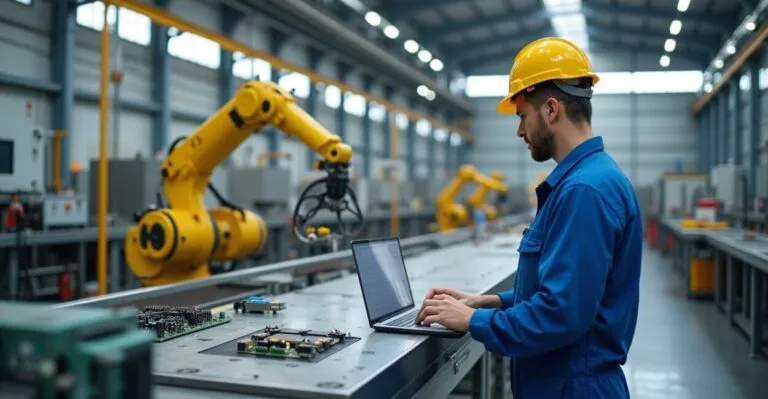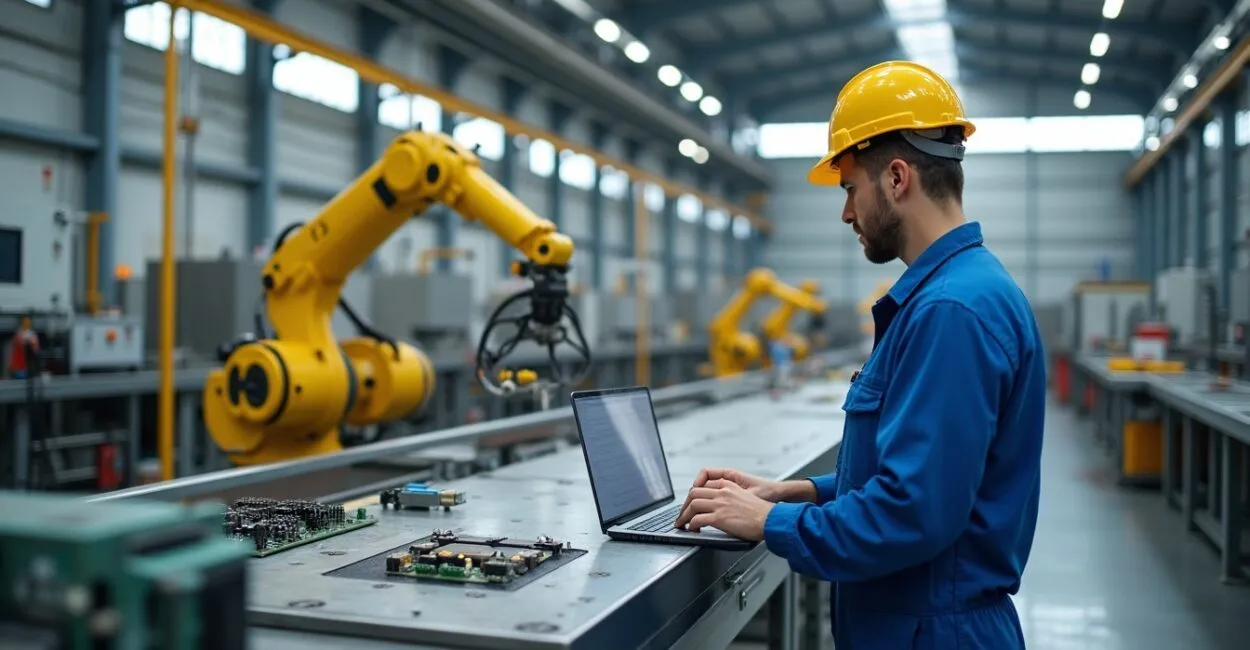
Industrial automation transforms factories, reduces human error, and speeds up production with robots, programmable logic controllers, and industrial software. Understanding what it is, why it matters, and how it affects jobs and quality is essential today. In this article, you’ll explore real-world examples, such as ABB robots at Embraer, and roles like PLC programmer.
This topic matters now because companies are looking to improve productivity, safety, and sustainability. Industrial automation combines sensors, robotics, IoT, and intelligent systems to compete globally. You’ll learn about its economic impact, practical applications, in-demand skills (such as PLC programming), and the steps to get an automation project started.

1. What Is Industrial Automation, and Why Does It Matter?
Definition and scope
Industrial automation uses machines, systems, control equipment, and software to perform repetitive tasks accurately and quickly. It reduces variability, increases efficiency, and improves workplace safety. It includes process automation, industrial robotics, and embedded systems, connecting the factory floor to management through data and telemetry.
Benefits and economic impact
Increased productivity, lower operating costs, and better quality are clear benefits. Companies become more competitive with shorter production cycles and less waste. Industrial automation also makes customized, scalable production easier while reducing accidents and rework on complex production lines.
2. Robotics in Action: The Embraer Case and ABB Robots
Implementation on the assembly line
At Embraer, ABB robots perform welding, apply adhesive, and move parts with millimeter-level precision. This has sped up assembly and reduced defects. Collaborative robotics and seamless integration with PLCs have helped maintain rigorous aerospace quality standards and improve component traceability.
Measurable results
Shorter assembly times, more consistent processes, and less human exposure to hazardous tasks were direct benefits. Reassembly and testing also became faster.
In addition, the company saved on rework and improved predictability across the aerospace supply chain, affecting delivery times and costs.
- Greater precision in joints and welds
- Less process variability
- Improved operator safety

3. Key Roles: PLC Programmers and Other Careers

What a PLC programmer does
A PLC programmer develops logic for controllers that manage machines and automated production lines. They translate process requirements into logic blocks and ladder logic.
They test and validate programs, integrate sensors and actuators, and commission equipment in the field, ensuring real-time response and functional safety.
Other essential roles
Automation engineers, maintenance technicians, industrial networking specialists, and data scientists make up the team needed for a successful project. Skills in SCADA, HMI, industrial networks, and programming improve job prospects and help professionals lead digital transformations on the factory floor.
Read also: The Evolution of Brazil’s Auto Industry: History, Challenges, and the Future
4. Complementary Technologies and Systems Architecture
Components and integration
A typical architecture includes PLCs, sensors, actuators, industrial controllers, and SCADA systems. Integration improves process visibility and centralized control.
Protocols such as EtherNet/IP, PROFINET, and OPC UA connect devices, enabling secure, standardized communication among different types of equipment.
Read also: Industrial Work Shifts: Flexible Schedules and Overnight Shifts in 2025
Safety, maintenance, and data
Industrial cybersecurity, predictive maintenance, and data analysis are essential for resilient operations. Sensor data feeds predictive models and alerts.
Condition-based maintenance reduces unplanned downtime, improves OEE, and extends the service life of critical production-line assets.
| Technology | Function | Benefit |
|---|---|---|
| PLC | Real-time control | Reliability and determinism |
| Robotics (ABB) | Handling and assembly | Precision and repeatability |
| SCADA/HMI | Monitoring and operation | Visibility and control |
- Clearly define the project’s objectives.
- Choose compatible controllers and robots.
- Design a standardized communication architecture.
- Conduct testing and commission the system in stages.
5. Social and Economic Impacts
Jobs and reskilling
Industrial automation eliminates repetitive manual tasks but creates more highly skilled technical jobs. Reskilling is vital to ensuring a fair transition.
Training in PLCs, robotics, and data analysis helps workers move into higher-value roles in the production chain.
Sustainability and competitiveness
Automated processes use less energy per unit produced and reduce waste, supporting environmental goals and improving efficiency. Companies that automate can offer more consistent products, enter new markets, and respond quickly to changing demand.
- Lower energy consumption
- Less waste
- Improved product quality
6. How to Start an Industrial Automation Project
Planning and assessment
Map processes, identify bottlenecks, and prioritize automation projects with a clear ROI. Involve operators and maintenance staff from the start to build support and benefit from their practical knowledge.
Assess digital maturity, network infrastructure, and physical security to ensure scalability and compliance with industry standards.
Implementation and scaling
Run pilot projects, validate results, and scale up in stages. Use metrics such as OEE, defect rate, and cycle time to measure real-world success.
Document programming standards, data exchange practices, and maintenance plans so solutions can be replicated across other production lines or facilities.
7. Conclusion and Next Steps
Key takeaways
Industrial automation transforms performance, quality, and safety, as shown by ABB robots at Embraer and essential roles such as PLC programmers. Balancing technology and people is key.
Companies that invest strategically benefit from increased productivity and sustainability, while professionals gain access to new technical career paths.
Take action
If you’re leading a project, start small, validate the results, and scale up. If you’re pursuing a career, learn about PLCs, robotics, and industrial networks to help drive this transformation.
Connect with experts, study real-world examples, and plan an automation journey with clear, measurable goals.
Frequently Asked Questions
What is industrial automation, and why should my company adopt it?
Industrial automation uses machines, controllers, and software to optimize production, reduce errors, and improve safety. Companies adopt it to increase productivity, lower operating costs, and improve quality. It also supports regulatory compliance, traceability, and process innovation, strengthening competitiveness in the global market.
How did ABB robots at Embraer change aerospace production?
ABB robots improved precision in welding and assembly, reducing defects and cycle times. This also improved traceability and repeatability in critical processes. Automation freed up technicians to focus on higher-value tasks, increasing efficiency while meeting the aerospace industry’s demanding quality standards.
What does a PLC programmer do, and how can I prepare for the role?
A PLC programmer writes control logic and tests and integrates sensors and actuators to operate machines. To prepare, study ladder logic and structured text, and learn about industrial networks, HMI, and functional safety. Technical courses and hands-on experience with real projects can help you qualify for jobs in this field.
What are the risks, and how can you ensure safety in industrial automation projects?
Risks include cybersecurity incidents, design errors, and unplanned downtime. Mitigate them with network segmentation, rigorous testing, functional safety standards (SIL/PL), and contingency plans. Ongoing team training and predictive maintenance monitoring can further reduce risk.
How do you measure the success of an industrial automation project?
Use metrics such as OEE (availability, performance, and quality), cycle time reduction, defect rate, and financial ROI. Track safety and sustainability indicators such as energy consumption and emissions. Results should demonstrate continuous improvement and the ability to replicate solutions across production lines and facilities.
Sources and recommended reading: ABB Global, Embraer, IEC Standards.