
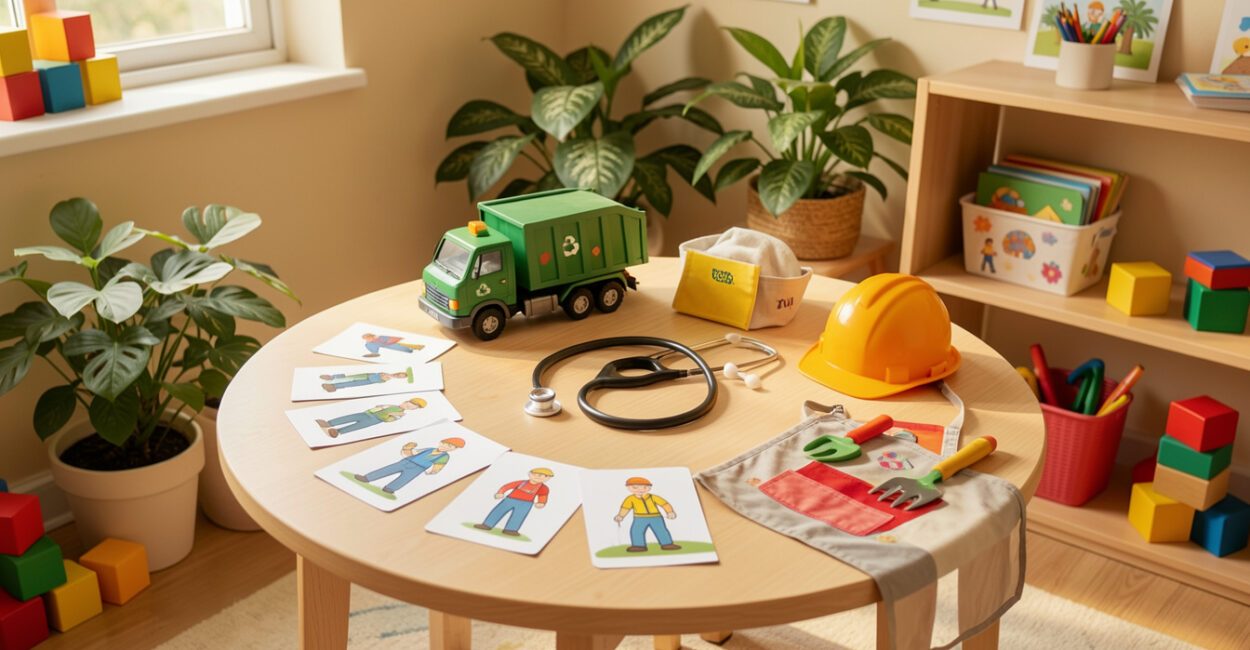
A child may learn about the work of a sanitation worker before they can explain what an engineer does. An activity about careers becomes meaningful when it starts with these everyday observations and leaves room to play, ask questions, and document ideas.
For preschoolers, short, hands-on, varied activities work best. They can introduce different occupations without deciding for children what they can be.

The ideas below can be used at school or at home with simple materials and adaptations for children who are not reading yet. They also include suggestions for first, second, and third grade, along with guidance on presenting past and present jobs while respecting diversity.
Quick overview
- Age range: Preschool and early elementary grades.
- Materials: Paper, pencils, pictures, safe objects, and pretend-play items.
- Skills developed: Speaking, imagination, observation, drawing, and cooperation.
- Adaptations: Young children can participate by pointing, choosing pictures, or acting out scenarios.
- Format: Combine conversation, games, role-play, and documentation in the same sequence.
How to introduce a career activity in preschool
A preschool activity about careers introduces occupations and different kinds of work through experiences that are familiar to children: observing what happens in their community, talking about who does each task, and pretending to act out different situations. The activity can include drawing, matching, and role-play, with verbal or nonverbal participation depending on the children’s ages and needs.
This approach aligns with Brazil’s National Common Curricular Base (BNCC), which guides preschool education through learning rights and fields of experience, such as “The self, others, and us” and “Listening, speaking, thinking, and imagining.” Brazil’s National Curriculum Guidelines for Early Childhood Education also emphasize interaction and play as foundations of teaching practice. This does not mean turning every occupation into a formal lesson: a conversation can grow out of a visit, a story, or something the class has observed.
A specific question often opens up more possibilities than asking children to memorize job titles: “Who helps when a street floods?” The class might think of firefighters, civil defense workers, civil engineers, healthcare professionals, and neighbors, recognizing that solving problems involves different roles. Brazil’s Base Nacional Comum Curricular (National Common Curricular Base) can help connect these experiences to the learning goals for each grade level.
Conversation, drawing, and matching activities for young children
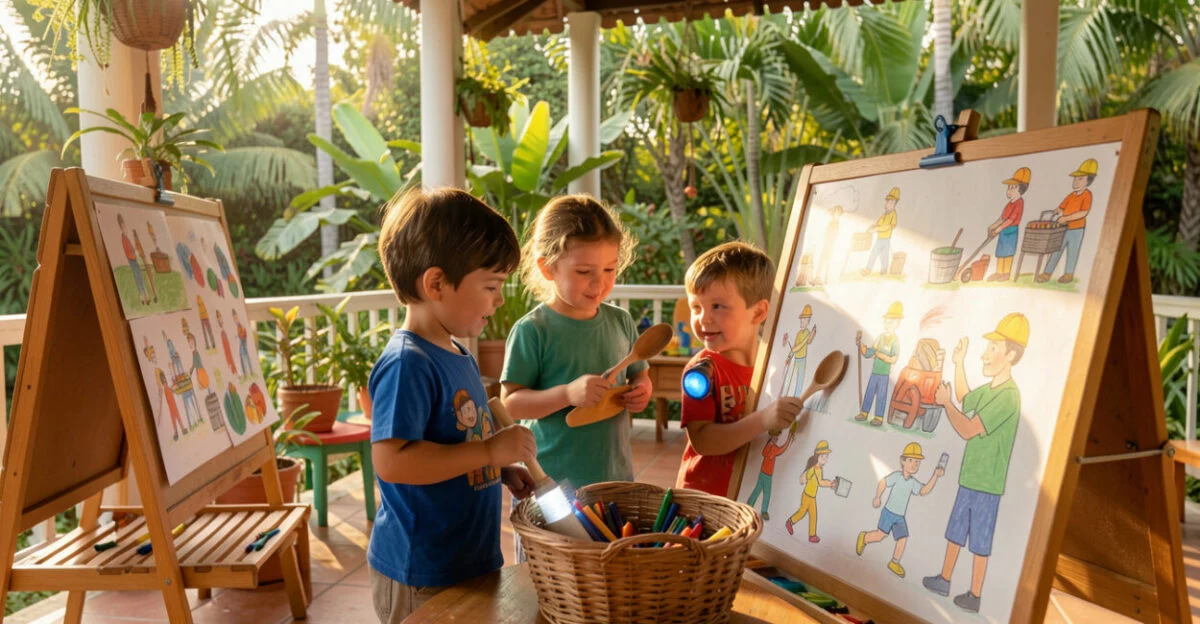
Play-based career activities for preschoolers work best when they start with what children observe and leave room for unexpected answers. Rather than presenting a long list, choose a few occupations from different settings, such as a farmers market, a health clinic, and a construction site. Ask what people do, what tools they use, and how their work helps others.
Conversation circle with everyday objects
Set out safe objects, such as a wooden spoon, a flashlight, a roll of paper, or a clean brush. Each child chooses an item and imagines who might use it at work; the same tool may inspire more than one answer. If the class is unfamiliar with an occupation, show a picture or describe a short scenario without turning the conversation into a quiz.
Drawing: “A job that helps the community”
Invite children to draw someone doing a task they think is helpful. Then ask them to describe what is happening in the picture; an adult can write the child’s words next to the drawing. This record honors the idea the child wanted to express, even if they cannot write yet or name the occupation.
Matching tasks, tools, and places
Make cards with pictures of tasks, objects, and places, such as preparing food, a pot, and a kitchen. For younger children, use just a few choices and large pictures; older children can explain their matches and suggest different combinations. Avoid presenting one match as the only correct answer when a tool or place could also be used in other jobs.
Career games to play as a group

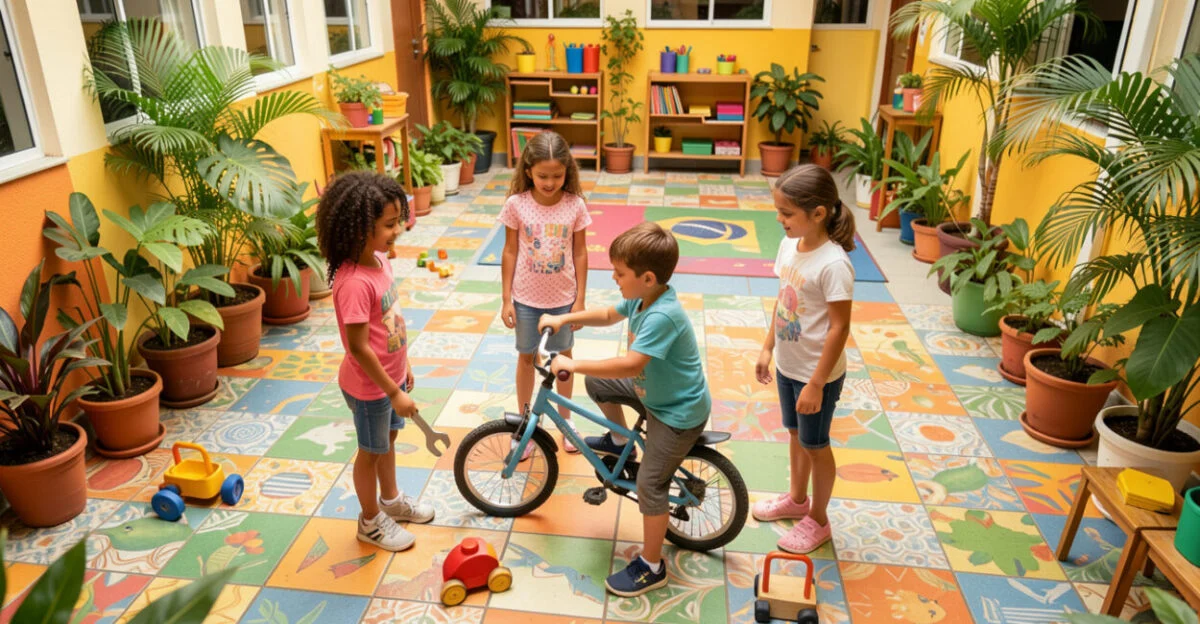
Career games help children try out actions and roles without needing to know all the technical terms. Before you begin, agree that any child can choose any character and that props used for role-play must be toys or otherwise safe.
Read also: Best Careers for Working From Home in 2025
- Charades: One child acts out a task, such as caring for plants or fixing a bicycle. The group guesses and can suggest more than one related occupation.
- Pretend play: Set up a service counter, workshop, kitchen, or farmers market with clean containers, paper, and age-appropriate objects. Children choose roles, switch roles, and make up scenarios.
- Who does this job?: Describe a task without naming the occupation: “This person organizes books so other people can find stories.” The class might answer “librarian” or suggest other possibilities, depending on the context.
- Chain of tasks: Each participant adds a step to an imaginary situation, such as planning a community celebration. The class can include people who cook, clean, transport materials, handle the sound, and set up the space.
A career game for preschoolers does not require reading: pictures, objects, and spoken clues are enough to play. If the activity stalls because children argue over who “got it right,” change the rules: players can explain one possibility and listen to others, since many tasks are shared by different professionals.
What to include in printable career activities
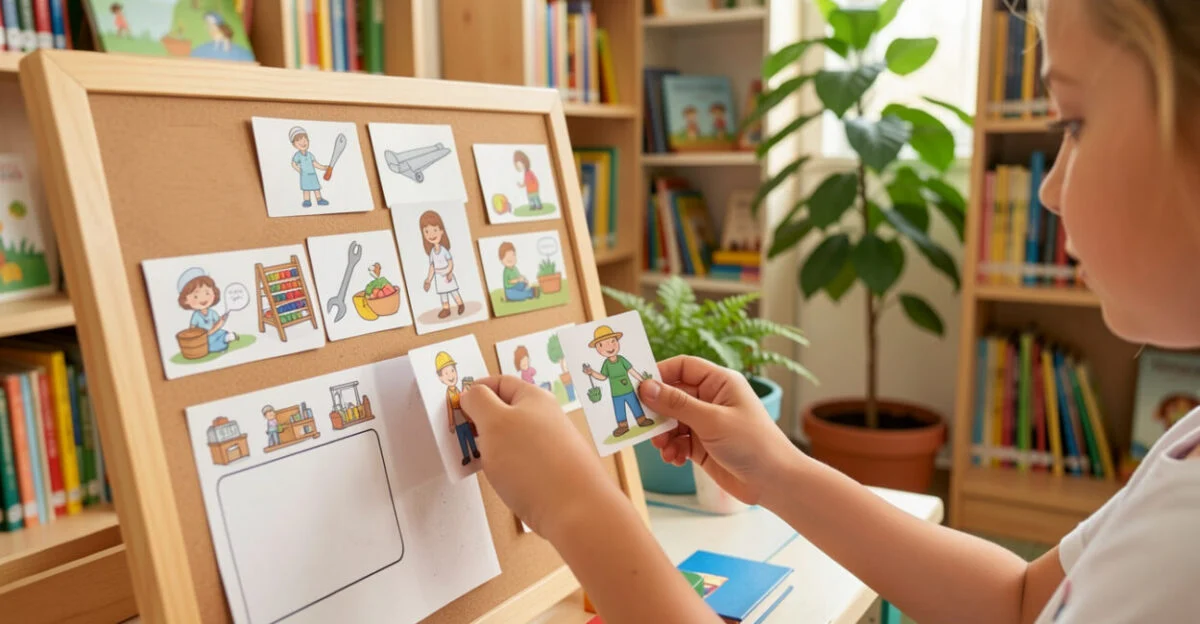
A printed worksheet can be a starting point for conversation, drawing, and recording ideas; coloring pictures by itself usually offers fewer opportunities for expression. Because these activities do not come with a downloadable file, you can make the formats below on a regular sheet of paper, using drawings made by an adult, authorized images, or cutouts from available materials.
Read also: Highest-Paying Careers That Don’t Require a College Degree
- Observation sheet: “What does this person do?”, “What objects do they use?”, and “Who benefits from this work?” For children who cannot write yet, leave space for drawing or pasting pictures.
- Matching cards: Bring together a task, a tool, and a place, without insisting on one answer when other combinations are possible.
- Interview record: The child draws someone they know and dictates an answer to “What do you do at work?” Family members can help ask the question without requiring anyone to share personal information.
- Sequence of steps: Show scenes from a process, such as planting, caring for plants, and harvesting, so children can put the pictures in order and talk about the work involved.
To make a printable career game, use cards with a picture and a short clue, rather than just a written job title. Choose a large font and strong contrast, and include descriptions that can be read aloud. A sheet with just a few cards is also easier to cut out, store, and reuse later.
How to adapt activities for first through third grade
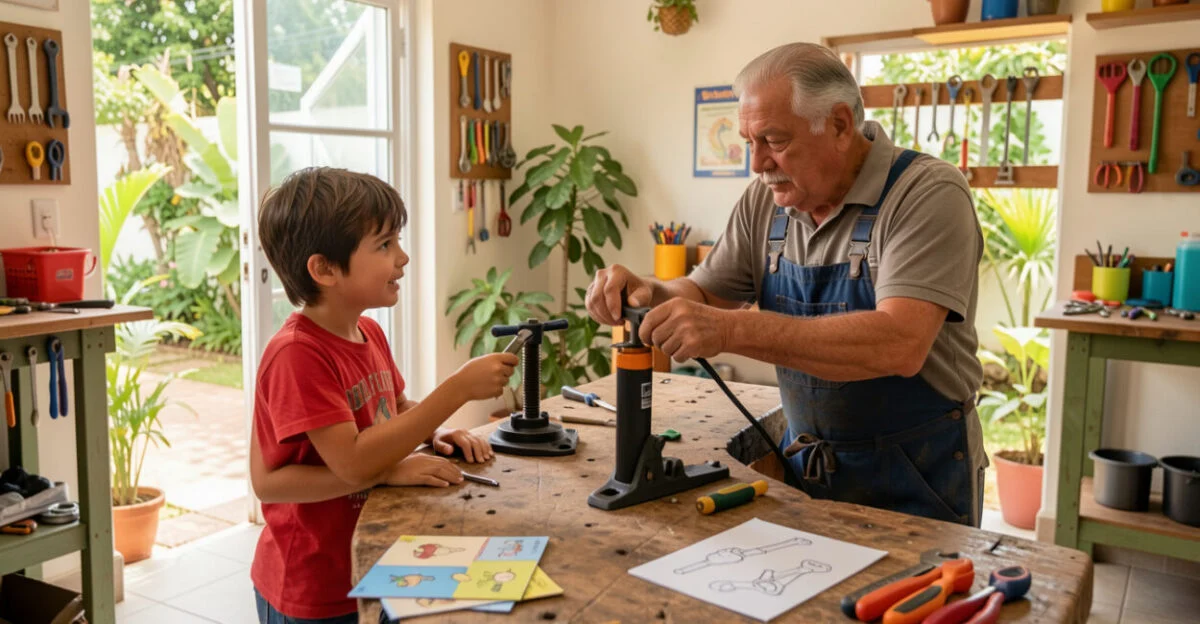
In the early elementary grades, activities can move from identifying tasks to making comparisons, conducting interviews, and creating more independent records. The table offers possible approaches, not a required sequence: the class’s experience, the school curriculum, and the time available all affect what you choose.
Grade Goal Activity First grade Connect work, tasks, and the community. Look at pictures of the surrounding area, draw a familiar job, and dictate a caption for the teacher to write down. Second grade Recognize different kinds of work. Compare tasks done at home, in the community, and in workplaces; talk about paid work, caregiving, and collaboration without measuring someone’s contribution by their salary. Third grade Explore how occupations and tools change. Interview an adult about how a task was done in the past and how it is done today; compare older and newer careers without assuming that newer is automatically better.
For a career activity in first grade, prioritize clear pictures and short explanations. In second grade, activities about different kinds of work can explore who helps care for shared spaces and people. In third grade, activities about past and present careers can compare letters, phone calls, and digital messages, discussing what has changed in the tools and what still depends on communication and organization.
How to talk about careers without reinforcing stereotypes
Present occupations without linking them to gender, appearance, or social status. Show men and women in a variety of roles, people with disabilities in different workplaces, and careers that require cooperation. The contributions of people who clean, provide care, transport goods, grow food, or prepare meals deserve the same respect as occupations with greater social prestige.
It also helps to distinguish a task from a professional title: cooking can be something you do at home, paid work in a restaurant, or part of another occupation. Brazil’s Classification of Occupations (CBO), maintained by the Ministry of Labor and Employment, is a resource for looking up descriptions of occupations. It organizes career information, but an educational activity for children does not need to reproduce the entire classification.
When children see different people doing different kinds of work, they learn that work includes many occupations and contributes to community life in many ways.
When discussing careers that require specialized education, avoid turning the conversation into career guidance for young children. If they become curious about healthcare, for example, pictures or books can introduce the different roles on a care team. Information about earning a college degree in nursing or medical school is better suited to adults exploring education and career options.
How to choose and organize activities for your class
Choose activities based on what the class is already curious about and how each child can participate. If the group likes to talk, role-play can channel their ideas. If some children prefer to watch before joining in, offer cards or objects to explore without requiring them to present to the group.
Simple materials are enough: paper, pencils, pictures, clean boxes, and safe objects. One practical detail can help prevent interruptions: during pretend play, packaging may look like a real object, so remove small lids, sharp edges, and any parts that could come loose before giving materials to children.
There is no single activity length that works for every class. Young children may engage with one activity for a short time and return to it later; age, interest, and support needs all matter. To wrap up, accept different kinds of responses: a drawing, spoken words, a picture choice, a gesture, or participation in role-play.
Keep reading in this series
Frequently asked questions
Which occupation should I choose to start the conversation?
Start with an occupation the class encounters in everyday life, such as a market vendor, driver, sanitation worker, or healthcare professional. The children’s interests are a good guide for choosing what to explore next.
How can I adapt a career activity for toddlers?
Choose a short activity with a few large, safe objects, simple pictures, and ways to participate through gestures, pointing, or sounds. A child can imitate an action, such as caring for a doll or pretending to water plants; they do not need to name the occupation.
Do professionals need to visit the school?
No. Talking with someone from the community can enrich the topic, but books, photographs, pretend-play objects, and family stories can also introduce occupations. If someone visits, agree in advance on the timing, space, and questions the children can ask.
How should I respond if a child says a job is “for boys” or “for girls”?
Respond calmly and offer concrete examples of different people doing that job. A picture or story often opens up more conversation than simply correcting the child by saying, “That’s wrong.”
How can I document learning if a child cannot write yet?
Record words the child dictates, a picture they choose, a drawing, or a photo of the role-play, following the school’s rules for permissions. The record should show what the child expressed, not just the name of the occupation.
Artigos Relacionados
 Career Fair at School: 9 Activities That Engage Students
 Recycling Activities for Preschool: 10 Ideas
 Nature Games: 10 Ideas for Preschoolers
 Environmental Activities for Early Childhood Education
 Play-Based Activities and Child Neuroscience: 5 Effective Ideas
 Fine Motor Coordination Activities: 12 Easy Ideas
