

A career fair where every visitor only reads posters can lose students’ attention before they reach the end of the hallway. School career fair activities work best when they invite students to try a task, make a decision, or ask a question.
Here are nine ideas with easy-to-find materials, estimated times, and tips for adapting each station.

This format works for a small fair organized by one class as well as an event featuring several fields and guest speakers. Start by deciding what students should learn, then plan the layout so everyone can take part.
You can adapt these ideas for elementary and middle school through high school. Students’ ages, the available space, and whether guest professionals will attend all influence your choices. For example, a customer service simulation requires more context than a matching game.
In a nutshell
- A short activity should have clear instructions, a defined task, and a wrap-up that explains what the experience reveals about the career.
- To prevent lines, set up stations with different formats and durations, including options for individuals and small groups.
- Simple materials, such as cards, everyday objects, and paper, are enough for many demonstrations.
- You can organize the nine ideas below by field without creating a different activity for every career.
How to plan school career fair activities
To plan a school career fair, first define your audience and learning objective. Then choose activities that fit the available space, time, and materials. Divide responsibilities among students and organizers, map out the visitor route, and test each station before the event. This way, visitors can take part without relying on lengthy explanations.
Your goal might be to introduce different fields, challenge misconceptions about a career, or help students connect their interests with professional tasks. This focus will guide which careers to include and what kinds of demonstrations make sense.
Next, create a simple map of the venue. Mark entrances, exits, outlets, tables, and any spots where lines might form. Place the most popular stations in different areas and leave room for visitors to move between them. Students can welcome visitors, keep track of time, and explain instructions; teachers or guests can handle content that requires technical expertise.
The project can connect with skills outlined in the BNCC (Brazil’s National Common Curricular Base), such as communication, argumentation, and responsibility. Consult the Base Nacional Comum Curricular, from Brazil’s Ministry of Education, to align the fair with the curriculum for the grade levels involved. For career guidance and the world of work, the International Labour Organization also offers resources on skills development and employability.
What makes an activity interesting to students
An activity holds visitors’ attention when they quickly understand what to do and see how the task connects to the work being presented. Instructions should take only a few sentences, and participation should lead to an answer, a choice, or a result they can discuss.
A healthcare station might ask students to arrange cards showing the steps in a fictional triage process. To make the activity meaningful, the facilitator explains the reasoning behind the sequence and clarifies that it is an educational simulation, not real patient care. This helps the demonstration feel connected to professional life rather than like a game with no real-world relevance.
A good station turns a professional task into a short, safe, and easy-to-understand experience for visitors.
Timing matters, too. As a planning guideline, many tasks can be completed in just a few minutes; a conversation with a guest professional may take longer as long as it doesn’t block traffic. The right limit depends on the complexity: a demonstration involving equipment or safety steps needs enough explanation, even if that means fewer visitors per round.
Quick icebreakers to get students involved

Start with activities that get students talking, making choices, and asking questions before they head to the stations. Three simple formats are a quick-fire round, a short challenge, and a decision-making quiz.
Read also: Careers That Start With the Letter C
- Quick-fire round: Each guest answers two questions in about 60 seconds. One might be, “What task takes up part of your day?” and the other, “What skill do you use often?” If you have several professionals, run rounds in parallel to spread out the crowd.
- Short challenge: Visitors complete a small task, such as arranging cards, interpreting a fictional sign, or putting steps in order. The facilitator explains what knowledge or skill the task uses.
- Decision-making quiz: Present two fictional scenarios and ask the group to choose what to do. Then explain what information a professional would consider before making a decision. This activity can cover fields such as careers, healthcare, or customer service.
These formats work across fields such as technology, law, and communications. For younger students, use concrete scenarios and visual instructions. With high school students, include dilemmas and questions about education, daily routines, and career options.
Nine activity ideas by field, with materials and steps
The ideas below combine observation, conversation, and participation. You don’t need to repeat them for every career: one station can introduce related careers, as long as the facilitator explains what sets them apart.
Read also: University of São Paulo Career Fair: A Visitor’s Guide
- Career tools and objects station. Gather safe objects or replicas, such as a tape measure, a toy stethoscope, or kitchen utensils. Ask visitors to match each item to a task and explain what it’s used for. Materials: objects and labels. Estimated time: 3 to 5 minutes.
- Mini customer service simulation. Use a fictional scenario involving customer guidance or reception. In pairs, one student plays the professional and the other the visitor; afterward, discuss listening and clear communication. Materials: scenario cards. Time: 4 to 6 minutes.
- “What does this professional do?” quiz. Present a real task and three possible occupations. The group chooses an answer, then learns how that task might come up in different careers. Materials: cards or a board. Time: 2 to 3 minutes.
- Put a process in order. Give participants shuffled cards showing the steps in a safe task, such as arranging recipe ingredients or preparing a presentation. They put the steps in order and explain their reasoning. Materials: cards. Time: 4 minutes.
- Tools or equipment demonstration. A guest shows how a tool or educational model works, explaining its use and any necessary precautions. Materials: approved equipment and a clearly marked area. Time: depends on the demonstration.
- Match tasks to careers. Hand out cards with tasks and cards with occupations. Visitors match the pairs and discuss when a task might be shared by more than one profession. Materials: paper cards. Time: 3 to 5 minutes.
- Quick interview with a former student. Prepare short questions about education, daily routines, and lessons learned early in a career. One student serves as interviewer and keeps track of time. Materials: a printed or handwritten question list. Time: 5 minutes.
- Career myths and facts. Read statements about education, daily routines, or work settings; participants vote, and the facilitator explains each answer. Materials: “myth” and “fact” signs. Time: 3 to 5 minutes.
- “A day in the life of…” schedule. Arrange cards showing tasks throughout a work shift, including fictional surprises. Visitors put the tasks in order and discuss priorities and responsibilities. Materials: cards and a sheet with times. Time: 5 minutes.
For hands-on activities, make it clear which items visitors can touch and which are for demonstration only. If visitors need to identify parts, tools, or information, use large, high-contrast items to make it easier for everyone to participate.
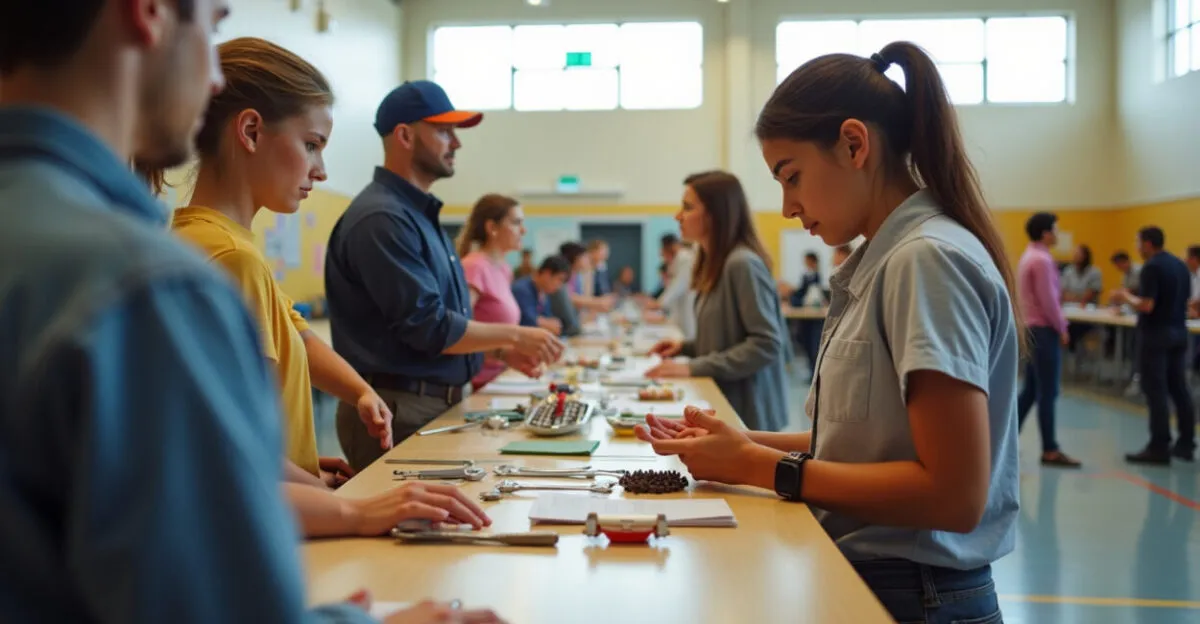
Hands-on stations and safe demonstrations
Set up each station with visible instructions, a designated facilitator, and a task that can be repeated consistently. The table helps you compare options; times are planning estimates and may vary depending on visitor numbers and how much explanation is needed.
Activity
Career or field
Materials
Estimated time
Decision-making quiz
Law, management, or customer service
Cards with fictional scenarios
2 to 4 minutes
Put a sequence together
Healthcare, culinary arts, or logistics
Cards showing steps
4 minutes
Matching game
Communications, technology, or engineering
Cards with tasks and occupations
3 to 5 minutes
Equipment demonstration
Technical field related to the equipment
Safe tool and clearly marked area
Varies by demonstration
Cutting equipment, substances, exposed outlets, and tools in operation require assessment and supervision by responsible adults. If you can’t control the risk, use a replica, photograph, or video demonstration instead. Visitors should not have access to personal data, clinical procedures, or real operations.
Before the fair, test each station with students who didn’t help set it up. If they can’t follow the instructions without additional explanation, rewrite the sign or simplify the task. This test can also reveal a common problem: materials left on a table without instructions may be mistaken for decorations or handled at the wrong time.
How to prevent lines, keep visitors focused, and avoid information overload
To keep lines short, mix activities of different lengths and avoid putting the most popular demonstrations in the same spot. A quick station can sit near one that involves more conversation, as long as the waiting area doesn’t block the route. Signs with estimated times help groups decide where to go next.
A common mistake is planning the fair around the number of posters without estimating how many visitors each activity can handle. This usually happens because the flow hasn’t been tested: a demonstration that works for four people can become a bottleneck when an entire class arrives at once. Split up groups, offer a parallel activity, or repeat the presentation at set times.
Keep the amount of text on display to a minimum, too. On each board, focus on one task, one skill it uses, and one question for visitors. Anyone who wants to learn more can talk with the facilitator or explore related careers. When discussing how to choose a career path, present different options without suggesting that one fair should determine a student’s decision.
Adapting activities to age, space, and available resources
The fair should be appropriate for the students’ grade levels. In elementary and middle school, visual activities, objects, and short tasks often make ideas easier to understand. High school students can have more detailed conversations about education, daily work, and different career paths. The BNCC and Brazil’s National Curriculum Guidelines for Basic Education can help schools integrate the fair into their curriculum, but activities should also reflect the school’s context and goals.
If you have only a few classrooms, set up a compact circuit and stagger group visits. A school with a large courtyard can create themed areas, but should still provide clear signs and accessible routes. If only a few guests are available, students and teachers can lead games based on prior research, making clear when an explanation is introductory and when it needs confirmation from a professional in the field.
You don’t need to buy expensive materials. Paper, pens, clean packaging, borrowed objects, and reusable cards work for many activities; bring in specialized equipment only when you have proper supervision, authorization, and conditions. Whether the school is preparing an elementary or middle school project or a high school career fair project, you can adjust the scale and language without changing the principle of student participation.
To wrap up your planning, choose three or four varied stations and test the route with a small group. Then decide whether to expand the program and invite people who can talk about what it means to work in each field. This initial selection is more useful than trying to represent every occupation at once.
Frequently asked questions
How many activities should we prepare for the fair?
There’s no set number; it depends on class sizes, the length of the event, and each station’s capacity. Start with a few varied activities, and add more only if your space and team can accommodate visitors without long lines.
Does each career need a different activity?
No. The same activity, such as a quiz or matching game, can introduce different fields. What needs to change is the example and the explanation connecting the task to the professional’s daily work.
How can we include visitors who don’t want to speak in public?
Offer ways to participate without being in the spotlight, such as choosing answers on cards, arranging a sequence with a partner, or watching a demonstration before joining in. Visitors should be able to take part in different ways, without having to introduce themselves in front of everyone.
Does an early childhood careers board need to be printed?
Not necessarily. Drawings, authorized photographs, and everyday objects can be used to make a board with the class. For young children, use recognizable images and connect each occupation to a specific task instead of listing lots of career names.
Artigos Relacionados
 Fun Middle School Activities to Engage Students and Make Learning Stick
 Career Fair at School: How to Plan a Useful Event
 Environmental Education in Elementary School: Activities That Work
 Creative Icebreakers: 7 Innovative Activities to Help Middle School Students Connect
 Collaborative Group Activities: 5 Creative Ways to Build Teamwork and Communication Among Middle School Students
 Career Counseling for High School Students: Planning Ahead
