
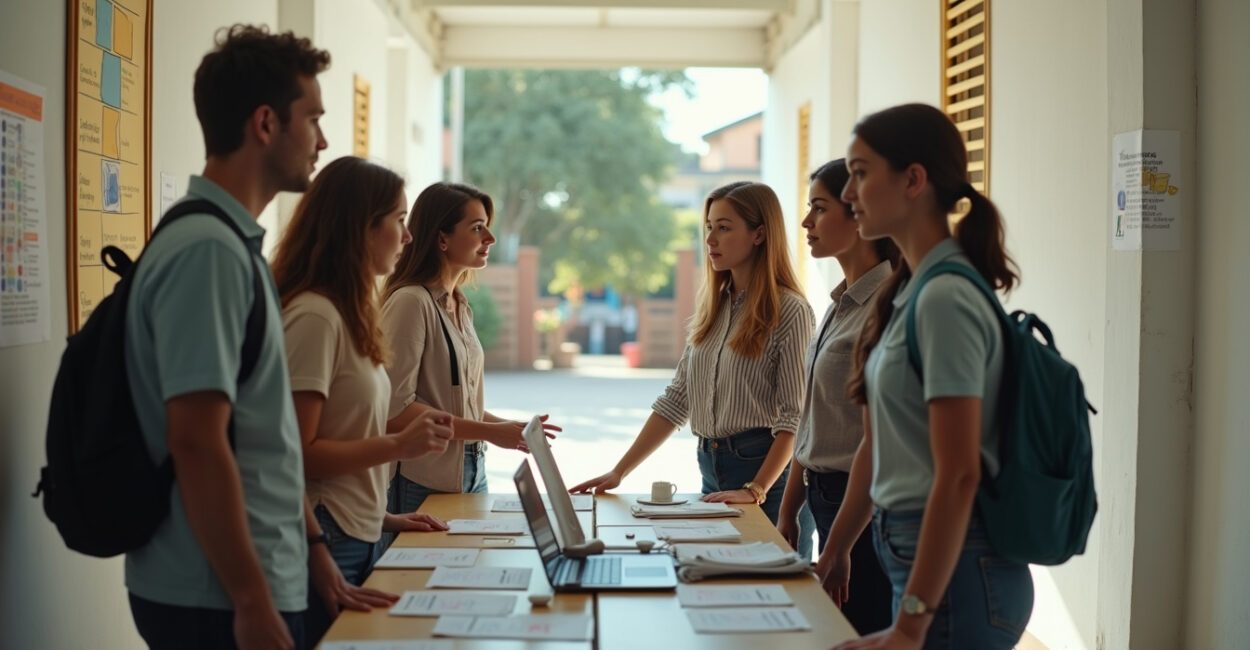
A school career fair is an educational event where students talk with professionals, explore career fields, and compare educational paths to make more informed decisions about their future. When done well, it helps students find answers, gives them useful points of reference, and connects school with the world of work—without turning career guidance into advertising.
The goal isn’t simply to “showcase careers.” It’s to create a valuable experience for students, teachers, school leaders, and families. Below is a practical step-by-step guide to planning the event, inviting professionals, organizing logistics, promoting it, and evaluating its results thoughtfully.

The Essentials
- A useful career fair has a clear educational goal: helping students make informed choices, not just showcasing careers.
- The best format makes careers easy to compare: every booth should answer the same basic questions about day-to-day work, training, and challenges.
- Clear, honest professionals engage students more than famous names or overly formal presentations.
- The event becomes a learning experience only when students reflect on what they heard and the school evaluates what was useful.
- Poor planning usually shows up as long lines, repetitive presentations, and too much scattered information.
How to Plan a School Career Fair with Clear Educational Goals
A well-organized school career fair starts with a simple question: What uncertainty should the event help students resolve? The focus might be broadening their horizons, connecting high school students with different academic and career pathways, or supporting students who are choosing a career.
Without a clear focus, the program becomes a collection of booths with no connection to one another.
Define the Audience and the Event’s Goal
Before inviting any professionals, the school team should answer three questions: Who is the event for? What age groups will attend? What specific outcome should students take away? An event for middle school students should not use the same language as a fair aimed at students in a technical high school program.
In practice, schools with a clear, measurable goal are better able to choose the right guests and organize their communications. If the priority is to broaden students’ horizons, for example, bring in professionals from a range of fields. If the goal is to help students choose academic and career pathways, focus on training, skills, and what the work is really like.
Build a Small, Effective Planning Team
Anyone who has organized an event knows that a large committee can slow down decisions. Ideally, the team should include a school administrator, a lead teacher, someone from the office or administrative support staff, and, if possible, a student council or class representative. This group can handle the agenda, deadlines, and responsibilities without spreading tasks too thin.
A career fair works when the school helps students explore their options—not when it simply sets up booths. The event’s value comes from comparing career paths, hearing from working professionals, and helping students ask better questions.
School Career Fair: A Step-by-Step Guide to a Smooth Event
Follow a simple sequence: plan, invite guests, prepare the space, promote the event, and facilitate the day. This approach prevents last-minute scrambling, keeps costs down, and helps the school stay on schedule at every stage.
1. Plan the Schedule and Budget
Allow four to eight weeks to organize the event, depending on the size of the school. Larger events need more time because inviting professionals, confirming attendance, and setting up the space all require a buffer.
Set the budget in advance. Many career fairs can be held at little cost by using classrooms, the cafeteria or gym, school sound equipment, posters, and simple name tags. Still, be clear about smaller expenses, such as printing, water, name badges, extension cords, and welcome-desk support.
2. Invite the Right Professionals
Look for professionals who can speak to teenagers and young adults without relying on too much jargon. A strong panel includes a mix of perspectives: someone from the local job market, a recent graduate, a technician, a college student, and a more experienced professional. This variety shows that there are different ways to enter the same field.
Fields such as nursing, architecture, information technology, culinary arts, design, logistics, education, and mechanics often lead to engaging conversations because professionals can talk about day-to-day work, training, challenges, and opportunities for advancement. If the school has community partners, consider inviting them first. Conversations feel more relevant when students recognize the people and places around them.
To help develop the event’s content, the school can draw on official sources such as Brazil’s Ministry of Education, the National Institute for Educational Studies and Research (INEP), and the Brazilian Institute of Geography and Statistics (IBGE), which provide context on education, schooling, and the broader world of work.
3. Set Up Booths and Plan Foot Traffic
Each booth should answer the same questions to make careers easier to compare. When everyone follows a similar outline, students can move from one field to another without having to rely on memory.
- What does someone in this profession do every day?
- What skills does it require?
- What education or training is needed?
- What is the day-to-day work really like?
- What are the main challenges in this field?
This structure may seem rigid, but it helps a lot. Students don’t need to memorize presentations; they need to compare information. Without a consistent approach, the fair becomes a series of polished but not very useful talks.
Read also: University of São Paulo Career Fair: A Guide to Making the Most of Your Visit
How to Choose Professionals, Colleges, and Partners Without Sacrificing Quality

The guests you choose shape the quality of the experience. The school can invite colleges and universities, federal institutes, technical training programs, local businesses, public agencies, and local entrepreneurs—as long as each guest has something concrete to share beyond an institutional pitch.
Set Clear Criteria for Inviting Guests
Don’t invite people just because they’re well-known. Look for clear communicators who can connect with students and show what the job is really like. A famous professional may be less helpful than someone who knows the local job market and answers questions directly.
Read also: Careers That Start with the Letter A
- Can explain the profession without overusing technical terms.
- Discusses real challenges, not just the benefits.
- Is available to talk with students.
- Represents a different career path within the same field.
Avoid Turning the Fair into an Advertising Pitch
This is a common mistake. Some guests turn their booth into a showcase for their personal brand or organization. Students quickly notice when a presentation is selling a career instead of explaining it. The event loses credibility right away.
What makes a booth useful rather than just decorative is honesty about the daily routine, pressure, limitations, and ways into the field. If the school glosses over the hard parts of a profession, the event loses its value as a source of guidance.
I’ve seen well-intentioned career fairs fall flat because guests talked only about success and salary. The following year, the school asked each participant to share a real example from the job, one challenge in the field, and an entry-level training path. Student engagement improved because the conversations became more concrete.
Logistics, Promotion, and Welcoming Students on Event Day
Logistics should be treated as part of the learning experience. If students don’t know where to go, when to ask questions, or where to write down what they learned, they won’t get as much out of the event. That’s why the fair needs clear traffic flow, facilitation, and a set amount of time for each activity.
Arrange the Space to Keep Things Moving
Arrange the booths to prevent bottlenecks. Classrooms, wide hallways, or the cafeteria or gym work best when they have simple signs, a floor map, and clearly visible name tags for professionals. If possible, use color-coding for fields such as healthcare, technology, humanities, STEM, services, and management.
Promote the Event Early to Boost Attendance
Use language that speaks to students. Instead of sending a generic invitation, tell them what they’ll find, how much time they’ll have to explore, and why it’s worth attending. Students are more engaged when they understand that the event isn’t just another requirement—it’s a chance to ask real questions.
Use bulletin boards, class group chats, school newsletters, and teacher meetings to spread the word. Families can also receive a brief announcement, especially if the school wants career guidance to make an impact beyond the classroom.
Build in Time for Reflection
Without a record of what students learned, the experience fades quickly. A short worksheet, reflection card, or digital form with three questions can make a big difference. Students can write down what they discovered, what surprised them, and which field they want to explore next.
Stage
What to do
Expected outcome
Opening
Explain the goal and outline of the visit
Students explore with a clear focus
Exploration
Let students visit freely or in groups
More interaction and shorter lines
Reflection
Collect students’ impressions and questions
Learning is reinforced
Wrap-up
Review discoveries and next steps
The event leads to continued learning
Operational Checklist: Don’t Forget the Basics
A successful career fair depends on small tasks getting done on time. This checklist helps the team catch common trouble spots: guest confirmations, signs, materials, sound, water, accessibility, and student supervision.
- Set the educational goal and define the target audience.
- Form an organizing team with clear responsibilities.
- Choose a date, time, and location.
- Confirm professionals, colleges and universities, and other partners.
- Standardize the questions for each booth.
- Prepare name tags, maps, and signs.
- Set up attendance tracking and student feedback.
- Check sound equipment, outlets, internet access, and accessibility.
- Schedule the opening and closing with a set time for each.
This checklist isn’t busywork. It keeps small problems from turning into chaos on the day of the event. A missing outlet, an unlabeled booth, or a room with confusing traffic flow can compromise the entire experience.
How to Tell Whether the Fair Actually Helped Students
Success isn’t measured by how many people showed up in the cafeteria or gym. It’s measured by the quality of conversations, how well students can compare fields, and how clearly they can identify their next steps. This is what many schools overlook: a good event leads to continued learning, not just a fond memory.
Look for Three Concrete Signs
- Students asked more specific questions after the presentations.
- Students showed interest in comparing careers and educational paths.
- Some students asked for resources, links, or follow-up conversations after the fair.
A simple evaluation can include questions for students and professionals. Ask students what they learned, what changed their perspective, and which field they want to learn more about. Ask guests whether they were able to talk with students and whether the event was organized to encourage interaction. This information shows where to improve without relying on guesswork.
For a broader perspective, the school can compare its findings with guidance from UNESCO on education and the transition from school to work, as well as guidance from career and technical education networks and academic research on career choice. Not every recommendation will apply in the same way—the school system, community, and student population all affect what works best.
Next Steps for the Next Fair
The best school career fair isn’t the biggest; it’s the one that helps students think more carefully about their options. When the next event starts with a clear goal, well-chosen guests, and an honest way to measure results, it can become more than a showpiece—it can be part of the school’s educational program.
The next step is to review the experience with the team, cut what caused confusion, and repeat what worked. Over time, the school can make the fair an annual part of its career guidance program, improving it with each event.
Frequently Asked Questions
What Is the Main Goal of a School Career Fair?
The goal is to help students learn about career fields, compare educational paths, and understand what different professions are really like. When done well, a career fair helps resolve uncertainty and broadens students’ horizons so they can make more informed choices.
How Many Professionals Should the School Invite?
There’s no fixed ideal number. The key is to balance variety with quality conversations and avoid so many booths that students feel overwhelmed. At many schools, a smaller number of well-facilitated guests works better than a large number of guests spread too thin.
How Can Schools Make Sure Students Participate Actively?
Provide guiding questions, time for reflection, and a clear schedule for exploring the booths. When students know what to look for, they listen more closely and ask more relevant questions.
Does the Fair Need to Take Place in a Single Session?
Not necessarily. Larger schools can schedule visits by class or grade level to keep things moving. The key is to avoid having too many people in the same place at the same time.
What Kind of Follow-Up Evaluation Is Worth Using?
A short evaluation with three or four questions can be very helpful. Focus on what students learned, what caught their attention, and which fields they plan to explore next.
Can a Career Fair Include Technical Training Programs and Universities in the Same Space?
Yes, and that’s often a good idea. Bringing different educational pathways together shows students there are many routes into the world of work—and they don’t all start at the same place.
Artigos Relacionados
 How to Change Careers at 30: A Practical Plan
 Most Popular Majors at UFMG’s Career Fair in 2026
 UFMG Career Fair: What to Expect and How to Make the Most of It
 A Complete Guide to Entrepreneurial Education: Build Leadership Skills, Create an Effective Business Plan, and Start a Successful Career
 Event-Day Operations Plan: Priority Task Run-of-Show, Communication, and Contingency Planning for Coordinators and Staff
 Neuroeducational Assessment: Useful Protocols for Schools
