
A child points to the stethoscope and says “doctor”; another remembers that nurses use it, too. This kind of conversation shows why a career game works best when it connects people, tools, places, and tasks without turning every occupation into a single right answer.
You can play with cards, pictures, or digital activities.

The activity works for children and can be made more challenging for teens. The guide below includes ready-to-use rules, adaptations for different ages, and ways to make a printable version or find an online activity.
Career game: what it is and how to get started
This matching activity asks participants to connect an occupation with tools, workplaces, or actions, and explain their choices. To get started, prepare cards or pictures in different categories, shuffle them, and ask each person to make plausible combinations. For children, use familiar images; for teens, include tasks, education and training, and different career paths. The goal isn’t to memorize a fixed match, such as “hammer = construction worker.” A tool can be used in many occupations, and the same profession can be practiced in different settings. This flexibility keeps the game accurate and opens the door to a conversation about work in the real world.
A good match explains one way a job can be done without limiting the profession to a single object or place.
How to prepare cards and organize the game
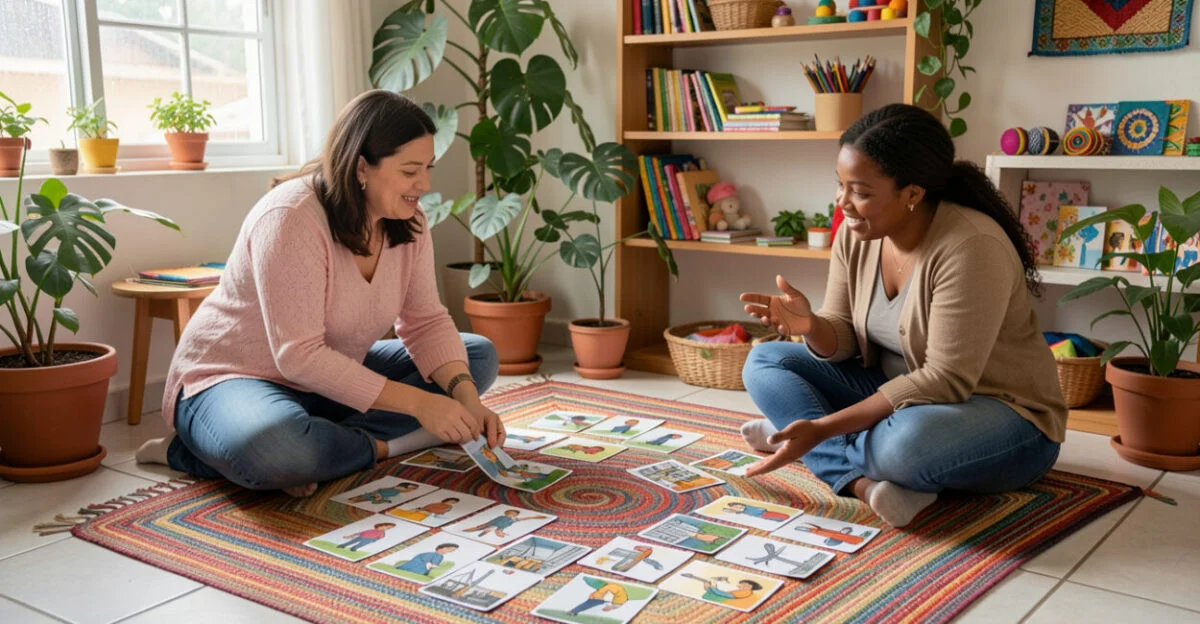
Make four types of cards: profession, object or tool, workplace, and action. For a first round, use just a few options, such as “photographer,” “camera,” “studio,” and “photograph an event.” Then add combinations that show different possibilities, such as photographing products or working outdoors.
You can make the cards from regular paper or cardstock. Write one idea on each card, use pictures if the group isn’t reading independently yet, and keep all the cards the same size to make shuffling easier.
To keep the activity from turning into a guessing game, accept different answers when participants can explain how they’re connected.
One tip to avoid confusion: don’t let the pictures determine the answer before the discussion starts. A picture of a hospital might suggest medicine, but it could also point to nursing, housekeeping, maintenance, food service, and other jobs.
Ask participants to explain what each professional does in that setting.

What are the rules for the matching activity?

Shuffle the cards and deal a few to each player, or place them all face up in the middle. On their turn, each player chooses a profession and tries to match it with a tool, place, or action. If more than one answer is possible, the group decides whether the explanation makes sense instead of looking for one memorized solution.
For scoring, award one point for each explained match. A player can earn a bonus point for recognizing a second possibility, if that rule is agreed on beforehand. End the game when the cards run out, everyone has taken the same number of turns, or the time is up. In large groups, small teams help reduce waiting.
- For a cooperative round: the group tries to make as many well-explained matches as possible.
- For team play: each team explains one match and can be challenged by another team.
- To mix things up: remove the names of the careers and ask players to guess the occupation from its tasks, without treating a guess as fact.
A simple rule can also prevent unproductive arguments: if a card could have several answers, the player needs to explain the context. “Scissors go with a hairstylist” may make sense; “scissors are only for hairstylists” does not.

How to adapt the activity for different ages and goals
The best adaptation depends on what you want to teach. For young children, the goal is usually to name actions and build vocabulary; in high school, the discussion can cover education and training, daily routines, and working conditions. In career guidance, the activity can be a starting point for exploring interests, not a way to choose someone’s career for them.
Complete guide: Career Activities for Early Childhood Education: Fun Ideas
Audience or goal How to adapt What to look for Children Use large pictures, a small number of cards, and concrete actions such as caring, building, or teaching. Whether the child can explain the connection in their own words. High school students Add education and training, daily routines, areas of work, and everyday challenges. Whether the discussion considers more than one path and doesn’t reduce the profession to a degree program. Career guidance Ask each participant to choose tasks they’d like to learn more about and research related occupations. Whether the activity opens up possibilities without labeling anyone based on a result.
In high school, it’s worth comparing specific activities instead of just asking, “What do you want to be?” A conversation about caregiving might lead to a college degree in Nursing, Medicine, or other fields, each with different responsibilities and pathways. To learn more about work involving photography, students can explore a college degree in Photography.
Brazil’s National Common Core Curriculum (Base Nacional Comum Curricular) can help connect the activity to classroom learning and life-planning projects. Consult the Base Nacional Comum Curricular to align the activity with your teaching plan, without assuming it replaces a lesson plan suited to the class.
Read also: In-Demand Careers in 2026: 15 of the Highest-Paying Jobs

How to make a printable, PDF, or memory-game version
To make a printable version, create cards with one word or picture per card, check that the categories are clear, and print them on paper that can withstand handling. A PDF can help preserve the layout when printing, but check usage rights and image quality before sharing it. There’s no single file that works for every age group and goal.
For a memory game, make related pairs rather than identical ones: one card shows a profession, and the other shows a related action or tool. Turn over two cards per turn; whoever finds a valid match keeps the pair and explains their choice. For children who aren’t reading yet, use illustrations. A coloring version can feature uncolored drawings, as long as they show a variety of occupations.
Career bingo works, too: each bingo card features pictures or names of occupations, and the caller gives clues about tasks or workplaces. Avoid clues so narrow that they allow only one stereotypical answer. For example, if the clue is “works caring for patients,” let the group think of different healthcare jobs.
Where to find online activities, including on Wordwall
To play online, look for activities on educational platforms such as Wordwall, and check the language, age range, and rules before sharing one with the group. Search for “careers” or “career game,” then open the activity to make sure the instructions are in English. Searches may also turn up Wordwall careers in English; those results aren’t the same as a Portuguese-language version.
If the group is using phones or computers, choose activities with short instructions and easy-to-read pictures. If the internet goes down or participants don’t each have a device, you can run the same activity with printed cards or projected pictures. Digital tools change how the activity is presented, not the need to evaluate matches carefully.
Don’t confuse an online activity with comprehensive career guidance. A quiz can suggest topics to explore, but it shouldn’t be treated as an aptitude test or a definitive career recommendation.
How to turn the game into a learning experience without reinforcing stereotypes
After each match, ask: “Who else might use this tool?”, “Where else could this person work?”, and “What other tasks are part of this occupation?” These questions help move beyond automatic associations and show that work involves different settings, teams, and activities.
Avoid handing out cards by gender, such as giving caregiving jobs only to girls or construction jobs only to boys. It’s also worth reviewing pictures and examples to include people with different backgrounds and career paths. Brazil’s Classification of Occupations (Classificação Brasileira de Ocupações), maintained by the Ministry of Labor and Employment, provides descriptions of occupations. It organizes career information but doesn’t determine who should do a particular job.
A conversation about careers expands choices when it presents each occupation as a set of tasks and possible work settings.
In career-guidance activities, the game can be the start of an exploration, but it doesn’t replace qualified support when someone needs help making complex decisions. Resources from Brazil’s Federal Council of Psychology can help explain the role of career guidance and the ethical considerations involved. To learn more about occupations mentioned in the game, you can also look into education and training in Dentistry or Computer Engineering, without treating a degree program as an automatic answer to someone’s interests.
Before the next game, choose a clear goal, prepare a small set of cards, and agree on how explanations will be evaluated. For teens, add a question about education or daily routines; for children, focus on pictures and observable actions. Then use any questions that come up to decide which careers to research using reliable sources.
Frequently asked questions
How many cards do you need to get started?
There’s no required number. For the first round, use a few cards in each category and add more once participants understand how to play.
Can a career game help you choose a career?
It can help people identify interests and come up with occupations to research, but it can’t determine which career is right for someone. Career choices depend on personal and social factors that the game alone can’t evaluate.
How can you make the activity accessible to people who aren’t reading yet?
Use clear illustrations, read the cards aloud, and allow players to answer verbally or by pointing. Before you start, make sure the group recognizes the pictures. Ambiguous drawings can create a problem with interpretation, not with knowledge about careers.